
The Art of Healing
Season 3 Episode 1 | 26m 47sVideo has Closed Captions
Art as healing with the Jingle Dress Project, poet Jaruwat Maendl & Every Brilliant Thing.
Art has a special way of resonating with people, bringing to light complex emotions that cannot always be conveyed through words. We’ll meet the people & organizations using art a powerful tool for healing —from Diné fine arts photographer Eugene Tapahe to award-winning spoken word artist Jaruwat Maendl to a new interactive play from the Utah Shakespeare Festival entitled “Every Brilliant Thing.”
Problems playing video? | Closed Captioning Feedback
Problems playing video? | Closed Captioning Feedback
This Is Utah is a local public television program presented by PBS Utah
Funding for This Is Utah is provided by the Willard L. Eccles Foundation and the Lawrence T. & Janet T. Dee Foundation, and the contributing members of PBS Utah.
Support provided by:


The Art of Healing
Season 3 Episode 1 | 26m 47sVideo has Closed Captions
Art has a special way of resonating with people, bringing to light complex emotions that cannot always be conveyed through words. We’ll meet the people & organizations using art a powerful tool for healing —from Diné fine arts photographer Eugene Tapahe to award-winning spoken word artist Jaruwat Maendl to a new interactive play from the Utah Shakespeare Festival entitled “Every Brilliant Thing.”
Problems playing video? | Closed Captioning Feedback
How to Watch This Is Utah
This Is Utah is available to stream on pbs.org and the free PBS App, available on iPhone, Apple TV, Android TV, Android smartphones, Amazon Fire TV, Amazon Fire Tablet, Roku, Samsung Smart TV, and Vizio.
This is Utah
Liz Adeola travels across the state discovering new and unique experiences, landmarks, cultures, and people. We are traveling around the state to tell YOUR stories. Who knows, we might be in your community next!Providing Support for PBS.org
Learn Moreabout PBS online sponsorship(bright music) - Welcome to This is Utah I am your host Liz Adeola.
It's no secret that art has the power to heal.
Coming up in this edition, see how a young poet from Utah uses words to overcome his challenges of being another.
We go on the road with the Utah Shakespeare Festival to experience an interactive play teaching teens to speak out about suicide.
And hear how a photographer hopes to bring healing to the world, via these stunning images, from the Jingle Dress Project.
- [Announcer] Funding for This is Utah, is provided by The Willard L. Eccles Foundation, The Lawrence T. & Janet T.Dee Foundation, and the contributing members of PBS Utah.
Thank you.
(bright upbeat music) - It has said that sometimes dreams are wiser than waking.
For photographer Eugene Tapahe it was a dream that inspired him to create Art Heals: The Jingle Dress Project.
An artistic journey that spanned thousands of miles, showcasing how art, landscape, and healing, are all intertwined.
(bright music) - When we're at our lowest part in our lives we get the most inspired, but we have to listen.
2020, you know this can be our year we're gonna do really well, you know, and then two weeks later, you know Utah's in quarantine.
And one by one my art show started canceling.
And then I had my aunt who passed away from COVID.
I felt, like I was broken I felt like there was nothing good is gonna happen.
(bright music) I had a dream, I was sitting in Yellowstone, in a grass field, and on the horizon there's a herd of bison and they were just grazing, and I was just sitting in the tall grass and it was so tranquil.
and I didn't wanna leave.
All of a sudden in my dream I heard jingles.
They started coming and all of a sudden I looked up and I saw all these beautiful jingle dress dancers.
And they just started dancing with the bison.
(bright music) And I could feel my heart healing I could feel hope.
And when I woke up I shared my dream with my wife and my daughters and I told them I said, "I think this is what we need to do."
I said, "I think this dream is telling me that we need to take the jingle dress to the land, to heal the land, and if we heal the land we're gonna heal the people."
(bright soft music) At the beginning we just had Erin and Dion my two daughters and I said, "If we could get two more jingle dress dancers, then we would have four.
And a four would represent the four worlds in our culture as being Navajo."
And so that's when Sunni and JoAnni Begay they both came into the picture.
(upbeat music) I really thought about why and where I was gonna go with the girls to dance and to shoot photos.
And I really thought this would be a great opportunity, to go to these parks, and to make a reclamation of these native lands, because a lot of times people don't realize is that these native lands and the national parks, they were prime spots for native people to live.
- America has such different landscapes.
Natives have been everywhere and natives are still everywhere and so for me it's been amazing to see that there's different resources in all of these different places.
And I feel like for me being an environmental science major, I've been able to learn a lot more about like my personal connection with the land.
- We're actually going in looking, trying to find the history of these locations and finding out the history and the ancestors and the tribes who were there.
Because when you're taking the photo shoot it's more than just standing in front of the camera where we're feeling the spirits of these ancestors.
We're actually embodying the spirit of these people.
(bright music) - Art comes from down deep inside us, in our hearts and who we are personally.
And it's the same thing with how we incorporated what we're done.
I mean we don't have just photograph art, but we have the art of dance.
We have the art of music.
We have the art of nature.
We always think oh art is a watercolor or oil painting.
When really art is all around us.
And when they all come together for a spiritual reason, it heals.
(bright upbeat music) There's no way you can be quiet in a jingle dress, it just calls for attention.
And everywhere we went, that's what it did.
We have four girls in jingle dresses, and there's no way those four girls could just walk quietly.
Guys just kinda pose right in the middle make sure that.
And we wanted it to be a statement in the sense of we're still here.
Three, two, one.
You would be amazed how many people nowadays don't think, Native Americans are still here.
- I've heard so many comments of like "Oh so you live in a teepee.
Oh I didn't know you still exist, I only read you in history books."
- We wanna treated as human we wanna be treated as equals we wanna be treated as we should be with respect and dignity, and we're not.
Three, two, one.
We weren't quiet in what we're doing.
We tried really hard to make a statement in wherever we went.
There we go that's good.
Okay let's try it with eyes open now okay.
- Am trying and they're not.
- Okay.
All right here we go.
- I feel like it was just an experience that I've had to have, like this point in my life right now, and I've learned a lot from it.
- Three, two, one.
- I felt more empowered I felt more connected to the community, I feel more confident in sharing my the things that I'm passionate about like native rights, and representation.
- I could see, how much confidence they gained, how much empowerment they had how much more respect they have for their culture and their traditions and for who they are.
I told them my girls and I said "From the moment you took your first breath into this world, you already had two strikes against you.
One you're a female.
Two you have brown skin."
And you haven't even done anything in this world but you already were looked at differently.
(upbeat music) - With this project, I have been able to definitely notice a shift before I wasn't really educated on native issues, my people's issues.
I didn't learn about generational trauma until, my freshman year in college.
And I didn't realize how important this is to my identity and who I am as an indigenous woman.
- Okay we're good.
To see them now and to see how much courage they have, the desire they have to be able to further their education, and to help change, not just the world but you know to themselves, and to help people around them, and I think that's the biggest thing about this whole project was, is that they learned to be of service.
(upbeat music) I realized as I was picking up one of the dresses, and I put my hand on one of the jingles, and I shook it, that one jingle didn't make any sound, and it really hit my heart and my mind in the sense that it was huge metaphor.
One jingle, doesn't make a sound, but together, they have the power to heal.
(upbeat music) As human beings, if we're able to unite and make a beautiful sound, and our prayers unite, as the jingle dress does, how powerful we could be.
And how much more we can learn from one another, if we could just listen to each other.
(bright upbeat music) - What do you get when you mix a football player, a poet and a wrestler?
No, it's not the intro to a cheesy punchline, but at the beginning of a complex tale about a young man from Utah and his dreams, versus the world.
- It's like being underwater, and like you can't breathe and then suddenly, all the water's gone, and like you can finally, like take a breath, and it's just like (coughs), whoa okay.
My name is Jaruwat Maendl and this poem is entitled How Do You Lose a Train?
How do you lose a train, easy with a capital, A-D capital H-D attention deficit hyperactive disorder, and just like a fine in my mind nothing but disorder well that's a sign that reads out of order, you see my mind is something short a hoarder it takes every thought, I think I'd like to say and the stories are the way for another day.
When that door closes softly behind me and a sweet sounds will echo elegantly through the empty house, down the dark hallway and bouncing back again unobstructed by any of the noise within my head, I mean me, I mean B begins, begins, and thus begins the downward descending descending to insane insanity with some might say holds no gravity through gravity but upon first instance of a sane mind mixing actions of morality one can only explain as an instant incident of insanity in which the human brain has transcended the plane of humanity oh the humanity in what I call simply sane insanity.
(bright music) I know what words I wanna use, but I cannot spell any of them, and I can not read any of them.
I have dyslexia, and so I still to this day struggle reading and writing.
My full name is Jaruwat Paul Maendl, slightly weird, but not too bad 'cause a lot of people in Utah spell their names in an odd way, which I think is interesting, so it means a big strong tree or one of great potential, and so I imagine that was also kind of like a prayer.
When I was born during my dedication, I stopped breathing, I was rushed to the hospital, you know their little baby is like struggling to breathe.
And so they're just like please God let him grow up, into a big strong tree.
When I was in second grade, I was put on an IEP which is an Individual Education Plan and then I was put in like special education and like resource classes in math and science, and comprehension I was scoring on a college level, and the composite IQ was 141, which is in the gifted range, and so as a little kid to like here it's like yeah you're probably smarter than some of your teachers, but you can't seem to spell the word from or form, it like it confuses you, and so all of that stuff coming it was like bottling up inside me that frustration and anger in that like not understanding why I'm that way, I guess it was just like a flood gauge open up and everything came out.
Inside, inside, inside, trapped inside in a cage like a bird doesn't sing I'm sorry.
I lost my train of thought.
(bright upbeat music) I 100%, believe that poetry has done, has not only helped me come to terms with who I am, and accept you know the beauty of my story and understand my story but it has also gotten me through school.
I don't like the word stupid, because I felt like everyone was calling me stupid, you know 'cause I couldn't write and I couldn't read.
I felt like I didn't have a voice.
In 10th grade, I was introduced to Poetry Out Loud.
And it's a national recitation competition where you recite someone else's poem and doing that, I found I could express myself, and then it was like wow, like I can that was so much stuff inside of me that I was all of a sudden able to just tell people, and that was with someone else's words, so then I was like well I bet you I can do that with my own words.
Take all the pain what I see is insane I won't have to stand here and explain the hurricane the rainstorm on my thoughts 'cause just like in the ancient world, how all roads lead to Rome the pathways that are inspired in my mind all go to the place that's fine.
I don't write anything down while I'm crafting my poems it's all just in my head.
I like to describe it as like there's a bunch of words kind of like floating around.
I just like reach up and grab one, and I kind of work on it.
That's where most of my motions come from, is like the shape the words take as I am presenting them to other people.
'Cause the Lord plucked a pretty piece from practically every person put them perfectly parallel and then stitched them together, and yet I still can't seem to find my own birds of a feather I have flocked alone for forever y'all so tell me, where my fellow penguins at?
People are like oh you're doing chemical engineering, I am like yep and I love wrestling and football, and they're like but these don't fully add up but I think it's just like who I am is just like a bunch of like bunch of things together that almost don't make sense but I make it work.
Just anyone with two colored skin and mixed blood running through the veins who knows what it's like to have the world take one look at you and say, "JP, what even are you?"
As if I owed an explanation how the 23 and me fought across oceans of separation to reach their final destination, this.
See the world thought I was too white to be black too black to be white in fact, they say my two halves don't make a whole but well I read that poem and my mama told me, she says "Child, you ain't no half breed."
She says "Child you are whole, and you are free."
She says "Child you are him and you are me."
She says "Child you may have German from your father, and African from your mother but child you are American."
I never forget that.
(soft music) The peace that I have come to, being able to express myself and tell people what I deal with and how I deal with it or what goes on, is it's just amazing it's so beyond me, if me sharing my story, can help another kid out there somewhere who may feel stupid, him hearing my story, or her hearing my story can help them find that confidence to then go find their place and their voice, then everything is worth it.
(soft music) Raise your hand if like me you walk the perfect middle.
Not a violin or viola but a fiddle see I've solved the riddle, the Lord He didn't just meddle in the middle of medical affairs the things He didn't understand, no He had a detailed and intricate plan we were all made by the same Renaissance Man, a creator greater than Donatello, Raphael and Da Vinci.
So subsequentially eventually I hope you all come to see the same thing I have, that in this Sistine Chapel we call a world, we are all just paintings on the wall in amongst you.
My fellow creations, clay animations in stone liberations, I have found my home.
(bright upbeat music) - In 2018 the Utah Department of Health found that suicide is the leading cause of death for children 10 to 17.
A troubling statistic The Utah Shakespeare Festival aims to change, with an interactive play that uses humor and realism to spark honest conversations about mental health.
- Okay so we're gonna need some help during the show.
I'm gonna be up here calling out lots of random numbers and I would just love if you guys would be willing to yell out the answers to the cards of the number I call out.
Yeah, okay.
So in Utah, it is like sixth in the nation for highest rate of suicide in the country, and when it comes to teenagers 12 to 19 we are number one, we are at the highest rated state for suicide.
- Coffee, will you, who's in love?
Who wants (laughs) your hands were down.
- I am in love.
- You're in love great.
Will you say number 1,857 planning a declaration of love.
- I love this part.
- Thank you.
- Yes.
- Our purpose in doing this our mission with The Utah Shakespeare Festival and the State Legislature which we partnered with, is to get a discussion going about depression and about suicide.
- All right here's the go, I'mma do this in four.
The story of probably the first half of my character's life starts when I'm seven years old I am taken to the hospital, to see my mom after she's attempted to take her life.
- It actually goes through and it's talks about how the storyteller has dealt with it throughout their life.
(crowd claps) I'm gonna tell you a story, and it's about a list, and the list began after her first attempt.
- A list of everything brilliant about the world, everything worth living for.
- Number one.
- Ice cream.
- Yes that's right number two.
- Water fights.
- Yes.
- Number three.
- Staying up past your bed time and being allowed to watch TV.
- Scandalous.
Number four.
- The color yellow.
- The color yellow.
- As a teenager, I think there's a lot you go through, I can understand that it can be difficult in this state, and that's really hard to hear, 'cause it's my hometown and my home state, and I'm so grateful to be from here but I find it incredibly important that we get to as many schools as possible and just get a conversation going.
Now I started this list on November 9th 1998.
I was picked up late from school and taken to the hospital which is where my mom was.
Now normally it's my mom who picks me up, and normally she's on time, and normally I travel in the back because I'm seven and I make things sticky but today it's my dad, and it's late, and he leans over and opens front passenger door.
- Eventually I got into the car.
The radio was on.
He'd been smoking with the window's down.
He'd been smoking with the window's down.
There we go, now actually what's gonna happen is I'm gonna be my dad and you're gonna be me as a seven-year-old.
Now just sit right there.
You don't have to do much just immediately after everything I say, I'd like you to reply, why.
- Okay, why?
- There we go put on the seatbelt.
- Why?
- Cars can be dangerous.
- Why?
- 'Cause other drivers don't always pay attention.
- Why?
- Well 'cause there's a lot to think about when you're an adult there's work to do, and bills to pay and relationships to sustain and there is never enough time to do it all.
- Why not?
- 'Cause I don't know can you just stop asking me questions and then put your seatbelt on.
- Why?
- Because we're going to the hospital.
- Why?
- Because that's where your mother is.
- Why?
- Because she hurt herself.
- Why?
- Because she's sad.
- Why is she sad?
- I don't know.
- Why don't you know?
- I just don't.
At least that's how I remember it.
We actually just sat in silence.
The only thing he did say, sit down, and I'd like you to repeat this very loud for everyone to hear, your mother has done something stupid.
- Your mother has done something stupid.
- I didn't know what that meant.
Coming into this I don't know if I really knew what to expect, I wanted to be open and ready to receive what they had.
And I'm standing there while she looked at me from the car.
A student came up to me one time and he said that he had attempted to take his own life 11 times, and he asked if he could give me a hug and then I said "Sure that's absolutely fine."
And so we hugged and then he said, he finally understands what it must be like, when his mom gets the call every time he attempts.
And that was huge.
- That horrible feeling when something is broken, and can never be fixed.
The trap door just swinging open.
Fight or flight.
Or stay as still as you can.
It's a wonderful privilege but also a little bit hard sometimes when a student comes up to you and says "I relate with everything that you've said, I've attempted myself, I've felt that I've been there, I have an uncle who passed away of suicide, I have my own mother who has struggled with depression."
Sam's note said that he loved me, and that when I was ready, we should try again.
My hope is that by doing that, by putting these people in these positions that feel vulnerable but still safe for them, that they feel like they can then talk about it, because it has been statistically proven that talking about suicide does not cause it, it actually will help it.
Hi everybody.
- Hi.
- Hey this is my first session, I've avoided doing this, I'm you know, American, (crowd laughs) I've come to find out that it's important to talk about things, particularly the things that are the hardest to talk about.
When I was younger I was so much better at being happy.
You know, like feeling joy.
As a grownup, being conscious of the problems in this world, the complexities, the tragedies, the disappointments, I don't think I could ever fully allow myself to feel joy.
I'm just not very good at it, but it's helpful, to know that there are other people, who feel the same way.
- 80% of people who were having thoughts of suicide can find their way out of that and back to happiness.
One of the lines in the show I have some advice for anyone who's been contemplating suicide it's really simple advice it's this.
- Don't do it.
Things get better.
They may not always get brilliant, but they do get better.
(soft music) - Wow those are incredibly inspiring stories.
Want more, This Is Utah is on Facebook, Instagram and YouTube.
Check us out online for behind the scenes photos or watch your favorite stories on demand.
Until next time I'm Liz Adeola and This Is Utah.
- [Announcer] Funding for This is Utah, is provided by The Willard L. Eccles Foundation, The Lawrence T. & Janet T.Dee Foundation, and the contributing members of PBS Utah.
Thank you.
(upbeat music)
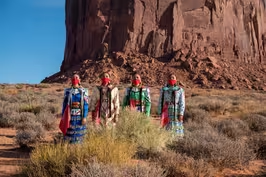
Preview: S3 Ep1 | 30s | Take a sneak peek at the Season 3 premiere, The Art of Healing. (30s)
Video has Closed Captions
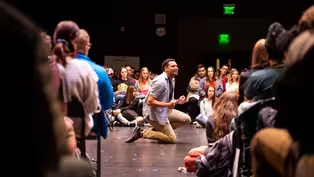
Clip: S3 Ep1 | 7m 41s | “Every Brilliant Thing” brings a play about mental health to high schools across Utah. (7m 41s)
Video has Closed Captions
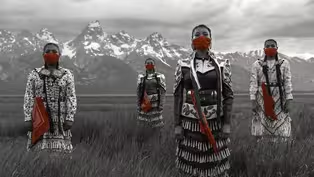
Clip: S3 Ep1 | 9m 4s | Eugene Tapahe’s Jingle Dress photographs aim to reclaim indigenous spaces & bring healing. (9m 4s)
Video has Closed Captions
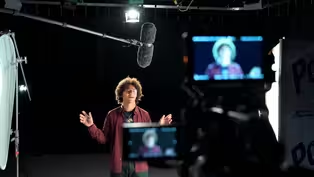
Clip: S3 Ep1 | 6m 51s | Growing up with ADHD & Dyslexia, poet Jaruwat Maendl finds acceptance through spoken word. (6m 51s)
Providing Support for PBS.org
Learn Moreabout PBS online sponsorship













Support for PBS provided by:
This Is Utah is a local public television program presented by PBS Utah
Funding for This Is Utah is provided by the Willard L. Eccles Foundation and the Lawrence T. & Janet T. Dee Foundation, and the contributing members of PBS Utah.