
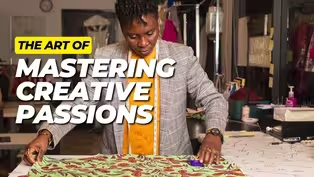
The Art of Mastering Creative Passions
Season 9 Episode 24 | 27m 45sVideo has Closed Captions
Explore beeswax art, fashion tailoring, and opera in this episode of "AHA, A House for Arts."
Meet artist Laura Moriarty in Rosendale, NY, and discover her enchanting art made with pigmented beeswax. Then, learn the inspiring story of Mo Rabiu, who left her finance career to pursue her passion for fashion by buying European Tailoring and Alteration in Albany. Finally, enjoy a captivating performance from Opera Saratoga.
Problems playing video? | Closed Captioning Feedback
Problems playing video? | Closed Captioning Feedback
AHA! A House for Arts is a local public television program presented by WMHT
Support provided by the New York State Council on the Arts (NYSCA), M&T Bank, the Leo Cox Beach Philanthropic Foundation, and is also provided by contributors to the WMHT Venture...
The Art of Mastering Creative Passions
Season 9 Episode 24 | 27m 45sVideo has Closed Captions
Meet artist Laura Moriarty in Rosendale, NY, and discover her enchanting art made with pigmented beeswax. Then, learn the inspiring story of Mo Rabiu, who left her finance career to pursue her passion for fashion by buying European Tailoring and Alteration in Albany. Finally, enjoy a captivating performance from Opera Saratoga.
Problems playing video? | Closed Captioning Feedback
How to Watch AHA! A House for Arts
AHA! A House for Arts is available to stream on pbs.org and the free PBS App, available on iPhone, Apple TV, Android TV, Android smartphones, Amazon Fire TV, Amazon Fire Tablet, Roku, Samsung Smart TV, and Vizio.
Providing Support for PBS.org
Learn Moreabout PBS online sponsorship(upbeat music) - [Matt] Learn how to make art from beeswax with Laura Moriarty.
Chat with consignment boutique owner Mo Rabiu, and catch a performance from Opera Saratoga.
It's all ahead on this episode of "Aha, A House for Arts."
(opera music) - [Narrator] Funding for "Aha" has been provided by your contribution and by contributions to the WMHT Venture Fund.
Contributors include the Leo Cox Beach Philanthropic Foundation, Chet and Karen Opalka, Robert and Doris Fisher Malesardi, and the Robison Family Foundation.
- At M&T Bank, we understand that the vitality of our communities is crucial to our continued success.
That's why we take an active role in our community.
M&T Bank is pleased to support WMHT programming that highlights the arts, and we invite you to do the same.
(electronic music) - Hi, I'm Matt Rogowicz, and this is "Aha, A House for Arts."
A place for all things creative.
The sun is out and the bees are buzzing.
So let's take a trip to the studio of artist Laura Moriarty.
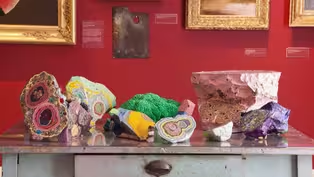
I am here in Rosendale, New York to meet with artist Laura Moriarty and to learn more about her beautiful art made with pigmented beeswax.
Follow me.
(whimsical music) - I make sculptures and works on paper out of pigmented beeswax.
It's sort of a form of naturalism for me.
It's a way of investigating the processes of nature, using just this one material.
(gentle music) Beeswax has been used in art for a really long time, like the Fayum mummy portraits, they're ancient.
There's oil paint, which is oil based.
There's watercolor, which is water based.
There's acrylic, which is acrylic based, and there's encaustic, which is wax based.
Yeah.
- And this is it right here.
- Yeah, now this is just the bees wax and the resin.
It would be just the raw medium that you're working with.
These are milled paints.
So these are the beeswax and the resin, and then they're milling pigment into it.
They just come in.
- [Matt] Hockey pucks.
- Yeah.
(whimsical music) I had been experimenting with beeswax as a way of giving my work on paper more heft, more physicality.
So I just kind of transitioned over to just working with the wax.
It's starts off like a traditional painting.
I'm on a panel, I'm using a brush, I'm melting the color, and I'm just painting it on the panel.
(whimsical music) So letting this cobalt blue melt out into a puddle.
The qualities of the medium are that it, well, first of all, it goes from solid to liquid.
You have all these opportunities between the fluidity and the solidity to do different things with it.
And you see how it's always moving when it's hot, when it's fluid.
(whimsical music) And I make layers.
So I'm building up layers of color.
- Cooling off the panel.
- I'm cooling this off because it's not settling.
- Must be all the hot film lights.
- And I just pile colors on top of each other.
Then at a certain point, I push the paint off the panel.
So this is gonna be very thin, but you know, just pushing it up off the panel.
And you can imagine if I had a lot of paint on there, that this would be.
- [Matt] Different layers.
- It would be like this.
Imagine that it's this much paint, but I mean, this object was made absolute, exactly this way.
(whimsical music) I'm using the poetics of geology very deliberately.
The subsuming and enfolding, erosion.
There was a point when I was literal about like looking at geology textbooks, looking at those diagrams of cross sections, and I was kind of evaluating like, what are these illustrating, and how can I illustrate that in a parallel way?
Over the years, I've just gotten looser and looser and looser with it.
And now I make these very strange objects that, you know, to me, they're never finished.
They're incomplete.
They're always in process.
And I think of myself the same way.
Like I am in this process too, and we're always gonna be in this process.
The work on paper started off as a byproduct of the sculptural work.
You know, I have this ecological kind of mandate in the studio where I really try not to waste anything.
So when I was making the sculptural pieces, I would do a lot of eroding on a hot pallet where I'm dragging the form along a hot palette and it's melting.
So I started picking those things up on paper, almost like a monotype or a monoprint, you know, in a way the works on paper were almost like cross sections and microscopic where you're seeing the thinnest slice of a rock.
And now I actually do more work on paper than sculpture.
Well, why don't you give it a try now?
(triumphant music) - I don't know what I'm doing.
I have a good teacher.
Okay.
(triumphant music) (gentle music) It's my first one.
It's not going to be beautiful, as perfect as you know, it's a student's piece.
Ooh.
- [Laura] Oh.
- [Matt] It looks nice on paper.
- Yeah.
(gentle music) I don't know.
It's kind of beautiful.
- [Matt] It's not bad, yeah.
- And I like this side of this one.
- [Matt] Yeah.
- It's really smooth and it kind of reminds me of a Gerhard Richter.
- I'm Gerhard Richter.
(Laura laughs) (gentle music) - I think of my practice as a form of spiritual practice.
You know, it is the most important thing to me.
It's the way I try to reflect back out at my culture.
Naturalism has always been really important to me.
You know, I'm committed to nature, to living in harmony with it, and to accepting my place in it.
And I reject a lot of philosophy that places humans in the center of everything.
I don't believe that.
I believe we're just one of the many species on the earth and there's all forms of matter.
And I really go very deep into thinking about how this is sort of a way of thinking about oblivion, of thinking about how nothing goes anywhere.
Nothing goes away.
Everything is here and it's constantly shifting shape, shifting form.
These objects are my way of investigating that and sort of giving people an opportunity to have that experience for themselves.
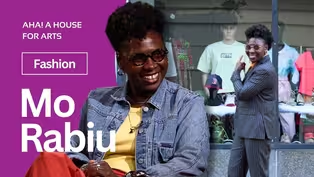
- Like many of you, our next guest, Mo Rabiu, had a perfectly fine office job, but in 2020, she decided to take the chance to pursue her love of fashion.
She ended up buying European Tailoring and Alteration in downtown Albany.
I wonder how she's doing.
Let's find out.
- Welcome to "House for Arts," Mo.
- Thanks for having me.
- Yeah, I'm super excited to talk to you.
So I know you have a background in finance, that's what you went to college for.
And got your degree in.
- Absolutely, yep.
- But you're also a fashion designer and clothing guru.
So how did you go from crunching numbers to just being like a fashion designer and into just creating and mending clothing?
- Oh, that's a very interesting question.
I am really inspired by my roots and heritage in, of African culture.
So seeing a lot of like textiles and fabric as my own mom was a, you know, fabric designer herself.
So I was like born into it.
- Yeah.
- But it was never like really visible to do and to, you know, to sustain a lifestyle.
Coming from Africa, your parents want you to, you know, have an education, stability, and have, you know, an income, a steady income.
So it was like, okay, you go to school and I went to school.
I got an accounting degree.
I worked in finance for a very long time.
Yes, and say 2020 came and I made a move to really creating my own brand and European Tailoring became available.
I just said, you know what, this is a great opportunity for me to really dive into what I love, to really express my creativity.
So that was what, you know, inspired European Tailoring.
- So like, give us a little bit of background.
What is European Tailoring?
- The actual service is just tailoring.
I do make suits and wedding dresses.
I mend clothes.
So it's just all around anything that has to do with textile.
- And tailoring is something that is so important today because we feel like we, you don't really see it as much anymore in my personal opinion.
You can let me know.
Is it like a dying craft?
- Absolutely, absolutely.
It is a dying craft.
Not a lot of young people are into it.
And I would say even in our area in this community, I'm one of the youngest people in this trade.
So it is quite interesting.
But I love it and I encourage people during my downtime, my down season, I tend to teach people, but it is, it's something that I want more and more people to get into 'cause it really helps with sustainability.
- It really does.
And speaking of, let's talk about your fashion brand So Radical.
So what is it and what is its mission?
- So Radical is a fashion brand that really intend on sustainability.
And it is about making sure that creating pieces, timeless pieces, that we can enjoy for a very long time.
And that was the mission, that was the statement mission from the get go of creating So Radical is, you know, coming from that tailoring background and you know, getting a lot of fabric.
And I usually, I just throw them out or I take it to Goodwill and I go, you know, I can really create something with this.
And that's how it started.
It was just taking, you know, modern fabrics and vintage fabric and mixing it together to create streetwear and avant garde pieces.
- Awesome, and would you say like the style is avant garde, or what would be the style of your pieces?
- The style is, you know, it's in the name.
It's so radical, like it's never a one way street.
So I go, I can go from like designing a couture to a T-shirt to, you know, it's all over the place.
So we are not following a template.
So it is so radical what we make.
- Oh, I love it.
So how do you convince people that slow fashion or we worked or upcycled, there's so many terms that go with this, is the way to go because you know, this is a sustainable practice.
You're reworking vintage or reused clothing or unused clothing, but where does it have to go?
- [Mo] Right.
- And you're creating art pieces from it.
So how do you convince people that this is the most sustainable, ethical way to buy clothing?
- That's a great question.
I usually try to emphasize on quality over quantity.
And one of the things is that, you know, being able to tell a story through a piece.
Every time, you know, a customer comes into the studio is that, you know this was made from a blanket?
And they go what?
It's like yep.
And you know, the ability to tell stories and also educating clients and customers about, you know, our carbon footprint and fast fashion has done a great deal of damaging our climate change, our climate.
So I'm just trying to create a little change that I can by starting So Radical and also educating people about sustainability.
And let's buy slow, you know, you can buy from anywhere.
You get a lot of stuff for like a hundred dollars, right?
But then you get two washes out of it and it's like, uh-oh, now I gotta go back again.
But so creating, buying slow means a piece might be a little bit expensive, but then you wear it more and you have that one of one piece that, you know, something that nobody else have, so you can really enjoy, you know, that piece and really, you know, tell the story that comes with that.
- One question before we wrap up is collaboration.
Do you collaborate with folks?
- On my design, no.
But as far as like when we have things like I've collaborated with like DJs and I've collaborated with all the people in the community, but yeah, I do love to collaborate because I think it's very important to our community.
It is, we need to tell stories when we do these things, we tell each other's stories and we create cultural awareness in the area that it, though it is a small space, but we can tell our own story and create our own vibe, so to speak.
So I think it is very important.
- Right, thank you so much Mo, for talking about So Radical and European Tailoring and all the great work that you're doing.
- Thank you so much for having me.
This is a great pleasure.
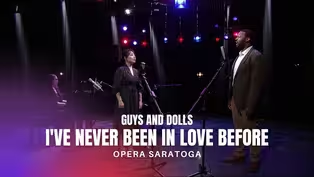
- Please welcome Opera Saratoga, performing some excerpts from their current season.
- What time is it?
- I don't know, four o'clock?
- This is your time of day, isn't it?
I've never been up this late before.
- How do you like it?
- It's so peaceful and wonderful.
- You're finding out something I've known for quite a while.
♪ My time of day is the dark time ♪ ♪ A couple of deals before dawn ♪ ♪ When the street belongs to the cop ♪ ♪ And the janitor with the mop ♪ ♪ And the grocery clerks are all gone ♪ ♪ When the smell of the rain washed pavement ♪ ♪ Comes up clean and fresh and cold ♪ ♪ And the streetlamp light ♪ ♪ Fills the gutter with gold ♪ ♪ That's my time of day ♪ ♪ My time of day ♪ ♪ And you're the only doll I've ever wanted ♪ ♪ To share it with me ♪ - Obadiah.
- Obadiah, what's that?
- Obadiah Matheson.
It's my real name.
You're the first person I've ever told it to.
♪ I've never been in love before ♪ ♪ Now all at once, it's you ♪ ♪ It's you forever more ♪ ♪ I've never been in love before ♪ ♪ I thought my heart was safe ♪ ♪ I thought I knew the score ♪ ♪ But this is love ♪ ♪ That's all too strange and strong ♪ ♪ I'm full of foolish song ♪ ♪ And out my song must pour ♪ ♪ So please forgive this helpless haze I'm in ♪ ♪ I've really never been in love before ♪ ♪ I've never been in love before ♪ ♪ Now all at once it's you ♪ ♪ It's you forever more ♪ ♪ I've never been in love before ♪ ♪ I thought my heart was safe ♪ ♪ I thought I knew the score ♪ ♪ But this is love that's all too strange and strong ♪ ♪ I'm full of foolish song ♪ ♪ And out my song must pour ♪ ♪ So please forgive this helpless haze I'm in ♪ ♪ I've really never been ♪ ♪ In love ♪ ♪ Before ♪ (piano music) (singer sings in foreign language) (singer sings in foreign language) - You can still see Opera Saratoga this season.
Head to operasaratoga.org for dates and tickets.
Thanks for joining us.
For more arts, visit wmht.org/aha and be sure to connect with us on social.
I'm Matt Rogowicz.
Thanks for watching.
(dramatic music) - [Narrator] Funding for "Aha" has been provided by your contribution and by contributions to the WMHT Venture Fund.
Contributors include the Leo Cox Beach Philanthropic Foundation, Chet and Karen Opalka, Robert and Doris Fisher Malesardi, and the Robison Family Foundation.
- At M&T Bank, we understand that the vitality of our communities is crucial to our continued success.
That's why we take an active role in our community.
M&T Bank is pleased to support WMHT programming that highlights the arts and we invite you to do the same.
The Art of Mastering Creative Passions: Preview
Video has Closed Captions
Preview: S9 Ep24 | 30s | Explore beeswax art, fashion tailoring, and opera in this episode of "AHA, A House for Arts." (30s)
Mo Rabiu's Impact on the World of Modern Tailoring
Video has Closed Captions
Clip: S9 Ep24 | 6m 24s | Mo discusses his inspiring journey from finance to sustainable fashion design. (6m 24s)
Opera Saratoga Performs Cosi Fan Tutte "In Uomini, In Soldati"
Video has Closed Captions
Clip: S9 Ep24 | 2m 33s | Watch Opera Saratoga perform excerpts from their current season. (2m 33s)
Opera Saratoga Performs Cosi Fan Tutte "Smanie Implacabili"
Video has Closed Captions
Clip: S9 Ep24 | 3m 10s | Watch Opera Saratoga perform excerpts from their current season. (3m 10s)
Opera Saratoga Performs Guys And Dolls "I've Never Been In Love Before"
Video has Closed Captions
Clip: S9 Ep24 | 4m 1s | Watch Opera Saratoga perform excerpts from their current season. (4m 1s)
Video has Closed Captions
Clip: S9 Ep24 | 7m 57s | Explore Laura Moriarty's art made with pigmented beeswax in Rosendale, NY. (7m 57s)
Providing Support for PBS.org
Learn Moreabout PBS online sponsorship

- Arts and Music
The Best of the Joy of Painting with Bob Ross
A pop icon, Bob Ross offers soothing words of wisdom as he paints captivating landscapes.












Support for PBS provided by:
AHA! A House for Arts is a local public television program presented by WMHT
Support provided by the New York State Council on the Arts (NYSCA), M&T Bank, the Leo Cox Beach Philanthropic Foundation, and is also provided by contributors to the WMHT Venture...