
The Attempted Coup/Fixing the Districts
Season 4 Episode 2 | 26m 46sVideo has Closed Captions
The Attempted Coup/Fixing the Districts | Episode 402
Nolan Finley and Stephen Henderson discuss the recent breach of the Capitol by Trump supporters. Cracking open Lake Superior State University's annual list of banished words and guides us through this year's contenders. Lori Higgins of Chalkbeat Detroit talks with Christy. And the fight to end gerrymandering in Michigan. Episode 402
Problems playing video? | Closed Captioning Feedback
Problems playing video? | Closed Captioning Feedback
One Detroit is a local public television program presented by Detroit PBS
The Attempted Coup/Fixing the Districts
Season 4 Episode 2 | 26m 46sVideo has Closed Captions
Nolan Finley and Stephen Henderson discuss the recent breach of the Capitol by Trump supporters. Cracking open Lake Superior State University's annual list of banished words and guides us through this year's contenders. Lori Higgins of Chalkbeat Detroit talks with Christy. And the fight to end gerrymandering in Michigan. Episode 402
Problems playing video? | Closed Captioning Feedback
How to Watch One Detroit
One Detroit is available to stream on pbs.org and the free PBS App, available on iPhone, Apple TV, Android TV, Android smartphones, Amazon Fire TV, Amazon Fire Tablet, Roku, Samsung Smart TV, and Vizio.
Providing Support for PBS.org
Learn Moreabout PBS online sponsorship- Hey, I'm Christy McDonald and here's what's coming up this week on One Detroit.
The six things we need to watch for when it comes to school and our kids in 2021.
Plus the challenge ahead for the independent citizens redistricting commission and how it will impact our representation.
Then Stephen Henderson and Nolan Finley on the politics of the new year.
And then the words that should be banished from our vocab in '21.
It's all coming up right now on One Detroit.
- [Female announcer] From Delta Faucets to Behr Paint, Masco Corporation is proud to deliver products that enhance the way consumers all over the world experience and enjoy their living spaces.
Masco, serving Michigan communities since 1929.
- [Male announcer] Support for this program provided by the Cynthia & Edsel Ford Fund for Journalism at Detroit Public TV.
The Kresge Foundation, Community Foundation For Southeast Michigan.
- [Female Announcer] The DTE foundation is a proud sponsor of Detroit Public TV.
Among the state's largest foundations committed to Michigan focused giving, we support organizations that are doing exceptional work in our state.
Visit DTEFoundation.com to learn more.
- [Male Announcer] Business Leaders For Michigan, dedicated to making Michigan a top 10 state for jobs, personal income and a healthy economy.
Nissan Foundation, Ally and viewers like you.
(bright upbeat music) - Hey One Detroit I'm Christy McDonald.
Thanks so much for joining me.
Happy 2021.
There's a lot going on this first full week of January.
Looking for more progress and getting people the COVID vaccine here in Michigan.
Also the turmoil in Washington and kids are back to school, most of them online.
So coming up on the show, Chalkbeat Detroit Bureau Chief, Lori Higgins on the top six things to watch for when it comes to K-12 education in Michigan this year.
Then Nolan Finley and Stephen Henderson meet up to talk about the chaos in Washington, the administration change and how questioning the election impacts Michigan.
And then Will Glover gives us the list of words we should banish from our vocab in 2021.
It's a good one and it's all coming up.
(bright upbeat music) - Steve, WDednesday, in my opinion was the darkest day of the presidency since perhaps Richard Nixon and maybe even darker than that.
Richard Nixon at least had the good grace to resign and allow the country to move beyond his scandal ridden tenure.
Donald Trump has no such respect for the nation and concern for its goodwill.
What we saw Wednesday, I'll tell you, I've been a Republican all my life, all my adult life.
This is not the party of Ronald Reagan, this is not the party of George HW Bush.
This is the party now of Donald Trump and I really want no, no part of it.
Imagine the president, the leader of the free world, most powerful man in the world standing before a crowd, an angry mob, if you will and chanting bull (beep), bull (beep) over and over.
That is the lowest point perhaps ever in the history of this office.
- Yeah.
I think the lowest point was when they took him up on his prompts and decided to storm the US Capitol.
You had people breach the outside of the Capitol, you had them breach the house floor.
There's a picture of a wild protester sitting in the speaker's chair.
This has never happened in this country.
This is the definition of insurrection, this is an attempted coup and is supported by the president of the United States.
We've never been here before and I think you absolutely lay the blame at Donald Trump's feet.
Talk about as enablers and the path that the Republican party took to this point.
These are people who have been used by the Republican party to keep power for a long time and the party has fed a of this for many years stopping just short of the kind of things that Donald Trump says but pushing toward the idea that people somehow have been disenfranchised by the expansion of opportunity in our country that somehow people's rights are being infringed by making sure that everybody's rights are respected.
And so the introspection that's due in the Republican party is due for everybody.
They are not all responsible for what's happening of course but everybody rode the train to this point.
- And if they don't get off, they're all gonna pay a price.
And we saw that with the election in Georgia, lay that right at the feet of Donald Trump and the refusal of the Republican party to shout him down.
Republican turnout in Georgia was depressed.
Largely I believe because of the president's attack on Republican officials there is continued denial of reality and Republicans and a lot of Republicans who could have turned that election didn't show show up to vote.
And again, I'm a conservative, considered myself a Republican, nothing scares me more than to have absolute power in the hands of progressive Democrats for the next two years at least but Republicans had this coming and here's what worries me the most.
It's not gonna end on January 20th, Donald Trump's not going to go away.
He holds control of the Republican party and he's not going to let it go.
You saw those senators and Congress members challenging the election.
They knew better than that but they were afraid to cross Donald Trump.
You saw his two idiots on standing up before the rally say, we're gonna primary anybody who doesn't do our bidding.
That family will have control of this party for a long while to come and it will continue to decline because of it.
Just one of the big questions going forward is what do the next two years look like now that it seems that Democrats will have the White House and both houses of Congress but also how does the Republican party sort of reorganize itself and who does it reorganize around?
I think that's a question nationally but it's also a question here in Michigan.
Think of the split among our house delegation for instance about challenging the election.
You've got folks like Fred Upton, long serving Republicans who didn't want any part in that but you got a newly elected rep in the 10th district McLean who was all about it, was ready to ride this to its conclusion.
So who steps forward in a way that makes the GOP viable again, both at the state and the national?
- Not gonna happen anytime soon.
This mega army will continue to pledge their allegiance to Donald Trump.
He's showing no signs of wanting to step back, step aside.
His ego demands that he be worshiped.
I predict on January 20th he'll start his election campaign for 2024.
I think he'll continue to hold rallies, continue to incite and disrupt.
I don't see another leader emerging and I don't think anybody at the state level who's not a Trumper, can step up and gain control of the party.
I think the Republican party is stuck with Trump for a long while to come.
- You know, I would be remiss if I also didn't take the opportunity to talk about this moment and the optimism of this moment in so many ways.
These Senate races in Georgia seem as though they're going to produce the first black Senator from that state and the first Jewish Senator from that state.
Now you think of what has gone on in that state and the civil rights struggles that have taken place there.
The legacy of Jim Crow, the legacy of Martin Luther King whose church, Reverend Warnock is pastor of now.
The progress that that marks I think is getting lost somewhat in the chaos of what's going on elsewhere and the questions about the GOP and these other things.
I think as Americans, we owe it to ourselves just to take a moment to mark that.
It's part of what is the solution here.
This sort of expansion of opportunity and inclusion in this country over the last 50 or 60 years really is what makes this country special.
- Well that's a silver lining Steve, I guess in what from my perspective is gonna be a miserable two years as we swing for the fences.
They've got an opportunity here to put their agenda in place.
They whipped on it the last time they had that opportunity.
I doubt their progressive wing is going to allow this opportunity go to waste.
- I hope they don't.
- We'll be arguing about that in weeks to come.
- Michigan will probably lose a congressional seat and we'll know more when the census numbers come in soon.
The Michigan independent citizens redistricting commission is taking the lead on drawing congressional and state legislative maps over the next year as we head into the 2022 vote.
One Detroit's Bill Kubota has more.
- Yeah.
Getting the political parties and their office holders to give up control of this process is hard.
- [Bill] The process, electoral redistricting, there's a big changer for it.
Well, what was the old way of doing it which is the political way, right?
- Yeah.
Well, the last two times around the Republicans controlled the legislature and the governorship.
So the idea is Democrats might as well go home and watch football or something 'cause I think we're gonna play no part.
This is gonna be done to them, not by them.
- [Bill] John Chamberlin's been a redistricting participant and observer since the 1960s but it's just recently, Michigan voters changed the game.
- [Narrator] Over 3000 volunteers collected more than 425,000 petition signatures.
- [Bill] Proposal tool called for an independent citizens redistricting commission in 2018.
It passed.
Now the work has begun.
- [Narrator] 83 County signed including Republicans, independents, Democrats and those somewhere in between.
- I've had one commission meeting under my belt.
So I'm rolling-- - [Bill] The commission's Executive Director, Sue Hammersmith started last month.
- This is for the citizens by the citizens of Michigan.
So it's pretty exciting to be part of this historic work.
- [Bill] The commission has a few other States to look to.
California started their redistricting commission a decade ago.
- We are the 14 members of the California citizens, redistricting commission and we draw the lines.
- The citizens of California we're very happy with the outcome of that process despite the fact that they were doing it for the first time.
People recognized Democrats and Republicans alike that, you know, this was a better way of doing it.
We'll keep it up.
- There are four Democrats, four Republicans and five independents that serve on the commission.
- But this is all going on in the middle of a pandemic.
How's that affecting things?
- Well, it's gonna be much harder on a pandemic to speak directly with people.
Point in case we're on zoom today.
In some respects, maybe that'll open up options for people to speak up.
- [Bill] Rebecca Szetela, attorney with four children and now a redistricting commissioner.
- I was very surprised that I made it on the commission but I'm very happy to have this opportunity.
- [Bill] She joined as a political independent.
- I think the workload is gonna pick up in the summer as we get closer and once we get sent this information so that we can actually start possibly redrawing maps but for right now, it's about every other week or every week of about four to five hours of meeting and then outside prep.
- [Bill] There will be at least 10 public hearings.
Will they be virtual, in person?
Don't know yet.
A lot to talk about state house, Senate districts and those congressional seats.
- There's no doubt that we're gonna lose another congressional seat.
I think we're pretty much, no matter what happens-- - [Bill] Kurt Metzger, Pleasant Ridge mayor and Demographer.
- We're now at about 61 of our 83 counties have more deaths than births on an annual basis.
- [Bill] Back in 1980, Michigan had 19 seats in Congress.
Soon it'll be just 13.
Every 10 years after every census, we keep losing.
- And none of this is really a surprise.
I know there was a big effort to get the census numbers as close as you can or get the numbers up.
- Right, right.
- But there was still probably not much hope of saving that seat, was there?
- No, I mean, all the forecasts that had us losing a seat and, you know Michigan did as well as one could expect in the census.
- [Bill] Michigan's overall census response rate in the top 10 but in cities like Detroit and Flint not so good, lower numbers there and the shift in population, that's expected to affect how congressional districts will be redrawn.
- I think this time around you've got a large movement of African-Americans into both Southern McComb and Southern Oakland.
- [Bill] With the voting rights act, two Michigan districts need at least 50% African Americans of voting age leading Kurt Metzger to speculate what's ahead.
- Andy Levin might get upset but I think the ninth district is the one that's gonna have to go.
We can't have as many districts in Southeast Michigan.
And the ninth district takes in Southern Oakland and Southern McComb.
And I think that that's gonna have to, the 13th or 14th or whatever they're renumbered will have to take in a larger section of Southern McComb to get that African-American community.
- High on the priority list, the commission must consider something called Communities of Interest Communities of Interest.
Is that a term that you use in your trade?
- Well, I'm learning more and more about communities of interest every day.
It is always been one of the factors in redistricting but it's usually if you look at other States, it's been way down at the bottom.
- You think about you know, who's a community of interest?
Is it a religious group, an ethnic group?
Is it economic group?
Then, you know, you're starting to make pretty core decisions about who people are and how they should be represented and so all of those become pretty controversial decisions.
- Communities of interest don't come predefined.
There's no directory of communities of interest that the commission could go to.
They're gonna have to depend upon people coming forward either in to testify in public hearings or virtual hearings.
And I think make the argument, don't chop us into pieces.
What your interest is, is pretty much open.
I mean, you can name your interest other than our interest is getting our guy reelected.
- [Bill] Another priority, partisan fairness.
How to do that with tightly packed urban areas with a lot more Democrats.
Breaking them up is hard to do which may be needed to create more competitive districts.
- There're a lot of maps that you could draw where Democrats will continue to have large problems in translating a statewide victory into a victory and say the Michigan Senate.
- [Bill] Thus the conundrum as more Michigan voters lean Democrat while more house and Senate seats are Republican.
- I'm just telling you, that's actually very hard to achieve in concern with the other objectives which are, you know we pay attention to communities of interest, we make sure racial groups have the potential to elect demographic representatives.
All of those things can be in conflict with achieving a map that means that a 50/50 vote would go 50/50 in representatives.
- [Bill] Now eyes turn toward that new commission where you can follow every development online courtesy the Michigan secretary of state.
- We have to have our final maps drawn by November one.
So that is our hard deadline that we're working with and everything else is just going to fall into place based on when we get the data that we need to do our job.
- The success will be whether people show up at these public meetings and people across the state get energized and engaged in the process.
- It is easy to make a map that is less partisan driven and less gerrymandered than the current maps.
So that's a bar that there'll be able to meet but it is a much harder to satisfy people.
We're all with reasonable criteria for drawing the lines.
(bright upbeat music) - Well, it is the new year and kids are heading back into school and really reaching the end of their first semester.
And a lot of districts across the state are having to make difficult decisions about how they're moving forward.
And joining me now is Lori Higgins, long-time education reporter in the city and now the Bureau Chief for Chalkbeat Detroit.
Lori, it's good to see you.
Happy new year.
- Happy new year to you Chrisy.
Thank you for having me on today.
- You just came out with a list of six things that you are looking for when it comes to education in Michigan for 2021.
And I really loved the list and the first one is return to in-person learning, exactly what so many districts are grappling with.
- Exactly.
You know, this week, you know schools came back and you know, some came back to in-person learning for the first time and you know a few weeks or a couple of months and some are playing a waiting game because we don't know right now what kind of spike we'll see from the Christmas holiday.
You have districts like the Detroit school district that is, they were supposed to come back on January 11th and they've delayed it until February because the the positivity rate in the city is still higher than their threshold.
Kids aren't necessarily thriving in virtual schooling and they know that face-to-face works best for most kids but they're also dealing with, you know, safety concerns that staff are raising and some parents as well.
- And that really goes into the second point you raised is the vaccine effect and we are still waiting to see a large scale rollout of people being vaccinated and how that will make a difference going into spring.
- What we're hearing so far is a little concerning.
A large number of healthcare workers are declining the vaccine, not only in Michigan but across the country.
We were already worried about whether or not, you know teachers and other school staff would be taking the vaccine in large numbers.
When we posted a story recently about this, most of the reaction from teachers was no, I'm not gonna get this vaccine.
Whether or not people get the vaccine will determine whether schools can come back, you know full time in person.
- So if we still have, you know virtual school and kids are online learning, the next point really is improving the online learning.
And the complaints that we're hearing from kids and I'm even hearing in my own house is, you know fatigue of being onscreen so long, not having the interaction, not feeling that they're connecting with their teachers and with other kids.
How do you even improve that when you're still looking at should we be back in or not?
- Right.
I mean, you, a lot of districts are spending probably a lot of time on the safety issues and on these debates about returning or not.
I think that districts are starting to look at how to improve online learning.
The Detroit school district for instance, is looking at you know, creating a task force to recommend changes.
You know, students have been very vocal about the fact that this is too much for them.
This is learning in a way that they're not used to.
- Looking at the next point you made, will students return?
They are down 53,000 students across the state and over 10,000 Lori are unaccounted for meaning they don't even know where those students went.
- Exactly.
The number is actually 13,000 which is a huge number in Michigan.
And we're seeing this, not just in Michigan but it's happening across the country.
Yeah.
So these are students where they have not notified their schools about what they're doing.
And the question is what kind of, what kind of education have they gotten in that year that they have essentially been lost?
- And that really kind of brings us to the next point you're talking about which is a focus on literacy.
And if you have kids who have been kept home for that first year of kindergarten or had been homeschooled and then get put back into public school, let's say that they are the same level, let's say that they're behind and we had that third grade literacy law that had been suspended for this year-- - The question is still out there about whether or not the legislature will suspend that law again this year.
You know, last year school districts were supposed to hold back students who were in third grade but far behind academically, but, you know they suspended it for a year.
You know, there's no indication what might happen this year.
and you're right.
I mean, if there are kids who are not being educated right now or not being educated adequately, we could see far more students who are eligible to be held back this year than previously predicted.
- Testing and accountability.
We all know that the standardized tests for Michigan always come in the springtime.
That we've Michigan has opted out of that or they've been waived out of that?
- Not for this year.
They were waived.
The US Department of Education issued waivers last year.
Michigan is among a number of States that have asked for another waiver for this year because they don't think that it's, it makes sense to test students during a pandemic but that waiver has not come.
We could be heading into a situation where students will have to sit down and take this standardized test beginning in March or April.
- All right.
So it's a new year.
So we should really ban some overused words from last year, right?
Well One Detroit's Will Glover has more.
- Since 1976, Lake Superior State University has compiled a list of words that as they put it are overworked, redundant, oxymoronic or a cliche.
So let's flatten the curve of words and see what our new normal will be.
Coming in at number 10 is I know, right?
A nonsensical phrase where you assert and question whether you do indeed know.
Number nine, sus.
Short versed suspicious from the game "Among Us".
It's not part of my vocabulary but I have a feeling this one might be among us for a while.
Number eight, Karen.
A moniker given to white women exhibiting racist behavior.
Some say the term has become misogynistic but to all the innocent Karens in the world take solace in the fact that we're not forced to wear name tags.
I'm sure seven, six, five and four are all words and phrases that we can definitely let go of which are unprecedented.
- [Male] Unprecedented times.
- [Female] Unprecedented times.
- [Male] Unprecedented times.
- [Male] This unprecedented moment.
- [Will] Pivot.
- The pandemic is putting pressure on companies to pivot their business models.
- [Will] In these uncertain times.
- [Female] During these uncertain times.
- [Male] During these uncertain times.
- [Male] In uncertain times.
- [Female] In uncertain times.
- [Female] Uncertain time.
- And in an abundance of caution.
As a media professional, I feel attacked but I understand.
So in these uncertain times, I'll do the unprecedented and pivot to the next sprays with an abundance of caution.
Number three, we're all in this together.
- [Female] Together.
- [Male] Together.
- [Male] Together.
- [Female] Together.
- [Male] Together.
- [Male] Together.
- A phrase that was wiped away as soon as the toilet paper went out of stock.
Number two, social distancing.
I'm not sure how we get rid of this one but I'd rather be socially distant than unsociably close.
Coming in at number one is COVID-19, Corona virus, the Rona.
And although it would be amazing to watch this word slip back into the obscurity of medical vocabulary until then don't forget to stay safe, stay healthy and wear your mask.
- All right.
So no more unprecedented times, I'll just pivot to another phrase.
All right.
That was a bad joke.
That's gonna do it for us on One Detroit.
Remember you can always find us @onedetroitpbs.org.
We're also on social media Facebook, Instagram, Twitter at One Detroit and One Detroit Arts & Culture, Monday nights, 7:30 PM.
That's gonna do it for me.
Have a great weekend.
I will see you next time on One Detroit, take care and be well.
(bright upbeat music) - [Female announcer] From Delta Faucets to Behr Paint, Masco Corporation is proud to deliver products that enhance the way consumers all over the world experience and enjoy their living spaces.
Masco, serving Michigan communities since 1929.
- [Male Announcer] Support for this program provided by the Cynthia & Edsel Ford Fund for Journalism at Detroit Public TV, the Kresge foundation, Community Foundation for Southeast Michigan.
- [Female Announcer] The DTE Foundation is a proud sponsor of Detroit Public TV.
Among the state's largest foundations committed to Michigan focused giving, we support organizations that are doing exceptional work in our state.
Visit DTEFoundation.com to learn more.
- [Male Announcer] Business Leaders for Michigan, dedicated to making Michigan a top 10 state for jobs, personal income and a healthy economy.
Nissan foundation, Ally and viewers like you.
(bright upbeat music)
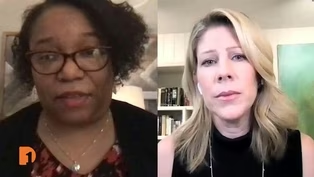
6 education issues to watch closely in Michigan
Video has Closed Captions
Clip: S4 Ep2 | 5m 48s | Chalkbeat Detroit's Lori Higgins outlines the 6 education issues to watch in 2021. (5m 48s)
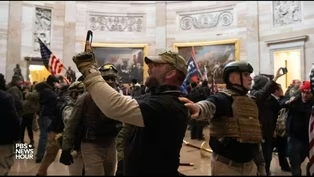
Video has Closed Captions
Clip: S4 Ep2 | 7m 20s | Stephen and Nolan discuss mayhem at the Capitol and senate history being made in Georgia. (7m 20s)
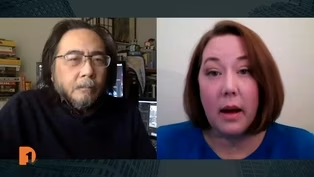
Video has Closed Captions
Clip: S4 Ep2 | 7m 28s | How might congressional districts be redrawn as we lose a seat this next election cycle? (7m 28s)
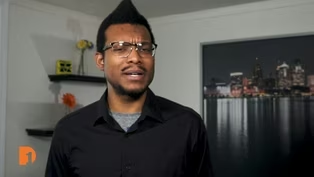
Will Glover - 2021 Banished Words
Video has Closed Captions
Clip: S4 Ep2 | 2m | Lake Superior State University's banished words of 2021 w/ One Detroit's Will Glover (2m)
Providing Support for PBS.org
Learn Moreabout PBS online sponsorship
- News and Public Affairs

Top journalists deliver compelling original analysis of the hour's headlines.

- News and Public Affairs

FRONTLINE is investigative journalism that questions, explains and changes our world.












Support for PBS provided by:
One Detroit is a local public television program presented by Detroit PBS