
The Balance of Power
Season 7 Episode 8 | 26m 53sVideo has Closed Captions
How Utah’s tight U.S. Senate race could impact the balance of power in Washington.
With less than two weeks until the election, the race for Utah’s U.S. Senate seat remains tight. Our panel evaluates how the outcome could affect the balance of power in Washington. Plus, the impact of down ballot races here at home. Journalists Saige Miller, Holly Richardson, and Max Roth join host Jason Perry on this episode of The Hinckley Report.
Problems playing video? | Closed Captioning Feedback
Problems playing video? | Closed Captioning Feedback
The Hinckley Report is a local public television program presented by PBS Utah
Funding for The Hinckley Report is made possible in part by Cleone Peterson Eccles Endowment Fund, AARP Utah, and Merit Medical.
The Balance of Power
Season 7 Episode 8 | 26m 53sVideo has Closed Captions
With less than two weeks until the election, the race for Utah’s U.S. Senate seat remains tight. Our panel evaluates how the outcome could affect the balance of power in Washington. Plus, the impact of down ballot races here at home. Journalists Saige Miller, Holly Richardson, and Max Roth join host Jason Perry on this episode of The Hinckley Report.
Problems playing video? | Closed Captioning Feedback
How to Watch The Hinckley Report
The Hinckley Report is available to stream on pbs.org and the free PBS App, available on iPhone, Apple TV, Android TV, Android smartphones, Amazon Fire TV, Amazon Fire Tablet, Roku, Samsung Smart TV, and Vizio.
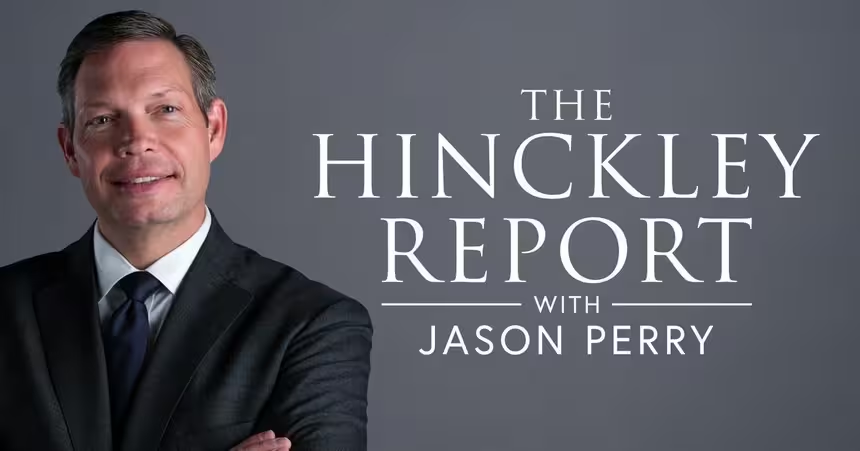
The Hinckley Report
Hosted by Jason Perry, each week’s guests feature Utah’s top journalists, lawmakers and policy experts.Providing Support for PBS.org
Learn Moreabout PBS online sponsorship♪♪♪ announcer: Funding for "The Hinkley Report" is made possible in part by the Cleone Peterson Eccles Endowment Fund.
♪♪♪ CC BY ABERDEEN CAPTIONING 1-800-688-6621 WWW.ABERCAP.COM Jason Perry: Good evening, and welcome to "The Hinkley Report."
I'm Jason Perry, Director of the Hinckley Institute of Politics.
Covering the week we have Holly Richardson, Editor of UtahPolicy.com; Saige Miller, Politics and Government Reporter with KUER; and Max Roth, anchor and reporter with Fox 13 News.
So glad to have you with us, big week and a half coming.
Max, we're 11 days from the midterms.
Max Roth: It really is something.
Jason Perry: We're watching so many races closely.
I want to talk about the Senate race for just a moment because the whole country is really watching that one.
In our last poll we had about 12% of Utahns were still not sure about who they're going to be voting for.
Talk about what these campaigns are doing to try to appeal to that critical group that they still can get.
Max Roth: I mean, the key is who is going to vote.
I mean, when you set the stage for a statewide election in Utah, you always have to have this caveat that a majority of voters are already identifying with the Republican Party, and so anyone who's going to beat a Republican has to even get some of those Republican votes along with every independent and Democratic vote, and the wild card in this one is all of those people who are disaffected by Donald Trump and by Mike Lee's support of Donald Trump and who are--but who are Republicans.
And will they go with this independent candidate who was at one time a Republican and still has conservative views?
Jason Perry: Go ahead, Saige.
Saige Miller: Both of them are conservatives.
They're both self-identified conservatives.
And if you watched the debate, while there was contention between the two candidates, they actually agreed fairly frequently, and it was--the question was more so of how are they going to address it or they went for personal attacks.
But a lot of it is, yeah, exactly what Max said is, who is going to show up to the polls?
And a lot of people are very much so unaffiliated in Utah.
I was looking at some of the voter registration statistics yesterday, and it's a large portion of Utah, especially in these counties that are primarily GOP, and Mike-- Evan McMullin has said that he's trying his best, you know, to reach out to those voters that no party has really ever attempted to.
Holly Richardson: Well, I think one of the things that's super interesting is the people who are undecided tend to lean moderate, right?
That's not usually what happens.
I mean, typically in a race if you have undecideds, they're going to not go for the incumbent.
They're trying to decide if they either are not going to vote, I guess, or they're going to go for the challenger, and so, that could bode well for McMullin, but we'll see.
Jason Perry: Yeah, so talk about this, because Max said it was a wild card, true.
It's a little bit of an experiment too that we have not seen in the state of Utah before, this--a third party candidate keeping a race pretty close.
Holly Richardson: And I think what's interesting is I think it's kind of taken not only Utah by surprise, but the nation by surprise that Evan McMullin has been able to mount a real campaign, he's got a lot of I would say momentum, I think the polls show that the gap continues to close.
Mike Lee is still in the lead, but the gap is closing, and those undecideds are moderate, which means the further right Mike Lee goes, the more disinterested I think those voters will become.
Jason Perry: Which is why, Max, I think we're seeing some--an interesting variety of endorsements coming out.
Max Roth: I think some folks are surprised because we have Jon Huntsman prominently endorsing Mike Lee, and and Jon Huntsman viewed by a lot of people as every Utah Democrat's favorite Republican, because he tended to be viewed as pretty moderate.
And so, and so, for him to support Mike Lee, you know, you have a sense that it's about their personal connection because Mike Lee was his legal-- his chief legal adviser for a time, and that they have that connection.
Because Huntsman even says in the ads that he doesn't agree with Mike Lee on everything.
Jason Perry: Who does that reach out to?
Who is persuaded by that?
Well, I mean, I think that some of those disaffected Republicans are going to be Jon Huntsman people, and also some of the independent moderates, they like Jon Huntsman, and so if they're not so keyed in on the difference between the views of these two candidates, then they may see something like that and think, oh, well, I like Huntsman, so I guess I'll go this way.
Jason Perry: Go ahead, Holly.
Holly Richardson: Well, I agree with that, I think he's aiming-- he's using the Huntsman endorsement to aim towards the more moderate but undecided voters, but he's also using some other endorsements to continue to shore up his base.
Saige Miller: And when--the thing that I find kind of interesting about this is when Jon Huntsman ran for governor against Spencer Cox, you saw in the primary a bunch of Democrats primarily switched their vote to Republican so they could vote in the primary--or switched their party affiliation to Republican so they could vote in the primary.
So, to me, that kind of shows that I don't know how much weight this is actually going to carry when specific parties and people with certain political ideologies are kind of mobilizing in order to get, like, what they consider the better candidate on the ballot.
And so, even--I don't--I don't--I don't know if this is going to actually appeal to moderate or undecided voters.
Max Roth: A couple of things that's--that kind of are battling in my mind over this race, one is campaign signs, yard signs, and the other is young people.
And the reason I bring them both up is because I live in an area that tends to be more Republican, and so I'm not used to seeing signs for the person opposing the Republican candidate, but there are a lot of Evan McMullin signs in my neighborhood.
So, that tells me that, you know, he's got a shot.
At the same time, on the day of their debate last week I was on the campus at Utah Valley University, talking to students.
I talked to at least a couple of dozen students, stopping them at lunchtime to ask them about the election.
Not one of them was even aware of these candidates and that there was a debate that was going to happen on their campus, and so I don't know if it is.
yeah--and so are those--are those young people who tend to be a little bit more progressive going to even vote?
Saige Miller: I went to--up to Provo not too long ago and walked around their campus, and just in Utah County in that section of Utah County I saw an overwhelming amount of Evan McMullin signs, and when I was walking around talking to students at BYU, a lot of them were undecided and very much so on the fence.
Like, one of them was like, I'm going to watch the debate, and that's where I'm going to make my decision.
Another one was like, I'm gonna wait till all 25 of my papers are due before I read up on this race.
But a lot of them, yeah, they-- when I was talking to them, didn't feel very represented by Mike Lee, which I think may be a motivating factor, especially for, like, a young educated population.
Jason Perry: Go ahead, Holly.
Holly Richardson: I think nationally, one of the things that I've been seeing is that the young voter turnout is expected to at least match and maybe break previous records, so that could be interesting, and we'll see, you know, what happens there.
Typically the voting block that doesn't show up to the polls, right?
They can, they're registered, but a lot of times they're unaware or, you know, they just don't know how to do it quite.
But nationally we're seeing I think a surge in young voters saying I'm gonna go to the polls, and I'm going to make my voice heard.
Jason Perry: Polling certainly seems to suggest that we're gonna get more and more of those young people voting, they could have an impact if they do show up.
I want to do just a couple more comments about some high profile endorsements and say, just tell me--I'm gonna give you a couple of these, both for Senator Lee and then for Evan McMullin.
So, Tulsi Gabbard has endorsed Mike Lee.
It's interesting, because a former Democrat candidate for president, then eventually left the party, became an independent.
Saige Miller: Yeah, I don't know how much Tulsi Gabbard's endorsement really matters to the people of Utah.
There wasn't a very large percentage of individuals who voted for Tulsi Gabbard in the primary presidential election, so, I mean, I think it's good, I'm happy that he has, like, that motivating support behind him, but I don't know how much it's going to influence or impact the Utah voter turnout.
Max Roth: I just wonder, I mean, she's kinda a wildcard in politics.
I don't know what kind of following she really has.
And I wonder what kind of conversations happened within the campaign as to about that endorsement and whether they were really going to embrace it.
Holly Richardson: And you know what I think is so interesting to me about her endorsement is that we have a congressman who is a previous Democrat, but he has that held against him, John Curtis, and now he's a Republican, so Tulsi is no longer a Democrat, she has not formally affiliated with the Republican party, but she is now the Republican party darling.
So, like, what is going on right here?
But it's so close to the election, I'm not sure how much difference it's gonna make.
Jason Perry: So, Max just a couple more I want to talk about here, just on the Evan McMullin side.
Mark Hamill's in town, Michael Steele, Adam Kinzinger, three big names.
Max Roth: Those are three big names.
The big name of those three is Mark Hamill.
It's weird, it's weird that Luke Skywalker walked into this race, and it was--and it's a wild card, exactly, because who is going to get the eyes on a candidate who is not--who those people who wouldn't normally be paying attention to politics?
It's, you know, you're going to get your your Star Wars.
He's got the force behind him, I guess.
But that's that's going to be seen on YouTube, and kids will like that.
Jason Perry: I want to take a moment to talk about what's on the line, Holly, okay, because this is what people are kind of transitioning to, and even these endorsements are getting to this.
This is the balance of power that's at stake.
And FiveThirtyEight website is interesting, they give the Democrats a 53% chance of holding the Senate, this is as of this morning, and Republicans an 82% chance of flipping the House.
Holly Richardson: Well, I mean, I think that's one of the key things that they're talking about in the Senate race, right?
Mike is saying we need to maintain Republican control or at least as much as possible so that I can be on committees and have a voice, and Evan has said he will not caucus with either party, but he sees, I think, a way for him to be like a Joe Manchin, where he can work with both sides.
And if you have a very, very tight Senate again, 50/50 or 49/51, he could be very influential.
Max Roth: Even without committee assignments.
Holly Richardson: Even without committee assignments, right?
And then when you have--if you have a House that has flipped Republican and you have a Senate that is Democrat controlled and you have a president that's Democrat, you have to start to see some work together or we just stay in gridlock, right?
So, can Utah punch above its weight by sending an unaffiliated senator?
Maybe, that could be--it's an interesting discussion for sure.
Saige Miller: I think it would put Utah on the map, right?
Holly Richardson: It already has.
Saige Miller: Yeah, it already has, but I think that if Evan McMullin is, like, is going to be elected, if he wins this race, I think that does put a lot of eyes on Utah when it comes to those gridlock situations, when it comes to the--like, the one deciding vote, you know, very kind of like Kyrsten Sinema, who, you know, at one point in her life was a pretty strong left leaning Democrat who has then become more moderate, and a lot of eyes have been on Arizona because of decisions that she needs to make.
Max Roth: It could be the most important endorsement is the non-endorsement of Mitt Romney, because one of the points that Evan McMullin made that had some substance in that debate, because there was a lot of just attacking each other in there, but one of the points that he made distinguishing him was that he and Mitt Romney would be two--Mitt Romney's at that negotiating table, he's one of those Republicans who can go either way, and if McMullin's there too, then that--then there is some clout there.
Jason Perry: So, Max, what do you make of this Fox invitation for another debate between these two candidates?
Max Roth: You know, well, first of all, I think they probably saw the first debate and saw how they went at each other and thought, oh, well, that's pretty good TV, let's get some of that.
McMullin, clearly, he is at a deficit in this race.
He's the one who needs the attention, he's the one who needs to claw some of those voters away from the Republican candidate, and so it's more to his advantage to accept that invitation than to Lee's.
Lee, you know, it might come back to bite him, but Lee can play a prevent defense because he's ahead.
Jason Perry: I want to talk about this experiment a bit with this third party candidate, because we had a student that submitted a question about this very issue, and, Saige, I'd love to have you listen to this and give a comment to the students asking this question.
Illise Ellsworth: Hi, my name is Illise Ellsworth, and I'm a student at the University of Utah.
This morning on my way to school I heard a radio ad against Evan McMullin.
I've noticed many ads on the radio and TV discrediting third-party candidate Evan McMullin, but not many ads explaining why we should vote for any particular candidate.
It seems to me like a lot of money is going into discrediting opponents rather than focusing on what the candidate plans to do for us.
So my question to you is if a third party candidate has a chance of winning here in Utah?
Saige Miller: First and foremost, thank you for listening to the radio.
Big fan of the radio.
And second, I think that any candidate has a chance, but it's just so hard to beat an incumbent.
And I think a lot of people, especially, like, kind of looking at polls, people are kind of moving away from parties, they don't necessarily identify with them.
And so, I think if a third party candidate really wanted to kind of claw and pull at that, I think that there really is a chance, but there has to be significantly more momentum.
A lot of people need to kind of disengage with their own parties and be motivated to do something else about it.
I also think a two party system probably hinders the ability to--for a third party candidate to actually make it on the stage.
But it's not impossible, right, it's not impossible.
Max Roth: You know, another thing, too, is that when you have--when you have two candidates who essentially agree on almost everything except how they should behave or how they should go about their their legislating, then what you have is going after how they behave.
It's going after--you go after McMullin for being, you know, anti-Trump, anti-Republican because of that, and you go after Lee for being so far, you know, so far to the right in his voting record and everything else that he tends to be the no vote on things rather than the one who's who's working, and like we were saying with Romney, the one who's kind of negotiating in the middle.
Jason Perry: So, Holly, that student got into a little bit on these issues as well.
And I'm kind of curious if you're foreseeing much in terms of the issues either in the Senate race, but also what's interesting is I want to comment about this, by the time the show airs this evening, we'll have had the one and only redo of the Congressional District Four race.
Holly Richardson: You know, one of the things that I think is interesting is you always have to set up differences between yourself and your opponent, right?
So I would say to the student who sent the question, thank you for the question, and also on campaign ads, most candidates will run positive ads, but third party groups, a lot of times the outside groups are the ones who are doing the attack ads, you know, where you've got the black filter over the face, right?
And, you know, they set them up as the devil.
Those are often third party groups that are doing that.
So, I think you have to be a little bit cognizant of that, too, but the reason people do it is because it works.
So, I think by the time this airs Burgess Owens and Darlene McDonald will have met.
Their debate, I don't know how it's going to go for sure.
I think Darlene is probably gonna be pretty pointed towards Burgess, but, again, because she's running from so far behind, she has to set herself up as there has to be such a huge issue with the incumbent that you have to vote for her.
Jason Perry: Max, this was an interesting one, because, you know, we had the Utah Debate Commission had a debate, Burgess Owens declined to participate because of his concerns about the editor of the Tribune being the moderator given the cartoon that they had run.
What do you think is behind this decision?
He had made a decision not to do one.
Why do you think he decided to do it now?
Max Roth: Well, it saves some face, because, you know, some people might think that he was running away from debating, that that might--that the Tribune's involvement might not be the real reason.
And so, for people who think that way, he can say, hey, look, I'm debating, I'm just, you know, it really was about that.
But, you know, the other thing is that this is a late debate.
I don't know how many people have voted, I haven't checked as of today, but a lot of people have already voted.
He has a big lead, there's not a whole lot that he has to lose, and he can--and he can save face.
Jason Perry: Okay, I want to talk about our ballots for a second.
One of the most interesting things that I think a lot of people got their ballot, they're reading through it, and they said, what is Constitutional Amendment A?
Haven't heard anything about it, 'cause usually you'll get a, you know, something with it with a for and against.
Holly, we don't have a for and against on this.
We just have the language.
Holly Richardson: Yeah, so interesting.
So, well, Constitutional Amendment A would authorize the legislature, when they pull themselves into special session, which was, I think, a 2019 bill, they can spend five times more than they can right now.
So, they go from 1% to 5%.
And I think what this sets up is their ability to be nimble, I think, in their minds, and I think the people who are opposed to it say this is a power grab, and the legislature is--and the executive branch should be working together, especially on fiscal decisions, right?
Even though the legislature has that ability to control the purse strings.
But to be able to take this amendment with no for arguments, no against arguments, and just say, hey, can you give us power to, you know, spend more money?
Saige Miller: And reporters have definitely been kind of, like, digging, like, who is for and who is for and against this bill?
I mean, against this amendment, right?
And so, my reporting partner, Sean Higgins, actually wrote an article about it yesterday where he was surprised to find out and so was I that the Utah Taxpayer's Association was in support of this amendment.
And it was because they were like, listen, there's some precedent around needing to spend money in terms of an emergency.
You know, COVID was the big, big identifying factor behind that.
And they were saying in case something like that happens again, we want access to this money so we can help stabilize the economy.
And then you have opponents like Alliance For a Better Utah who says, no, this absolutely is a power grab, there should would be executive decision making when it comes to spending this huge amount of money, because it's like it went from millions to, like, a billion dollars, right?
And it's something that, like, the Alliance For a Better Utah says the governor and the executive branch should have a say in how this money is spent.
Max Roth: And I think also you two are absolutely right, but I also think the big picture that we've been talking about in this discussion already of Utah politics, the legislature tends to be more conservative than our governors.
We don't have a whole lot of Democrats with power in Utah except in Salt Lake County, so at the state level the pull, the tug of war is between the executive and the legislature, and we've had a couple of years where there's been a lot of executive power that's been used because we've been in crises, and because of that I think that's what's happening, but I think that's the big picture is the legislature doesn't want a strong executive, especially when they're more moderate than they are.
Jason Perry: Yeah, it's so interesting for the viewers to know, to get a constitutional amendment, you need a two thirds vote in the House and the Senate for this to go on, which was passed in this last legislative session.
But I'm curious, Max, what you have to say about what what Holly just mentioned here.
So, people are looking at this in 2018, the legislature passed a bill.
We also voted to let them call themselves into special session.
So, I think they're the legislature is saying this is just adding to their toolbox when they do call themselves into special session.
But there's certainly some that are-- Max Roth: And there's always going to be an inclination-- if the vote is I get more power if I vote this way, then that's going to be the natural inclination, you know, that we, you know, we know what we're doing, and we we need more say, and so two thirds of them vote that way.
Saige Miller: The thing that was very fascinating about that vote to even get this on the ballot, this run around, was that very conservative people of the Utah legislature voted against it.
Like, Phil Lyman was like, absolutely not.
And so, I was looking at the people who voted for it, I was like, okay, I did not expect this, right?
But, like, the Democrats said, okay, yeah, let's put it-- let's put it on the ballot.
Interesting.
Jason Perry: Well, as our ballots are coming in, they're being counted even now.
Holly, I want you to talk about election security a little bit.
And it's interesting, in our last legislative session a bill was passed that says that observers have to have the right to be no more than six feet from the election process.
I want to show this picture here of what's happened in Salt Lake County, because I think it's so interesting the result of this bill, but if people want to go and watch what's happening, they can.
Holly Richardson: One of the things that I have really noticed a lot over the last-- it's probably been even six months, is different county officials, election officials, have opened their doors and said, come do a tour.
Davis County, Utah County, Weber County, right?
Come see what we're doing.
Salt Lake County, come even try your signature and see if we can match it, those types of things.
I think because there's some concern about election integrity, even though most people in Utah think our elections are safe, the vast majority actually, and most people are going to vote by mail.
We've been doing it for years now, right?
So, just in case there might be an issue, they really have been forthcoming and saying these are all of the measures that we've taken to make sure your ballot is not only secure but also counted.
Max Roth: And it would be fantastic if people go to observe, because, you know, I've been to observe these things.
I also should warn them, it's going to be pretty dull.
You walk in, you walk into that room, and it's a whole bunch of nice men and women who are just sitting down and checking their ballots, and it's, you know, it's all very quiet.
So, yeah.
Jason Perry: So, Max as we are talking about election security here, we've got the yellow brick road, people can go watch if they would like.
It's a big discussion around the country, but in Utah it's clear from our polling that Utahns by a very far majority completely believe that their votes are going to be counted and not tampered with.
Max Roth: You know, it's--it was something like 82%, I think.
I'm trying to remember what the number was in the pol, but-- Jason Perry: Eighty-nine percent confident.
Max Roth: Eighty-nine percent, okay, yeah, that's quite a high number.
That does mean that 11% of people think that votes might be tampered with, and when you talk about what's happening in our society and the anger that we see, that's still a lot of people.
I mean, you have a state with three million people, I'm not going to do the math in my head, but it's hundreds of thousands of people.
Jason Perry: Yeah, it's so important, and we have the mail-in ballots.
Just for our viewers to know, November 7th is the final day to get them postmarked, although, of course, you can drop them off at the polling sites all the way up until 8 p.m. on November 8th.
I want to talk about a couple of the issues that are driving people, but one was interesting this week because it gets right to our students.
And our governor, Spencer Cox, Holly, he was here in the very studio where we are, and talked about something he wants to do in this next legislative session that really coincides with the executive order from President Biden eliminating a significant portion of student loan debt.
I want to read what he said, tell me how this plays, okay?
Governor Cox.
But being the best of a broken system isn't helping anybody.
You know what would help people?
A tuition freeze.
We should not increase tuition next year.
So if you're looking for a headline or something to write, that's something I will be proposing, a tuition freeze.
Talk about that.
Holly Richardson: Well, I'm a recent graduate, actually, so I've been paying tuition, or at least certainly in that world.
So, I think who that plays to are the people who are incurring student loan debt right now, right?
Students who feel like that's their only option to get an education or higher education.
Does it play well with the higher ed community?
Probably not so much, right?
But I think those are policy issues, right, that need some discussion.
I think the overall, speaking of overall issues, that we've looked at in higher ed is that the cost for students has increased at a rate that the wages have not kept up with.
So, students used to be able to have a part time job, go to school, pay tuition, not going into debt.
You can't do that anymore.
It's just too much.
Max Roth: Tuition inflation has been out of control for years, and it is a real problem.
I don't, you know, I'm not--I don't know about the freeze.
I mean, I do have a Utah college student living in my house right now, so tuition is something that impacts my budget.
Holly, I know you have kids that are that age as well along with your own schooling.
But at the same time, you know, we have--Utah is in a pretty good place.
Our colleges aren't as expensive as they are in some other states.
So, yeah.
Saige Miller: I think it's interesting.
I was talking to an economics professor at the University of Utah when the student loan debt forgiveness went through, and I was like, so, what's the underlying problem here?
He's like, the way public higher ed is structured.
That's kind of the fundamental root cause problem is higher ed's gonna get this money from student loans no matter what, so freezing them might kind of juggle it, but people are still going to take out loans, and the higher ed institutions are still going to get that money.
And so, that was something that was kind of fascinating to me.
But additionally, I understand that we raised tuition, but a freeze is still going to have people to take out loans.
Like, those loans are still going to have to be withdrawn.
People are still going to have to pay them back.
And so, even if they were to freeze, it's still very unattainable for a person working.
You know, I mean, when I was in college, I worked four jobs plus going to school full time so I could pay it, right?
So, and I still have debt.
Jason Perry: That's gonna have to be the last comment.
So insightful this evening, thank you.
And thank you for watching "The Hinckley Report."
This show is also available as a podcast on PBSUtah.org/HinckleyReport or wherever you get your podcasts.
Thank you for being with us.
We'll see you next week.
♪♪♪

- News and Public Affairs

Top journalists deliver compelling original analysis of the hour's headlines.

- News and Public Affairs

FRONTLINE is investigative journalism that questions, explains and changes our world.












Support for PBS provided by:
The Hinckley Report is a local public television program presented by PBS Utah
Funding for The Hinckley Report is made possible in part by Cleone Peterson Eccles Endowment Fund, AARP Utah, and Merit Medical.