
The Battle of Blue Licks
Clip: Season 31 Episode 8 | 5m 4sVideo has Closed Captions
Chip learns about the battle of the Blue Licks.
Every August, the Blue Licks Battlefield State Resort Park recreates the Battle of Blue Licks right on the grounds where the actual fight took place. Join Chip as he grabs a musket, throws on some pantaloons and a three-cornered hat and commemorates what’s considered the final battle of the Revolutionary War – fought right here in Kentucky.
Problems playing video? | Closed Captioning Feedback
Problems playing video? | Closed Captioning Feedback
Kentucky Life is a local public television program presented by KET
You give every Kentuckian the opportunity to explore new ideas and new worlds through KET. Visit the Kentucky Life website.
The Battle of Blue Licks
Clip: Season 31 Episode 8 | 5m 4sVideo has Closed Captions
Every August, the Blue Licks Battlefield State Resort Park recreates the Battle of Blue Licks right on the grounds where the actual fight took place. Join Chip as he grabs a musket, throws on some pantaloons and a three-cornered hat and commemorates what’s considered the final battle of the Revolutionary War – fought right here in Kentucky.
Problems playing video? | Closed Captioning Feedback
How to Watch Kentucky Life
Kentucky Life is available to stream on pbs.org and the free PBS App, available on iPhone, Apple TV, Android TV, Android smartphones, Amazon Fire TV, Amazon Fire Tablet, Roku, Samsung Smart TV, and Vizio.
Providing Support for PBS.org
Learn Moreabout PBS online sponsorshipEvery August, the Blue Licks Battlefield State Resort Park marks the anniversary of an important conflict that took place there.
The Battle of Blue Licks is recreated right on the grounds where the actual fight took place.
Now, the reenactors there take their roles very seriously and recently gave me a chance to go into battle beside them.
So, join me as I grab a musket, throw on some pantaloons and a three-cornered hat, and commemorate what's considered to be the final battle of the Revolutionary War fought right here in Kentucky.
[reenactors mimicking the battle] These reenactors do put a lot into providing a living look look at the battle, which transpired right here.
And I was surprised by the number of people who showed up to see this historical interpretation.
The Battle of Blue Licks reenactment weekend is a major event at the park, and the staff is proud to memorialize such an important event.
We're here with Matthew Dollar.
He is the park naturalist here at Blue Licks Battlefield State Park.
Matthew, thank you so much for having us here today.
Chip, I'm over the moon for you being here today.
Thank you for coming.
We appreciate it.
So, what is Blue Licks?
For folks who don't know about it, what is this place?
The Battle of Blue Licks occurred August 19, 1782.
A lot of people consider this the last battle of the Revolutionary War.
It certainly was the last large military open-field conflict where British native forces and Virginia militia came together.
The heat of the conflict is pretty close to where we're standing at right now.
You said it was Virginia militia.
Is that because this was considered Virginia at that time?
So, 1782, the Virginia Territory still included.
They were calling this the Kentucky Territory, but the Virginia Colony was still included with West Virginia and the Kentucky Territory.
So, statehood for Kentucky didn't come until 1792.
Got it.
The significance of the battle here, why was it so important?
And why is it important to remember it?
A lot of the fighting for the Revolutionary War occurred on the Eastern Front, but Revolutionary War soldiers were here in Kentucky fighting against tribal Indians that had sided with the British Rangers that came out of Canada.
So, we want to make sure that we maintain our part in the historic viewpoint of the Revolutionary War.
So, how did the battle begin, and how did it make its way to this area?
There was a guy named William Coldwell.
He was born in Ireland.
Whenever he was 34 years old, he ended up being a captain with the Butler's Rangers out of British Canada at that time.
He crossed the Ohio River in early August and made his way to Bryan Station.
He tried to overtake that settlement.
He was there for a couple days with his 300 or 400 Native Americans.
They couldn't get in the fort, so they vacated that ambush, and they made their way up the Buffalo Trace.
So, he got up here, probably right around where the campground area is, August 18th, and he camped out, and the very next day, 182 guys got to the far side, the south side of Licking River over there.
One of them was Daniel Boone.
He was in this battle.
They looked across, and they saw some of the Natives that they felt like were the ones that had been there at Bryan Station that were trying to attack.
So, they made a decision to cross the river.
Those 182 Virginia militia made their way up this ridge, and eventually they started to enter a tree line, and they heard a war whoop.
And as soon as they heard that first war whoop, then they heard war whoop all up and down in ravines on either side of them.
And basically, they had said that Coldwell had set an ambush for them.
This battle didn't last very long, 10-15 minutes.
It was an absolute devastation for the Virginia militia.
Seventy-plus men got killed on the American side, and just a handful on the British side.
So, the Buffalo Trace, how did it get that name?
This Buffalo Trace historically was 8 to 10-foot wide, and that's better than tromping through the woods.
There's different salt licks from Big Bone down to Drennan Licks, Stamping Ground close to Lexington, and then it loops up here to Blue Licks.
So, there was a very well-defined, what we call Buffalo Trace, but it was a wild game trail for any type of woodland creature that would be coming through there, hitting these different salt licks and licking up that salt to provide minerals for bodies.
So, that's why it got well known as it did.
Well, it's a beautiful sight.
It really is.
Well, I'm all kitted out for the reenactment.
I'm ready to go.
You think we're ready for this?
Yeah, man, I think we should do it.
I think we'll have fun.
Let's give it a shot here.
Okay.
[reenactment of war] So, clearly I did not know what I was doing here, so I stayed on the hip of a guy who seemed to know.
And when he was felled by a redcoat bullet, I did what I thought was the most logical thing and hid behind a tree.
It really was powerful, though, being a part of something that had happened where lives actually been lost.
And I appreciated the opportunity to walk in their footsteps.
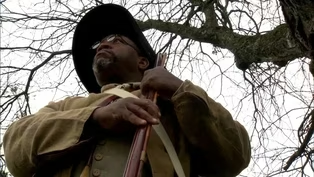
Video has Closed Captions
Clip: S31 Ep8 | 7m 25s | Learn about the fascinating life of African-American Revolutionary War soldier Daniel Goff. (7m 25s)
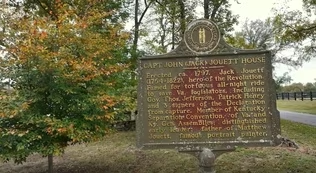
Jack Jouett House Historic Site
Video has Closed Captions
Clip: S31 Ep8 | 3m 34s | We’ll learn more about Revolutionary War hero Jack Jouett in this story. (3m 34s)
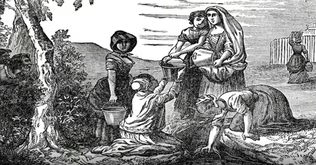
Video has Closed Captions
Clip: S31 Ep8 | 6m 7s | Learn about the siege at Bryan's Station. (6m 7s)
Providing Support for PBS.org
Learn Moreabout PBS online sponsorship












Support for PBS provided by:
Kentucky Life is a local public television program presented by KET
You give every Kentuckian the opportunity to explore new ideas and new worlds through KET. Visit the Kentucky Life website.