
The Black Church & Education, National Black Business Month
Season 52 Episode 35 | 26m 46sVideo has Closed Captions
The “Black Church in Detroit” and education, National Black Business Month.
The “Black Church in Detroit” series explores the partnership between schools and the faith-based community. Guest host Trudy-Gallant Stokes explores how Black churches support students’ education. Plus, August is National Black Business Month. Gallant-Stokes learns about the current challenges and opportunities for Black business owners in Detroit.
Problems playing video? | Closed Captioning Feedback
Problems playing video? | Closed Captioning Feedback
American Black Journal is a local public television program presented by Detroit PBS
The Black Church & Education, National Black Business Month
Season 52 Episode 35 | 26m 46sVideo has Closed Captions
The “Black Church in Detroit” series explores the partnership between schools and the faith-based community. Guest host Trudy-Gallant Stokes explores how Black churches support students’ education. Plus, August is National Black Business Month. Gallant-Stokes learns about the current challenges and opportunities for Black business owners in Detroit.
Problems playing video? | Closed Captioning Feedback
How to Watch American Black Journal
American Black Journal is available to stream on pbs.org and the free PBS App, available on iPhone, Apple TV, Android TV, Android smartphones, Amazon Fire TV, Amazon Fire Tablet, Roku, Samsung Smart TV, and Vizio.
Providing Support for PBS.org
Learn Moreabout PBS online sponsorship- Just ahead on American Black Journal, our Black Church in Detroit series examines how the faith-based community is uplifting education.
We'll talk about the church's role in helping to empower students and their families.
Plus, it's National Black Business Month.
We'll check in on the state of black business in Detroit.
Stay right there.
American Black Journal starts now.
- [Narrator] From Delta Faucets to Behr paint, Masco Corporation is proud to deliver products that enhance the way consumers all over the world experience and enjoy their living spaces.
Masco, serving Michigan communities since 1929.
Support also provided by the Cynthia and Esso Ford Fund for Journalism at Detroit PBS.
- [Narrator] DTE Foundation is a proud sponsor of Detroit PBS.
Among the state's largest foundations committed to Michigan-focused giving, we support organizations that are doing exceptional work in our state.
Learn more at DTEfoundation.com.
- [Narrator] Also brought to you by Nissan Foundation and viewers like you.
Thank you.
(upbeat music) - Welcome to American Black Journal.
I'm Trudy Gallant-Stokes sitting in for Stephen Henderson.
Today, we're continuing our series on the Black Church in Detroit, produced in partnership with the Ecumenical Theological Seminary and the Charles H. Wright Museum of African-American History.
As students go back to school, we're taking a look at how the church supports education.
Many Black churches partner with schools to help fill the gaps and tackle issues.
I spoke with Bishop Dr. Corletta Vaughn of Holy Ghost Cathedral Church, who's also a member of the Detroit Board of Education and Pastor Velma Jean Overman from Christ Temple City of Refuge in Inkster.
So Bishop Vaughn, DPSCD, I still have a hard time getting through that title.
I'm used to DPS, but they have faith-based initiatives that encourage churches to adopt public schools in their neighborhoods and help them in various ways.
And the churches also meet up regularly with leaders to share their updates and best practices.
So why is this such an important collaboration?
- Well, since I've been an elected official here on the school board, I wanted to bring the faith-based community back into partnership with our schools.
It was very important, I thought, first of all, being a faith leader in the community.
And most of those persons were the people that elected me.
I wanted to make sure that the faith of all of our students, our teachers, and those stakeholders were represented in our schools because in a culture and climate of the school, often what's missing is someone that speaks the language of the child's faith.
And so I wanted to make sure that children knew they were loved and challenged, but that they also could see someone from their particular faith expression in their schools.
Because many times with bullying, whether it's counseling, coaching, whether it's transitioning in terms of literacy, from, of course, from class to class, lunchroom time, gym time, there's always something going on with children.
And if they can see someone in their school that they identify with, that will make them feel safe, that will make them feel protected, and that will provide a safe space for them to communicate, I thought that was essential.
So I began to put together, there was a faith-based council, I had about 25 pastors and leaders from all different walks of faith.
And when I came on the school board, I began to knock on doors and I began to say, hey, listen, we need pastors, we need courageous women, we need evangelists, we need spiritual mentors in these schools.
And most times the same child that's in your school is also in your church.
So providing that spiritual support for parents, providing support for caregivers, oftentimes we go in and there's an altercation and a faith-based leader is present and they get to pray for someone.
Someone will request prayer.
Sometimes I go into the school and it's the teachers that says, could you just come and pray in my classroom?
Could you just pray for me, principals?
So there's a lot going on in our schools.
- Well, Pastor Oberman, I'm sure, so you must've answered the call.
How did all of that come about?
- She did, and we thank you.
(laughs) - So when I think about the question and what we've done and how important it is in Outland County, when I think about our schools were all dissolved in 2013 in the Inkster Public School District.
So our call to action was different.
We had to really leave our building as a church at Christ Temple City of Refuge and began that community walk and dashboard.
And it's often called that windshield view and see what is needed inside of our community, whether we're talking the educators, the facility or the children, how do we address, how do we attack?
So we made sure that we were very intentional in that.
So we partnered with so many different organizations, the five districts, along with the charter schools that our children are in to see how we can partner.
We partnered with superintendents to see how to be most effective.
And we didn't just do that as an individual church, but we brought along the ministerial alliance where there's 52 churches in Inkster and me being a part of the NAACP over religious affairs.
I was very intentional, not just to do Christian faith, but to address, as you said, Dr. Vaughn, all faith, everyone that has a higher thing power than themselves.
How do we be there to be supportive?
So that's what we're very intentional about, including this was very important to me, legislative support, right?
Because none of it matters if you can't be financed.
So we make sure that we looked at that, how to be supportive with our early childhood to make sure that legislation is passed, to make sure that we're in touch with our legislators as faith-based leaders.
- So Bishop Vaughn, chronic absenteeism is a huge issue in Detroit schools.
And obviously if kids aren't in school, we can't help them.
So how does the church help the kids get to school?
- Well, the church can help in multiple ways, certainly making announcements across the pulpit help.
And remember that the faith-based liaison as I serve services multiple faith groups.
So synagogues, mosques, we even go as far as the Scientology because we have children there.
We deal with the Catholics, we deal with Jehovah's Witnesses, we deal with the Muslim community, both African-American Muslims and indigenous Muslims.
So we have quite a variety of shepherds and pastors and parishes represented, but we always try to make it so that faith leader can announce it, can put it in their bulletin, can send out text messages, can include it in a sermon or speech or presentation.
We make sure that it's included in their database so that when they send out information, some pastors, leaders will even put it on their websites.
Some have automatic text messaging.
And like for now, we're getting ready to return back to school.
And so many faith leaders are pushing it in the sermons, youth leaders are talking about it.
They're making a special messaging, branding, returning back to school, attending school regularly.
Let me tell you what chronic absenteeism is.
Most people think it's a lot of absences, it's not.
If a student is absent nine times, nine times, that's one, two, three, four, five, six, seven, eight, nine, that is considered chronic absenteeism.
And so what that does is that reduces, obviously their learning a curve and we have seen it reflect in the GPA, in their grades, as well as their mental health.
And we also have virtual school learners as well.
So we want them to tune in every day, turn your cameras on.
So the churches are really helping.
We even had signs to go out in the yards that spoke about go to school every day.
So we're branding it, we have it on billboards and churches are really supporting the effort.
- Excellent, so Pastor Overman, tell us about your church and how you're supporting education.
How are you taking some of these same tools and making them work in Inkster?
- So the one thing that we're doing for just Inkster and our surrounding communities is we partner with Michigan Department of Education and we're one of the grantees that do out of school time learning.
So whether it's the summer or after school, we make sure that we have an opportunity for children to come in and receive the support they need in education.
And one of our initiatives is rewarding perfect attendance.
So it would have to be in alignment with your school.
So when we get your report card and your attendance is perfect, and we really thrive for that because as Dr. Vaughn alluded to, nine times in a semester means you almost missed a day a week.
That's an awful lot of learning that you have missed.
So we are intentional with our children and our parents and our community that you understand how important it is to be consistent in your own development.
So when we think about education and educating our children, it's so important that you go into the classroom on purpose.
Your family is on purpose.
Your community is on purpose.
And the purpose is for you to receive the very best education provided to you.
So whether that's after school, during school, before school, we want you to make sure you get your good night's rest, that you get what you need as nutrition, you get what you need from educators and from those that support the educators.
And a big part of that is you must be present.
So I think things that we want children to do, we know if you reward them, and that's whether it's certificates or a dollar or what is the thing they love the most?
Those little robots or Roblox or something.
My granddaughter tells me that I forget the name of it or the Apple cards, right?
And you can get donations for that and you can provide those through the churches.
But I think the biggest thing really is, is we get our young people to understand that throughout life consistency matters for their own personal success.
If you want a healthy body, you're consistent every day, all day long.
And it's the same thing for our learning.
- And what do you find in terms of helping the other important components, the educators in the classroom and the parents?
How do you help them help the young people?
- So for our schools, we keep in touch with educators.
And the great thing is we have the opportunity to employ educators during the summer to work our summer programming.
So we make sure that we do any sort of education and learning.
And Dr. Vaughn, Detroit has so much additional funding for great ideas.
But the one thing that I have found in our community is that our educators and teachers love when the community and the churches come to them.
If we just drop in a classroom with gifts, and when I say gifts, I don't mean a bunch of things that cost a lot of money, but that I appreciate you today.
We go to our superintendent, Dr. Stiles, he's always open, our Westland superintendent, because we have five different districts.
Our children go to Romulus, they go to Taylor, they go to Wayne-Westland, they go to Westwood, which is Dearborn Heights, and then they have charter access.
So that's a lot of busing in and out of one small five square mile community.
And the big challenge really is for Inkster is that we don't have mass transportation.
So once your child gets on a bus early in the morning, they have to come back at three with the bus.
So what does that do that takes them out of afterschool programs?
It takes them out of afterschool tutoring because we have the transportation issue.
So we did as a ministerial alliance and as a faith-based initiative, is we opened up right in the community down the street from housing, and we have several spaces and places doing the same thing.
So our teachers have access to this.
You can tell me that he's not reading.
You don't have to make anyone else know.
You just tell me you got a literacy issue.
We bring it back and we address it personally for that family.
And that's the thing that I think is, connects us in a special way, is that our teachers know that you have a place and a person that cares, and we're there to address it.
I know that I have a lot of viewers that wanna become involved and wanna learn more.
So Bishop Vaughn, where should they go?
And what kinds of things do you need the most help with?
- Well, DBSCD has 108 schools.
We have 52,000 students.
So our issues are much larger, but so are our resources.
And for a city like Detroit, Michigan, that has some 8,000 churches and faith assemblies, not just churches, synagogues, et cetera, what we need is for one person from every one of those 8,000 spaces to give us one person.
We want you to start with the school in your community, and then you can branch out.
And each principal, we set up a meeting with each faith leader so that principal can identify what they need in their school, because there's no blanket approach, because there's different levels of age groups, there's different level of economics, and there's different needs in each community.
Now, if you wanna volunteer for Detroit Public Schools, you can go to detroitk12.org and put in the search bar volunteer.
That again is detroitk12.org and put in volunteer.
And we'll connect you immediately to a school.
Sometimes we have more than one faith leader in a school because we can have up to 1,000 students per school.
- Thanks so much for both of you.
This is a great time to do this, this is the start of school, so we're all motivated, and thanks so much for your contributions.
- And thank you.
- Yes, this is great, thank you.
- August is National Black Business Month, a time to recognize and celebrate the contributions of African-American entrepreneurs.
According to the latest data from the U.S. Small Business Administration, there are about 3.5 million black-owned businesses in America.
For an update on black businesses here in Detroit, I spoke with Bartell Welch from the Detroit Black Chamber of Commerce and Kai Bowman from the Michigan Black Business Alliance.
So I have a couple stats I can kind of throw out and we can get going talking about this in terms of that black business owners own about 3.5 million businesses nationwide, employ about 1.2 million people, so that has a huge impact.
But yet, when you drill down to Detroit, they make up a large percentage of businesses, but what type of businesses are they and how extensive are they?
Talk about those challenges.
Bartell, first I'll go to you and then I'll go to Kai.
- First of all, thank you for having me.
But like you said, it is really a challenge here in Detroit.
Detroit has about 62,000 small and minority enterprises of which around 51,000 are minority business enterprises.
And out of that, there's literally about 80% of those that are black-owned.
But despite the large number of black-owned businesses, only 95% of them, of that 51,000, operate with just one employee, right?
So that really highlights the challenges of scaling and accessing your markets.
So with the Detroit Black Chamber of Commerce, in partnership with the National Business League, we're supporting over 13,000 black-owned businesses in Detroit and over 40,000 across Michigan to try to focus on growth and sustainability for these businesses.
- And you work from both sides of the aisle, so to speak.
You are involved with business organizations but you are a business owner yourself of multiple businesses.
- That is correct, that is correct.
So I, along with my wife, own a marketing company that's been in business for about, wow, almost 14 years now.
We've had offices ranging from Sterling Heights to Detroit.
We also have an interior design company that's been in business over five years.
Then I run a local non-profit organization as well focused on news, film, and bridging.
- Great, so you get a lot of different perspectives.
And I saw the one business is called Red Diamond.
I saw where you were going with that.
And awesome, kudos to your Catholic connections as well.
I come from a family of Catholics.
So Kyle, tell us about the Michigan Black Business Alliance and the things that you do.
- So we formed in March of 2021 with the mission to help close the racial wealth gap.
And we do that in a number of ways.
We have four core programs that we operate but we also do a lot of advocacy on the policy side.
It's no surprise how we got to this point as the state of black business in our country.
There were very intentional policies to prevent us from accessing capital from traditional banks.
And so there were laws that were put in place.
And so what we kind of do a lot of our work is being equally intentional about reversing some of those policies and working with our legislators to figure out how we can create laws and policies that will positively impact black entrepreneurs.
So at the city level, we've worked with various council members in the city of Detroit to sometimes when there's legislation we've fought for the food ordinance, the food grading ordinance.
That was a two-year fight where we believed that it was going to be and our members believed that it was gonna be something that negatively impacted restaurants across the city.
And so we fought to the first time around was to actually make sure it didn't happen.
And then we came back when we gave a number of recommendations to council members and city officials and they came back a year later, they did the hard work to come up with a solution that we thought would work for entrepreneurs.
I mean, we weren't as successful with the cashless ordinance that was passed a couple of years back, but which it's now resulted in, it's a misdemeanor to not accept cash as a small business owner, even though during the pandemic, we actually were trying to get people to not accept cash, to not spread germs.
And so it's every day it's a fight, but even at the state level, now you've got one fair wage, which is the law of the land now, which is going to again, impact our small business owners.
And so we're working with some of our state legislators to figure out how we can come up with solutions to for that piece of legislation to not have as large of an impact or as negative of an impact on small business owners until at the state level, they can come up with a solution that works for everyone.
- So what are some other things, Bartell?
I know you mentioned a couple of different organizations, ways you've been able to have an impact.
- Outside of government advocacy, some of the bigger, I mean, some of the also just as big challenges with black business is access to capital, right?
And outside of that, it's just providing development programs.
And networking opportunities to work with other like-minded businesses or businesses that can complement your work.
So, that's some of our opportunities as well that we're trying to be dedicated to, so empowered black businesses with a vision to transition these sole proprietors into small enterprises, so they can employ others and continue to like broader their economic revitalization of the city of Detroit.
- Maybe one business does one particular thing, another business does another, but if they get together, then they can offer more.
- Exactly, and that's our goal, since 1999, when we originally started the Detroit Black Chamber, which started as the Michigan Black Chamber of Commerce, we've been on that mission of striving to connect those elite professionals and business people to be able to work together to build this cornerstone of black-owned businesses in the city of Detroit.
- Also, you're bringing in young people.
I know you said that your nonprofit helps students in STEAM.
Already, we're into our last couple of minutes, but briefly tell me a little bit about that nonprofit.
- Gotcha, so similar to the Detroit Black Chamber and just black business in general, one of the things we have to realize is in order to keep our workforce thriving is we have to work with youth and give them access to the training, the education, and the resources to be able to thrive in our future, 'cause they are our future.
And one of the biggest industries right now are the industries within the STEAM or STEM realm, so science, technology, engineering, arts, and math, and the disproportion of black individuals within those fields, it's astronomical.
The jobs, there's over 20,000 jobs available in the STEAM and STEM fields that go unfilled every year.
And one of the reasons that many of them go unfilled, especially from a minority standpoint, is that it's not taught in schools.
It's not being given to, the access to learning about that is not being given.
So that's why Go 313 was birthed.
We started with the mission to provide equitable access to STEM education, to be able to provide youth that opportunity to see it as a thriving career for the future instead of just being a doctor, engineer, a lawyer, or someone that works in entertainment or sports.
So that is our goal.
- Kai, let me get you in one more time.
What do you think is the number one thing, the biggest thing that people need to know or need to advocate work towards as we're winding down Black Business Month?
- I think the number one thing is that every month is Black Business Month.
For us, every day is Black History Month.
Every month is Black Business Month.
We want people to consciously support black entrepreneurs.
It's not a, you're not doing them a favor by supporting their businesses.
It should be a normal practice for us to seek out black entrepreneurs, especially in the city of Detroit, city that's 80 plus percent black.
We should be leveraging our black business owners to, for any opportunities that come about, whether it's procurement, large events, whatever it is, we should be considering, they should be top of mind because these businesses are the backbone of our economy and we should be treating them as such.
- That's going to do it for this week.
You can find out more about our guests at AmericanBlackJournal.org, plus connect with us anytime on social media.
Take care and we'll see you next time.
(upbeat music) - [Narrator] From Delta Faucets to Behr Paint, Masco Corporation is proud to deliver products that enhance the way consumers all over the world experience and enjoy their living spaces.
Masco, serving Michigan communities since 1929.
Support also provided by the Cynthia and Esso Ford Fund for journalism at Detroit PBS.
- [Narrator] DTE Foundation is a proud sponsor of Detroit PBS.
Among the state's largest foundations committed to Michigan focused giving, we support organizations that are doing exceptional work in our state.
Learn more at DTEfoundation.com.
- [Narrator] Also brought to you by Nissan Foundation and viewers like you.
Thank you.
(gentle music)

Black churches play supporting role in students’ education
Video has Closed Captions
Clip: S52 Ep35 | 13m 58s | A look at how local Black churches play a supporting role in Detroit students’ education. (13m 58s)
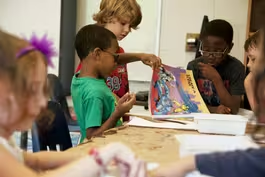
National Black Business Month supports Black business owners
Video has Closed Captions
Clip: S52 Ep35 | 9m 50s | Black Business Month focuses on more financing and networking opportunities in Detroit (9m 50s)
Providing Support for PBS.org
Learn Moreabout PBS online sponsorship
- News and Public Affairs

Top journalists deliver compelling original analysis of the hour's headlines.

- News and Public Affairs

FRONTLINE is investigative journalism that questions, explains and changes our world.












Support for PBS provided by:
American Black Journal is a local public television program presented by Detroit PBS