
The Black Church's role in civil rights activism today
Clip: Season 51 Episode 35 | 6m 49sVideo has Closed Captions
Detroit religious leaders discuss the Black Church’s role in the Civil Rights Movement.
In excerpts from a virtual town hall, New Destiny Christian Fellowship’s Rev. Horace Sheffield III talks about his father, community and labor leader Horace Sheffield Jr.’s significant role in the Detroit Walk to Freedom and how it influenced his own social activism. Plus, Henderson talks to Hopewell Church Senior Pastor Rev. Kenneth Pierce II about the next generation of civil rights leaders. Det
Problems playing video? | Closed Captioning Feedback
Problems playing video? | Closed Captioning Feedback
American Black Journal is a local public television program presented by Detroit PBS
The Black Church's role in civil rights activism today
Clip: Season 51 Episode 35 | 6m 49sVideo has Closed Captions
In excerpts from a virtual town hall, New Destiny Christian Fellowship’s Rev. Horace Sheffield III talks about his father, community and labor leader Horace Sheffield Jr.’s significant role in the Detroit Walk to Freedom and how it influenced his own social activism. Plus, Henderson talks to Hopewell Church Senior Pastor Rev. Kenneth Pierce II about the next generation of civil rights leaders. Det
Problems playing video? | Closed Captioning Feedback
How to Watch American Black Journal
American Black Journal is available to stream on pbs.org and the free PBS App, available on iPhone, Apple TV, Android TV, Android smartphones, Amazon Fire TV, Amazon Fire Tablet, Roku, Samsung Smart TV, and Vizio.
Providing Support for PBS.org
Learn Moreabout PBS online sponsorship- 2023 is also the 60th anniversary of the Detroit Walk to Freedom, which of course also featured Dr. Martin Luther King, and an early version of his "I Have A Dream" speech.
There was a reenactment of that march here in the streets of Detroit in the summer of 2023.
And "American Black Journal" held a town hall to talk about what's happened over the last 60 years, and about the work ahead.
Here are a few clips from that conversation.
You were a young boy when this march happened, and you attended the Walk to Freedom here in Detroit.
Take us back.
What do you remember about that day?
- Well, actually, you know, my exposure to civil rights movement began before that.
My dad took me everywhere.
You know, I've sat in on planning meetings for the March on Washington that was held in Washington, A. Philip Randolph, all those folks were people that I knew.
And because of my dad's work, and his exposure to violence and the unsafe conditions...
I mean, I lived the Civil Rights movement.
I mean, I was as much a, you know, a non-violent participant in that movement as anyone.
I mean, it was in the ethos of who I was.
So, for Dr. King to come to Detroit, where I had seen him else places, it's really resonated with me for a variety of reasons.
One, I was very familiar with restrictive covenants.
We grew up in a Jewish neighborhood, the only neighborhood where, you know, blacks could live pretty much at one point on the west side.
I knew about stress.
Well, not stress at that time, it was the Big Four.
And black Plymouth furries with, you know, machine guns in the back window.
So to me it was Dr. King coming to not only address what was going in the south, but also the experiences of discrimination, segregation, that we had experienced in the north.
- Reverend Pierce, Dr. King's leadership grows out of the church, and is rooted in the church throughout his life.
Talk about in a religious context today, the way you see that youth leadership stepping forward, and coming together maybe in the same way.
- Young people are beginning to speak up and step up.
In the church, I am proud to say that we're seeing more pastors begin to go back, to using the pulpit to speak to the injustices that we see, to encourage the people that the church is still the forefront, as it always has been, of the social justice movement.
I think Dr. King really encouraged us all through his history, and through what he fought for, and what he stood for.
That has pastors, we have more, more of our responsibility than just to encourage people, you know, part of the Bible, we talk about and pray about, pray to, and preach about a Jesus, a savior who was a fighter for the oppressed people.
And so we have that same responsibility, and Dr. King showed us that.
And I, and again, I'm proud to see that we are equipping and pouring into the generation and the church, as it relates to making sure the social justice still remains at the forefront, even in the church.
- Yeah.
Let's talk a little about Hopewell, and what you see there.
And in particular, what you see young people drawn to, in terms of the causes or the issues, or the challenges that we still face in our communities in Detroit.
What do you hear from them about what motivates this idea that things can be better, and they need to take the lead in making that happen?
- Absolutely.
I think we read more now, right?
We pay attention to what's going on in and around our communities.
And so I think when our generation, from what I hear from my congregants, when they see things going on in the community, when they see things going on around them, they are now triggered to talk, they're now triggered to speak up and fight, and fight in a respectful way, unless we have to fight other ways, right?
And so they are, they are encouraged, they are eager to see the things that our grandparents taught us, the things that history has showed us, to not see that blood sweat and tears go to default.
And so when I talk to some of our congregants, a lot of the, a lot of the injustices that we see, both directly in the community and higher up, it really triggers the fight that's within us.
And so, I'm excited about that.
I'm very excited about that, to see our generation not being quiet, and really standing up and sticking up for what we believe in.
- Talk about later that year, when your mother takes you with her to Washington, to see Dr. King again, and see him give basically the same speech that he gave here, but it's a much bigger stage.
There are way more people.
What was that like?
- That was also exciting.
Let me say, hearing Dr. King's voice, he captivated you regardless to your age.
So to hear him a second time, to participate in a march with, I couldn't tell that it was twice as many people, because I was, I'm only five feet tall now, so I'm sure I was about 4'10" then.
But it was just, you know, massive people all over.
The difference, though, with the Washington, DC march, it was, I'm sure 20 degrees hotter, hotter and humid.
But I arrived early.
And we went to the Washington march because Dr. King asked us in Detroit to come in and join he and others.
We didn't have the fear that something was gonna happen to us, we were gonna be hosed or anything like that.
But we knew that our courage came from a higher authority, so to speak, as Dr. King was a reverend to me, more than he was just a speaker.
Since most of his speeches always referenced scripture.
When you hear that kind of message, you get a different kind of encouragement, and certainly fearlessness.
People weren't afraid to die then.
I'm not afraid to die now, because there's a cause, there's a reason, there's a purpose that we have to fulfill.
- The Church of the Messiah on Detroit's east side, is celebrating the young activists in its congregation,
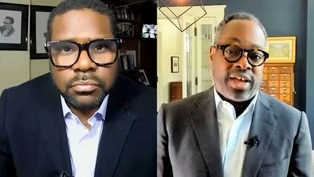
How the Black Church supported civil rights then and now
Video has Closed Captions
Clip: S51 Ep35 | 10m 13s | Rev. Charles Williams II discusses the 1963 March on Washington and civil rights today. (10m 13s)
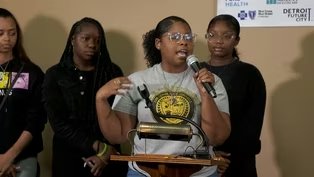
Peace & Prosperity Youth Action Movement promotes leadership
Video has Closed Captions
Clip: S51 Ep35 | 6m 52s | Peace & Prosperity Youth Action Movement promotes youth leadership at Neighborhoods Day. (6m 52s)
Providing Support for PBS.org
Learn Moreabout PBS online sponsorship
- News and Public Affairs

Top journalists deliver compelling original analysis of the hour's headlines.

- News and Public Affairs

FRONTLINE is investigative journalism that questions, explains and changes our world.












Support for PBS provided by:
American Black Journal is a local public television program presented by Detroit PBS