
Who Killed Vincent Chin?', Making Michigan Competitive
Season 6 Episode 35 | 26m 46sVideo has Closed Captions
Revisiting "Who Killed Vincent Chin?". Plus, a panel on making Michigan more competitive
It was June 19, 1982, when Chinese American Detroiter Vincent Chin was brutally beaten to death with a baseball bat outside of a nightclub in Highland Park. Nearly 40 years later, One Detroit revisits the documentary "Who Killed Vincent Chin?" with the filmmakers and Detroit Public TV. Plus, a conversation on making Michigan more competitive from the 2022 Mackinac Policy Conference.
Problems playing video? | Closed Captioning Feedback
Problems playing video? | Closed Captioning Feedback
One Detroit is a local public television program presented by Detroit PBS
Who Killed Vincent Chin?', Making Michigan Competitive
Season 6 Episode 35 | 26m 46sVideo has Closed Captions
It was June 19, 1982, when Chinese American Detroiter Vincent Chin was brutally beaten to death with a baseball bat outside of a nightclub in Highland Park. Nearly 40 years later, One Detroit revisits the documentary "Who Killed Vincent Chin?" with the filmmakers and Detroit Public TV. Plus, a conversation on making Michigan more competitive from the 2022 Mackinac Policy Conference.
Problems playing video? | Closed Captioning Feedback
How to Watch One Detroit
One Detroit is available to stream on pbs.org and the free PBS App, available on iPhone, Apple TV, Android TV, Android smartphones, Amazon Fire TV, Amazon Fire Tablet, Roku, Samsung Smart TV, and Vizio.
Providing Support for PBS.org
Learn Moreabout PBS online sponsorship- [Narrator] Just ahead on "One Detroit", a special report on Vincent Chin.
40 years after he was beaten to death in a hate crime that spurred a civil rights movement for Asian American justice and equality.
We'll talk with the filmmakers behind the Oscar-nominated documentary, "Who Killed Vincent Chin?".
Plus we'll revisit one of the important conversations on Mackinac Island about making Michigan more competitive for jobs and people.
It's all coming up next on "One Detroit".
- [Narrator] From Delta Faucets to Behr Paint.
Masco Corporation is proud to deliver products that enhance the way consumers all over the world experience and enjoy their living spaces.
Masco, serving Michigan communities since 1929.
Support for this program is provided by the Cynthia and Edsel Ford Fund for Journalism at Detroit Public TV, The Kresge Foundation.
- [Narrator] The DTE foundation is a proud sponsor of Detroit Public TV.
Among the state's largest foundations, committed to Michigan-focused giving.
We support organizations that are doing exceptional work in our state.
Visit DTE foundation.com to learn more.
- [Narrator] Nissan foundation and, viewers like you.
(tense electronic music) - [Narrator] Just ahead on this week's "One Detroit", Michigan leaders at the Detroit Regional Chambers 2022 Mackinac Policy Conference debated how to make the state more competitive.
The conversation focused on making Michigan an attractive place to live and work, and having an educated and trained workforce.
Coming up, we'll hear what business leaders said about the future of work and jobs in Michigan.
But first up, this month marks the 40th anniversary of the killing of Vincent Chin, a Chinese American who was brutally beaten with a baseball bat outside of a Highland Park club.
At the time, US auto makers were struggling due to a rise in the sale of Japanese imports, which also resulted in a rise anti-Asian sentiment.
Chin's attackers worked in the auto industry, and ultimately received no prison time.
A national PBS documentary titled "Who Killed Vincent Chin?"
told the story of his death and helped frame the Asian American experience.
Detroit Public TV co-produced the Academy Award nominated film with New York filmmakers, Christine Choy and Renee Tajima-Pena.
Local filmmaker Chien-an Yuan caught up with the two women and Detroit Public TV's executive producer at the time, Juanita Anderson, to talk about the making of the documentary.
- [Robert] Detroit, it's got the reputation murder capital of the world.
It's like, and I didn't even do it on purpose, you know, I didn't walk up and shoot somebody.
♪ Dip, dip, dip, dip, boom ♪ ♪ Sha, na, na, sha, na, na, na ♪ ♪ Da, da, doom, sha, na, na, sha, na, na, na ♪ ♪ Da, doom, sha, na, na, sha, na, na, na ♪ ♪ Da, doom, sha, na, na, sha, na, na, na ♪ - The murder happened in 1982 in June.
It was big news in the City of Detroit, particularly in light of the fact that Detroit was in a major recession at that time, the Japanese auto industry particularly was blamed for Detroit's woes.
- The American auto industry and its army have targeted Japan as a major source of its problems.
- We are being shot at and shot up by the Japanese, who have the most protectionist economy in the world.
(tense dramatic music) But some of those who hold up the specter of a trade war ignore is that we are already in the middle of such a war, but only the Japanese are shooting.
- Chrysler ultimately took a bailout during that period, though, the auto industry itself, and Detroit economically, because so many people relied on the auto industry was really in a bad time.
("1812 Overture, Op.
49" by Tchaikovsky) - But many of their verbal bullets aimed at the Japanese government and car makers have strayed off course and are hitting home instead.
- Vincent Chin's death attracted a lot of press attention, particularly in light of the fact that he was Asian American and there were auto workers who were implicated in his killing.
- I remember getting this mailing in snail mail.
This young man named Vincent Chin had been beaten to death with a baseball bat by two auto workers, Ron Ebens and Mike Nitz, and at this time they had pleaded guilty in state court to manslaughter and they would serve no time in jail, and the local Asian American community, particularly the Chinese American community was really up in arms, and so they wanted people all over the country in different Asian American communities to know about it.
- [Crowd] Justice for Vincent Chin!
Justice for Vincent Chin!
- [Reporter] The 11:30 rally began with a list of speakers nearly a page long waiting to add their personal support, and that of many organizations to the cause of justice for Vincent Chin.
- We ask that all of you who had been so supportive on the struggle for justice- - [Juanita] It really became clear that this was much bigger than a local story.
- [Man] And to sentence the- - [Juanita] I just felt that this was a national story that deserved to be developed.
- I think anybody who takes the time to go over the facts of this case and to read what people who were witnesses there, anybody who takes the time to look at that, I think, can only conclude that there was racial motivation in this killing.
- As the Attorney General's office began to investigate, we realized that there was the potential of it being the first civil rights case involving Asian Americans, which made it an even bigger national story.
- [Reporter] Nitz and Ebens were both charged with killing Vincent Chin.
I spoke with some of his neighbors, asked for reaction.
- They're really good people and it could happen to anybody, you know, it could happen- - [Juanita] As there was this tremendous surge in news coverage, particularly in Detroit, but also nationally.
There was very little effort to get the perspectives of the Asian American community outside of press conferences or the protests that were covered.
(Lily speaking in a foreign language) - [Juanita] Nobody really attempted to talk to members of the Asian American community or Vincent Chin's family at all.
(Lily speaking in a foreign language) (slow traditional music) - So the Vincent Chin film was an idea until Detroit Public TV got involved.
Bob Larson was the president of Detroit Public TV.
Juanita shot the idea to Bob.
He wanted to take it on, like they were local in Detroit, they knew all about the case, and they said, "Yeah, let's do it."
You know, it was kind of like a dream come true.
(uptempo rock music) (plane engine roaring) ♪ Summer and sun, riding high ♪ ♪ Winter nights, warm and dry ♪ - [Juanita] The Corporation for Public Broadcasting had a growing track record, I should say, of funding Black and Brown and Indigenous people for cultural affairs programs, but something that was a contemporary, what they considered a public affairs social issue, they had not really funded People of Color and certainly not women.
So what happened was our proposal was put aside to see if they could find us a mentor in a new Minority Mentorship Program that they were developing.
Now, mind you, one of us had a degree in journalism from the University of Michigan.
A second person had attended Harvard.
A third had attended Columbia.
All of us had done work before that had made it to national television in one way, shape or form so it was sort of peculiar to us that our credentials were being questioned.
- So CPB assigned a story consultant white boy from (stammers) WGBH Boston to supervise me (laughs) to, quote, the objectivity, can you believe this?
- And he was supposed to be kind of like our overseer, and Bob and Juanita said, "Don't worry, we'll take care of him.
You guys just make the film."
(uptempo piano music) (woman singing in a foreign language) They just believe that if you have a vision for a film, a filmmaker has to be free to pursue that vision.
(uptempo piano music) (woman singing in a foreign language) So we were a very small crew.
There was Chris and I, Nancy Tong, our associate producer, and camera person, sometimes an assistant camera, but generally just a sound person as well, and we just all worked as one unit.
Nancy and I did all of the interviews.
(Lily speaking in a foreign language) (food sizzling) - [Woman] Next thing I know while the other girls out dancing, we hear boom, boom, boom, boom, you know?
And we run to the stage to see what's happening, she's coming off the stage, you know?
We go, "What's up?"
When I look out and I see guys are fighting out there in the club.
- What if we'd have had an accident prior to it?
What if we'd have went to the ball game?
And there was 10,000 what-ifs I've asked myself.
And it's just like this was preordained to be I guess, it just happened.
- One of the things about documentary in general and I think successful documentaries is that the producers and directors have to build trust.
Whoever's doing the interviewing has to build in a sense of trust, and maintain that trust with their subject whether they're protagonist, antagonist, or what.
- I was talking to Jimmy on my left, Vincent was on my right.
- [Juanita] And Renee was really tremendous at doing that.
- And that's when I turned, and saw who Vincent was talking to, a man I later found out was Ronald Ebens.
And I put my hand on Vincent's arm to kind of calm him down.
- I came around the bar and all I saw was that Mr. Ebens was yelling at Vincent Chin.
And the next thing you know, Vincent got up, walked around, and hit Mr. Ebens.
- And he come around, and sucker punched me, and that was the start of it all right there.
- [Juanita] She had a sense of integrity.
She would ask the hard questions, but very calmly.
I mean, it's part of the demeanor, you're listening to these stories.
But one of the techniques that she used that became very powerful was really simply listening.
So you ask a question.
- Well, I often wondered who the ACJ was, because every time a different program came on, a different month of the year came up there was a different president.
- [Juanita] It gets answered, and you wait, and see if there's more, and sure enough, there's more.
- I personally think that a lot of 'em used it for their own vehicles just to get ahead.
Secondly, they used it to promote the Asian American, and their alleged plight in this country which I am not aware of that they have a plight, 'cause I know very few Asians, very few.
And the ones that I do know have always been really nice people, in fact, we used to help an Asian kid at school.
- Getting him on camera was so important.
It was like if you're a journalist or a filmmaker, you wanna talk to people who are directly involved, but in this kind of case, I mean Ron Ebens was like at the center of the story, or one of the people at the center of the story.
So I wanted to talk to him.
- Well, to be quite honest, I expected to go to jail.
I pleaded guilty to manslaughter on that.
I did just like anybody else, I went to take my licks, I thought sure I would go to jail.
- Now, one guy, older guy, was checking the young guy's head, 'cause blood was running down his face, and went over to see if they needed help.
They said they needed some help, and they was gonna offer me $20 to catch these Chinese guys that they got into it with.
So we got into their car.
- Pretty quickly I thought it would be sort of a "Rashomon" kind of story.
It's this idea that in "Rashomon," there was a rape in the forest, and you have all these witnesses, but they all interpret what they saw in a different way, and I thought in a hate crime, particularly in this case, if you listen to the different witnesses it was very similar.
They might have been in the Fancy Pants, or they might have been with Ron and Mike as they looked for Vincent, or could have been with Vincent as he left the Fancy Pants.
People might have been witnesses at the McDonald's when Vincent was being beaten to death by Ron and Mike, people had a different interpretation of what was going on inside the heads of Ron, and Mike, and Vincent, and specifically, was it an act of racial animus?
Was it a hate crime?
- I never even got a chance to stand up.
Never seen it coming, and that's the way the whole thing started.
- I identify myself as a police officer, I showed him my badge and a ID card.
I had my weapon drawn.
I asked him to drop the baseball bat.
- He hesitated, at which time, he eventually dropped the baseball bat.
But at that particular time, the damage had been done.
- When we pulled up, we found there was an Oriental gentleman.
His skull was obviously fractured.
There was brains laying on the street, and Chin was obviously in a fatal condition.
He wasn't dead yet, semi-conscious, but you know, from my experience of being the street for so long, the man was a goner.
(counter beeping) - The structure of "Who Killed Vincent Chin?"
is definitely non-linear.
I would say it is rather experimental.
(tense electronic music) I would say almost like experimental music, okay?
Like Laurie Anderson, you know like avant garde way.
You play a note, (Christine humming) then you play the second note second time, (Christine humming) then you play the same note, (Christine humming) okay?
It's that kind structure, every time it's adding new information, after you're repeating the old information.
(uptempo march music) - To change your image of Asian people, our image of passiveness, able to sit, just do nothing, to accept whatever is coming to us.
We decide it's time to stand up for our rights.
- I don't think it is such a thing called objectivity.
Journalism stress objectivity, but emotion is not objective, very subjective.
What are the emotion, sadness, happiness?
You know, despair, terrified?
Film is composed of that emotion.
Once you're able to reach the emotion of your spectator, then logic will come through.
It doesn't go other way, not the logic first.
Once you have logic, there is no emotion, and it would not be very successful.
What I learned about Vincent Chin is every time I screen the film, I never seen anyone stood up, and leaving the room, because every single minute is emotional.
- [Interpreter] It seems that Mrs. Chin is having some difficulties speaking.
I think what she had said at the beginning was the court failed the first time.
It seemed like the second time the court fails again, to speak, maybe will fuel questions.
- I would hope people use that footage as a historic document, and young filmmakers will take it and create something new because things have changed, history has changed.
I mean, I think that we can't look at the Vincent Chin case through the same lens as the 1980s we have to look at it through 2022, or in 10 years, in 2030, like how things have changed.
- Please, I want everybody (tense dramatic music) tell the government to not to drop this case.
I want justice for Vincent (sobs).
- Wen Ho Lee was accused as spy, and I made a short film about him, and I went to interview his lawyer.
He thanked me, he said, because your film, I became a criminal lawyer.
Yeah, that's really satisfying to hear that good things actually come out of it.
- [Interviewer] Do you think this trial would've occurred had not your group and other Asian Americans gotten involved and brought pressure to the AU and around the country?
- I don't think any civil rights trial occurs unless there's pressure.
- [Juanita] All of us, people of color there's still issues with racial profiling, there's still issues with scapegoating, there are issues clearly of the justice system, and I think that we have a responsibility to each other to know each other's history.
- [Narrator] You can see the documentary, "Who Killed Vincent Chin?"
on Detroit Public Television on June 20th at 10:00 PM.
Plus we hope you'll join Detroit Public TV, the City of Detroit, and several other organizations for four days of local and national events commemorating the 40th anniversary of Vincent Chin's death.
The remembrance and rededication takes place June 16th through to 19th, and includes a film series and national conversation.
Get the full list of events at onedetroitpbs.org/vincentchin.
Turning now to this year's Detroit Regional Chamber Mackinac Policy Conference, one of the sessions focused on making Michigan more competitive in the national and global race to attract jobs and people.
(uptempo cheery music) - From your perspective, Doug, is Michigan competitive and if not, why not?
- So I think we have a larger role to play particularly in the new jobs, the new economy of technology innovation, so forth, than we actually get credit for.
Right, people don't generally think in tech of Michigan especially as a growth state, I think it's evidenced by the fact that we have not actually grown, our population, and so forth, but another thing to actually think of auto actually as a tech industry, which it actually is.
The big challenge though is that is the World Economic Forum they just had a port on the future of jobs.
There's 75 million jobs that will be displaced by technology with 133 million new jobs being created that are digital, and we have to fight harder for the jobs that remain in manufacturing.
Our manufacturing levels are back up, but with a third less jobs, and in some cases, like an EV as many of you know, it takes 30% less labor to actually develop.
So we have to fight harder for not just the jobs that we have but for the jobs of the future.
And those really are driven by technology innovation.
- We have to worry about K-12.
And when you look at where we stand in the state of Michigan, let's not go global right now, let's just stay in the United States of America.
We are 33rd in the eighth grade math scores.
39th in fourth grade reading.
We're 41st in high school graduation.
We have to invest in our children for the jobs of the future, and we have to have them graduate, and want and give them a path for jobs that will be available.
But people aren't gonna come to this state when they look at those statistics, and they don't have the talent here.
- As a relatively new transplant to Michigan, I had never thought about coming to Michigan for tourism, or livelihood prior to coming, and I came for a job and I'm still here six years later, and I love it, and I'm here on stage.
So thank you for having me, but the thing that we are missing is there's not a one-size-fits-all solution, right?
There's many different populations of talent.
Some of whom come here for two or four years for university, and then some of whom leave, people that grew up here, and went through the K-12 school system, and then moved along, or others like Doug and I, that grew up somewhere else and would stay.
So you can't have a one-size-fits-all solution, but people want a lot of the same things.
They wanna have a good life, they wanna have a good job, they wanna have mobility.
they want leisure activities, and those are things that we have parts of, but we need to create a vision of the life that they could have that enables them to come join us.
- We've got a long way to go.
Jeff Donofrio at lunch, talked about where is our common shared vision of where our economy's going, what our industry needs, and how are we mapping to that, right?
How are we mapping the skills of tomorrow that are industry of tomorrow, where we have competitive advantages?
What are we mapping to that, right?
How do we ensure that A, we make the state more attractive for especially young, talented people, and how do we then communicate that to people?
And then, and then finally the sense of urgency, and all of our friend, John Rakolta, has really been pushing on this, which is we need a sense of urgency, we need action, not soon but sooner than soon, and he's talking about a commission, and maybe that's the right idea, but whatever we need to do, we need to do something robustly, we need to do something big, and we need to do it quickly, and it needs to be in a bipartisan way.
- So I'm grateful to be sitting on stage with leaders like this, being here at a conflab, we have some of the best minds globally that are thinking about how to change the marketplace whether it's healthcare, whether it's research, chemicals, financial services, mobility, you name it.
So gratitude is to seek for more, so we can't lose perspective on what we have.
The second thing are two things that my dad told me, you have to be your own best critic, you have to be relentlessly objective but you also be your own best cheerleader.
We are very good at being the critic, we must celebrate what we have here.
- [Narrator] And you can watch the Mackinac Policy Conference sessions along with onsite interviews by "One Detroit" founding managing editor, Christie McDonald, at onedetroitpbs.org.
That will do it for this week's "One Detroit".
Thanks for watching.
Make sure to come back for "One Detroit Arts And Culture" on Mondays at 7:30 PM.
Head to the "One Detroit" website for all the stories we're working on.
Follow us on social media and sign up for our weekly newsletter.
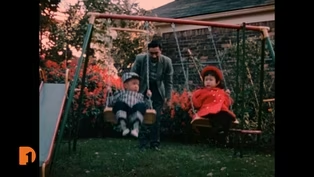
Revisiting 'Who Killed Vincent Chin?', AAPI Civil Rights
Video has Closed Captions
Clip: S6 Ep35 | 17m 19s | Revisiting the "Who Killed Vincent Chin?" film and Asian American civil rights. (17m 19s)
Providing Support for PBS.org
Learn Moreabout PBS online sponsorship
- News and Public Affairs

Top journalists deliver compelling original analysis of the hour's headlines.

- News and Public Affairs

FRONTLINE is investigative journalism that questions, explains and changes our world.












Support for PBS provided by:
One Detroit is a local public television program presented by Detroit PBS