
The Block
Clip: Season 23 Episode 15 | 8m 53sVideo has Closed Captions
Explore the Block in Asheville, a hub of Black culture, history and creativity.
Explore the Block in Asheville, a hub of Black culture, history and creativity. Once the center of Black business and community life, this district is home to landmarks like the YMI Cultural Center, Noir Collective AVL and the Asheville Black Cultural Heritage Trail.
Problems playing video? | Closed Captioning Feedback
Problems playing video? | Closed Captioning Feedback
North Carolina Weekend is a local public television program presented by PBS NC
The Block
Clip: Season 23 Episode 15 | 8m 53sVideo has Closed Captions
Explore the Block in Asheville, a hub of Black culture, history and creativity. Once the center of Black business and community life, this district is home to landmarks like the YMI Cultural Center, Noir Collective AVL and the Asheville Black Cultural Heritage Trail.
Problems playing video? | Closed Captioning Feedback
How to Watch North Carolina Weekend
North Carolina Weekend is available to stream on pbs.org and the free PBS App, available on iPhone, Apple TV, Android TV, Android smartphones, Amazon Fire TV, Amazon Fire Tablet, Roku, Samsung Smart TV, and Vizio.
Providing Support for PBS.org
Learn Moreabout PBS online sponsorshipI'm in downtown Asheville with Kirby Gibson, the producer of our next story, which is about Asheville's historic black business district.
Kirby, what was it like covering that story?
- Oh, it was fantastic.
My favorite part was just getting to meet all the amazing people.
We met up with Larry at the Foundry, Alexandria at the Noir Collective, Reverend Sean at the YMI, and I learned so much from all of them, just about not only the block, but about Asheville as a whole.
And so it was very, very exciting.
- Wow, and did you learn a lot about the black history here in Asheville?
- I did, so much.
As someone who's actually lived here for many years, I still did not have this information.
And so I was very grateful for the opportunity, and I even got a private drum lesson in there as well.
- Oh, I can't wait to see and show our viewers.
Take a look.
(upbeat music) - Oh, wow, yeah, this was awesome.
- This is one of my favorites.
- Yeah.
- The eyes are really captivating.
- Really breaks through, yeah.
My name is Kirby Gibson.
Welcome to the block, Asheville's historic black business district.
Once upon a time, this was the thriving epicenter of black Asheville, home to doctors, lawyers, cultural institutes, and more.
The block has changed a lot since its heyday, with urban renewal and gentrification hitting this area hard over the decades.
But it's experienced a bit of a renaissance in recent years, and we're here to check it out.
We are kicking off our day in the beautiful Foundry Hotel, a place emblematic of new life coming into this historic part of town.
A building that was once the Asheville Supply and Foundry Company, a major industrial steel mill in Asheville, which helped form the foundation of the city in an area steeped in black history.
- I'm Larry Crosby, General Manager of the Foundry Hotel, a curio collection by Hilton in downtown Asheville, located in the historic neighborhood of the block.
1915, 1920 are the dates of our buildings.
We did an adaptive reuse project, repurposing these buildings into the wonderful hotel you see today.
What's really unique about it is that each building has a story of its own.
The room that we're in, the workshop lounge, the old carriage and woodworking factory, building A, where we have our restaurant.
We've made concerted efforts in our restaurant and our cuisine to be able to highlight historic traditions through food in the neighborhood.
The Foundry itself kind of represents a return to lodging to this neighborhood.
There is this revitalization of the neighborhood that we're excited to be a part of.
- The earliest memories would go back to 1936, when my parents brought me and my brother and sister to their first restaurant on Eagle Street.
So my father and mother were responsible for the funding and disbursements.
This was in order to help the black businesses develop further and give them some capital in any event they needed.
The block was the beginning and end, the mix of businesses.
For that type of transition to happen, business-wise, black people.
Sure, we had all the other businesses.
They were good, but this was all brand new.
- On today's exploration, we'll get our start at the YMI Cultural Center, formerly the Young Men's Institute, one of the oldest, most significant historical landmarks in the United States, dedicated to African-American heritage.
- The YMI Cultural Center was built originally as kind of an offshoot of the Young Men's Christian Association, which we know as YMCA.
It was called the Young Men's Institute because in its day, it would have been the segregated space.
Founded in the Gilded Age and the Reconstruction Age.
So our building, the YMI, is older than the NAACP.
It's older than the Urban League.
It's older than most black colleges and older than every NPHC organization, which we call the Divine Nine.
Has just undergone a $6 million renovation.
There's been a lot of effort by lots of parties to help make sure that this area is not forgotten, but also continues to share the history and the legacy of our community.
- As you stroll through the block, you'll notice markers for the Asheville Black Cultural Heritage Trail.
This walk through history celebrates the dignity, humanity, and agency of black people.
- So the Asheville Black Heritage Cultural Trail was a idea that grew out of the brainchild of Catherine Mitchell.
She wanted to have a project that recognized and celebrated the resiliency of the black community in Asheville.
But we really wanted to focus on things around education, the civil rights movement, around black businesses that were a part of Eagle Market Street and Asheville in general, as well as historical figures.
I would say it's the history of the block that makes it so one of those stops that you just have to see.
And when you look at urban renewal and how many of those businesses were displaced, as well as the homes that were around the block area, it becomes a really important part of our history here in the Asheville area.
And so not stopping in the block, you're not getting the full story of the rich history of Asheville.
- Next up, we are headed to a place that is unapologetically B-L-A-C-K, black, which stands for Black Liberation Through Arts, Culture, and Knowledge.
I gotta check that out.
- This place, while it carries 23 different vendors, wares, and the things that they're creating, we've got folks who are coming in from out of town that visit this spot, and magic happens.
So you got the locals, you got people who are visiting, and they wanna talk, they wanna gather, they wanna know the history and where black people are.
And they're here, they're here in this space.
And we need people to recognize and to participate and to make decisions that make sense for building a black cultural arts district.
NOR Collective is inextricably tied to YMI Cultural Center.
We chose to be here because we believe in black art and black enterprise.
So we're about building that.
And I'd like for our city to participate in making decisions that make sense for the people who live and breathe and work here and who are building up the block.
- Our next stop as we tour the block takes us to the headquarters of an international arts organization with a hands-on feast for the eyes and ears.
Get ready to have some fun.
(upbeat music) - Our brand and what we do here is to bring a piece of authenticity to your experience in the place that you visit.
Asheville, known for its cultural arts, its galleries, its music, its food scene, and its people, we embody that here in the block.
We want this to be a place for everyone and we welcome everyone to come here.
- We would love for people to come to Asheville, North Carolina, because we've got an overall city that there's something good for everybody that come here.
- It's a great adventure for a person to come here and witness all those beautiful artists in the area.
So come to Asheville, meet new friends, get a new experience that you can take back home and spread out to other people.
- As Asheville continues to create a new version of itself post-Halleen, I think that it has to remind itself of the past but not get stuck in where it was.
I'm hoping that we can see the block and the YMI as places to celebrate but also places to remember.
- I would say that you really have to come and you have to experience it.
One of the things that we discussed was that we wanted to look at the past but look forward to the future of the foundation that we are now standing on the shoulders of our elders.
(upbeat music) - For hundreds of years, Black people have lived, worked, created, innovated and celebrated in Asheville.
For about 130 of those years, the block has been at the heart of it all.
It's a lot different today than it was at the beginning but the story continues and it's a story you can participate in.
So get to Asheville and get to the block.
(upbeat music) - The block neighborhood is located in downtown Asheville.
To find a map with all the featured locations and their hours, head to visittheblock.com.
 New
NewVideo has Closed Captions
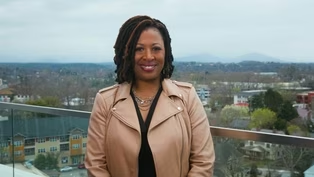
Clip: S23 Ep15 | 4m 35s | Taste bold biscuit creations at Main Chick Jammin’ Biscuits in downtown Hickory. (4m 35s)
 New
NewVideo has Closed Captions
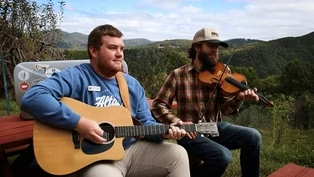
Clip: S23 Ep15 | 5m 3s | Visit the Orchard at Altapass along the Blue Ridge Parkway, where mountain heritage comes to life. (5m 3s)
 New
NewVideo has Closed Captions
Preview: S23 Ep15 | 29s | Experience the charm, flavors and history of North Carolina’s mountains. (29s)
Providing Support for PBS.org
Learn Moreabout PBS online sponsorship












Support for PBS provided by:
North Carolina Weekend is a local public television program presented by PBS NC