
The Bridge Food and Diaper Bank
Season 12 Episode 7 | 26m 48sVideo has Closed Captions
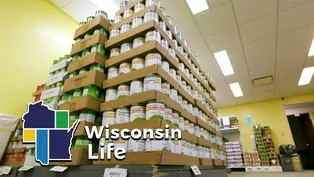
Discover how The Bridge Food and Diaper Bank supports families in Walworth County.
The Bridge Food and Diaper Bank supports Walworth County with fresh produce, diapers and necessities. Host Angela Fitzgerald joins volunteers at the nonprofit as they package supplies to help fight food insecurity in their community. Then, visit a free pet food pantry run out of a garage and a bench bringing people together in Castle Rock.
Problems playing video? | Closed Captioning Feedback
Problems playing video? | Closed Captioning Feedback
Wisconsin Life is a local public television program presented by PBS Wisconsin
Funding for Wisconsin Life is provided by the Wooden Nickel Fund, Mary and Lowell Peterson, A.C.V. and Mary Elston Family, Leon Price & Lily Postel, Stanley J. Cottrill Fund, UW...
The Bridge Food and Diaper Bank
Season 12 Episode 7 | 26m 48sVideo has Closed Captions
The Bridge Food and Diaper Bank supports Walworth County with fresh produce, diapers and necessities. Host Angela Fitzgerald joins volunteers at the nonprofit as they package supplies to help fight food insecurity in their community. Then, visit a free pet food pantry run out of a garage and a bench bringing people together in Castle Rock.
Problems playing video? | Closed Captioning Feedback
How to Watch Wisconsin Life
Wisconsin Life is available to stream on pbs.org and the free PBS App, available on iPhone, Apple TV, Android TV, Android smartphones, Amazon Fire TV, Amazon Fire Tablet, Roku, Samsung Smart TV, and Vizio.
Providing Support for PBS.org
Learn Moreabout PBS online sponsorship- Announcer: The following program is a PBS Wisconsin original production.
- Angela Fitzgerald: Coming up on Wisconsin Life: [dog barks] We visit a food pantry for pups in Milwaukee.
- Who's that?
Is that Miss Roxz?
- Angela: A Castle Rock bench with a story to tell, a Rhinelander weaver honoring women and water, and... - Then you go to main course... - Angela: ...a restaurant owner sharing his journey from Tanzania to Stoughton.
That's all ahead on Wisconsin Life.
[knife chops] [bright music] - Announcer: Funding for Wisconsin Life is provided by: the Wooden Nickel Fund, Mary and Lowell Peterson, the A.C.V.
and Mary Elston Family, the Stanley J. Cottrill Fund, UW Health, donors to the Focus Fund for Wisconsin Programs, and Friends of PBS Wisconsin.
[cart thumps] [upbeat acoustic music] - Hello, and welcome to Wisconsin Life.
I'm Angela Fitzgerald.
I'm joining the volunteers at The Bridge Food and Diaper Bank as they prepare to welcome guests visiting the pantry.
Set back just off I-43 in Elkhorn, the organization serves local residents and supplies other food pantries in Walworth County.
[upbeat music] On Thursday evenings and Friday mornings, The Bridge invites county residents to come once a month to receive fresh produce, meats, and canned goods.
It all started with local Boy Scouts pulling wagons of food, and kept growing into the robust nonprofit it is today.
Serving families and supplying other local pantries, impacting this community where The Bridge says 30% of the county faces food insecurity.
It all runs smoothly with the help of a dedicated group of volunteers fulfilling the nonprofit's motto of "Neighbors helping neighbors."
We'll sample more of the programming and volunteer work happening here after we head out around the state.
We journey to Castle Rock, where a beloved bench has a reputation for bringing people together.
[gentle music] Every journey starts somewhere, and this one begins right here.
Locals call it Lookout Point, but to Brian Johnsrud, it goes by a different name.
- Brian Johnsrud: It's home.
Every time I'm there, I get that feeling, you know, the connection.
- Angela: For over 50 years, this spot in the town of Castle Rock, Wisconsin, has brought people together.
That's exactly what Brian's dad had in mind when he created it: a peaceful place to sit, reflect, and connect.
- So, my father knew that it was a special place.
So, he put the first set of railings up there when he was probably in his 20s, I believe.
- Angela: Eventually, Brian's dad added a mailbox with a notebook and pen tucked inside, inviting visitors to leave a note, share a memory, or simply say hello.
- Brian: It's just so peaceful.
- Angela: Like the trees holding up the old fence his dad built, this is where Brian's first love took root.
- Brian: I was young, in high school.
The girl I was dating, she was part of this community, and we dated off and on for three years in high school.
And as youngsters, we would go up and spend time and sit up there and just watch the world flow by.
[water rushes] - Angela: After high school, they parted ways, as young people often do.
But soon, another couple would embark on their own journey.
- Troy Larson: When I decided to ask her to marry me, I thought, "Where can I go with her?"
And that she would not, you know, so-called know what I was doing.
And I said, "Let's go for a ride."
And this is where we ended up.
- Angela: Troy and Leslie Larson's next ride led them to the altar, but the memories of where it began still fuel their way forward.
- Leslie Larson: It's just special.
It's a place we bring friends and family when they come to visit, and just to enjoy the view.
- Angela: Love's not the only thing folks have been searching for around here.
That first notebook Brian's dad left behind?
It filled up.
Then another.
And another.
Over the years, visitors from across Wisconsin and beyond have poured their thoughts, memories, and stories into those pages.
- Jim Tollefson: Most everything in there is somehow related to beauty.
- Angela: Today, Brian's cousin Jim Tollefson and the Castle Rock Lutheran Church help care for the space.
The church organizes monthly cleanups, keeping the area tidy and welcoming.
And yes, there's still a mailbox.
Still notebooks.
Still space to leave your mark.
- I've seen people just sitting here all by themselves.
They come up and reminisce.
- Angela: Remember Brian's high school sweetheart?
Her name's Sherry, and it turns out, their journey wasn't over at all.
- Sherry: I just never suspected that that would happen.
- Angela: They reconnected over social media after several decades apart.
- And we communicated back and forth for literally over seven months.
[messages blip] - Sherry: And then one day, he asked if I wanted to go for a drive.
And that is exactly where we went.
- We sat down there, sat together side by side, looking out over the valley.
I'm getting goosebumps as I talk about this because it was like all the years melted away.
And we were those young children again, and we've been together ever since.
[gentle music] - Angela: Brian and Sherry got married in a familiar church.
You can probably guess where they took their wedding photos.
It was a fitting moment, and one Brian's niece would emulate herself years later.
- They decided they wanted to have their wedding here in Castle Rock, and I officiated the wedding.
And it was great, you know, that we were able to grab a little bit of the past and bring it back.
[gentle music] - Angela: The best journeys in life aren't always clear from the start.
But if you keep a lookout for the right messages, they might just point you in the direction it's meant to go.
- That's kind of the gist of it, I guess.
There's probably a lot of places like this in the state of Wisconsin, you know, but this is our little one here that we're proud of.
Just here for everybody to enjoy.
[chuckles] [gentle music] [water rushes] - Angela: Next up, we visit a different kind of food pantry in Milwaukee, one that runs out of a garage and serves paws instead of people.
[birds chirp] Like most dog owners, Vicky Van Lare is paid in big, wet kisses.
- Vicky Van Lare: Thank you, thank you.
- Angela: Roxz is her special needs pitbull terrier.
- Who's that?
Is that Miss Roxz?
- Angela: Roxz is also the face of a Milwaukee charity that helps people and pets get through difficult times.
- Is that the blue box?
Oh, goodness, the blue box is here!
Does that mean more donations?
Is that more donations for you?
[Roxz barks] This is all dog and cat mixed in here.
It's freeze-dried food.
The goal is to not have so many animals in the shelters because the people cannot afford pet food.
That's my ultimate goal.
- Angela: Besides her garage, the Free Pet Pantry has taken over Vicky's basement.
- All right, hi, Roxz.
We're gonna go down.
We gotta go help some people.
We will see lots of supplies in our basement.
Over here, we have all of our collars, leashes, and harnesses.
Extra box of toys.
So over here, we have a lot of wet food.
Extra litter.
We even have, like, little blankets for cats.
- Angela: Vicky's heart is full, and so is her house.
- When we bought this house, it was never in our dream or imagination to ever run this big, huge pet pantry.
- Angela: Vicky is a dog mom to four large pups.
- Vicky: You'll get to meet Roxz and Bruno and her other friends, Ty and Jasmine.
Treats, come on, Ty.
Come on, let's get treats.
Come on, treat time!
Yay!
Ty is our very first rescue.
He came from a high-kill shelter in Alabama.
Jasmine is a purebred red heeler.
She's kind of the queen of the house.
[laughs] Roxz is, obviously, the face behind Roxz's Resources & Awareness.
She's a spunky, spicy little girl.
And then Bruno, or AKA, the house hippo.
He is a foster fail.
His expressions are priceless.
[laughs] - Angela: Her four-legged friends helped Vicky get through the pandemic, with a lot of soul-searching.
- I volunteered for a rescue that is no longer in town.
COVID pretty much took them away, and it was really sad.
Never imagined this, but I knew the need, and I decided to take on it myself and do it.
We have fed 645 families.
In a month, we're probably going through about 1,000 pounds of food and 200 pounds of cat litter.
It all depends on what the need is that month.
- Angela: Starting the charity and the constant search for food could be overwhelming.
- Vicky: There were some days that I've struggled, I've cried.
Yes, I had a bad day today, but I got my big girl panties on.
Watch out, world, because here I come!
[laughs] - Angela: That's where the second part of Vicky's passion comes into play.
Her quest to destigmatize pitbull breeds.
- Vicky: Come here, let's get your harness on.
We are a group that goes out and educates people on pitbull-type dogs.
They are not born evil.
They are very loveable.
Come on!
Good boy.
People make them evil.
People treat them to fight.
Rescues are picking up that mess.
Shelters are picking up that mess.
We're tired.
We are beyond tired of picking up other people's messes.
- Angela: The task may be tiring, but Vicky's passion for Roxz's Resources & Awareness endures.
- Vicky: They need the help, they need the help.
They leave my house in tears.
Then I end up in tears.
So I've learned to have Kleenex in my garage.
[laughs] I just really feel that's what I was called to do, to help animals.
It was just always my passion, and just to stay with them to the end.
Just you and I. What do you say?
Yeah?
You wanna stay?
- We're at The Bridge Food and Diaper Bank in Walworth County, finding out what it takes to run this finely-tuned operation.
[upbeat music] I began by chatting with Executive Director Tammy Dunn.
- Tammy Dunn: The Bridge Food and Diaper Bank, we're a food pantry, so we're helping about 500 households every month that are facing food insecurity.
We also help them with diapers, incontinence products, period supplies.
So we really take that edge off.
And then as a food bank, we're also helping about a dozen other pantries throughout the county.
- Absolutley, your footprint extends beyond your physical space and into, like you said, the other food banks that you support as well.
- Tammy: The face of hunger, it is not what people think.
It happens everywhere.
I think what people are always surprised about is that only 2% of our guests come every month.
So, you know, they come when they need us and we're here for them when they need us.
- It sounds like, just based on the number of volunteers that you have, that they really are like a lifeline for your organization.
- Yeah, they are.
I mean, when you think about the fact that we will move 500,000 pounds of food valued at a couple million dollars through this building every year.
There's just so much joy and laughter in this building when they're helping people.
- And that's important when you think about the work here, the care, the dignity that's preserved for people who may feel uncomfortable, as you mentioned, coming in, seeking help.
- Tammy: It really is neighbors helping neighbors.
They show up every week, and they are just this well-oiled machine.
- Angela: A machine so well-oiled, I jumped right in to help.
Hi, Marian, nice to meet you too.
Very nice.
Okay.
- Volunteer: All right.
That's it.
- Awesome.
Well, thank you all.
- Oh, absolutely.
- Angela: All to support guests visiting The Bridge, like Valerie Rohde, whose family started coming here after their business fell on tough times and closed.
- Valerie Rhode: We found ourselves at the point where we had just tried to do it so much on our own, and we just needed help.
So, that's kind of how we landed here.
We just kind of were able to find the bank, and we're so grateful to come and just have their help.
- And what has that meant for you and your family?
- Just the kindness and the respect and the, just the love.
It's obviously helped my kiddos.
Just being able to have a place where there is love and support in a time where we, you know, didn't expect to need it.
I guess important for us is that we felt, again, like we belong here and we weren't, you know, looked down upon.
They truly just came alongside to help.
And we've been able to also share with others in similar situations who needed help.
- I love that.
Can I hug you?
- Yeah, absolutely!
- Thank you so much.
- Yeah, absolutely.
- Angela: Neighbors helping neighbors, here at The Bridge.
[upbeat music] We now head to Rhinelander to meet a weaver honoring women and the water they work to protect.
[gentle music] - Mary Burns: I have a very deep-seated love of water.
I just feel really blessed to live along the Manitowish River.
I'm Mary Burns.
I am a fiber artist.
I love to weave.
I've been a weaver since I was 17.
When I'm at the loom, it feels like a spiritual experience.
It's really deep within me.
It's something I probably couldn't live without.
[river rushing] Without water, none of us would be here.
I saw that women across the world were doing wonderful work advocating for water and not getting the recognition that they deserve.
It was time for an exhibit to honor these women.
We have 29 portraits.
Scientists, oceanographers, activists, Native American water walkers.
Grandmother Josephine Mandamin-ba walked around each of the Great Lakes.
She walked the length of the Mississippi.
She was an amazing voice for water and for women.
Through this high-tech Jacquard weaving, I can tell more stories.
I can put so much detail into these weavings that you can look at Rachel Carson and you know that's Rachel Carson.
I start with a combination of photographs and drawing, and I simplify it because I can't weave the thousands of shades that are in a photograph.
And I wouldn't want to.
I mean, I want this to be an interpretation.
So this would be the lightest value here.
In her hair here, it's the darkest value.
When Nafisa Barot from Gujarat, India, witnessed people dying from lack of water.
And it was so appalling to her, as it would be to anybody, but she took action.
Monica Lewis-Patrick is considered the water warrior of Detroit.
The cost of water was going up astronomically.
People were having their water shut off, and she organized to fight that.
And they're still working to make it a right for people to have access to fresh drinking water.
Some of these women are so brave.
I mean, it just humbles me what some of these women have done.
In Honduras, Berta Cáceres organized peaceful protests to safeguard sacred waterways.
They murdered her.
In Honduras, over 100 environmental activists were murdered.
In her weaving, I depict her with her mother.
Because her mother was her greatest inspiration.
They worked to bring international pressure to bear.
Well, they were able to stop the dam.
I've been getting wonderful response.
A lot of emotional response.
People are very touched by the women and their stories.
It's important for people to see that everyday people can make a difference.
The stories of these women should help people start to take those steps.
[gentle music] - Angela: Our last story gives us a taste of Africa in Stoughton, as we meet a restaurateur who made Wisconsin his home.
[bright accordion music] Along Main Street in Stoughton, the town's Norwegian heritage is on proud display.
But off Main, Ben's African Mediterranean Cuisine shows that Stoughton's global connections go even broader.
- Ombeni Pallangyo: Well, I grew up in Tanzania, East Africa.
Born and raised.
- Angela: Ben Pallangyo's East African background is seen in the decor and on the menu.
- Then you go to main course, then you go to dessert.
This is so fresh.
You can do this with any meal.
- Angela: Keeping it fresh for Ben means an always-evolving menu.
- Our menu changes every hour.
- Angela: And hours could be spent looking at the trophies of Ben's travels across Africa.
There, he leads safaris featuring encounters with animals unlike any from Wisconsin.
[lions roar] - Ben: The pride of lions.
The hippo up closer.
Up-close encounter with the elephants.
If you go on safari, you come back different person.
- Angela: The word "safari" simply means "journey" in Swahili, one of Ben's native languages.
His journey brought him along an unlikely path to Stoughton.
Ben met a Wisconsin woman while working as a restaurateur and tour leader in Africa.
- My now ex-wife, but great friend, good relationship still because we have a family together.
- Angela: Ben still remembers the shock of arriving during Wisconsin's winter.
- Ben: It was bloody hell cold.
I feel like I'm at 19,340 feet, which is the height of Mount Kilimanjaro.
- Angela: But Ben quickly found Wisconsin's warmth.
- My first impression was Wisconsin people are wonderful people.
Make no mistake.
- Angela: And Ben found other signs he'd come to the right place.
- When I come to Stoughton, I found this flag from Tanzania.
- Angela: It was at the Lutheran church he'd just joined.
- Ben: They support a mission in Tanzania, and I have a family member who works there.
I immediately felt that it was no coincidence.
You cannot ignore a sign, a good sign.
There is a good sign sometimes lands upon you.
- Angela: But not all signs have been inviting.
Ben's own restaurant sign was vandalized a few months after he opened.
And that wasn't all.
- I just woke up, I went to parking lot, came to my car, and I found out, [glass shatters] the window, it's broken.
I'm not concerned about the small intimidation of breaking my window.
You can break the window, but you cannot break Ben.
Ben is an unbreakable animal from Serengeti.
- Angela: And the community rallied its support.
- Ben: People were very upset.
The community was upset.
So many people came here to support me.
I've never seen this love before.
Now there is something personal to me about Wisconsin.
- Angela: Wisconsin will always be a part of Ben's safari through life.
- Wisconsin has given me a family.
My son Remi, my daughter Chloe, they're both Wisconsin kids, raised here, and they are incredible.
Wisconsin has given me life.
[gentle music] - We've spent the day with The Bridge Food and Diaper Bank, sharing their efforts to eliminate food insecurity in Walworth County.
To dig into more, visit WisconsinLife.org.
Or connect with us on social media or by emailing stories@wisconsinlife.org.
I'm Angela Fitzgerald, and this is our Wisconsin Life.
A goodbye from your neighbors at The Bridge.
See you next time!
- In unison: Bye!
[gentle music] [volunteers talking] [volunteers talking] - Have a nice day, take care!
Go Packers!
[bird chirps] - Announcer: Funding for Wisconsin Life is provided by: the Wooden Nickel Fund, Mary and Lowell Peterson, the A.C.V.
and Mary Elston Family, the Stanley J. Cottrill Fund, UW Health, donors to the Focus Fund for Wisconsin Programs, and Friends of PBS Wisconsin.
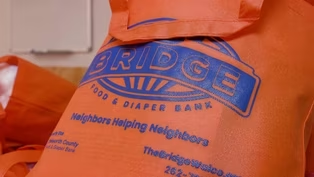
Neighbors helping neighbors at Walworth County's food bank
Video has Closed Captions
Clip: S12 Ep7 | 3m 5s | Volunteers at The Bridge Food and Diaper Bank support families facing food insecurity. (3m 5s)
Preview: The Bridge Food and Diaper Bank
Preview: S12 Ep7 | 30s | Discover how The Bridge Food and Diaper Bank supports families in Walworth County. (30s)
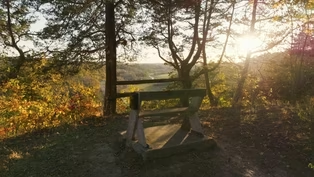
An overlook where stories, love and memories grow
Video has Closed Captions
Clip: S12 Ep7 | 6m 16s | Lookout Point in Castle Rock, Wisconsin, inspires reflection and connection. (6m 16s)
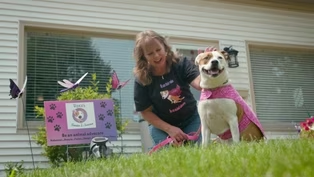
Video has Closed Captions
Clip: S12 Ep7 | 4m 16s | Vicky Van Lare runs a charity providing free pet food to families struggling with costs. (4m 16s)
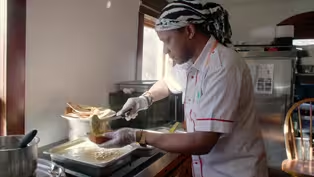
Tanzanian safari leader's journey leads him to Wisconsin
Video has Closed Captions
Clip: S12 Ep7 | 3m 50s | Ombeni “Ben” Pallangyo cooks up the flavors of East Africa in his Stoughton restaurant. (3m 50s)
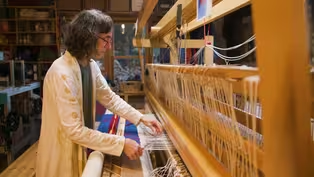
Fiber artist weaves portraits of global water protectors
Video has Closed Captions
Clip: S12 Ep7 | 4m 31s | Mary Burns honors water rights advocates with intricate woven portraits. (4m 31s)
Providing Support for PBS.org
Learn Moreabout PBS online sponsorship











Support for PBS provided by:
Wisconsin Life is a local public television program presented by PBS Wisconsin
Funding for Wisconsin Life is provided by the Wooden Nickel Fund, Mary and Lowell Peterson, A.C.V. and Mary Elston Family, Leon Price & Lily Postel, Stanley J. Cottrill Fund, UW...