
The Broadgauge, Petersburg
11/16/2021 | 27m 41sVideo has Closed Captions
A local man moves back home with his fortune to buy & restore one of the iconic buildings.
A local man moves back home with his fortune to buy and restore one of the iconic buildings on the square.
Problems playing video? | Closed Captioning Feedback
Problems playing video? | Closed Captioning Feedback
Illinois Stories is a local public television program presented by WSIU
Illinois Stories is sponsored by CPB, Illinois Arts Council Agency, and Viewers like You. Illinois Stories is a production of WSIU Public Broadcasting.
Support provided by:


The Broadgauge, Petersburg
11/16/2021 | 27m 41sVideo has Closed Captions
A local man moves back home with his fortune to buy and restore one of the iconic buildings on the square.
Problems playing video? | Closed Captioning Feedback
Where to Watch Illinois Stories
Illinois Stories is available to stream on pbs.org and the PBS app.
Illinois Stories
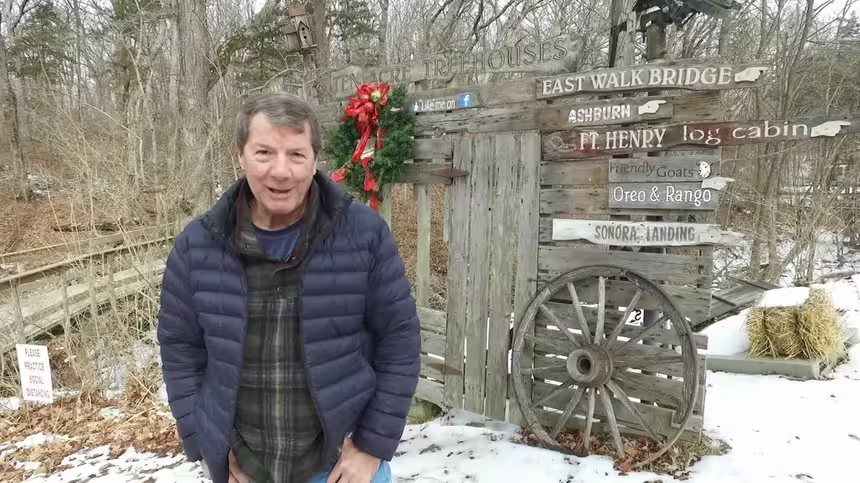
Join Mark McDonald as he explores the people, places, and events in Central Illinois. From the Decatur Celebration; from Lincoln’s footsteps in Springfield and New Salem to the historic barns of the Macomb area; from the river heritage of Quincy & Hannibal to the bounty of the richest farmland on earth.Providing Support for PBS.org
Learn Moreabout PBS online sponsorship(theme music) - [Narrator] "Illinois Stories" is brought to you by the Corporation for Public Broadcasting, Illinois Arts Council Agency and by the support of viewers like you.
Thank you.
(theme music continues) - Hello, welcome to "Illinois Stories".
I'm Mark McDonald in downtown Petersburg where the name Broadgauge really means something to everybody here.
As you can see, the old Broadgauge Building is having a rebirth here at the corner of 7th and Douglas.
And this whole corner of the block is being reborn.
Now, Douglas Pope, the Broadgauge, for people in Petersburg, they're all familiar with the Broadgauge.
But back in what, 1872 or so, this building was built as a retail outlet and a big one, wasn't it?
- Yeah.
Yeah, it was built in 1872 as the original mega store for central Illinois.
So people came from all over.
It was originally three stores all under one roof.
So there was hardware store, grocery store and a dry goods store.
And so for 150 years, it's been basically retail shop, different varying owners.
There's been 4 owners over the 150 year span.
But yeah, it has been an occupied retail establishment.
- Yeah, and you can see, now you guys, as we look down on it, we're up on a sort of a walkway that overlooked and I guess since it was retail, they had retail up here too?
- [Douglas] Yeah.
- [Mark] They had some shelving and some things for folks to look at.
But this is really a nice touch because you get a chance to really look, overview, and this that we're looking at now, this will be a restaurant, a big restaurant.
- [Douglas] Yeah, exactly.
So, yeah, we're standing right now up on the mezzanine overlooking what will be the Broadgauge Restaurant.
So that's the main dining room there and then there's a bar that is built underneath this cool kind of mezzanine balcony.
- And we're going to see that.
Now you just painted it so right now it's drying, but we'll get a chance to see it.
But this is interesting too, because these blueprints from the original building, you were able to find these in your construction.
And they helped you out in some way, didn't they?
To understand what was here?
- [Mark] Oh yeah, absolutely.
So this building was remodeled in 1915.
The facade was totally redone.
And the family that owned the Broadgauge at the time of the remodel had been saving these blueprints all the time and donated them to the project.
And so we were able to use these during our National Park Service Historic Preservation application and during the actual redevelopment of the facade, and so that helped a lot.
Plus they're beautiful and they're historic.
- And your historical application was accepted?
- Yes, yeah.
- Terrific.
- Yeah, our application was accepted.
So this is a historic preservation project.
And yeah, all we have to do is follow the rules and then we're done.
- Let's walk this way.
This is the original flooring?
- Yeah.
Original floor, look at this shelving.
- It's certain these are arch windows.
- Yeah.
They're lovely.
On the outside, it looks like there would have been windows underneath them, but there never were.
There was always kind of bricked in, they're kind of a bricked in window.
It's kind of a cool feature on the outside.
- It is very much.
Now, what's really special about this is we're looking at a double staircase.
- Yeah.
- And it's a very dramatic look when you're down on the level of the main floor, because you look up...
But it's interesting what you learn, because on that right set of staircases, you are not aware this was a double staircase, right?
- Yeah.
For at least 90 years, the right side of the staircase was completely covered up and kind of built around.
There was an office and a platform built on top of it.
And so no one alive had ever really seen or walked on those stairs until we started messing around here.
And when I realized that those stairs were under there, I absolutely had to rip out that office.
And it was amazing because for 90 or a hundred years, the steps had never really been stepped on, so they're in pristine condition.
Compared to the left side, which has 150 years of wear and tear, you can see the dips and the footprints, and everything.
They're beautiful in and of themselves.
- Now, it looks like in the middle, below the staircase, it looks like that's a safe.
Is that what that was used for?
- [Douglas] Yeah.
There's a vault and then a safe inside of it.
The restaurant is going to use it as a wine vault.
So that will be where will store our special wines and have to- - [Mark] That's a nice touch.
That's a nice touch.
Well, listen, let's go downstairs and take a closer look at all this.
- [Douglas] Sure.
- Okay.
So we're standing in the main entrance to what will be the restaurant.
- Yes.
- And this is going to be a big restaurant.
It's going to have to seat I don't know, a hundred, 100?
- 180.
- 180 people at a time.
And you also have these beautiful little areas, these nooks that face the street that are well-lighted.
And those would be little lounge areas, et cetera.
So this is what this area is going look like now.
The bar is one of a kind, isn't it?
- Yeah.
The bar is one of a kind.
So the mezzanine is original, the bar is what we added.
Its our special touch to the building.
But yeah, it's a 40 foot wide courts top bar, both sides front and back.
The back is kind of antique, mirrored tile, all around.
- Let's take a look.
Now, we can't see all that wonderful work.
- No.
- But we can see sort of what's going on because, oh, well, he did take the plastic off of it.
So hey, it's okay, keep working.
- Are you sure?
- Oh, sure.
Keep working.
But you can see he's working on the bar here.
That's new.
And then the back bar course is still covered.
And that's just below the mezzanine where we just standing up there.
Now, we've mentioned the flooring is original?
- Yeah.
Flooring is original.
Basically all woodwork is original.
- All the woodwork?
Okay.
- Yeah.
So yeah, a 100% new original flooring, original, beautiful grand staircase.
The ceiling is all restored and original.
- [Mark] Really?
This is what the ceiling, it wasn't painted this color but it was- - [Douglas] No, it was more of a creamy color.
But yeah, it's a kind of wood rounds.
- [Mark] And is this your wallpaper?
- Yeah.
We picked out the wallpaper.
But it kinda mimics what some of the wallpaper was here during the Robbins' era.
- And then the booths and the lighting fixtures?
- Yeah.
Those are all new.
- [Mark] They're all new, of course.
But the woodwork behind it, is that original woodwork?
- [Douglas] No, that's wainscoting is new, we added that.
- [Mark] Very classy, very classy.
- [Douglas] But it actually mimics that original, that white Wayne's putting in the storefront is original.
So what we did was extend that along the wall.
- [Mark] And the color is a perfect match?
- [Douglas] Yeah.
- Okay.
While we're down here, before we go up to see the event area, this is going to be entered by a separate entrance and this will be a separate operation?
- Well, this will be part of the restaurant, this part.
There's a bakery and coffee shop next door.
So during the day, this will be part of, kind of transitional space, so people can have coffee and read the newspaper.
It's the Robbins Shoe Room.
So that's- - It was Robbin's Departments Store?
- Yeah.
- Okay, next to the sign?
- Yeah.
The Robbins Department Store from 1939 to 1999, so 60 years.
So we moved the sign in here, made it the Robbin Shoe Room.
This is where they used to sell shoes.
So this will be a communal table during the day, and then semi-private dining room at nighttime.
- Okay.
This will be the kitchen for the restaurant?
- [Mark] Yeah, that's correct.
- And then you have a sort of institutional kitchen for the events on the other side?
- [Mark] Yeah, exactly.
- Okay I tell you what?
We got to go up the stairs.
- Yeah.
- We've got to see what's upstairs.
- Absolutely.
It's amazing how pristine the stairs are for being 150 years old.
- Well, Douglas, like you said, pristine staircase and really, the style is, how would you describe that style?
- It's unique.
(both laughing) - There is no description.
- Yeah.
- Nobody's ever seen anything like it before.
- Yeah.
That's how I describe a lot of the style of this building is it's unique.
Broadgauge's tagline is, "Uniquely Petersburg."
Because we do think it's a unique building a unique space, unique location, so.
- Okay.
So up here, what we're seeing is this would have been the second floor of the store.
But it shows you how big the store is.
because look how high the ceiling is.
And the windows, again, delight just pours in here.
- [Douglas] And isn't it such an elegant room?
But was used for storage for 150 years.
- [Mark] Is that right?
People weren't shopping up here.
It was a storage.
- [Douglas] Now, they would occasionally have some attic sales up here, but for the most part, it was storage for the retail shops.
- [Mark] How did you choose the chandeliers?
(both laughing) - My mother.
(both laughing) - Well, she's got great taste.
- Yeah.
My mom has good taste.
And so she has her hand in a lot of this project.
And yeah, so my mom found this.
They're beautiful.
- It's kind of tough to find a dozen beautiful chandeliers like that.
- Yeah.
We actually had to send my creative director, his wife, to St. Louis to pick them up because it was really hard to locate.
- That's nice.
Okay, let's take a little look around.
Now, we're not anywhere near done here, but let's take a look around.
Of course, you're going to have a big bar and that's what this room will serve us here.
Right?
- Yeah.
- This'll be for events, weddings, those kinds of large gatherings?
- Yeah.
This is the ballroom bar servicing the ballroom.
We'll have weddings.
I want to have live performances, CamiEx, concerts.
- When you look at this room, it's almost perfect if you want to do something in the round.
If you wanted to have a band or acoustic music, or dance, you could have an area there in the round.
- Yeah.
There's actually kind of a circular inlay of a different type of wood, right in the middle of kind of like a dance floor.
- [Mark] And the tile here is all new.
The wood is all- - Wood is original, this tile is new.
Yeah, all the way up.
Wallpaper and everything is new.
- Okay.
Now, I know there's a lot of work to do but let's take a look.
- Yeah.
A lot of work to do.
- What we've seen this far is basically been phase one.
Well, this is the south side of the second floor.
So the elevator comes up and all the catering supplies are back here.
- [Mark] So you have an elevator for the public and you have a service elevator?
- [Douglas] Yeah.
It's a two-sided elevator that serves both the kitchen and the guests.
- [Mark] And what's on the other side, through that far doorway?
- [Douglas] The staff office and more storage for the restaurant.
- [Mark] And we're talking about three storefronts here.
So it goes way over.
- [Douglas] Right.
Yeah.
- And then of course, you're going to have a bunch of restrooms because you're going to have a bunch of people.
- Yeah.
- And you can see, these are all lined out and ready.
They're not installed yet but they're all lined out.
- They're getting there.
I think they're going to get installed hopefully tomorrow.
So well, fingers crossed.
- And then you've got further space down there which goes to- - So that enters phase two of the project.
It's the cigar factory.
We have two more events phases that are to come online, it will be later in phase two, cigar factory and a boardroom.
The cigar factory, it was an original cigar factory in the early 1900s.
- Is that right?
They were rolling cigars from there?
- Yeah.
- There was a lot they had done around here.
Jacksonville had a lot of cigar factories, and Petersburg.
Apparently there was a lot of cigars smoking going on, and a lot more than today.
- Right.
For sure.
- All right.
I'll tell you what, while we're on this level, I want to see one other fascinating thing.
And you were describing to me the fact that this is something you found, because nobody really knew how they got to the next building and this was connected to- - Yeah.
So originally in the early 1900s, the Broadgauge was actually connected to the building next door, across an alley with a bridge.
But there was no evidence of it other than two doorways on either side.
And then the bridge was written into some like fire maps in the early 1900s.
- But it had to be here.
You knew that - But it had to have been here.
It's just- - So you rebuilt it?
- But no pictures, no evidence of it.
So we rebuilt it and connected this kind of rustic Oscar Hubbard Building.
This is phase three of the project.
- So it's down the road a little bit, but the way you work, this might be next year.
- We're getting started on it next year, so.
- You guys really get after it.
And in addition to that, it's raining here today, but if you look down in there, you're going to have an outdoor beer garden down there, is that the plan?
- Yeah, yeah.
Exactly.
It used to be a warehouse with a dilapidated roof.
We tore the roof down.
And then we're going to build a beer garden, potentially one or two bocce ball courts.
(Mark laughing) Because it's a pretty big cement pad down there.
So it could be fun.
- Yeah.
Emily, Falcon, I guess you're going to be the manager of this restaurant?
- Yes.
That's correct.
- You got your hands full.
I mean, you got like three areas that you're going to have to handle.
This is going to be a coffee shop?
- It is.
The Talisman.
- And as you can see, it's pretty well.
I mean, we're getting to the point where you're going to be able to serve people in here.
That won't be too long, will it?
- Very soon.
- You and your husband had a restaurant in Springfield?
- Yes we did.
- And now you've both moved here.
Your husband is the executive chef and you'll be the manager?
- Correct.
- Okay.
Good deal.
Okay.
So you'll have a coffee shop and then you're going to have a transition area there, - Absolutely.
which can also be shared.
And so let's just kind of walk through here as we go.
- Sure.
- We've seen this big, beautiful table.
And you'll have entrances but this won't be an entrance from the street.
But you can come in there and you can come main area.
- Yes.
- And this is your kitchen to serve, what, this whole area?
- Yes.
It will be.
This will be for the main dining room, the Broadgauge.
- Yes.
- Let's walk through here and see this part of the building that's finished.
Because this is what we were looking at the upstairs, and it looked kind of like this when it's done.
Although the color choices are different, but this is what the restroom areas look like.
And we talked a lot about the elevator which can be used for service, as well as get people in and out.
- Yes.
- Let's go to the big area.
- Okay.
- That's where your husband will he be working?
- That's will be where my husband will be everyday.
(both laughing) - Now I think we said there's going to be seating for 180 people in this room.
- Just about, yes.
- Tell me about the challenges of opening a restaurant that size.
It's a big deal.
- It is a big deal.
It's going to be a lot of people, it'll just be a lot of work training for the staff.
But we've got some really talented guys in the kitchen.
So I think that it's going to be- - Including your husband, right?
- Yes.
Including my husband.
- Tell us what your ideas are for for the menu.
- Yeah.
So Petersburg, traditionally, originally was German settlers.
And so a lot of our menu is American-focused, but hints of German throughout.
So our specialty is definitely our house-made breads, which we kind of sourced from our previous restaurant.
So house-made breads, pretzels, all of our meats will be roasted in-house.
We will be featuring a lot of the local farmers, beef and chicken, pork.
Really just what Broadgauge is about is embracing what was Petersburg and bringing it back to life.
And then also just uplifting everyone in the community too, so.
- It's a very difficult time to open a business.
- It is.
- What, with the pandemic and the economy is so dicey and everything.
I don't know, I certainly hope the best for you.
But boy, a small community supporting a big operation like this is a real challenge.
- It is.
And I think one thing that I'm very confident is the food, the quality, the food is wonderful.
My husband is great at what he does.
And we had a great following even through the pandemic with our previous restaurant.
And I think as long as you've got friendly faces, great service and a great product, people are going to come.
They really will.
- Well, good luck.
- Yeah.
Thank you.
- Thank you.
- Yeah.
Thank you very much.
(Emily laughing) - [Mark] Douglas, have you ever been in the restaurant business before?
- No.
I'm not really sure how it's done.
- It's kind of an eye-opener.
- Yeah for sure.
- I mean, when you start pricing and ordering all this stainless steel that you need to do this, and the cost of stainless steel is outrageous, isn't it?
- Yeah.
No, yeah.
Didn't really seem like anything was cheap.
(both laughing) - No, no, no.
But everything has been delivered now, right?
- Yeah.
- I mean, your kitchen is about ready to go.
You could say that - Yeah.
We have all the appliances.
We fought like heck with all the different COVID delays, and the container ships off the coast of California, and all of that stuff.
But yeah we have all the equipment, all the dishware around.
We're just- - You're fortunate because I mean, if you were waiting now for a thing, you wouldn't know how long the wait would be.
So you got in pretty good shape.
- Yeah.
- But a kitchen like this, in an event, you're going to be able to have to feed how many people at a time?
- Well, we can do about 150 to 180 in the restaurant at any one time.
And then upstairs, we can do a wedding of up to another 180 in the ballroom.
And then you'll see, we have a couple other events spaces too, where we hope to have multiple events going on at the same time on the second floor.
- This place is going to be buzzing.
If you have a busy weekend, this place going to be buzzing.
- Absolutely.
Yeah.
- Okay.
So this is the catering kitchen?
- Yeah.
Catering kitchen.
- Then you've got the smaller one here for your everyday use.
- Yeah.
So this is the open restaurant kitchen.
So the guests can see in- - [Mark] It's a neat touch.
It's a nice touch.
We just talked to the executive chef's wife.
So she's confident he'll keep this in good shape.
- [Douglas] For sure.
- And then what you're able to do then is to get to the rest of the building.
Where's the elevator?
Am I going the right way?
- Yeah.
You're going the right way.
- Okay, good.
Let's take the elevator up and see where... Because you got future plans in what you call phase three?
- Yeah.
- So it's not enough.
You don't have enough to do here.
- Right.
Correct.
Yeah.
We definitely had a few phases.
It's a big grand plan, so.
- Which one do I- - Second floor.
- [Mark] Second?
Okay.
Okay.
We're on second floor again.
- Yeah.
And so we're going to be taking- - A lot going on, a lot going on.
- Yeah.
A lot going on.
A lot of tiling.
- Okay.
And we're talking about phase three now, I'd say.
- So this is actually phase two phase two.
- Phase two?
- Yeah.
So we saw the ballroom.
So the ballroom would be for weddings and live music performances.
And this is the boardroom.
So this would be more for corporate events, private dinners, anniversary parties, birthday parties, just like smaller- - A smaller event than the second floor.
- Right.
- Because that's a big, big space.
- Yeah.
- But this is pretty big too.
In fact, it goes down, you're on two levels here.
- Yeah.
We took the fronts of basically two apartments and made them.
Because you've got the beautiful windows overlooking the Petersburg town square.
- Now was this part of the Broadgauge retail at one time?
- Well, yeah.
Well, this was part of the Broadgauge building.
It was actually a doctor's office for 80 or 90 years.
So it's an office space.
- Okay.
Well, you call it a boardroom.
So the plan would be to have a big enough table in here that if I wanted to have a meeting, a business meeting of some kind, this would be where this would go?
- Yeah, there'll be about 12-person table here with a beautiful chandelier coming down, another sitting room over there, and like that, so.
- And then if you wanted to expand that, you've got a place here to do that.
And this will be transitional.
- Yeah.
- Could you close it off or would this be the same- - No this would just be the same space.
- Okay.
- If someone's having a party in here, there'll be cocktail tables spread around and maybe this is where the food will be and whatnot.
- Okay.
And then it goes even further.
- Yeah.
So this is a three-room suite.
So there's a boardroom, sitting room.
And then this is going to be the billiards room.
(Mark laughing) Kind of a game room.
- I love that idea.
- Yeah.
- I love that idea.
- But yeah, we want to have as many kind of cool event spaces that people can use.
And this building has been here for 150 years, but no one's really ever used the second floor.
You have to have an elevator, really, to make a second floor functional.
So then all of a sudden, now that we have an elevator in our building, all this infrastructure, it just makes like the whole floor accessible - And you put the elevator in, right?
It was not here.
- Yeah, that's right.
- So that's really what ties this whole thing together.
Because there weren't any way to get in here on the second floor.
- Yeah.
Exactly.
- Now, we can see what kind of shape this room is in.
Was the rest of the building in this kind of condition?
- Parts of it we're in kind of rough shape, but for the most part, like the bones of the building, were pretty good because it's been taken care of by the owners for the last 150 years.
So it never was unoccupied or unused space.
So luckily the owners really kind of took care of it.
- [Mark] But there's still a lot of clean up to do, didn't you?
- Sure.
Yeah.
- [Mark] Because you can look down and see that to get to the brick and to get to the wood and the lathe and everything, you have a lot of cleanup to do.
- Yeah.
No, it is a lot of work, but it turns out beautiful.
- It certainly has so far.
Okay.
There's one thing we haven't seen.
And that would be, the VFW has a space in this building.
- Yeah.
- And they have for a long time.
- Yeah.
- And there used to be a cigar rolling factory.
- Right.
Exactly.
- So let's go in there and then we'll talk about your plans there.
- Sure.
- Doug, we talked about phase one, two and three, and I get a little confused myself because this building is so big and there's so many nooks and crannies.
But we're now on the far, is this the north?
This is the north end?
- Yeah.
- Okay.
We're on the far north end.
And this is an area that it's attached to your other buildings, but it wasn't always part of the Broadgauge.
It was actually a cigar factory at one time.
- Yeah.
We're now in the building next to the Broadgauge.
And yeah, in the early 1900s, the second floor was used as a cigar factor.
So people were rolling up cigars and doing that.
- And then the VFW wanted to move in, so they moved in this space, and then they moved downstairs and this was vacant.
So now this is part of your project.
- Yeah.
Exactly.
- Okay.
So what's going to happen up here?
- So the cigar factory will be just a little bit more casual banquet space than the ballroom.
So you can imagine, we're going to make it like kind of a speakeasy type feel.
It'll be nice and cool.
So you can have like class reunions up here, or birthday parties, or just any sort of gathering that's a little bit more casual or smaller than then what you would expect in the ballroom.
- So you're going to have to have a bar in this room too?
- Yeah.
- Or maybe even a portable bar, some way to serve.
- Yeah.
- So have you ever counted up how many bars you're going to have in this building?
(both laughing) - It's at least three or four.
So, yeah.
(both laughing) - Well, when you get your beer garden outside, that's going to be one.
- That'll be another one, yeah.
- You've got the big one that you just finished.
- That's correct.
- That you just built.
- Yeah.
- Then you've got another one in the catering area, you've got a bar there, you'll have to have some way to serve in here.
So you might end up with five bars.
- Yeah.
Hopefully people like to party.
I don't know.
- You know what?
I mean, that's where the money is, isn't it?
- Yeah.
(Douglas laughing) - Okay.
But this is interesting.
So in here, would you ever turn this into like a sports, people would watch sports on- - Yeah.
That's a good idea.
I hadn't really thought about that.
Because we don't really have TVs in the main area of the Broadgauge.
But yeah this could be a cool sports bar.
It's possible.
- You could do that or for special events, World Series, Superbowl, stuff like that.
- Yeah.
We want to do some- - You could rent it out for a private sports party.
- Yeah.
- Wow.
Yeah.
Good idea.
- I like that.
- Well, listen, you're a Petersburg boy.
- Yeah.
- You've come back and you're making a real difference in downtown Petersburg.
What kind of feedback have you gotten from people in the community?
- Oh, yeah.
It's been nothing but positive.
Everyone in this community is so supportive and they're rooting for me and the whole team.
And yeah everyone in the town and surrounding communities is excited about it.
So yeah, it's been great.
- Being on the square is a really essential thing, isn't it?
- Yeah, absolutely.
And Petersburg town square is kind of lighting up right now.
We have this really cool brewery called Hand of Fate, we have this new wine boutique called 1st and 3rd.
And we have really cool new clothing boutiques all around the square.
So yeah, it's just really fun to see this kind of revitalization of small town and town squares.
- Well, Douglas Pope, good luck.
It's been a fascinating tour.
And when this story was first mentioned to me, I could barely keep track of all the spaces that you were planning, but I think it's very ambitious and it's great.
All the best to you.
- Okay.
I appreciate it, Mark.
Thank you.
- And talk about an aggressive timetable.
November is the opening for the events center.
Of course, then the restaurant will come after that.
And these areas on the side here, he's talking about having all three phases done by the end of next year.
with another Illinois story in Petersburg, I'm Mark McDonald.
Thanks for watching.
(theme music) - [Narrator] "Illinois Stories" is brought to you by the Corporation for Public Broadcasting, Illinois Arts Council Agency, and by the support of viewers like you.
Thank you.
(theme music) (cool ambient music)

- Arts and Music

Art21 showcases today's contemporary visual artists and their groundbreaking creations.







 New Episode



Support for PBS provided by:
Illinois Stories is a local public television program presented by WSIU
Illinois Stories is sponsored by CPB, Illinois Arts Council Agency, and Viewers like You. Illinois Stories is a production of WSIU Public Broadcasting.