
The Business of Women’s Sports
Clip: Season 9 Episode 3 | 15m 4sVideo has Closed Captions
Women’s sports are no longer sidelined as they are becoming big business for owners and fans alike.
Women’s sport is no longer pushed to the sidelines. It is becoming big business for owners, players and fans.
Problems playing video? | Closed Captioning Feedback
Problems playing video? | Closed Captioning Feedback
Nevada Week is a local public television program presented by Vegas PBS
The Business of Women’s Sports
Clip: Season 9 Episode 3 | 15m 4sVideo has Closed Captions
Women’s sport is no longer pushed to the sidelines. It is becoming big business for owners, players and fans.
Problems playing video? | Closed Captioning Feedback
Where to Watch Nevada Week
Nevada Week is available to stream on pbs.org and the PBS app.
Providing Support for PBS.org
Learn Moreabout PBS online sponsorship-SHE Weekend put female athletes center stage, but will that attention translate into lasting growth for women's sports?
I spoke with Nancy Lough, a professor of Sport Management at UNLV, and I began by asking her how significant SHE Weekend was.
(Nancy Lough) The fact that the community came together to host this event because Flavor Flav put a tweet out and said, Hey, I'll throw a party for y'all, just doesn't get any better than that, because that's the kind of thing that Vegas does.
-We have heard before that women's sports are having a moment.
What is this moment like?
Is it temporary or perhaps sustainable?
-You know, I love that question because I've studied women's sport for several decades now, and we did have many a moment.
We had an undulation of periods of time where it was the big thing everyone was talking about, and then it just kind of faltered and went away.
It went out of the consciousness, out of the, out of the conversation around sports.
So if you think about the 1996 Olympic Games in Atlanta, those were considered the "women's games" for good reason.
We won gold medals in so many different sports on the women's side, but people forget about that, right?
1999, the World Cup.
Just this week I was asked about the last time the U.S.
held the World Cup, and reference was made to 1994.
Well, the reality is that was the Men's World Cup.
The U.S.
has held the Women's World Cup, right?
And we tend to forget these things.
So the interesting thing is this is not a time that's going to go away.
We now have--and by "we" I mean women's sport, because I identify very strongly as an advocate, as a fan, and as a scholar.
I was an athlete.
I was a coach, right?
So it's part of my DNA.
But I believe that there is very strong evidence that we now are in a sustainable position because the economic value proposition has been proven.
So that's the difference.
For decades, the issue was that women's sport was treated like a cause, and causes are things we donate to.
We give a couple dollars here, a few dollars there, and the pockets aren't deep, basically, for causes.
Now we're talking about women's sport as an economic proposition, as a great way for sponsors to invest and get a great return on investment, as a great way for cities to invest to bring teams to their city, grow the participation of the sport through the role models that they can see as both female and male.
And so it's-- This is not something that's going to go away.
There's many a data point to support the fact that women's sport is on an upswing.
In fact, we call it a "hockey stick trajectory," meaning the up, right?
That's what we see with women's sport.
Not saying men's sport isn't growing, because it is, but the reality is the trajectory of women's sport is unlike anything we've seen.
-What are those data points that come top of mind for you?
-Yeah.
The easy one is thinking about our friend Mark Davis here in Las Vegas, who owns the Raiders and purchased the Las Vegas Aces for $2 million.
You cannot buy an WNBA team for $2 million anymore.
In fact, his investment quickly had a 750% rate of return within years, so the valuation of that team is well over $150 million at this point.
Those are the kinds of numbers when we say return on investment that have gotten attention.
Previously, if we're talking about sponsorship, it was assumed that there would be a return on investment if you invested in the NFL or Major League Baseball or what have you, but there was also an assumption that you would not have a return on investment if you had sponsored women's sport.
Well, now it's quite the, quite a different proposition because now that investment in women's sport is probably going to be less, but the return on that investment is likely to be greater.
-What happened for people to reject that assumption and start investing more in women's sports?
-Yeah.
It's been a cultural phenomenon.
There's a number of factors.
I think the two biggest factors are what I was just speaking of, the business case for women's sport.
That's a huge one.
When we start talking about women's sport as a viable business, that first piece leads to the second, which is media.
So most likely the singular--if we were going to point out one really singular change or shift--it's the disruption of social media, because women athletes now can create their own image, their own brand.
They can control the narrative around who they are and what they do as an athlete or as a woman, and, frankly, that was very poorly done when they-- when it was up to the marketing people to try to, try to present them as a commodity, if you will.
Case in point, let's think about Serena Williams, right?
Serena Williams, hands down, I don't believe there'll ever be another athlete that can achieve all that Serena achieved in her career.
It's just unbelievable.
Even in the later years of her career, she was getting between $25- and $50 million in endorsement money, which sounds like a lot of money, but her contemporary Roger Federer was getting 50 to 100.
So twice as much as she was getting, right?
And it wasn't just Roger.
There were several male athletes.
If you went to the rankings, which we have, of who are the most valued athletes, and that's valued based on the endorsement money that they earn, Serena was likely the only woman to show up on those lists.
Meanwhile, we have 10 guys from all different sports that are receiving millions and millions in endorsement money.
The irony of that is Serena had such an incredible value proposition, but the marketing folks, especially the sport marketing people, had no idea how to market a woman well other than to sexualize her, which Serena was not going to do, and they didn't know how to market a black woman.
In fact, they probably said there isn't a good market out there for that.
So one of the cultural shifts that we've seen is the fact that there's now an understanding of what the value proposition a female athlete offers.
And interestingly, this has created the conversation around women as consumers in a way that it never used to.
So, case in point, if you look at the WNBA and you look at who the sponsors are, historically you would have seen a smattering of sponsors but not in the spaces that we see today.
So now you've got State Farm.
You've got Allstate.
You've got the insurance companies.
Now you've got CarMax.
You've got the auto companies, Ford.
All of them want in on it.
Now you've got Google, right?
Now you have these categories of sponsors that are appealing to a much wider market, if you will, as opposed to the sense that, oh, well, back in the day--and this is way back--it was Virginia Slims that saved women's tennis.
That's a cigarette brand that your generation doesn't even remember.
-I do, because my mother smoked them.
-But it was the cigarette brand for women; therefore, they invested in women's tennis, thankfully.
That's the Billie Jean King story.
Without Virginia Slims, the WTA would never have existed.
Tampax, right?
That brand, thank goodness for Tampax because they were one of the top brands that supported women's sport.
But that's what we call endemic, which means it's for women, right?
And that's so short-sighted because that means folks didn't understand that the fan base for women's sport is not just women.
I mean, yes, there are women who are fans, without question, but 50% of the fan base of women's sport are men.
And that's-- You know, it's ironic because the marketing people think they need to appeal to men more broadly, and data tells us that women make 80% of all consumer decisions because they're deciding for themselves, they're deciding for their husband, they're deciding for their children.
So who's deciding ultimately about the car?
Like it or not, if she doesn't put her, you know, her approval on it, her stamp of approval, it's not happening.
You know, one of the big growth areas in women's sport also has been merchandise.
So what merchandise do we need?
Well, historically and even now, we see too much of the one size fits all, which means it fits men; it doesn't fit women.
And now there's been a very bright light shown on the fact that kids want to wear stuff.
Little boys are wearing A'ja Wilson jerseys because we make those available and they they idolize her as a basketball player.
So that's another cultural shift, where, back in the day, if you wanted a basketball jersey, you had to get a Kobe, you had to get LeBron.
But now, even as a little girl or a little boy, you can wear jerseys, you can wear hats, you can represent, right, your team.
-The marketing folks that you keep mentioning and the media, are they correctly doing their job with someone like A'ja Wilson now?
-That's a good question, because I think she's very special.
I think she's-- Not just as an athlete.
As an athlete, she's very special.
She's the best in the game, but she also has a personality that makes her unique.
She's going to do more than basketball.
And so I think she's being very selective because she can.
That's not a privilege that a lot of women have had.
And, still, a lot of women don't have the privilege of being selective.
So let's talk about college sport, because that's how we got here, right?
To some some degree Name, Image, Likeness, that happened very recently, has brought to the fore a number of female athletes that have brought more attention to women's sport.
Caitlin Clark, Angel Reese, right?
The difference is that these athletes, the NIL era, they grew up with social media.
They know how to use it, and they can make decisions about whether they want to be the pretty feminized version of themselves when they're not playing basketball or not.
If you think about one of the things that's phenomenal with the W, it's the walk-ups, right?
They're coming into the arena.
We're looking at what they're wearing.
People love to see their fashion.
-Yes.
-And they're leading in this cultural space that, you know, it's happening in the NHL as well.
Those guys, our VGK guys, we like to see what they're wearing.
We like to see them looking their best.
But that's where sport has this profound opportunity to open people up to more than just the sport itself.
These athletes become celebrities.
-If I'm remembering correctly, though, A'ja Wilson was not part of that Name, Image, and Likeness era.
-Correct.
-She went into the WNBA before that started.
But do you think that's had a big impact on her?
-You know, it's a good question.
It hasn't hurt anybody.
I think it might have created some animosity in some ways for the women who came up without those opportunities.
I know the NCA is trying to make that right for a number of those athletes.
In other words, reparations, if you will, for no Name, Image, Likeness when they were clearly the driving factor behind television coverage for, you know, college sport.
At the same time, I do believe that the W in particular sees it as a sisterhood in the sense that what's good for one is good for others.
It's sort of like Las Vegas.
I've said ever since VGK and the Aces have really gotten going, it's like one of the beautiful things about this city, one of the beautiful things about their example of sport is, one, "a rising tide lifts all boats" sort of thing.
So greater visibility for VGK means greater visibility for the Aces, means greater visibility for the Raiders, and on and on and so forth.
We could compete with each other, but at the end of the day if we all lift the tide, we're all going to benefit, right?
And I believe that's a good metaphor for NIL as well.
You know, would you as someone who didn't have the benefit feel a little bit of animosity about that?
Perhaps, yeah.
I mean, we're all we're all human, right?
But at the same time, it most likely has opened opportunities up that maybe wouldn't have opened up before, because now there's so many more brands that are saying, Hey, there's a sponsorship opportunity here.
And I see these phenomenal athletes that have this social media presence and I see them playing and I see their fans, and I want my brand to be associated with that.
-There are some people who look at Las Vegas and think, because of the multiple championships that both the Aces and the Golden Knights together have had, because of that early success, that's what drove the fandom.
And had they not been as successful so soon, maybe they wouldn't be so popular.
And I'm wondering, with this new professional women's hockey league that is coming, is that what they're facing?
How successful do you think they're going to be?
-It's a fun question.
And it's a fun question because I teach sport marketing.
And one of the things I teach my students is if you are banking on wins to sell your product, you're not doing your job.
The reality of sport is there will be a down season.
There just will.
At this point last year, our Aces were not doing well at all.
And I remember being with Nikki Fargas watching a game, and she said, It's okay, it's okay.
It's going to turn around.
And it did; we won.
We won last year.
Now, as far as championships, no question.
Everyone wants to be affiliated with a champion, and the city of Vegas wants to be affiliated with winning.
Of course, no question.
-Has it hurt the Raiders to move here?
No, it has not.
Have they had phenomenal success and won championships?
Unfortunately, not yet.
We'll hope that that's on the, on the horizon.
The interesting thing with the PWHL, the Professional Women's Hockey League, is that we are the beginning of the movement west.
The real hockey hotbeds, especially for women's hockey, are back east and in Canada.
And so the interesting thing about coming to Las Vegas is it plays more on the model of they've been hosting games in different cities; and when they go to that city, they sell it out, right?
They went to Pittsburgh and they sold it out.
They went to Denver and they sold it out.
So it's a little bit of that model.
Like if we play in Vegas, people are going to come very much like they do for Raiders games.
So I do believe that the economic proposition is a little more similar to the Raiders' economic proposition, which, if you know, if you go to games, it's not always a home game, even in Las Vegas.
-A lot of visiting fans.
-A lot of visiting fans, but then we also have our true die-hard local fans.
So I think you're going to see both at PWHL games, a nice complement of local fans and visiting fans, and that will make it fun.
It'll make it unique and special.
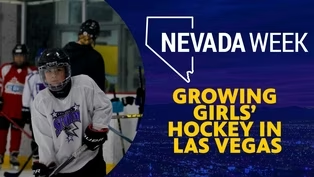
Growing Girls’ Hockey in Las Vegas
Video has Closed Captions
Clip: S9 Ep3 | 3m 48s | Hockey isn’t just for the boys. More and more girls are joining the sport and excelling at it. (3m 48s)
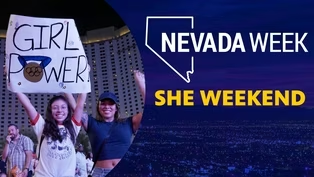
Video has Closed Captions
Clip: S9 Ep3 | 6m 23s | Celebrities and sports stars gather in Las Vegas to celebrate women’s sports at SHE Weekend. (6m 23s)
Providing Support for PBS.org
Learn Moreabout PBS online sponsorship New Episode
- News and Public Affairs

Top journalists deliver compelling original analysis of the hour's headlines.
 New Episode
- News and Public Affairs

FRONTLINE is investigative journalism that questions, explains and changes our world.
 New Episode
 New Episode
 New Episode
 New Episode
 New Episode
 New Episode
 New Episode
 New Episode

Support for PBS provided by:
Nevada Week is a local public television program presented by Vegas PBS