Unspun
The Changing Political Map of North Carolina | Unspun
Season 2 Episode 213 | 27m 52sVideo has Closed Captions
Pat McCrory examines shifting primaries and Donald Trump’s impact in NC.
North Carolina has long been a purple battleground where elections are decided by narrow margins. But the political landscape is shifting, with many key races now decided in party primaries. Pat McCrory examines major primary upsets, record spending, and whether a Donald Trump endorsement will help—or hurt.
Problems playing video? | Closed Captioning Feedback
Problems playing video? | Closed Captioning Feedback
Unspun is a local public television program presented by PBS Charlotte
Unspun
The Changing Political Map of North Carolina | Unspun
Season 2 Episode 213 | 27m 52sVideo has Closed Captions
North Carolina has long been a purple battleground where elections are decided by narrow margins. But the political landscape is shifting, with many key races now decided in party primaries. Pat McCrory examines major primary upsets, record spending, and whether a Donald Trump endorsement will help—or hurt.
Problems playing video? | Closed Captioning Feedback
How to Watch Unspun
Unspun is available to stream on pbs.org and the free PBS App, available on iPhone, Apple TV, Android TV, Android smartphones, Amazon Fire TV, Amazon Fire Tablet, Roku, Samsung Smart TV, and Vizio.
Providing Support for PBS.org
Learn Moreabout PBS online sponsorship- [Voice-Over] This is a production of PBS Charlotte.
- Tonight on "Unspun," North Carolina has become one of the most important political battlegrounds in the country, but with redistricting, low primary turnout and growing polarization, are our elections still as competitive as they appear?
We're looking for the answer with two political insiders, and my take on how the most powerful politician in the state found himself in the center of a nailbiter.
(upbeat music) In today's America, welcome to the spin game.
Believe me, I know.
I'm Pat McCrory.
When I was governor and mayor, I played the spin game.
I was played by the spin game.
But aren't we all done being spun?
Let's take the spin out of the world we're in, here on "Unspun."
Good evening.
I'm Pat McCrory.
North Carolina has long been known as a purple state, a place where both parties can win and where elections are often decided by narrow margins.
But recent years, the state's political landscape has shifted.
In many races, the real contest now happens in the primary.
This year alone, at least eight state incumbents were defeated in their own party primaries.
One major race is still too close to call, and several contests set new records for spending, all before the general election even begins.
So what's next?
And will a Trump endorsement hurt or help?
Let's hash it out with Tariq Bokhari and Larken Egleston.
They're with me and the Southern Group, one of the largest government relation firms in the Southeast.
Welcome to both of you.
It's great to see my old council colleagues.
You weren't around when I was mayor, but you came later.
- I was around in Charlotte though, I knew Mayor Pat.
- Okay.
You're the Democrat.
You're the Republican.
- Thankfully.
Yes sir.
- [Pat] I'm gonna jump on the Democrat first.
- Please let's go.
- Is that fair?
- Absolutely.
- Okay, the Democrats and the Republicans say we want teamwork.
We need to work together.
Well, you had two county state representatives, right here from Mecklenburg County, team with the Republicans.
They're out now.
So do they really want teamwork or do you have to stick with a party to win a primary?
- Well, I think we could ask Thom tell us the same question about the Republican party.
- Oh, you just re-pivoted.
No talking points here on "Unspun."
- It's "Unspun," unspin it.
- I just spun it.
- And I caught you.
- But I think when we force people to choose between two parties, you're not going to have monoliths within those two parties.
You're gonna have people that have a variety of perspectives, some of which are gonna be further left, some of which are gonna be further right.
Many of which, I think, many of us sitting here at the table would be more centrist, in our party.
But I think that it's not surprising, particularly with Representative Cunningham.
I think it wasn't just the vote she took, but it was the speech she made in that vote.
Talking about cultures not all being equal or not all being the same, and comments that were inflammatory enough and the blowback of which was strong enough, that she ended up apologizing for it.
Which you can decide yourself if that was genuine or not.
But I think that there's a little bit of an anti-incumbent sort of flavor right now.
Both parties, I think we saw some of that across the state.
It just so happens they're all Democrats here, but we saw- - And they all voted against Governor Stein's one veto.
- The veto, but again, I think it's an issue that has been made a wedge issue between the two parties, and so people feel very strongly that if you don't stand with the majority of your party on that issue, then you get pushed out.
And again, it's the same issue that's caused Senator- - Tell him what the issue is.
- Immigration.
And so I think Senator Tillis saw the same thing where he tried to find a more moderate, let's work across the aisle, let's try to find a solution to this, and it's sort of what pushed him out of the Republican party's favor.
- Okay, Tariq, you saw him re-pivot right back.
Change the subject from Nasif Majeed, which you didn't bring up his name.
Well, he served with me on the city council.
Great guy.
- He is a great guy.
- Great guy, and he got wiped out.
He got wiped out, but you re-pivoted to Thom Tillis.
So I'll re-pivot to Thom Tillis, did the President like him?
He might have not even won a primary, much less the general election.
He didn't toe the line with the president.
Is that the way it is now?
- Yeah, I mean, I think that is the way it is.
And I think, you see it in National, D.C.
politics, with Thom.
You see it with the two examples you started, with Nasif Majeed, for example, in that race, they didn't tow the line.
And I think the argument Larken and I have been having for the last week or two has been like, do you want to send Democrat or Republican, people up there who are just absolutely fighting to unseat the majority of the other side that's there, or people who are gonna go win and bring things back to their constituencies?
We saw them do that and we saw them side, and Governor Stein came in and endorsed one of the opponents that was there.
The powerful black political caucus came in and did not endorse in the race we were just referring to.
- And in a Democratic primary, the black political caucus here locally- - In Mecklenburg County- - Mecklenburg, it's probably the last power group that's standing.
- Nothing changes.
That was the case when I was in politics here locally.
I found out it was really five people, with a mailing list.
- Oh, well, I don't know what it was back then.
It's a good bit larger than that now, but I think- - But they had a mailing list and they got a lot of publicity.
- Yeah, and more importantly, they've got a lot of people that are out at the polls handing out that ballot and- - The polls, the mailers.
I mean, it is just a statement.
- That really brings home the value of that endorsement.
But I think, to Tariq's point, there are people who go down to Raleigh and try to compromise and try to get things for their district.
We've seen that particularly with some of the few rural Democrats that still exist in the legislature.
They've said, "Well, my district has a lot of real dire needs, and I'm gonna try to work across the aisle to get things."
But then they do the work of going back to their constituents and saying, "Here's why I compromised, here's what I got for our community that I wouldn't have otherwise."
I think the argument could be made that the vote around immigration didn't do anything for the constituents of those representatives, and I'm not sure that they did a good enough job coming home and defending those votes.
- But the dilemma, they were in gerrymandered democratic district, the election's over after the primary, so they're under even more pressure to tow the line to meet the 100% litmus test of either the Democratic or Republican party.
If you're in a gerrymandered district.
- Yeah.
- The election's over after the primary.
- I agree with you, Governor, gerrymandering is bad in North Carolina.
- Well, but here's the broader point.
It is bad, and the Democrats always talk about that at the state, while we remember we won on their maps back in 2010, 2011.
- Roy Cooper helped write the original gerrymandering.
- But the thing that is never brought up 'cause it's too local and niche, is, the city council and city of Charlotte is gerrymandered as well.
20% of Republicans make up the city.
Yet in the 11 seats that are there, four of them are at large and unwinnable.
And one of them we just lost, and we may have lost forever.
The other one is teetering.
We should be able to have two safe seats and another four toss up seats.
- All right, so the fact of the matter is, the Democrats are guilty of gerrymandering at the local level.
- Everyone's guilty of gerrymandering.
- Republicans are guilty at the state level, before they were in charge, the Democrats.
Everyone's guilty of power.
- Exactly.
- Power.
- That's why politicians shouldn't be able to draw their own districts.
- We've got bipartisan agreement.
I don't think we could run again for elected office.
We'll lose.
- Unfortunately, that's correct.
That is absolutely correct.
- All right, let's talk about the Senate primary.
We've got Cooper just (Pat imitates an airplane).
The guy says a little, and he is gonna raise a ton of money.
From your perspective, what's his weakness in this general election?
- Oh, I think we know, right?
- Come on.
- Come on, we know it.
- I really think that the only way Roy Cooper loses this election is if something materially shifts at the national level.
And it's kind of unfortunate that US Senate races largely end up getting decided, and you ran one, you know the dynamics of this.
You're not only running for what's good for North Carolina or what you've done, you're sort of running, having to respond to the things that are happening in D.C.
as you run, that are really largely outta your control.
And so I think, you know, Michael Whatley obviously ran and did well in the Republican primary to win that nomination, large part because President Trump endorsed him and said, "This is who I want to be the senator for North Carolina."
He's now gonna have to figure out whether... How closely he wants to align himself with the President, whose popularity is dropping.
- He won't have a choice.
He's in.
- Right, but how closely does he want to do that?
Or does he wanna start to tack back towards the middle?
Roy Cooper, because- - You just re-pivoted, and let's get back to what is... I wanna hear a Democrat say, from a Democratic perspective, what are... Former governor Roy Cooper, who defeated me in a very close election and he has some major strengths.
If you were a Republican, where would you attack Cooper?
- Well, I think you're already seeing it, I think they're trying to make public safety a piece of this.
They're trying to talk about how, you know, people that were released under his leadership, some of them have gone back out and committed crimes.
I don't know that that's gonna stick that much.
I think part of the challenge with attacking Roy Cooper is, Roy Cooper's been known so long in statewide office.
I mean he was in statewide office for what, 24 years?
So voters kind of feel like they know who he is.
I think it's gonna be tougher with Whatley 'cause we don't know him as well.
- Yeah, Whatley.
- Yeah.
- If you were running against Whatley, you were the Democratic opponent.
I always ask the opposite question, you never really got me.
He re-pivoted.
Let me see if you're gonna bed direct here.
- Fine.
If I was running against Whatley- - Where would you attack him?
Because this is all gonna be attached.
- So I would know that Whatley is, and I've seen it personally, is an excellent campaigner and he has a lot of favors to call in from his previous role, so he'll be able to raise a significant amount of money.
So how I would attack him- - Don't filibuster on me.
- I would know that... I'm Roy Cooper in this scenario, my knowns are complete 100% out there.
His unknowns are off the charts.
So I'm gonna define him before he defines me, and I'm gonna attack him as much as I possibly can, to say, "This guy is bad," and I'm gonna attack him on affordability right now.
That's what we see Cooper doing.
Now obviously, this is hard for me to do, because I think the public safety narrative can definitely combat that, but affordability is the only thing that I can hammer on.
- I got it.
You would attack Whatley on affordability.
The inflation, the gas prices are now going up 'cause of the war.
You had attacked Cooper on public safety.
- And you're already seeing it because both of them knew- - [Pat] And this is the light rail stabbing?
- Yeah, both of them knew who their opponent was gonna be.
- Yeah.
- We knew Michael Whatley was gonna win, we knew Roy Cooper was gonna win.
So both of them sort of were already running a general election campaign during the primary.
- Will the transgender issue come back?
You know, it help get him elected against me.
Do you think that will be used against him or is everyone gonna just stay- - I personally don't think so.
I think you were ahead of your time in that issue.
I think through the last, you know, half decade to decade, it's kind of normalized, the ability to talk about it.
I think that one is not gonna be a big problem.
- Let's get to some other races.
District One, US Congress race.
It might be the only competitive race, maybe out west there's one competitive race, but Don Davis against a former Navy veteran who's lost a very close election last time to Don, from a Democratic perspective, what's that gonna look like?
- He's certainly vulnerable.
I mean, the district that he beat her... The district lines that he beat her on have now shifted, and it's now shifted more towards Republicans.
That's the ones where they went in and redrew Don Davis's district, and I believe Greg Murphy's district down on the coast.
- Right, this is the deal that Trump made with Phil Berger.
- To get one extra seat, yeah.
- Helped redraw it.
- Lot of good that did.
I hadn't even thought about that till you just said it, but- - Well, that part of the deal on the race.
- It was and didn't get him there.
- Yeah.
- But... And as you mentioned, Chuck Edwards, that race is gonna be close, but Chuck probably wins that, though it'll be more competitive than it has in the past.
- What's ironic, Don Davis, Democrat, African American, I'm very impressed with him, by the way.
- He's very centrist.
- He was a part of no labels.
- He's very centrist.
- He would come to no labels meetings, but I don't think they're gonna punish him for that in this race.
- Well, and I think it speaks to the value of having districts that are competitive in a general election because Don Davis, who is a Democrat, but is a more conservative democrat than most of his colleagues.
He obviously gets grief from my party for that, but then at the same time, I think he gets respect from the center and the center-right for being more independently minded.
- He's probably the most moderate of the Democratic Congress people in North Carolina.
- Oh, a hundred percent.
- Tariq, do Republicans... Is that a shoo-in now that we redrew the districts and District One?
- I fear, no, and at a more macro across the state for both the national elections and the state elections in general, unless something drastically changes between now and then, macro wise, what I see is, there's gonna be a nationally promoted wave.
And if you are in a R plus five or less district, you are in danger.
- Okay, the biggest race in North Carolina right now is a primary that's still going on.
- No, but- - State senate leader is 23 votes down as of this filming today, taping today.
What's your reflection on that race as a Democrat?
- I mean, it's incredible.
- This is- - Phil Berger, yeah.
- Phil Berger against Sheriff Sam Page, Rockingham County, Guilford County.
- Two very well known people in their communities.
Maybe not as well known statewide, but Phil Berger has arguably been... He's definitely been the most powerful member of the state senate for two decades.
He's arguably been the most powerful politician in North Carolina for two decades.
For him to lose, particularly with the Trump endorsement that you just referenced, is pretty staggering.
But, you know, sheriffs have big personas and sheriffs are well known.
And that county, Rockingham County really overperformed for Sam Page in a way that Senator Berger couldn't make up in Guilford.
The power shift and the power dynamic of what could happen, assuming that is a verified win for Sam Page, which it looks like it will be, the jockeying for that power in the Senate's gonna be incredible.
- $10 million spent by Phil Berger and Super PACs and every, every interest group, including corporations here in Charlotte, gave to it.
Wow, what a change in Raleigh.
I mean, y'all work in Raleigh.
One minute, less than one minute.
What do you think the dynamics are gonna be if Phil Berger's out?
- Well, it's gonna be hard to tell, but it's gonna be the biggest power shift that this state has seen in a very long time.
And right now, you already see some people rising, there's questions, does Michael Lee take the mantle or is he- - Michael Lee, a state senator from Wilmington.
- Yeah, and he is incredibly smart, sharp, I love him, but he is in an at-risk district.
The name that we continue to hear in back office chats is Senator Todd Johnson, and Senator Todd Johnson coming in there.
We see a lot of other folks stepping into leadership positions.
You know, it's gonna be a huge, huge change if this stands.
- Yeah, you guys didn't hold back.
I had to bring you out a little bit, but that's what "Unspun" is all about.
And- - You got "Unspun" today.
- We appreciate you having us.
- Congrats buddy.
- [Pat] I hope you all come back on our show sometimes.
- I'm sorry, we can't.
- That's it.
That's it.
He's out.
He's voted out of the primary right now.
- That suits me fine.
- That's it.
Thank you, thank you guys very much.
- Appreciate it.
(intense music) All right, the top five "Unspun" countdown.
And tonight it's one of the best, the top five reasons incumbents lose their primary.
Happens very rarely, but it's happening in today's politics.
Number five, voted against or with the opposing party.
We had two representatives in the state legislature, both Democrats, who voted to override Governor Stein's veto.
They got beat in the primary, beat badly in the primary.
Number four, inappropriate sexual relations.
A Texas congressman had an affair with an aide.
She tragically committed suicide later on.
The affair has been found out, he's out.
Number three, one issue politics in the home district.
Give you an example, Phil Berger, the most powerful person in state government, proposed gambling for Rockingham County.
They didn't want it.
He's down 23 votes with a recount to go.
Number two, political leaders endorsing the opponent.
Hey, right now, John Cornyn, longtime senator from Texas, he's begging for President Trump to endorse his incumbency.
If he doesn't, he'll probably be defeated in a runoff primary in Texas.
And number one.
Huh, incumbents often just stay too long in office and people get tired of that politician.
It's time to go they say.
(intense music) All right, it's time now for "Unspun" one-on-one.
Joining me now is our good friend, Tony Mecia, the editor of the Charlotte Ledger.
Tony, it's great to have you back.
- Great to be here, Governor.
- Boy, what an election year.
- It was pretty amazing.
You don't see incumbents lose all that often.
You had a number lose in the primary.
What do you think is behind that?
- Teamwork's not rewarded.
You know, the public always goes, "God, why can't these people get along and work together?"
And then when a Democrat dare crosses with the Republicans or a Republican dare crosses with the Democrat, in the primary, they will pay for it.
The leadership in the Republican Senate and the House will punish someone who votes with the Democrats, and vice versa, the Governor, Governor Stein will punish any Democrat who votes to override his veto, and people like Nasif Majeed, person who I served with on city council, really was a good bipartisan person.
He's no longer in public service after this year.
- Right, that was a university city area.
North Carolina House, you had Carla Cunningham, same sort of thing there.
What's the incentive for... Is there any incentive for incumbents to work across the aisle or vote their conscience, if their conscience is a little bit different from what their party wants?
- These most recent elections are gonna make it difficult for anyone to jump their party in any vote in the legislature.
Probably in the city council down the road, although that's now all Democrat except for one Republican.
No, teamwork is being discouraged by the political leaders.
You gotta remember, the political leaders control the funds.
So what the political leaders, from the Governor to the Speaker of the House, to the head of the Senate, they'll tell, "If you don't vote our way, we're gonna fund a primary opponent against you."
And now they'll use these primary elections as an example.
"We mean it."
And Trump's doing the same thing at the federal level.
- Yeah, I mean in these primaries especially, especially in Mecklenburg County, the turnouts are... It's so low that a small number of people can kind of swing things.
The other incumbent that you had lose here locally was Vilma Leake.
She'd been on the school board and the county commission for almost 30 years.
She was in her nineties, lost in a primary.
So, you know, you see a lot of that.
- What was my last reason on the top five?
Stayed too long.
Sooner or later, you gotta leave standing up.
Thank you very much for this long service, but it's time to go.
She didn't know when to leave.
- What do you think is more important?
Federal types of issues that are dealt with in Washington, or state and local issues, as far as what affects people's lives the most?
- Oh, I'm a bias towards state and local.
In fact, probably more toward local.
That's why I always encourage people.
Everyone comes up to me and goes, "I wanna run for elective office."
And I go, "What?"
And they go, "US Congress."
I go, "Really?
Do you really want to do anything?
Or do you just want to enjoy the spotlight in D.C?"
School board is probably the most impactful job in North Carolina politics, after that it's probably county commission, city council.
Has more power actually over our lives as we live in the city and county and region.
- Why is it then, do you think, people tend to focus more on Washington and the Trump administration or whoever's in power in Washington, versus these school board races?
- It's Washington.
And the media gets more clicks when they talk about Washington than when they talk about the school board.
I mean, how many of us can name the people on the school board?
How many of us can name the county commissioner?
I can't do it now.
They change so much, and they're off-year elections.
No one really knows 'em, the voter turnout's very low.
So it's a combination of everyone's fault.
But I still say local and state have more impact than the federal government.
- Anything that can be done to highlight those races or those elected officials?
- Yeah, we can just look at our school board and look how many people are leaving the school system.
And you can say, "Okay, what's happening?
What are the decisions being made?"
The biggest danger is our school board, our county commission or city council are all almost determined by the primary.
So very few voters, 20-30,000 voters are determining all of our local elections, not just in Charlotte, but this is true in Durham and Greensboro and throughout North Carolina, and throughout the United States.
- Why do you think turnout is so low?
This is a problem we've dealt with here in Mecklenburg County, but you know, around the state, you see places where, you know, there's just not a lot of voters turning out.
- Well, a lot of it is because there's very little media left.
In fact, to your credit, the Charlotte Ledger is one of the few media sources now to go to, to find out what's going on locally.
I give you credit for that.
And I used to always go, "Thank God the media is shutting down."
No, if we don't have local media like yourself, people don't know what's really happening.
And frankly, we'll have corruption if we don't follow what the politicians are actually doing.
And you're talking about tens of millions of dollars too, controlled by these local part-time politicians.
- Do you think we're getting... And I appreciate the plug for the Charlotte Ledger, but do you think we're getting the best- - I hate to compliment the press, you know that.
- Do you think we're getting the best elected officials?
Are we getting people, who are the brightest minds, into politics?
- Well, let me first compliment them for having the courage to run.
But no, we're not getting the brightest minds.
We're getting good people, but are we getting the same level of aptitude that I see in the business community?
No.
We don't have the diversity of people with business experience, with financial experience, with engineering experience, with problem solving experience.
It's getting like a homeowner's association.
With all due respect, retirees, people that have nothing else to do, which, it's good to have them, but if everyone's that way, you're not gonna have effective representation.
- I mean, I think you do.
If you look at the state legislature, you have people coming from different backgrounds from all around the state, driving to Raleigh every week.
But a lot of times it seems like people, when they leave elected office, they don't go necessarily back to those professions.
You know, they go into lobbying, they go into public affairs, that sort of thing.
Besides being TV stars on PBS Charlotte, what do former elected officials do?
- Big money.
Big money.
What's sad that's happening is, people go in the state legislature and state senate, they're turning around, just like they have been in Washington, becoming big time lobbyists.
We've got former state legislators who used to be a bails bondsman, for example, who's now probably making, I hear, over seven figures, being a lobbyist.
If you used to work for Phil Berger on his staff, up until now, since we don't know the results of that election, most likely he's gonna lose.
If you work for Phil Berger, you could get a job, a high-paid job as a lobbyist for a corporation in North Carolina.
That's the way politics is.
And the revolving door is just as bad in Raleigh, as it is in Washington D.C.
It's a sad commentary.
- Any reforms that you would make, if you were... If you could just sign something and say, here's what we- - I think ought to have a revolving door, where you can't turn around and... Yeah, I think you ought have a ban or at least a a moment of time.
In addition, people are now calling themselves consultants instead of lobbyists.
I think there's a huge loophole in the lobbying rules in the state of North Carolina.
There are a lot of consultants who are really lobbyists.
Tony, it's great to have you.
We need to plug one thing right now.
- We do.
We are going online, and people can check out "Unspun Unscripted," the last Friday of the month at 10:00 AM, for a unfiltered discussion.
They can ask their questions, you can ask them questions.
- It's live.
Thank you, Tony.
- Great, looking forward to it, thanks.
(intense music) - Well, the biggest race in North Carolina politics is almost over.
A US Senate race?
Nope.
A US house race?
Nope.
A North Carolina State Senate primary between Phil Berger, the most powerful politician in our state, and Sam Page, the popular sheriff from Rockingham County.
Yep, that's the race everyone is watching.
Berger spent more than $10 million.
That's right, $10 million on a State Senate race.
That's unprecedented, in state history.
So where did the money come from?
Well, for many of the special interest groups, corporations, and political action committees that have benefited from his leadership while serving as President pro tempore of the North Carolina Senate.
For the last 14 years, Phil Berger has been one of the most dominant figures in state politics.
He often got his way, regardless of what the governor wanted, me included.
He got his way regardless of what the State Supreme Court wanted or what the State House of Representatives wanted.
Around Raleigh, lobbyists used to say there was one simple rule.
If you wanted to get something done, you wanted Phil Berger on your side.
And that often meant donating and hiring former Berger staff members as consultants or lobbyists.
But then something happened.
Phil Berger may have overplayed his hand in his own hometown.
He pushed to bring a casino project into Rockingham County, and many of his own constituents revolted.
They said, "No way."
So the sheriff, Sam Page, decided to turn against him, and in one of the biggest political upsets in recent state history, Page appears to have won by just 23 votes.
Let that sink in a minute, 23 votes.
That's after being outspent by millions, having very little campaign money, and even turning down a job offer from President Donald Trump, that some believe was meant to get him out of the race.
He said no to the President.
The final margin, when all is official, will likely be small enough to trigger a recount.
Under North Carolina law, a candidate in a state legislative race can request a recount if the margin is less than 1% of the total vote.
So far, there's been no word on whether Phil Berger will ask for one, but for now, the message from Rockingham County is pretty clear.
The voters, the voters, not the money, decided this race.
And in modern politics, where big power, big endorsements and big money often win, well, that's a very rare feat.
That's the truth as I see it.
See you next time on "Unspun."
(upbeat music) - [Voice-Over] A production of PBS Charlotte.
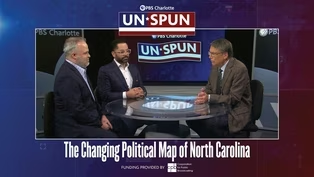
The Changing Political Map of North Carolina Preview | Unspun
Preview: S2 Ep213 | 30s | Pat McCrory examines shifting primaries and Donald Trump’s impact in North Carolina. (30s)
Providing Support for PBS.org
Learn Moreabout PBS online sponsorship
- News and Public Affairs

Top journalists deliver compelling original analysis of the hour's headlines.

- News and Public Affairs

FRONTLINE is investigative journalism that questions, explains and changes our world.












Support for PBS provided by:
Unspun is a local public television program presented by PBS Charlotte