
The Cheech
Season 15 Episode 1 | 57m 8sVideo has Closed Captions
Follow Cheech Marin's journey from comedy icon to Chicano art advocate.
The Cheech Marin Center for Chicano Art & Culture of the Riverside Art Museum showcases the actor's collection of more than 700 pieces by Mexican-American artists. Told through perspectives of established artists and those who know him best, the film tells his journey from comedy icon to Chicano art advocate.
Problems playing video? | Closed Captioning Feedback
Problems playing video? | Closed Captioning Feedback
Artbound is a local public television program presented by PBS SoCal
The Cheech
Season 15 Episode 1 | 57m 8sVideo has Closed Captions
The Cheech Marin Center for Chicano Art & Culture of the Riverside Art Museum showcases the actor's collection of more than 700 pieces by Mexican-American artists. Told through perspectives of established artists and those who know him best, the film tells his journey from comedy icon to Chicano art advocate.
Problems playing video? | Closed Captioning Feedback
Where to Watch Artbound
Artbound is available to stream on pbs.org and the PBS app.
Providing Support for PBS.org
Learn Moreabout PBS online sponsorshipCheech: Ha ha ha!
Woman: Cheech.
Man: Cheech is--of course he's a comedian.
Woman: I knew him as Rich, Rich Marin.
Woman: I was a teenager and, you know, the "Up In Smoke."
And so I was very aware of who Cheech was.
Man: He has carried the flag for Chicano art.
He has been a warrior for the cause for decades.
Man: He has incredible avarice to acquire and build his collection.
Woman: Well, he jokes around.
He's deep.
Cheech: "Why don't you have your own museum?"
I said, "Well, I should have a jet plane, too, but I don't have that either, you know?"
Ha ha!
[Theme music playing] ♪ Announcer: This program was made possible in part by a grant from Anne Ray Foundation, a Margaret A. Cargill Philanthropy; the Los Angeles County Board of Supervisors, through the Department of Arts and Culture; the City of Los Angeles Department of Cultural Affairs; and the National Endowment for the Arts.
♪ Cheech: Seeing the sign lit, especially lit up, which is the first time I saw it walking by the museum, "It's like, hey, you're officially in showbiz, art showbiz here."
It was--it was thrilling.
I mean, you know, never thought about it because it was outside of the realm of possibility.
So, seeing the sign lit up right in the center of town is really a--"Here we are.
We've arrived.
You know, our name in lights."
♪ I was collecting something all the time as I was a kid, whether it was baseball cards or marbles or matchbook covers or--or whatever it is.
I like these kind of themes.
This is in the bayous in Louisiana.
These other ones, these are smaller little-- Carl's paintings.
I love these.
Whenever they pop up, I try to grab them.
I had a tendency to try to collect the whole set.
You know, I want to get all of them.
And I learned how to do that.
You learn how to collect, you know.
And so it was always--I had that.
So, when it got to art, I applied it to that as well.
And this is a gift from Hugh Davies, one of my very best friends, who was the director of the San Diego Museum.
This is a painting that I recently acquired just recently, but I love this painting.
Woman: Well, Cheech likes what he likes.
He makes no qualms about it.
I mean, he never collected like a museum would collect, where it's, you know, encyclopedic or getting every particular artist.
He fell in love with pieces, and he often talks about how works haunt him.
And he sees and he looks at a painting.
If it's something that he walks away from, if it continues to haunt him, he'll go back and get that piece.
Cheech: Instinct plays a great part in collecting.
You know, you have to recognize instantly, almost, something that attracts you and something that has great elements and you develop that instinct, primarily seeing 10,000 images first.
But developing your centeredness.
Centeredness has a great deal to do with instinct.
My mantra had been, "You can't love or hate Chicano art unless you see it," because paintings have to be seen in person.
So, go to museums, 'cause that's where they are.
Woman: The Cheech has 700 pieces in his collection, and this is just a small fraction exhibited here.
So I think for a lot of people who have not experienced Chicano art, it's, um, you know, it's like discovering a whole new world.
Woman: Cheech is very well-versed in art history.
He has traveled the world, has been in many museums.
And when he saw this work, I think he saw himself in this work.
And he also saw amazing work.
He was just so passionate about making sure that this work was seen, and that other museums were aware of them.
Man: When I first arrived in Los Angeles at LACMA in 2006, one of the first agenda items for me was to talk to Cheech Marin.
I became very good friends with Cheech at that moment.
And of course, the rest is history, because we've been able to work on a lot of projects to give Chicano art of all kinds a stronger presence here at LACMA, but also to celebrate that in the world.
Cheech: Uh, this is-- how's this going over?
Govan: I think it's going over pretty good.
Couple of people tried to drive it out.
Cheech: Really?
Ha ha ha!
Ah, this is a great painting.
Govan: It really is.
It is, it is.
It's a masterpiece.
It has a sense of urgency.
Cheech: Yeah, yeah.
When I started exhibiting the collection, and we've played in over 50 museums, we did a big national tour that lasted for over 7 years, and we called it the Chicano Visions Tour.
And we traveled across the country featuring many Chicano artists that I collect.
Vincent Valdez was the youngest artist in the Chicano Visions tour.
He had just graduated from-- from RISD, which is, you know, one of the most prestigious art schools, maybe in the world.
Valdez: After I graduated from-- from school, I returned home to San Antonio, Texas.
I was living with my parents.
Um, you know, knew that I was going to be a full-time, working artist in the studio.
I was approached by museum curators, and they began including me in exhibitions.
And, uh--and so, as things started rolling, then one day I got a phone call from the director of the gallery saying, "I have a potential collector.
Can we come over and look at some works?"
"OK, so you have to come over to my parents' house."
I didn't know any better.
Uh, so the doorbell rings, we open the door, and there's Cheech Marin.
And so Cheech walks into my parents' bedroom where me, my mother, and my father are all standing in my parents' bedroom.
I reach under my mom's bed and I pull out a roll of canvas on her carpet.
Cheech: And it was rolled up in a tube.
And, uh, and his mother and father were there.
And it was that moment where, like, "Well, that was money good spent for RISD," you know, like... At that point, he convinced him that he was a real artist, and it was a serious thing for him.
And this is what he was gonna be.
Valdez: The painting was created in my final semester at the Rhode Island School of Design.
I think I was probably about 22 years old.
That moments that's captured defines not only who I was about to become as an artist, but it really marked a real transition for me in many-- in various ways, not only in terms of how I was learning to paint, but it also really blew wide open my own doors of perception about what my voice was about to become.
It's a battle between white America and brown America.
It's a battle between the servicemen and the pachucos with the zoot suitors, Mexican-Americans, Chicanos.
That a story in past American history is as relevant today as it was 75 years ago.
Cheech: I looked at this painting, and it was incredibly well-painted, and the construction of it was amazing.
And it was a historical event.
And I said, "I want to get this painting."
Valdez: Somebody like Cheech, you know, is--plays a powerful but a mere role.
It has to be a number of sparks that keep amplifying these voices and these messages, and eventually that becomes like an act of resistance in itself.
You know, a wildfire.
Govan: Everybody wants their selfie with--with Cheech, but he's also a very serious person.
He sits on our LACMA Board of Trustees, and he has done as much for the visibility of Chicano art, I think as anyone other than artists.
♪ Woman: This is a self-portrait when I was about 3.
Cheech: 3?
Woman: So I'm standing in front of the home that my grandfather owned, and with the arguing in the house, I felt like my world was starting to fall apart.
I was actually posing for my uncle, who was a photographer.
Cheech: Really?
Valdez: So I took his photograph, and the only change I made was adding the fissures on the cement, because that was depicting my world falling apart, so... Cheech: Every time I look at this, I see you're just, like, holding on for dear life.
Valdez: Oh, the little purse.
Cheech: The little purse or just like... Valdez: Yeah.
I really didn't know what was-- how my future was gonna be.
Yeah.
I was born and raised in East Los Angeles, and I went to high school during the walkouts.
I was a 10th grader.
I went to Garfield High School, and I realized that I needed to participate in the walkouts.
It was a political action against teachers that didn't really teach.
There was racism in the schools.
I would--I had a homemaking class, and my white teacher would say, "You better pay attention in this class, because one day you're gonna be cooking and cleaning for others."
And I would think, "What?
I'm gonna be a famous artist."
I mean, I had my own goals.
And when I have a goal, I'm very fierce.
I just go for it.
I started making art with an art group called ASCO, which consisted of 3 Chicano male artists and myself, and we started responding to the political atmosphere, things that were going on in my neighborhood, the racism I would encounter, the police brutality.
So, that started the performance group.
It was in response to what was going on in my neighborhood.
And within that group, I sort of took on a glamour role, because beauty also was not brown.
So, I took it upon myself to sort of say, "We're all so beautiful, we're talented, we're smart--all of the above."
And so we'd act these things out in the neighborhood.
That was the ideal audience.
And you shared it with the people.
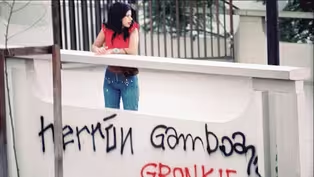
♪ Govan: You know, it wasn't long ago, as recently as 1972, um, that, uh, 3 artists from the ASCO Group, Chicano Group-- Herrón, Gamboa, and Gronk-- wrote that exactly in spray paint on LACMA's balcony as a protest about the fact that Chicano art wasn't shown at LACMA.
Valdez: The guys went and spray- painted LACMA and left me out.
And so I was so outraged that I was left out that, uh, one of the members drove me to LACMA the next morning before it got erased and photographed me in front of the spray painting of their names, and I was there physically.
I remember I was doing a walk through the open--one of my openings, I was in a gallery setting, and somebody attacked me and said, "Well, what are you doing politically for the people?"
And I said, "By the mere fact that I'm a Latina and an artist is a political act in itself, mister."
♪ Cheech: Oh, working away.
Govan: You might be constricted.
Cheech: Ah... Valdez: What's up, Jude?
Baca: Hey, hey.
Valdez: You meet my friend Michael Govan?
Baca: Cheech?
Um, I knew him as Rich, Rich Marin, and I met him in high school.
We were in a small class at Alemany-- Bishop Alemany High School.
His mother worked at our-- at the school.
And so I've known him since I was a teenager.
But over the years, as he became a famous comedian and he did his work, he started his collection and it grew and grew.
I'm actually not in his collection.
Um, I'm not sure why I'm not in his collection, but I'm not.
And he is a dear old friend.
Cheech: I went to high school with Judy Baca, and I didn't see her a long time, and then she got involved with the L.A.
River project, which kind of became the focus of her artistic output for the next however many years.
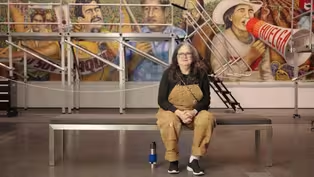
Baca: I came out of the university, trained as a minimalist painter studying gesture and color and non figurative work, which was really the sort of mode of the 19--early seventies and late sixties.
And I walked into a revolution.
Los Angeles was in upheaval, the Chicano moratorium was happening, and I looked at my capacity and my hands and realized that I was perfectly equipped to do nothing.
I was very interested in seeing what was going on in the street.
And on the street, I saw young people writing on the walls, and they were writing things that were sometimes really powerful statements.
And there was a statement on a wall at Mott and 2nd Street in Boyle Heights.
It said, "I'd rather live one day as a lion than 100 years as a lamb."
And I thought, "I get this."
Govan: Judy Baca is a famous artist...before her show at LACMA.
I mean, she's won the National Medal of Arts.
Her mural in the L.A.
River is one of the most famous paintings in the world.
But she will tell you herself, in those days, being a woman Chicana, chances of her being in the museum were small.
And so just paint outside.
Baca: In the 1970s, as people began to take to the painting on walls, there was a mission.
And the mission was really to speak to the people.
We painted a place in Hollenbeck Park, a mural called "Mi Abuelita."
Mind you, there were no public billboards in which a brown face was apparent.
So we were looking at the absence of our own lives in any public setting.
So to the act of painting a giant grandmother, a brown woman, an indigenous woman on a bandshell in Boyle Heights was outrageous.
I knew it was outrageous, and I expected a backlash.
I expected there would be trouble, but what I found was that the young men all related to this.
They all had a grandmother that they adored and that they followed and that they listened to.
And the grandmother became a favorite image of the neighborhoods.
And we began to put murals all over the city-- hundreds of them.
Cheech: Well, the Chicano movement started off as a political movement.
It just--it was--it mirrored the Civil Rights Movement of the sixties.
That's where the Chicano artists grew out of.
They were the sign painters for that movement.
They were the backdrop makers for Chicano plays.
And Luis Valdez and the Teatro Campesino, they were the signs, "Si se puede," that comes out of Chicano painters painting those signs.
Baca: We were driven by the intention of creating social change, education for the public and for people who never went to a museum, to people who were not necessarily art aficionados.
They were people who were neighborhood people.
Our thought was that we could transform people's ideas about who we were, by who we-- who we painted, and how we painted ourselves.
Every person we paint should be extraordinarily beautiful.
They should be beautiful, and they should be elevated, and that they should actually be a representation, if not who we are, who we want to be.
Space and scale is power.
So paint the longest mural with the biggest story of the recovery, not only of the river, but of the people who lived alongside of it.
That's what the Great Wall is about.
This is the oddest thing, isn't it?
We're in a museum, a place we never thought we would be.
It was not a place where my family would come, but things were transforming within the art world as the population changes dramatically.
A younger group is coming forward, so the museums have become more interested in how they can be more relevant to the public that they're addressing.
Cheech: Oh, this is good.
Woman: Oh, I love that.
Banks: After Chicano Visions, Cheech wanted to continue organizing exhibitions, and so I helped him collaborate with other museums across the country.
Oberjuerge: In 2017, the Riverside Art Museum worked with Melissa Richardson Banks to bring Cheech's exhibition to the Art Museum.
People were so excited.
Cheech: And it was the biggest attended show they had ever had.
Banks: And at that time, they had this beautiful public library that was going to go unused.
And this light went on the heads of the representatives from both the museum and the city of Riverside.
And they said, "What about asking Cheech?"
Cheech: They came to me, which is highly unusual.
Oberjuerge: We met Cheech in downtown L.A.
for pizza.
He really didn't know what we were gonna ask.
Cheech: They come up with this plan.
"Well, we'll offer it to Cheech for the collection.
He gives us the collection, and we give him the museum to house it in for--" And I didn't understand what they were saying at first.
You know, it's like, "You want me to buy a museum?"
Well, I'm doing pretty good, but I don't know if I'm museum-rich yet, you know?"
But "No, no, no.
We want to give you the museum.
You give us the collection, and we'll--and then it'll be the home for the collection and no other."
Banks: They plopped down this full-color brochure with pictures and a vision of what that museum would look like if it was, you know, had Cheech's name on it and had Cheech's art.
They just put together this wonderful piece.
Oberjuerge: And we pitched the public-private partnership to him.
"You have the collection.
Um, the city has an empty building.
Riverside Art Museum is willing to fundraise and to run it.
What do you say?"
Cheech: And so I thought about it, you know, like, "I have to give them this collection."
I've been 50 years putting this together, you know.
And so I was looking for a sign that I should do this, you know, because it was a big move, and so haphazardly, I was walking through the museum one day, I said, "Well, how big is this building that we're..." She says, "Well, it's 66,420 square feet."
I go, "420 squ... 420!
That's the sign!
OK, I'm supposed to do this."
And we started the process.
Oberjuerge: At the press conference that we had in May 2017, when we announced it, Cheech quipped that it would be called "the Cheech," and then the rest is history.
Cheech: The overwhelming need and the overwhelming interest, but mostly need that the Chicano community felt was like the dam burst and the doors opened and they all flooded.
And we--and we set attendance records and we were-- we were voted one of the top 50 shows in the world.
And this is kind of a drawing section, more-- We haven't put up these drawings, putting up these drawings before, but there are various artists Alex Rubio, CiCi Segura Gonzalez, uh, Carlos Donjuan, uh, Eloy Torres, John Valadez, the uh, "Getting Them Out of the Car."
You know, it's a--it shows the the aftermath of a drive-by shooting or a gang warfare or something, and the soul ascending into heaven and the people dealing with the aftermath, and then life goes on every day.
But the most fantastic thing about this painting is that it's a pastel.
He draws photo realistically with the pastels.
You can't get no more original gangster than-- than John Valadez.
He's--he was my idol.
Man: Being a Chicano and coming from a Chicano environment, we describe ourselves.
"I come from that generation."
What does it look like being a Chicano?
What is that?
So, that was--when we started in the late sixties, early seventies, that was what I had to focus on.
Being a Chicano is self-imposed.
If it bothers people, that's their problem.
That's not my problem.
It's the basis of what I do.
♪ The most principal thing as a realist was about what do we look like.
It's about identity.
So, my idea at the time was to do the very Western realist tradition of portraiture, but paint ourselves.
And that was a subversive act to paint in a realist, highly realist way, where I'm not getting caricature, I'm getting the person.
And the challenge was to get the presence, the essence of a person and put it in a gallery setting and dare people to buy highly rendered portraits of marginalized people you don't even want to look at walking down the street.
Cheech: For the most part, the Chicano artists, they were ignored by the art world.
You know, they were at most they were condescending, you know.
"Oh, well, he paints very good.
I don't know who that guy was, but he paints very good," you know, and dismissive.
Woman: LACMA, MOCA...all these L.A.
museums, for the most part, do not show Latino artists or Chicano artists.
Maybe currently they're starting to, but our representation is nowhere in this city, in our museums.
That's shameful.
Why can't we be a part of the American landscape?
So, don't get me started.
Ha ha!
I just... ♪ 2012, 2014, I was in a show at a place called ChimMaya.
The owner, Stephen, asked me if I had a large piece, and I did.
So, anyway, there I am, taking it over to the gallery.
Cheech happened to go to that show that day, and he immediately just--he loved it.
He loved the piece, and he did buy it.
And so that was my first encounter with him.
I went to East L.A.
College.
I became aware more of the struggles of the Latino people and Chicanos.
It was an enlightening moment for me.
So many things were going on-- the Vietnam War.
There were protests, and basically the kids said, "Basta.
No more.
we're not gonna take this anymore," and they walked out of the school.
So, I kind of moved into showing as a Chicana.
♪ My father is from Texas.
He's a Tex-Mex and was very proud of it.
You know, my father was in World War II, but when he came back from the war, he wouldn't be able to sit with the rest of his group because he wasn't allowed in the restaurant.
My mother, she, um, also experienced discrimination.
They had an idea of the word "Chicano."
For them, it was a negative.
Right?
It was a slang word, but it wasn't used as a compliment.
But as things progressed politically, um, the word "Chicano" was really-- And "Chicano" is really a word that has a lot of political strength to it.
Cheech: The origin of "Chicano" comes from-- it was an insult from Mexicans to other Mexicans living in this country now, and the concept being that the Mexicans who had moved from Mexico, uh, were not longer-- no longer Mexicanos because they had moved to another country.
They were something less.
They were--they were chicos, they were little Chicanos, little satellite Mexicans living in tin shacks along the border.
So that was--there was always that antagonism between those two groups.
And so, you know, you have a situation where you have a group that is an othered group in an already othered section of society.
When I heard the term "Chicano" and the term "Chicano" was explained to me--"That's what I am.
That's what I am.
I am this other.
I'm this other other," you know.
And that's how I identify myself.
Man: I mean, the sixties and seventies, the Chicano movement.
I didn't really connect with it, per se.
Like, you know, they're talking about the struggle, and in the sixties and seventies, it made sense.
Right?
But you don't have to follow that route.
Maybe esthetically or visually, you want to rebel against your parents where they do it a certain way, but then you come and become a teenager and you're like, "Oh, I don't want to do it that way."
And I think that's what keeps things interesting, right?
So, I think that's--right now, like, it is super interesting that we're, you know, we're not just looking at, you know, the struggle, but now we're looking at like, maybe cartoons.
We're looking at comic books, we're looking at MTV, we're looking at all these things that are bringing culture from this different spots, and we're sort of like taking them in.
Right?
We're doing like a remix or like we're taking them in, and we're like throwing up something new.
♪ Growing up in East L.A., it's just like they don't tell you where you fit in and within that narrative in the United States and/or in U.S.
culture.
East L.A.
has a long history with art muralism and--but it's not like mainstream stuff.
You know, I got accepted at an art school.
I mean, I loved it and it was really, really, really helpful.
And then I came back to L.A.
after I graduated.
I felt kind of lost.
I felt kind of defeated in some weird way.
I had no idea how to get off my foot into, like, a gallery or to any shows.
I felt like so isolated.
I wanted to rekindle that spark.
So, I thought, "Well, how did I get into art in the first place?"
I was like, "Well, it was through drawing."
I started to think these moments when I would draw, when I was about, I don't know, maybe 5 or 6 years old.
And I just thinking about those memories.
And I started to draw the landscape.
♪ And it felt really good.
And so that, I think, rekindled my love or my interest in making artwork again.
♪ So, I opened up on Instagram in 2016.
A reporter from the "L.A.
Times," she got ahold of that, and then she invites me to be interviewed by the "L.A.
Times."
That's what got me a foot into the door, I guess.
Man: I identify the original generation of Chicano artists with a certain "for us, by us" sensibility, in that it was intracultural.
The artists that I'm working with inherit tremendously from the original generation of Chicano artists, but they themselves grew up almost wholly American, and it's reflected in the work.
Contemporary Latinx artists are crossing over in ways that the original generation of Chicano artists did not.
Cheech: Graffiti and plein air painting, the studio painting, and the confrontive painting, and all those elements in the way these Chicano artists handle them is very influential to not only younger Chicano artists, but artists in general.
Lopez: I think with Chicanismo or Chicano art has always been a little political, but nowadays it feels more like it's more-- it's more global context and it just feels like more like open.
It feels more like if there's more info coming in.
I like--all these ideas are coming forth, and we're connecting them in a unique way, seen through the lens of, like, a large population of L.A., that for a long time has been ignored.
♪ Got this one-- bigger landscapes.
James: Yeah.
I know right where I am here.
Lopez: That's some South Central stuff right there, man.
James: So, Manuel makes the drawing.
So, there's a drawing that exists, and then this is basically a scan of the drawing that he uses as a reference when he makes the painting.
This thing is a perfect Manuel Lopez landscape.
Man: The gallery-- We are the, uh, the representatives of the artist.
So the reason we work with them is because we think this career is important and we think we can further it.
Lopez: Having a place that will sell your work so that you could get some money so you could eat, so you could pay rent, so you could, you know, pay for gas or you know, you need that to also keep moving.
And I think that it makes for a fertile ground, for sure.
Yeah.
Cheech: You know, making your living as an actor is a very hard thing, you know?
It pales in comparison to making your living as a painter because people don't need paintings.
Some people are lucky and get discovered early and establish an audience, and some people work their whole lives and never discover an audience.
We want to kind of cut down on that part of it and more focus on people getting discovered earlier and having a long artistic career that they can feed their family with.
♪ Woman: We're putting this one up.
Cheech: Oh!
Woman: Sandy's right here.
Cheech: That looks just like you.
Woman: Ha ha ha!
Woman: You know the story behind the makeup?
Cheech: No, I don't.
Rodriguez: So, this was a nude self-portrait.
Cheech: Oh.
Rodriquez: And at the tender age of 21, I was like, "I don't know if I can have a nude self-portrait out there."
Cheech: Mhm.
Rodriguez: So then, I put on a bathing suit, and I was like, "Nah... How about a payasa face?"
Cheech: Oh, OK.
It's funny how it evolves.
Rodriguez: I came of age in the nineties in terms of, um, consciousness of Chicana politics, art, and activism.
I had finished art school.
I didn't paint for a year.
I think a lot of us that went to art school know that there's a moment to kind of gather ourselves after we've undone ourselves and trying to put yourself back together.
So I did a self-portrait in 1998, and it was one of those, like, critical moments.
Fast-forward to 2008 or 2009.
Melissa had reached out and said, "Hey, we're organizing a show of small works for Cheech."
And that was the painting that Cheech wanted to get for the collection.
I decided it was critical at this point in my development to understand what does it mean to be a painter in Los Angeles and of the Americas, leveraging a history of art specific to this region?
So I ditched canvas and store-bought oils for working with pigments of the Americas and on sacred ceremonial paper.
So this paper that you see behind me is amate.
It's used for ritual.
It's used for ceremony.
It's used for recording histories.
And so if I'm going to tell stories of resistance, of our contemporary moment, it's gonna be on that wallpaper.
And I'm going to use the ceremonial pigments and the colorants of the Americas to tell these stories.
♪ Cheech: This one kills me.
It's just every aspect of this painting kills me.
This is a painting by Michael Alvarez.
It's called "I'm the Boss."
And just the look of this guy looking straight.
This is one of those.
Kind of like the eyes are looking at you wherever you go in the room, but the elements that are combined in this--in this painting just--just kill me.
He was the next generation of painters, Chicano painters that was coming out.
They weren't--weren't known yet.
Now, that was a big deal.
Alvarez: The first art book I'd ever gotten was "Chicano Visions So that was a book of Cheech's art and collection.
So, yeah, with Patssi Valdez on the front cover and John on the back, the huge, huge inspirations.
I think that may have been the first time I'd seen, at least within print or within any type of media, you know, artists that are from a similar location and environment that I grew up in that are painting worlds that I have some type of connection to and relationship to, I guess to see it like maybe honored and historicized as art kind of made me feel like there could be space for me in there as well.
Cheech: You know, the thing about--Michael Alvarez is really terrific.
His crowd is like the skateboarder guy of Mexicans, the Chicanos, you know, they hang around the parks and you see him all the time.
And I got turned onto him by juxtaposed magazines, old ones.
And I was leafing through them, and I saw this article on Michael Alvarez with his paintings.
I said, "Oh, these are terrific!"
And I said, "I got to meet this artist because really, these are spectacular."
Alvarez: And then I get a call from Melissa, you know, saying that Cheech is interested in my work and wants to talk to me.
And I thought it was a prank because my friends and I, it's kind of messed up.
But we pranked each other like that for sure.
And then sure enough, within that week, you know, he's visiting my studio.
I went to his little studio.
It's about a third of the size of this room.
And--and they were still there!
The paintings--"I'll take them all, you know, because they're all terrific.
How did you still have these paintings?"
Alvarez: That was a game change--it was a game changer.
♪ [Clattering] Going on a walk, or riding a bike or skateboarding, or just doing something recreational, where maybe like my mind can be stimulated, or my experiences or visual sensibilities are activated, at least for me, that just helps me feel-- I don't know about comfortable, but I feel good and I feel like I can exist.
[Rattling] [Paint spraying] Maybe there's a lot inside of me that like if I wasn't able to process it in either a creative way or a creatively engaging way, then, um, I might just dissolve into like some type of numbness or something.
I've been, you know, making art since I was about 2 or something like that.
So, I mean, it's a 38-year commitment.
♪ What I paint is generally-- I mean, it's all informed by a real-life and experience at least that I have within a world that I navigate, which is, you know, L.A.-centric, just only in the fact that, like, I was born and raised here and the up and the down and-- [Thud] ♪ While I was really like getting comfortable with spray paint and trying to figure out the different ways that I could use it and having that long-term investment, then I'm committing myself to oil paint and learning how to use it.
And then, you know, starting to go to Pasadena City College and then later Art Center College of Design.
So I'm from there, starting to learn like different types of fundamentals in terms of, uh, portraiture and, you know, figurative components and composition and color theory.
You know, I feel fortunate just to come from--from a culture and community where memorializing is such an important thing and kind of keeping people's, uh, memories alive and just kind of, uh, preserving their spirit.
At least for me, it kind of shows like, almost like a duality of what it's like growing up in L.A.-- real, uh, kind of tragedy and heartache that I'm familiar with and my family are familiar with.
And, you know, that's a reality of our world, but also, too, just the beauty of community and the beauty of, you know, family and the just beauty of love and support that I think can help us get by.
Cheech: To get yourself known, it's always good to assign yourself or join yourself to some group because the single artist has basically no power, you know, because he's not part of a movement and they don't attract museum attention or collector attention because of that, you know.
[Train whistle blows] Man: I think being in community with artists is extremely important, being that I didn't go to art school.
when I sort of first kind of entered, started going to art shows and trying to see what's up, I kind of felt out of place, but eventually I found my people.
I feel like they speak the same language.
We have a lot of similar backgrounds, similar stories.
I've always drawn.
I've always been interested in art-making, whether I thought about it in that way.
My early days of making art are like drawing cartoons, like, you know, copying Looney Tune drawings, making drawings of that, tagging graffiti really early.
I think doing graffiti was just something that I seen on the street, and I was always drawn towards being really young and seeing different graffiti around Los Angeles, whether like it was like graffiti that felt very dark, intimidating, sharp.
It just really had like such a strong presence and it was something I wanted to be a part of.
I went to L.A.
Trade Tech, which has a sign-painting program.
I eventually started working for companies that paint large outdoor advertisements, and through that type of work is where I really learned how to blend and how to fill in a background and just got comfortable painting.
Then I started working for a few different companies, one based out of New York, and with that company I was traveling a lot around the U.S.
I started visiting museums.
One really important show was "Art in the Streets" at the MOCA.
Very controversial show, but I think it was really inspiring to me and a lot of my peers, and I think we still think and talk about it.
That was the first time I seen people that I knew or I knew came from a similar background.
It just felt like accessible and familiar and possible, and I just felt like the need to capture and document the time I'm living in, my area, my community.
Cheech: Chicano art is constantly changing.
It's evolving all the time because of the generations that come in.
And they put on their--their, you know, expertise and their-- their interests.
And that's the beauty for me of Chicano art, how it keeps evolving.
Because for me, Chicano means evolution.
Man, over P.A.
: Train 6... Muñoz: The values and expectations of my family were to follow in the lineage of my uncles, which was, you know, working for this structural concrete company.
So I did.
I worked there from 2005 all the way to 2008.
That period was really formative to the way that I-- that I see and make.
Using industrial processes to make something, working off of a blueprint to make something.
The recession-- it was an important pivotal point in like my narrative, because I was fired.
I was doing warehouse work.
That allowed me like a stable schedule where I could pursue going to school at night.
My design teacher and mentor, he saw some of my paintings and encouraged me to, like, drop the design and go to art school.
He really encouraged me to apply to UCLA.
That was like another like turning point, too, that was random because up until that point, I applied to all design schools, and UCLA was the only one that I applied to for fine art.
I kind of said to myself if I were to get in, then I'll do it.
So when I did, I went for it, you know.
♪ I've always kind of been inspired to use different materials in my compositions and just trying to, like, incorporate different techniques.
[Liquid spritzing] A lot of the tools and techniques that I use in my work come from like commercial realms.
Airbrushing.
That kind of comes from like the world of automotive painting, but also advertising.
And I feel like that's just kind of what I'm familiar with.
That just comes natural, you know?
So 2018 and then 2019.
This is when I started, um, like my own practice...observations.
It's like I kind of keep record of like titles, dates, but also, too, I always try to find an opportunity to like, uh, take a portrait of myself just so that there's kind of like an archive of me, too.
I took all of them at that photo booth at Union Station, um, during my commutes to UCLA.
[Chuckling] Like, this is like a real early one.
So sometimes I just like to, like, look at myself at a specific point in my life, you know?
I'm Chicano, which means I'm Mexican-American.
My parents, uh, were born and grew up in Jalisco.
I find myself contemplating and thinking about the complex and diverse identity of this country and how important it is to, like, define my own identity as like an artist and maker, making certain narratives visible.
That's kind of like what I'm trying to do in the work, like just make, just simply make something that was historically like unseen, whitewashed, hidden, suppressed, visible.
Cheech: Chicano work can encompass historical events as well as the most intimate moments in people's lives and artists' lives with their lovers or their children or their grandparents or all those types all in the same time, told from a Chicano perspective.
Muñoz: I've always known about Cheech.
And a long time ago, I think 2017 or '18, I participated in a show at the Riverside Art Museum.
There was some interest in acquiring some work.
It never happened, though, but nonetheless I was like really excited to meet him at Deitch.
♪ Cheech: Hey.
Muñoz: Jaime.
Nice to meet you.
Cheech: Jaime.
This is your stuff here?
Lopez: Yeah, yeah, Cheech: Yeah, it's cool, man.
And this is yours?
Lopez: Yeah.
Cheech: Over here?
And you over there?
Gonzalez: Yeah.
Cheech: OK.
Go over there, then.
Ha ha!
No, no.
I'm just... I'm teasing you.
Oh, well, this is really amazing work for all three of you.
Wow.
Talk to me about this.
Muñoz: With this piece in particular, you know, I discovered this early 20th-century Russian play by Karel Capek called "Rossum's Universal Robots."
Cheech: "R.U.R."
Munoz: "R.U.R."
Cheech: Yes, I read it in high school.
When robots regained consciousness.
Muñoz: Yeah.
Cheech: We're going through that right now with Artificial Intelligence.
It's the same exact thing, man.
Muñoz: I've always been intrigued by science-fiction movies, literature, because I feel like they always kind of reflected something about the human condition that--that I related to.
Like "R.U.R."
was like the first science-fiction narrative that was kind of talking about some of the fears that the working class had specifically around, like, ethics, you know, like, can industry and democracy coexist?
Man: Something that marks the work of a number of the artists in the show is that they are fusing a sophisticated understanding of art history with an embrace of vernacular visual culture.
As an example, the work of Jaime Muñoz, you can talk with him in a very sophisticated way about art history.
His work references pop art reaching into real life in the vernacular and combining it with the great art historical pictorial tradition.
I also believe in the university of the streets.
And Alfonso Gonzalez Jr, whose work is behind us, and we're sitting on his bench, his education came from doing graffiti, being in a studio building.
That's as good an education often as being in an art school.
Cheech: It is.
Gonzalez: This series is looking at the lawyer advertisements all over L.A.
Cheech: Uh-huh.
It's an Espanol crowd.
Gonzalez: Exactly, exactly.
Take a look.
This is like a site-specific piece.
So it's made up of different canvases that I applied on the wall and then did like a fire extinguisher spray.
So I don't know if you ever seen these crazy sprays on the side of the freeway or on a building or whatever.
It's basically people fill up extinguishers with paint and tag with them.
You know, people have beef and tensions, so they cross each other out.
And then it sort of becomes like this abstraction that is similar to the AbEx movement, but it's almost a different conversation, which is what I'm exploring, which was always sort of caught my eye when I started studying or just going to museums because I didn't go to art school, but I started going to museums, and I started looking at-- Cheech: Me too.
That's how I learned going-- Gonzalez: Yeah, you just go and you look and-- Cheech: The libraries, too.
Gonzalez: Yeah, exactly.
Deitch: There are different channels, different routes to becoming a world-class artist.
It doesn't necessarily have to go through CalArts or Yale Art School.
Gonzalez: This is more of a traditional landscape, I guess you would say, where you see, like the sky, some trees.
But I'm really looking at the areas that I live in.
Cheech: I always talk about that, what a big aspect of what Chicano art is.
This is what my neighborhood looks like.
These are the people in my neighborhood.
Gonzalez: Exactly.
Cheech: This is what our concerns are in this neighborhood.
And, you know, it's just a perfect snapshot of it.
Yeah.
Gonzalez: Thank you.
Cheech: And you're good.
We want to let you live.
Gonzalez: Yeah.
Cheech: Michael!
What's up?
Alvarez: What's up, Cheech?
Cheech: Hey, man.
Good to see you.
I haven't seen you in a long-- Alvarez: Yeah, it's been a minute.
Cheech: How's everybody?
Alvarez: Everybody's OK.
Yeah.
And, you know, thankfully here with, like, a big group of friends and, like, yeah, just stoked for that opportunity.
Cheech: This is your-- you're going to do a different palette now, huh?
Alvarez: Yeah.
I think it's a bit lighter, a little softer, you know, than previous.
Cheech: It really fits with the outdoor.
Oh, these are nice.
Alvarez: Oh, thank you.
Cheech: All these trees in here.
Alvarez: Thanks.
Cheech: This is really cool.
The application of these.
Alvarez: Thank you.
Cheech: Yeah.
The characters.
This is great.
Alvarez: Thank you.
Cheech: I love this thing.
♪ Deitch: Well, I came into the art world during a period when it was all about art about art.
Art was about art.
The use of even figurative imagery, anecdotal imagery, was frowned upon.
And that was kind of a lower level.
You had to be more pure, but that is pretty much played out.
And the most interesting art today, I say, is art that reflects people's life experience.
So these artists here, it's so much about their experience of Los Angeles.
Part of the objective of a show like this is to bring the community here.
We had 3,000 people at the opening.
It was amazing.
Muñoz: Most things in the world is about who you know, and for a lot of us, it's like we're some of the first in our family to be showing art in the way we are.
So for Cheech to be collecting that work from these artists and to be that person to support, I think it's extremely important for someone like me.
Deitch: When I moved to Los Angeles in 2010 to become Director of the Museum of Contemporary Art, one of the first calls that I received was from Cheech, and he said, "You have to come over to my place--" You were in Malibu then.
Cheech: Malibu.
Deitch: "and see the art that I collect," saying, "These are great artists.
Most of them are not in the museum yet, and you have to pay attention."
So now the artists in the show, I don't think, need to fight anymore to be recognized.
They are, in fact, defining the scene.
It's just the opposite.
Cheech: They have that work ethic and that, you know, "OK, we're gonna make it, you know," so they're my kids.
you know.
I want them to do very well and have a secure job and raise a family and pass that tradition on to them, because now they see that that's possible.
♪ Like, so colorful.
And these came out great!
Woman: I know.
This whole wall-- Cheech: I mean, this is-- Woman: fantastic.
James: How you doing?
What's up?
Charlie James.
Cheech: Hey, Charlie James.
How you doing?
James: ...Velasquez.
Velasquez: Good to see you.
How you been?
Cheech: I've been good.
How you been?
What's up, dude?
Muñoz: How are you?
Cheech: Everything good, man?
Muñoz: Great, great.
Yeah, yeah.
What's up, Cheech?
How are you?
This is Manuel.
Cheech: Manuel, how are you?
Manuel: I'm good.
Yourself?
Cheech: I'm OK.
Alvarez: Great to see you.
Cheech: There's many times in this last year that I struggled with, "Man, was I happier just having the collection or now having the museum?"
Overwhelmingly, the answer is having a museum because of its openness and exposure to the whole big world.
And I hear it every day.
Every day.
I've experienced nothing but 99.9% joy.
And what is it accomplished for the community can't be understated.
Banks: What has happened, what it is today is more than we could have ever dreamed of.
And I think, Cheech-- he says it a lot-- "I can't believe--I never would have dreamed this is what would be."
And it was really the answer to what he was searching for.
He wanted to provide a legacy for the art and the artists.
Fernandez: I hear it from so many people.
I want to go to the Cheech.
I want to see like things that I've never seen before, all these Latino Chicano painters together.
Valdez: The great thing about the Cheech Marin Museum is that young people get to see themselves reflected in the work that's on those walls.
So they're bringing our neighborhood into these gallery settings.
So that museum is a very important place for our youth and for all of us, really.
Valdez: There is--there is the beginning of some kind of shift in the wind.
Right?
The art world in itself is now much more aware than it ever was about artists of color, about the role, the experience, and the historical importance and significance contributions of Chicanos and Mexican-Americans in this country.
Cheech: The final imprimatur of cultural acceptance is the establishment of a museum.
That means that everybody--it's official now.
We accept this as a true art and worthy of having a museum built around it, but this one fell out of the sky, you know.
It was like-- like "The Wizard of Oz" when the house is twirling through the sky.
And I said, "If I stand on this 'X,' it's gonna land on me.
So, I'll just brace for impact here and see what happens," you know?
[Imitates crash] And flowers came out.
You know, it's beautiful.
♪ [Clack] Man: Got it.
Woman: So, what is the number 420?
Cheech: 420.
420 is a big stoner number.
That's the time that everybody smokes weed.
[Chuckles] And so I said, "Well, that's a pretty good sign, you know, given its roots--" my roots, you know.
Woman: Wow.
I didn't know that.
Cheech: Where are you from?
They have no--they don't have any 420 there?
[Woman laughing] OK.
You're in need of an injection of 420 humor.
Ha ha ha!
Patssi Valdez and the Power of Chicana Art in Protest and Performance
Clip: S15 Ep1 | 3m 2s | Patssi Valdez, a Chicana artist drew inspiration from the activism in her community to pursue art. (3m 2s)
Preview: S15 Ep1 | 1m | Follow Cheech Marin's journey from comedy icon to Chicano art advocate. (1m)
Judy Baca and the Power of Murals in Los Angeles
Clip: S15 Ep1 | 4m 49s | Judy Baca, Chicana artist and activist, shares her story behind the inspiration of muralist artwork. (4m 49s)
Providing Support for PBS.org
Learn Moreabout PBS online sponsorship New Episode
- Arts and Music

Innovative musicians from every genre perform live in the longest-running music series.
 New Episode
- Arts and Music

Intimate portraits of six of the most influential and celebrated classical music artists.



 New Episode


 New Episode
 New Episode
 New Episode
Support for PBS provided by:
Artbound is a local public television program presented by PBS SoCal