
‘The Chinese Lady,’ Rose Morton, ‘GOSPEL,’ Weekend events
Season 8 Episode 32 | 26m 46sVideo has Closed Captions
“The Chinese Lady” play, Rose Morton’s ancestry, PBS “GOSPEL” series and weekend
“The Chinese Lady,” a play about the first Chinese woman in America, makes its Michigan premiere at Tipping Point Theatre in Northville. Author Rose Morton traces her family’s enslaved ancestry in her book “Our Family’s Keepers.” A look at Henry Louis Gates, Jr.’s “GOSPEL” documentary series and a performance from gospel singer Kevin Stewart. Plus, some events coming up with weekend.
Problems playing video? | Closed Captioning Feedback
Problems playing video? | Closed Captioning Feedback
One Detroit is a local public television program presented by Detroit PBS
‘The Chinese Lady,’ Rose Morton, ‘GOSPEL,’ Weekend events
Season 8 Episode 32 | 26m 46sVideo has Closed Captions
“The Chinese Lady,” a play about the first Chinese woman in America, makes its Michigan premiere at Tipping Point Theatre in Northville. Author Rose Morton traces her family’s enslaved ancestry in her book “Our Family’s Keepers.” A look at Henry Louis Gates, Jr.’s “GOSPEL” documentary series and a performance from gospel singer Kevin Stewart. Plus, some events coming up with weekend.
Problems playing video? | Closed Captioning Feedback
How to Watch One Detroit
One Detroit is available to stream on pbs.org and the free PBS App, available on iPhone, Apple TV, Android TV, Android smartphones, Amazon Fire TV, Amazon Fire Tablet, Roku, Samsung Smart TV, and Vizio.
Providing Support for PBS.org
Learn Moreabout PBS online sponsorship- [Narrator] Coming up on "One Detroit," the story of the first Chinese female to set foot on U.S. soil in 1834 is told in a new theater production.
Plus, in recognition of Black History Month, we'll meet a local woman who set out to learn the history of her enslaved ancestors.
Also ahead, we'll preview a new PBS series about gospel music and its role in the African American experience.
Plus, we'll have a performance from Detroit gospel artist Kevin Stewart.
And we'll share some ideas on how to jumpstart your Valentine's Day celebration with events taking place this weekend.
It's all coming up next on "One Detroit."
- [Narrator For Commercial] From Delta Faucets to Behr Paint, Masco Corporation is proud to deliver products that enhance the way consumers all over the world experience and enjoy their living spaces.
Masco, serving Michigan communities since 1929.
Support for this program is provided by the Cynthia and Edsel Ford Fund for Journalism at Detroit Public TV.
- [Narrator For Commercial] The DTE Foundation is a proud sponsor of Detroit Public TV.
Among the state's largest foundations committed to Michigan-focused giving, we support organizations that are doing exceptional work in our state.
Visit dtefoundation.com to learn more.
- [Narrator For Commercial] Nissan Foundation and viewers like you.
(upbeat music) - [Narrator] Just ahead on "One Detroit," a local woman visits the plantation where her ancestors were enslaved to find out more about her family history.
Plus, a new four-hour PBS documentary series examines the origin and evolution of gospel music in the Black church.
Also ahead, a performance by Detroit gospel singer Kevin Stewart.
And Dave Wagner of 90.9 WRCJ has a list of events you might wanna check out this weekend.
But first up, the remarkable story of a teenager believed to be the first Chinese female to set foot in America 190 years ago is being told in a production at the Tipping Point Theater in Northville.
The play is entitled "The Chinese Lady," and it tells how 14-year-old Afong Moy is put on public display for a half century for curious Americans to view.
"One Detroit's" Bill Kubota has more on this rarely told story that has been lost in time.
(peaceful music) - [Bill] The Tipping Point Theater in Northville, dress rehearsal.
The play is called "The Chinese Lady."
- Hello, my name is Afong Moy.
It is the year 1834.
I am 14 years old and newly arrived in America.
- When I read "The Chinese Lady" and when I saw it for the first time, it really was one of the first pieces of theater that I completely identified with and made me feel seen.
- My family has sold me for two years of service to Misters Nathaniel and Frederick Carnes, traders of Far East Oriental Imports to New York.
- Well, "The Chinese Lady" follows the story of Afong Moy who we believe may be the first Chinese woman to arrive in the United States in the 1800s.
- [Bill] "The Chinese Lady" by playwright Lloyd Suh first premiered out East in 2018.
Afung Moy, famous in her seating room two centuries ago.
Details of her life are sparse, speculative, so Suh was unbound to give her voice the press accounts back then did not.
- Thank you for coming to see me.
- Not a lot of people know her story, so it's a take on her life story.
But it's also taking creative liberties of what her story means to the present and to the future.
- Shrimp and Chinese vegetables, pot of tea.
- I will eat these foods with chopsticks.
- It follows her journey from that arrival all the way to the end of her sort of visible presence in the public.
But it definitely gives us a glimpse of a woman who was brought to the U.S. as an object for exhibition, as an example of exotic oriental otherness for the education of the American public.
- Her life was a performance.
She did things for the sake of the people looking at her, the gaze.
We talk about the gaze in the show of what people are seeing and not understanding.
- What do you think it feels like?
And they look at me.
They look at my eyes, at my hair, at my face.
They say things to each other.
"Do you think she..." "I wonder if she..." "And my goodness, look at her feet."
- [Bill] Afong traveled the country on display, a human attraction with bound feet, a curiosity with the artifacts her promoters offered for sale.
For a time, Afong appeared with her servant and interpreter named Atung.
- From a 21st century point of view, it's like, wow.
I guess, I don't know.
It must have been because of the times.
But I always marvel at the fact that, you know, these things happened and, to be honest, that it does continue in some way today.
- I am finished, Atung.
- Very well.
- Atung is a servant.
Afong is the person who is brought in as the exhibition, the star of the show.
And they have a contentious relationship.
Because she's a young girl, and they're both in a situation where they don't necessarily want to be there.
They don't have agency over their lives.
And so they only have each other.
- Don't you care about representing your people and your homeland?
- I'm just here to translate.
- Atung is someone that has a voice that maybe he's developed through the years, but is not either allowed to express that voice or even encouraged, you know, to discuss his opinions, his thoughts.
- What are we doing here, Atung?
- I don't know what you mean.
- Is it good what we are doing?
Does it matter?
- I do not think about that.
- Throughout the play, the relationship between Afong and Atung deepen.
He's more comfortable in expressing who he is, his thoughts and his feelings.
- Sometimes when I dream, I dream of China.
But most of the time when I dream, I dream of this room.
In the dream, it is my room.
- I think that's how he finds himself, and he finds himself in this relationship with someone that's in the same situation as him.
- Also in this dream, she cannot speak for me.
No one can speak for me, in the dream or otherwise.
I speak for myself.
- [Bill] Through Atung and Afong, we hear about the Opium Wars, the Gold Rush and the Transcontinental Railroad as more Chinese arrive.
Afong would not be an attraction anymore.
- It is very relevant to Asian American history, but it is super relevant to American history.
Her story is not just one community's story, it's our story as Americans.
So I think with the audience that is coming in, I think it can be a wide ranging variety of backgrounds and they're still gonna walk away with something.
- This is the Michigan premiere of the show.
I grew up in Michigan, so it means a lot to be back in my home state doing this show.
- For many theater artists who go to school here who come up in Michigan, even if they're not Asian, if they're White, they're Black, they're Latino, they're going to go to Los Angeles or New York because that's just the reality of where the industry is.
However, there has been very, very little opportunity for Asian Americans to do work here in Michigan until recently.
And I hope that this is just a beginning.
- Growing up as an Asian American in the Midwest is very different from growing up on the coasts.
And I definitely had a lot of experiences growing up here of being the only Asian person in a class, being the only Asian person in certain spaces.
So to be able to do this show that I hope not only represents the Asian American community here but I hope that a lot of other people identify with, I'm just really excited to see how our audiences respond.
- What do you think it feels like as they look at me?
So let's do that.
Let's look at each other.
- It's wonderful to think that perhaps this could herald something in terms of a changing tide.
- Are you looking at me?
- I think because of the changing population, the changing times, the conversations that people have had... - Can you see me?
- [Jasmine] We're seeing the need for new voices and new people to be heard.
♪ (lyrics in foreign language) ♪ ♪ (lyrics in foreign language) ♪ (audience applauding) - [Narrator] "The Chinese lady" runs through March 3rd at the Tipping Point Theater.
Tracing family roots has gained popularity in recent years as more people become interested in learning about their ancestry.
A Detroit area woman who went in search of her family history discovered some interesting information about her enslaved ancestors and the families that owned them.
Contributor Daijah Moss sat down with Rose Morton to talk about that painful part of her family history.
(peaceful music) (melancholy music) (melancholy music continues) - [Daijah] Rose Ella Morton's journey tracing her ancestors took her to the Middleton Plantation in Charleston, South Carolina in 2002 where she discovered her direct relationship to a key figure in the American Revolutionary War.
- This would be my great-grandfather, Goodloe Harper Yancey, because he's the one they had a baby by, yeah.
- Ella?
- Yeah, he had Ella.
- You did something so powerful and so unique.
You took a trip down your ancestral history, literally.
Take me back to the beginning.
Tell me about that.
- I was in front of my mother's house one day.
And I was picking up my kids.
And my brother was outside.
And he had been doing research and he had some pictures.
And he said, "Look at this picture.
"This is our last slave owner."
I said: What?
I said: Let me see.
And as soon as I saw the picture, I kind of like froze.
I got scared.
I couldn't understand what I was feeling.
Something about his face.
I felt he could hurt me right there on the spot.
I felt like he could control me.
It was just, I was afraid.
And I didn't like the feeling I felt; it was really weird.
And that's what got me all involved to wanna find out what had me so afraid.
- You tied together all of these different pieces that led you to different plantations.
You even wrote a book that highlights the story.
Tell me about your journey with acquiring all of the different documents.
- We went through the libraries.
I start doing my ancestry search on family trees and stuff and going through that.
And my brother, he had started at about 16 years old.
He was going down to my grandmother's house in Alabama.
And he would ask her, she was still alive then.
He would ask her about things and she would tell him stories.
At that time, I wasn't interested in everything.
But then all the stories she told helped me enter my journey because I started putting all that stuff together.
- And I know that, of course, you did a lot of the research.
And I know that your brother helped you along the way.
- Right, my brother did have a couple of pictures.
After I started journeying out into the slave owners, he wanted me to...
He said, "Don't bother with them."
He said, "Just keep it in... "Just find out things about the Black side, "the slaves, the ancestors.
"We don't wanna go into that part."
And I said to myself: That doesn't make sense.
I said: In order for me to find out more about my people, I gotta find the White people that had them.
So that's when I started.
I took it out towards going to find the White slave owners and stuff and going to the plantations and stuff.
I started out collecting information.
My brother had pulled up something about the plantations and everything that they were on.
And it was like three plantations.
And the story sounded real good.
I said, you know what?
I think I'm going to visit every plantation my ancestors were enslaved.
He said, "Well, if you're gonna take a visit, "I wanna go with you."
So that started off my first trip.
So we went to Charleston, South Carolina.
It was in February, 2002.
We went to the Middleton Plantation.
- When you went back to these plantations, you were essentially, in a way, traveling back in time.
What was the feeling that you felt when you were there?
- As soon as I got on the ground, I could feel, like I said, I could feel it move up under my feet and everything.
It was kind of, it was beautiful.
It was beautiful.
But I also know, you don't go back to an ancestors' place where your ancestors was at, where they slaved and died, without them coming back with you, some coming back when you leave.
So some of 'em did follow me back.
I know they did.
- So you are a part of the Daughters of the American Revolution, which not many Black women are a part of.
How did you become a part of that group?
- My great-grandmother, Ella, who I'm named after, Ella Snow, she's a product of the slave master's son.
His name was Goodloe Harper Yancey.
And she couldn't tell nobody that was her father.
Her great grandfather, which was named James Yancey, served in the American Revolutionary War.
And so that was my connection.
- What does it mean to you to be a part of the Daughters of the American Revolution as a Black woman?
- The first Black woman, she joined the group in 1977.
And the reason that I joined was not I'm so patriotic.
I'm not.
The main purpose, which only I care about, is to take in my grandmother, great-grandmother from the position of couldn't claim her father to her record being in Washington that she is the daughter of this man.
And that's what I wanted.
- And I'm sure that you plan to pass this journey along to the generations to come.
Why is it important for them to have access to this information and to be able to continue that legacy?
- Well, I don't want them to ever be ashamed of where they came from.
And I want them to know, it was very important people, that they were strong.
And they had to be strong so they could survive, you know.
Certain times bring about different feelings.
Like right now, we're in the feeling where everybody wants to find out.
But will they wanna find out?
Will they really care about it?
I really don't know.
But if they do, everything is there for them.
- [Narrator] If you are looking for somewhere to go this weekend for fun and entertainment, there are plenty of events and activities to choose from.
Here's Dave Wagner of 90.9 WRCJ with today's "One Detroit Weekend."
- Hi, I'm Dave Wagner with 90.9 WRCJ here to get you excited for the upcoming weekend.
With Valentine's Day next week, why not get the celebration started early with a Valentine's Soul Jam Saturday at the Fox Theater at seven p.m.
Performers include Russell Thompkins Jr., The New Stylistics, Heatwave, Bloodstone, Enchantment, and The Intruders.
And it isn't Valentine's without chocolate.
And downtown Chelsea has us covered with the Chocolate Extravaganza all day Saturday.
The events during the festival include the Cocoa Crawl, shopping, demos, vendor markets, and more.
On Sunday, the Birmingham Concert Band holds their performance entitled Elements of Nature at the Lutheran Church of the Redeemer in Birmingham where they will play music representing earth, wind, water, and fire.
And Friday is the opening of "Lend Me a Tenor" at the Farmington Players.
It's the story of a world famous tenor who hilariously cannot make the performance.
What happens next will leave you laughing till you cry.
And for those who enjoy stories of forbidden romance and star-crossed lovers, you can check out a modern interpretation of "Romeo and Juliet."
Stagecrafters is performing the great Shakespeare play through February 25th on the Main Stage in the Baldwin Theater.
And, of course, there's so much more to do around here.
So let's check out a few more.
Have a fantastic weekend, everyone.
(mid tempo jazz music) (mid tempo jazz music continues) - [Narrator] Noted historian and storyteller, Professor Henry Louis Gates Jr., has a new documentary series airing on PBS called "Gospel."
The four-hour series explores the rich history of Black spirituality through sermon and song.
Gates talks with religious leaders, music artists, and scholars about gospel's origins and its impact around the world.
The presentation begins with a special gospel concert on Friday, February 9th at 10 p.m. here on Detroit Public Television, followed by the docuseries on Monday and Tuesday, February 12th and 13th at nine p.m.
Here's a preview.
(inspirational organ music) - [Prof. Gates] From the blues to hip hop, African Americans have driven sonic innovation for more than a century.
(inspirational organ music) While styles have changed, there's one sound that's remained constant, a source of strength and courage, comfort and wisdom, gospel.
- That's a little bit of the gospel.
(instrumental gospel music) - Gospel music is soul.
Gospel music is R&B.
Gospel music is funk, it's hip hop.
Gospel music is the full spectrum in terms of its sound, of Black music and beyond.
- Mahalia Jackson, what was special about her voice?
♪ Up to the walls of Jericho ♪ ♪ Marched with spear in hand ♪ - She believed every word she was singing and she wanted you to believe it.
♪ The battle was in God's hands ♪ ♪ Oh yeah, Joshua fit the battle of Jericho ♪ (audience cheering and applauding) (inspirational music) - Preachers have style.
Gospel singers have style, right?
♪ Can't nobody do me like Jesus ♪ - Black style in music and preaching is similar because it allows Black people to believe that they can survive a bit longer.
♪ He's my friend ♪ ♪ Can't nobody (can't nobody) ♪ My mother had gone to New Bethel Baptist Church.
♪ Is God still standing there ♪ C.L.
Franklin would preach and then Aretha would sing.
Oh my God, if you ain't got the Spirit then, you dead.
- The sermon becomes the song.
The song becomes the sermon.
- God, we ask that you would reinvigorate somebody.
- It's almost as if there's a soundtrack in a church setting.
- Amen, brother.
That was beautiful.
For generations, gospel music and preaching have formed the bedrock of the Black religious experience.
- The sound still connects people.
The sound still gathers people.
♪ Oh oh, can't nobody do me like Jesus ♪ ♪ Can't nobody do me like Jesus ♪ - These astonishing art forms' caring and enduring tradition continue to evolve.
Do you think there will always be gospel music 100 years from now?
- I don't see how we can thrive without gospel music.
- [Prof. Gates] That's right.
- I say it's gonna always be there forever.
- [Prof. Gates] Listen as we tell the story of how a people learn to sing the Lord's songs in a strange land.
♪ Can't nobody (nobody) do me like (nobody) ♪ This is the powerful story of gospel.
♪ Aye aye aye aye aye ♪ ♪ He's my (He's my friend) ♪ ♪ Hey hey hey hey hey hey yeah ♪ (upbeat instrumental gospel music) - [Narrator] Detroit plays a major role in the "Gospel" docuseries.
From Aretha Franklin to the Winans and Clark Sisters, a number of gospel artists have called Detroit home.
We're going to leave you now with local gospel recording artist Kevin Stewart singing "Come By Here" taken from his recent appearance on "Detroit Performs Live from Marygrove."
And make sure to watch another gospel-centric edition of "Detroit Performs" next Wednesday, February 14th at 7:30 p.m. ♪ Who is this King of Glory ♪ ♪ Who is the King of Glory ♪ ♪ The Lord God strong and mighty ♪ ♪ The Lord God strong and mighty ♪ ♪ The Lord God mighty in battle ♪ ♪ The Lord God's mighty in battle ♪ ♪ No one else like Him ♪ ♪ So life up your heads, O ye gates so he can come on in ♪ ♪ Come on ♪ ♪ You say (come on in) ♪ ♪ Who is this King of Glory ♪ ♪ Who is the King of Glory ♪ ♪ The Lord God strong and mighty ♪ ♪ The Lord God strong and mighty ♪ ♪ He's the Lord God mighty in battle ♪ ♪ The Lord God mighty in battle ♪ ♪ There's no one else like Him ♪ ♪ So life up your heads, O ye gates so he can come on in ♪ ♪ Lord ♪ ♪ Lord, come on in ♪ ♪ Lord, come on, come on ♪ ♪ Come on in, God (come on in) ♪ ♪ So when I was younger, ♪ ♪ Grandma used to sing it something like this, listen ♪ ♪ Come by here, my Lord, come by here ♪ ♪ Come by here, my Lord, come by here ♪ ♪ Come by here, my Lord, come by here ♪ ♪ Oh Lord, come by here ♪ ♪ You said it (come by here, my Lord, come by here) ♪ ♪ Come by here, Lord (come by here, my Lord, come by here) ♪ ♪ When I see you, come by here, Father ♪ ♪ Come by here, my Lord, come by here ♪ ♪ So we sing, oh Lord (oh Lord) ♪ ♪ We're crying out, oh Lord, yes we are (oh Lord) ♪ ♪ Oh oh oh oh oh oh oh oh (oh Lord) ♪ ♪ Father when I sit down to crying out, oh Lord ♪ ♪ Come by here, Lord ♪ ♪ Clap your hands ♪ ♪ Hey aye aye aye aye aye aye ♪ ♪ Hey, come by here, Lord (come by here) ♪ ♪ Come by here, Jesus (come by here) ♪ ♪ Come by here, Lord (come by here) ♪ ♪ I'm asking you to stop by (come by here) ♪ ♪ Please stop by here, Jesus (come by here) ♪ ♪ We need you to stop by (come by here) ♪ ♪ I'm asking you to (come by here) ♪ ♪ I need you to stop by, Jesus (come by here) ♪ ♪ Hey hey, come by here, Lord (come by here, Lord) ♪ ♪ Come by here, Lord (come by here, Lord) ♪ ♪ We need you to stop by (come by here, Lord) ♪ ♪ We need you to stop by (come by here, Lord) ♪ ♪ Come see about me, Jesus (come by here, Lord) ♪ ♪ Go see about my family (come by here, Lord) ♪ ♪ Go see about my friends (come by here, Lord) ♪ ♪ Ooooh, come by here, Lord (come by here) ♪ ♪ I'm asking you to, God (come by here) ♪ ♪ I'm begging you, Jesus (come by here) ♪ ♪ We need you to come by ♪ - [Narrator For Commercial] From Delta Faucets to Behr Paint, Masco Corporation is proud to deliver products that enhance the way consumers all over the world experience and enjoy their living spaces.
Masco, serving Michigan communities since 1929.
Support for this program is provided by the Cynthia and Edsel Ford Fund for Journalism at Detroit Public TV.
- [Narrator For Commercial] The DTE Foundation is a proud sponsor of Detroit Public TV.
Among the state's largest foundations committed to Michigan-focused giving, we support organizations that are doing exceptional work in our state.
Visit dtefoundation.com to learn more.
- [Narrator For Commercial] Nissan Foundation and viewers like you.
(mid tempo music) (playful piano notes)

Gospel singer Kevin Stewart performs at Greater Grace Temple
Video has Closed Captions
Clip: S8 Ep32 | 3m 24s | Gospel singer Kevin Stewart performs “Come by Here” at Greater Grace Temple in Detroit. (3m 24s)
One Detroit Weekend: February 9, 2024
Video has Closed Captions
Clip: S8 Ep32 | 1m 49s | Find out what’s happening in and around Detroit this weekend on “One Detroit Weekend.” (1m 49s)
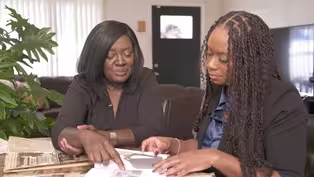
Rose Morton traces her ancestry in ‘Our Family’s Keepers’
Video has Closed Captions
Clip: S8 Ep32 | 6m 8s | Rose Morton unravels her family’s history of slavery in her book “Our Family’s Keepers.” (6m 8s)
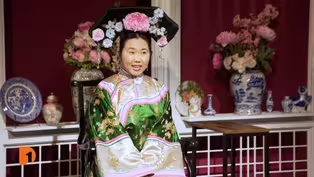
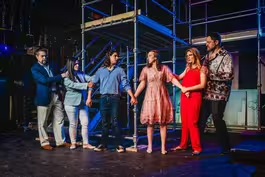
‘The Chinese Lady’ makes its Michigan premiere in Northville
Video has Closed Captions
Clip: S8 Ep32 | 7m 14s | Lloyd Suh’s play about the first Chinese woman to arrive in America premieres in Michigan. (7m 14s)
Providing Support for PBS.org
Learn Moreabout PBS online sponsorship
- News and Public Affairs

Top journalists deliver compelling original analysis of the hour's headlines.

- News and Public Affairs

FRONTLINE is investigative journalism that questions, explains and changes our world.












Support for PBS provided by:
One Detroit is a local public television program presented by Detroit PBS