
The Conviction Integrity Unit/Tuskegee Airmen
Season 49 Episode 12 | 23m 55sVideo has Closed Captions
The Conviction Integrity Unit/Tuskegee Airmen | Episode 4912
A program that is providing justice for individuals convicted of crimes they didn’t commit. Stephen talks with the director of Wayne county’s conviction integrity unit and with two men who were freed after being wrongfully convicted of murder. Plus, a milestone anniversary for the famed Tuskegee airmen, and a new home for their national museum. Episode 4912
Problems playing video? | Closed Captioning Feedback
Problems playing video? | Closed Captioning Feedback
American Black Journal is a local public television program presented by Detroit PBS
The Conviction Integrity Unit/Tuskegee Airmen
Season 49 Episode 12 | 23m 55sVideo has Closed Captions
A program that is providing justice for individuals convicted of crimes they didn’t commit. Stephen talks with the director of Wayne county’s conviction integrity unit and with two men who were freed after being wrongfully convicted of murder. Plus, a milestone anniversary for the famed Tuskegee airmen, and a new home for their national museum. Episode 4912
Problems playing video? | Closed Captioning Feedback
How to Watch American Black Journal
American Black Journal is available to stream on pbs.org and the free PBS App, available on iPhone, Apple TV, Android TV, Android smartphones, Amazon Fire TV, Amazon Fire Tablet, Roku, Samsung Smart TV, and Vizio.
Providing Support for PBS.org
Learn Moreabout PBS online sponsorshipComing up on "American Black Journal," we'll talk about a program that's providing justice for individuals convicted of crimes they didn't commit.
We'll talk with the director of Wayne County's Conviction Integrity Unit, and with two men who were freed after being wrongfully convicted of murder, plus a milestone anniversary for the famed Tuskegee Airmen and a new home for their national museum.
Stay right there.
"American Black Journal" starts now.
Announcer 1: From Delta faucets to Behr paint.
Masco Corporation is proud to deliver products that enhance the way consumers all over the world experience and enjoy their living spaces.
Masco, serving Michigan communities since 1929.
Announcer 2: Support also provided by the Cynthia and Edsel Ford Fund for Journalism at Detroit Public TV.
Announcer 1: The DTE Foundation proudly supports 50 years of "American Black Journal" in covering African-American history, culture and politics.
The DTE Foundation and "American Black Journal," partners in presenting African-American perspectives about our communities and in our world.
Announcer 2: Also brought to you by AAA, Nissan Foundation, Ally, Impact at Home, UAW Solidarity Forever, and viewers like you.
Thank you.
♪♪ Welcome to "American Black Journal".
I'm Stephen Henderson, and I'm really glad you've joined us.
Imagine going to prison for a crime you didn't commit.
There's a program here in Michigan that's trying to right those kinds of wrongs and get justice for the innocent.
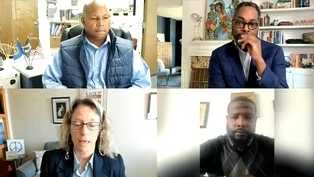
The Conviction Integrity Unit at the Wayne County Prosecutor's Office was created in 2018 and it has helped to free 28 people by investigating new evidence in their cases.
I spoke with the program's director, Valerie Newman, and two men who were exonerated, Danny Burton and Marvin Cotton.
Valerie, I'm gonna start with you.
Tell us about this Conviction Integrity Unit in the Prosecutor's Office, why you're doing it and how it works.
Sure, thank you, Stephen.
Well, the Conviction Integrity Unit is a unit within the Wayne County Prosecutor's Office.
Our mission as a unit is to investigate credible claims of innocence that have new information that's been presented that can support the innocence claim.
So for listeners, viewers to understand, it's kind of like an Innocence Project, but in the Prosecutor's Officer.
We've been up and running since 2018, and to date, 28 men have had their convictions vacated, convictions and sentences vacated and most of them have been released from imprisonment.
So we're very proud of the work that we do.
We're very grateful that Prosecutor Worthy was able to get funding to get this unit up and running.
And it's been used as a kind of a template for other units in the state.
And two of the gentlemen who have received relief from the unit are with us today.
And they're really the stars of the show.
You're right.
These guys are the stars.
Danny Burton, you've been with us before on "American Black Journal".
It's great to have you back.
Quickly retell viewers, though, your story.
Well, you know, like, I think again, Valerie Newman is being so modest (laughs), but I just wanna say that her and Ms. Kym Worthy are doing an excellent job.
I think without them, this program wouldn't have went as far as it has to this day.
And again, I wanna thank her and Kym Worthy for their hard work and dedication to this program in working to expand throughout Michigan.
You know?
Like I said, I thank her and again, and for you, inviting me to this show.
Yeah.
Tell us your story, Danny, what happened to you?
Well, you know, I was...
I was wrongly convicted.
I served over 32 years for a crime that I did not commit nor had any knowledge of the crime even taking place.
To this day, I'm still baffled about how things went, and I'm still getting used to being free.
It's kinda hard, but I'm struggling through it and with the help of Ms. Valerie Newman, things are kinda moving in the right direction, slowly, you know, but it's getting there.
It's been a bit for you.
Have you been able to put your life back together in the way that you'd like?
Well, not really, but I'm working now at Ford Motor Company and it's a step up and the way things are, it's like, you're still somewhat at a stand still because I haven't been out here long, and most of my family members kind of died off.
And it's like you're still alone, you know?
As far as relationships, it's just a learning process, and it's hard.
I don't think anyone would understand it until they kind of walked in me and Mr. Marvin's shoes.
Like I said, thanks for Ms. Valerie Newman.
She's directing us in a path that hopefully, we would come to understand and adapt to society.
Yeah.
That you know.
Yeah.
Marvin, tell us about what happened to you.
Well, I was arrested in February, February 19th, 2001.
I was arrested and charged with first degree murder and felony firearm, and it was double pain, because not only was I arrested for a crime I didn't commit, I was arrested and accused of killing a very good friend of mine.
I spent 19 years, seven months and 12 days fighting in order to prove my innocence.
And it was through the efforts of the Conviction Integrity Unit that brought a lot of new things to light as well as supported the things that I already knew, and through the work of Kym Worthy and Valerie Newman, things turned out beautiful.
Tell us what it's been like to come back and try to, again, put your life back together.
Right.
It takes time to really take in the fullness of things.
You know, everything is new, 20 years later, the world is different, the people are different, Detroit doesn't look the same.
The people doesn't dress the same, so everything is different.
So just getting used to that is a task, and then rebuilding a life on top of that makes it even more difficult.
But I'm loving it, I'm enjoying it, and I'm loving the process.
I have some really good people around me.
I talk to Val all the time and I talk to all of the exonerees all the time and you know, we really enjoy helping each other move forward.
So it's been good.
Yeah.
Valerie, most of these guys have made reference to the help that they continue to get from your unit.
It's not just about finding evidence and exonerating people.
It's also about helping them get back to life outside of prison.
Absolutely.
It's very jarring.
What people don't understand or probably don't think about, if you're convicted of a crime and you're gonna be paroled, the Department of Corrections puts you through a year, a year and a half process getting you ready to leave prison and reenter society, with housing, employment, getting your ID, all those things.
When you are exonerated or granted relief, things happen very quickly.
So we might've been working on the case for awhile, but nobody knows the resolution, really, until we get to the end of our investigation.
By the time we get to the end of our investigation, we're talking, you know, if the prosecutor has decided that someone's deserving of relief based on our investigation, we don't want that person in prison a day, a minute longer than they need to be.
But that translates into a very, very quick turnaround for people.
So they may, at the outset, have two weeks' notice.
And like Danny said, a lot of family members may be deceased, you might not have a support network.
Most of the guys have been convicted and serving, convicted of first degree murder, serving mandatory life sentences.
Unfortunately, a lot of people give up on you when they think you're never coming home.
And so, to try and put things in place, to come out, to have a place to stay, to have clothes on your back, to be able to put food in your mouth, to have basic necessities like a toothbrush and toothpaste and a place to lay your head can be very, very difficult.
So we do our best.
The Prosecutor's Office is obviously not equipped.
We're not a reentry, you know, we don't have those resources, but what we're doing is we're connecting with organizations that we can vet and make sure they're credible organizations that can then help people.
We have some of our exonerees.
Aaron Salter has purchased a home and it's a home where, when people are getting out, if they have nowhere else to go, they can stay at this exoneree house.
Other exonerees, Marvin, for example, has really, he's only been out a few months.
He didn't tell you that.
He's not been not that long, but he's really stepped up on this.
We have a meeting once a month with everyone who's gotten relief from the unit, as well as other people.
We invite anybody who has been exonerated to attend our meetings.
And Marvin's really taken this group to a whole new level.
He's got a welcoming committee.
We had two people who were recently released, Larry Smith and Kenneth Nixon and people got together and they went to the prison when these men got out so they could show them, we're here for you, and we're gonna help you, and anything you need, we're gonna try and take care of it for you.
So I think it's been, when I started this group, it was always my hope that, at some point, I would fall to the background and the men would, I mean, I say men because so far, they have all been men, but I'm sure that we will have some women join our group someday soon, that they would lead it themselves.
And that's exactly what's happening with Marvin stepping up and taking control.
Well, Marvin and Danny, of course, I wanna wish you all the best at trying to get back to life as you deserve to have it, and it's incredibly inspirational to hear your stories and to hear how hard you're working to do that.
So good luck to you, and thank you all for being here on "American Black Journal".
Thank you for having me.
Thank you.
Thank you for having us, Stephen.
We appreciate it.
The legendary Tuskegee Airmen are gonna mark their 80th anniversary on March 22nd.
It was on that date in 1941 that President Franklin Roosevelt activated the all-Black World War II fighter squadron.
They were the first African-American aviators in the U.S. Armed Forces, and a virtual anniversary celebration is gonna include the grand opening of a new home for the Tuskegee Airmen National Museum.
Their historical artifacts and exhibits are now going to be housed inside the Charles H. Wright Museum of African-American History thanks to support from the Ford Motor Company Fund.
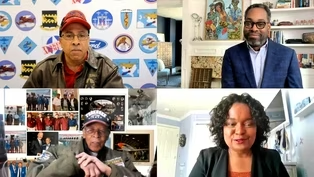
I got all of the details from Pam Alexander of the Ford Fund, from Brian Smith, President of the Tuskegee Airmen National Museum, and Lieutenant Colonel Alexander Jefferson, an original member of the famed Red Tails.
Brian, I'm gonna start with you.
This is a big anniversary coming up, 80, and it's hard to imagine that that number, but you're celebrating it in part by dedicating a new home, celebrating a new home as well.
Tell us what's going on.
So the Tuskegee Airmen started March 22nd, 1941, and we wanted to celebrate that as the beginning of African-Americans in military aviation.
We would like to celebrate that plus announce the opening of our new home at the Charles H. Wright.
And talk about why you're moving to the Charles H. Wright Museum.
So there were folks in the community and the Ford Fund, through Pamela Alexander, who thought that our old location, which was Historic Fort Wayne, since 1987 needed updating.
And she was right.
Our exhibits needed updating, some preserving, and a body with intelligence was the Charles H. Wright Museum.
They had the curators who were able to do that.
So we worked out an agreement for 10 years and we'll be in their building for the next 10 years.
Wow, yeah.
Pam, talk about the Ford Motor Fund's interest in this, and this great idea.
(chuckles) Well, you know, the Ford Motor Company and the Ford Fund, we've been supporters of the Tuskegee Airmen and the museum for a long time.
You know, we're a legacy company, we've been around a long time, it's in our DNA.
And so, this partnership has been very important to us, whether it's, you know, when the Airmen won the gold medal, Congressional Gold Medal and we did the celebration on the Hill, to our documentary on two of the airmen that we are gracious and blessed to have in Detroit, Lieutenant Colonel Jefferson and Colonel Stewart.
There's a long history there, and we have so many treasures in Detroit, as you know, Stephen, and everyone who's watching knows.
We have the Airmen, and we also have the Charles H. Wright.
So what an incredible opportunity to combine those treasures and bring this history into an amazing facility so that so many people can see what the airman are about.
They're legends.
People think they know the story, but they don't know all of the story.
So Ford is really excited to be presenting sponsor of this museum inside the Charles H. Wright, that will tell their story to so many from around the world.
Lieutenant Colonel Jefferson, it's hard to imagine how long ago all this happened, but for you, this was a firsthand experience.
Tell us about joining the Tuskegee Airmen.
Well, it's a lifetime.
Well, mainly, you gotta understand, all men considered for the 99th had to be college graduates.
This is part of the whole training of being a pilot.
I used to tell (chuckles), nobody wants a dumb-dumb.
(group laughs) I'm serious.
In order to be a pilot, even the whites, the program itself was nine months.
The war took all the men who were college graduates, and then, they had to take high school graduates and put them through three months of concentrated math and science to get them along.
And it was interesting, exciting, awfully exciting.
I can't explain how exciting it was.
And the idea that this, of course, made you into a pilot, which that's something you get to keep for the rest of your life.
Tell us us what that meant after the war, being a pilot.
Well, after the war, I wanted to be a pilot, but the opportunity was not there because racism and segregation, discrimination, denied many of us the opportunity to fly.
Some stayed in the military.
These are the men who were college graduates, no, high school graduates who went through, you know, three months of extra training.
And when the war ended, they had an obligation to stay in, and the service allowed them to stay in.
These are the ones who actually flew, Korea and further, but I was kicked out, literally, and became a teacher.
Another high calling, though.
(laughs) It was exciting to be a teacher.
I can imagine.
To teach 6th, 7th and 8th grades science, and you're trying to get across an idea, and have the youngster look at you all of a sudden, and say, "Oh yeah!"
Bingo!
Right.
To actually understand.
That's the best feeling at all.
Brian, Lieutenant Colonel Jefferson's memories, of course, are part of what you guys are celebrating at the museum.
It's amazing to hear their stories, but it's also really amazing to be able to have them in the way that you do at the museum and to be able to share them with people.
One of the main reasons for our museum, I'm sorry, it escaped.
We want to emphasize Blacks in aviation, starting with the people who started in Chicago, and other Blacks who started.
This is a hard road, and we have a, there's a display.
Brian, where's that display of the St. Louis?
Yes, we have several murals in airports around the country, Los Angeles, St. Louis, and there might be one in Denver.
Well, this is the one put out by St. Louis, we're all starting out with Bessie Coleman, and all the ones, people in Chicago, and including all the Tuskegee Airmen.
Even the space, Blacks have gone into space.
Yeah.
And the museum tries to cover the history of African-Americans in aviation.
We do start with Bessie Coleman and end up with today's fighter, that is a Red Tail, in honor of the Tuskegee Airmen.
The Air Force has named a fighter Red Hawk in honor of the Tuskegee Airmen.
Our mission is to inspire young people to not only pursue careers in aviation, but aerospace science.
We want them to go to Mars.
So having Colonel Jefferson and Alexander, I'm sorry, Harry Stewart around, it's great to get them together, listen to their stories, stories you don't hear in their books, and it's amazing to have them inspire the young people.
We had a session the other day where we had current commercial airline pilots along with our students here at the museum who are learning to fly, and to have them talk to the airmen, it was an inspiration both ways.
The airmen were very proud of today's commercial airline pilots, and today's students who are learning to fly.
And of course, all of them hold in high regard the airmen.
We realize we're standing on their shoulders, and it's a honor for me to be able to honor them with the continuation of the museum.
We really thank the Ford Fund, Pamela Alexander, for their long-term and continued support of our programs here in Detroit.
Yeah.
Pam, the sharing of this knowledge and history with the next generation, I know that is a big part of what the Ford Motor Fund is focused on here, too.
Absolutely.
We're about celebrating legacy, but you honor and you celebrate by making sure it doesn't end and the work that the museum and Brian and his team are doing to make sure that youth are exposed to careers in aviation and STEM all along with it is crucial.
I don't know the exact statistic, but I know that I've been told that there are fewer African-American pilots now than there were just after the war, if I'm not mistaken.
So, you know, we have to have things like this museum that are carrying this legacy into the future, that are letting young kids get the opportunity to see what pilots do to fly planes, to learn about aviation and aerospace.
It's really key to the next generation, because that's really how you honor the Tuskegee Airmen is that you carry on their legacy.
That's gonna do it for us this week.
Thanks so much for watching.
You can find out more about our guests at americanblackjournal.org.
And as always, you can keep up with us on Facebook and on Twitter.
Take care of yourselves and we'll see you next time.
Video has Closed Captions
Clip: S49 Ep12 | 10m 19s | The Conviction Integrity Unit | Episode 4912/Segment 1 (10m 19s)
Video has Closed Captions
Clip: S49 Ep12 | 9m 57s | Tuskegee Airmen | Episode 4912/Segment 2 (9m 57s)
Providing Support for PBS.org
Learn Moreabout PBS online sponsorship
- News and Public Affairs

Top journalists deliver compelling original analysis of the hour's headlines.

- News and Public Affairs

FRONTLINE is investigative journalism that questions, explains and changes our world.












Support for PBS provided by:
American Black Journal is a local public television program presented by Detroit PBS