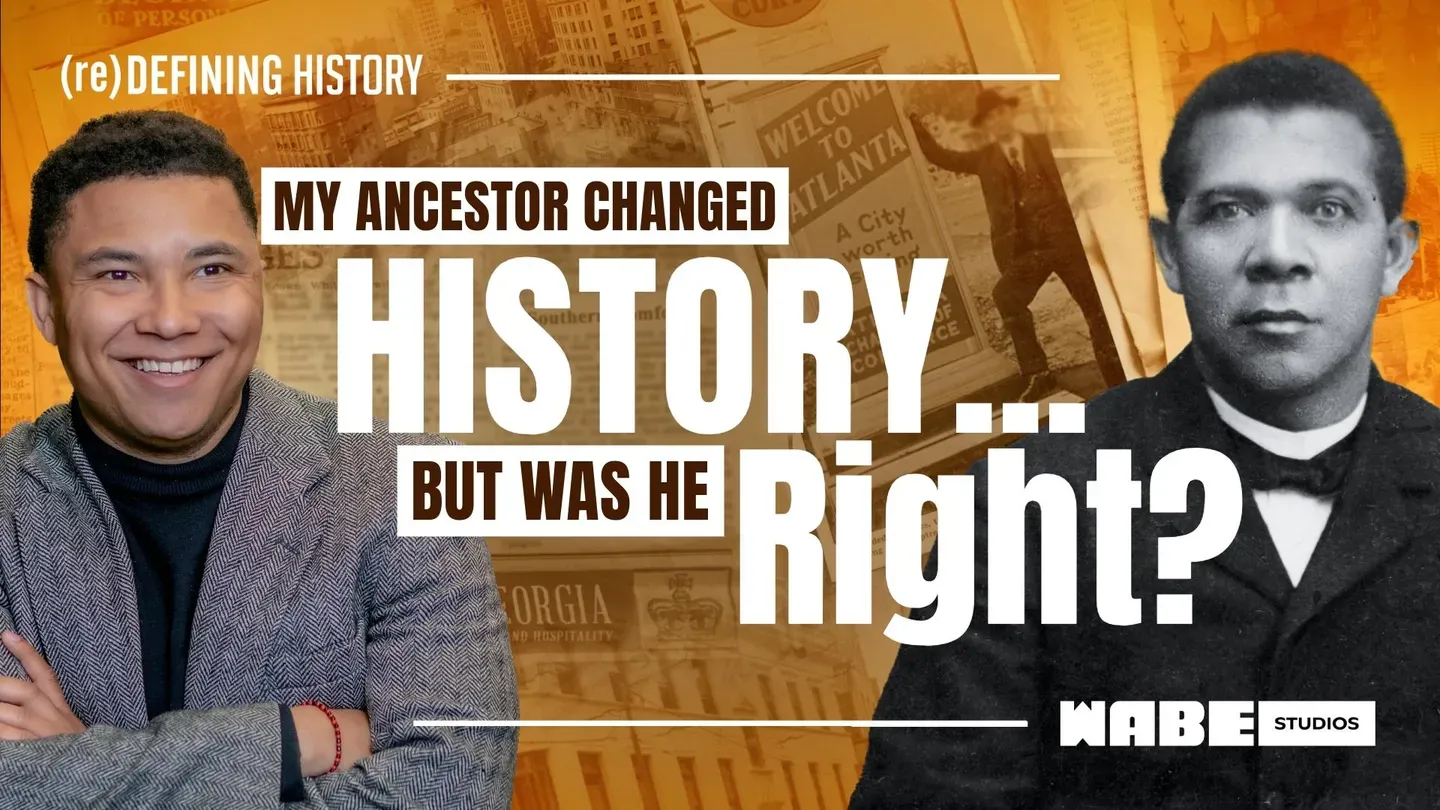
(re)Defining History
The Cotton States and the Compromise
Season 1 Episode 3 | 26m 46sVideo has Closed Captions
Noah Washington unpacks the 1895 Cotton States & International Exposition and progress in the South
The 1895 Cotton States & International Exposition was one of the most iconic events in Atlanta’s history, a showcase of the “New South.” (re)Defining History’s host, Noah Washington’s great-great-great-grandfather, Booker T. Washington, delivered his famous speech 'the Atlanta Compromise'. In this episode we unpack the event and the speech that challenged the means of racial progress in Atlanta.
Problems playing video? | Closed Captioning Feedback
Problems playing video? | Closed Captioning Feedback
(re)Defining History is a local public television program presented by WABE
(re)Defining History
The Cotton States and the Compromise
Season 1 Episode 3 | 26m 46sVideo has Closed Captions
The 1895 Cotton States & International Exposition was one of the most iconic events in Atlanta’s history, a showcase of the “New South.” (re)Defining History’s host, Noah Washington’s great-great-great-grandfather, Booker T. Washington, delivered his famous speech 'the Atlanta Compromise'. In this episode we unpack the event and the speech that challenged the means of racial progress in Atlanta.
Problems playing video? | Closed Captioning Feedback
Where to Watch (re)Defining History
(re)Defining History is available to stream on pbs.org and the PBS app.
Providing Support for PBS.org
Learn Moreabout PBS online sponsorship- The Cotton States and International Exposition of 1895, was a grand spectacle to all who attended.
A beacon of the New South and its elected capital Atlanta, Georgia.
It was an opportunity for the New South to show that it was progressive in industry, technology and even race relations.
Selected to give the opening address at this grand event was my great-great-grandfather, Booker T Washington.
In this episode, we'll explore the Cotton States and International Exposition, which took place in Atlanta's beloved Piedmont Park.
As well as the hidden complexities and influences of my grandfather's famous speech, the Atlanta Compromise.
♪ Rise up, come on wake up sleeper ♪ ♪ Rise up, come out of the ground ♪ ♪ Rise up ♪ - [Maurice] There's no better way to understand history other than immersing yourself in the actual places where it unfolded.
♪ Rise up ♪ - [Victoria] From the archives to the streets of Atlanta, join us as we uncover the hidden stories from Atlanta's past and how they impact today's future.
♪ Rise up, rise up ♪ ♪ Rise up ♪ - [Noah] With every question and new discovery, we all leave our mark.
(upbeat music) And Redefining History.
(upbeat music) - [Announcer] Brought to you by the Rich's Foundation and the National Endowment for the Arts.
(upbeat music) (birds chirping) - [Narrator] Piedmont Park, the heart of Midtown Atlanta, and one of the city's most popular gathering spaces.
It's also where a pivotal chapter in American history unfolded.
130 years ago, a grand public fair called the Cotton States and International Exposition of Atlanta was held at Piedmont Park.
There, a former slave, renowned order, educator and civil rights leader stood before a crowd of more than 800,000 people to deliver the opening address.
That address was known as the Atlanta Exposition address, or more commonly known, the Atlanta Compromise.
The speaker who gave the address was my great great grandfather, Booker T Washington.
- [Booker] Mr.
President and gentlemen of the Board of Directors and citizens.
1/3 of the population of the south is of the Negro race, but the opportunity here afforded will awaken among us a dual era of industrial progress.
- [Narrator] "In all things that are purely social, we can be as separate as fingers.
Yet one is the hand in all things essential to mutual progress."
His words were met with a polarizing response then and even now, they continue to spark debate about what progress and a quality truly looked like for black Americans.
(upbeat music) Today, I'm visiting the Atlanta History Center to unpack the layers of my grandfather's message.
I also wanna know, what was the purpose of the Cotton States and International Exposition?
What were the social realities of the South and the Cotton States era?
Why did the address provoke such backlash and mixed perception?
And how did the words impact Atlanta and its leaders who are on the front lines, fighting for civic progress?
- I'm Dr.
La'Neice Littleton.
I'm a historian and director of community collaborations here at Atlanta History Center.
- What's up, Dr.
Littleton?
- Hey Noah.
- How are you doing?
- I'm wonderful, great to see you again.
- For having me.
So what do we have here?
- We have a lot of materials that deal specifically with the Cotton States and International Exposition that was in Atlanta.
- [Narrator] What was the main purpose of the exposition?
- It's like a world's fair, and the intention was to bring people from all over the United States and all over the globe to participate in the New South.
Specifically in Atlanta, right?
The New South being this idea that we're leaving the old plantation south behind and moving towards industry, right.
Henry Grady was pivotal in developing that idea of the New South, but it was really like a marketing strategy.
It was really reintroducing Atlanta to the world stage as a place of international commerce and industrial development.
- What different types of people centered here in Georgia could attend?
- All types, business folks, citizens of Atlanta.
Everyone came to the exposition.
It contained several exhibits from places all over the world and also places throughout the US.
So there was an Alabama exhibit.
There was an exhibit on the Negro in the Negro building that was constructed at the time.
We see some very negative stereotyping of black folks that is existing at the same time that black folks have their own exhibition on the ground.
- [Narrator] Who were some of the key players that made the exposition in Atlanta possible?
- In 1893, the Chicago Colombian Exposition took place and a man named Irvine Garland Penn advocated for black folks to boycott it because it was a segregated space.
Two years later, he becomes what they call the chair of the Negro Department for the Atlanta Exposition.
And he as well as other individuals such as Henry Rucker, who we see here at his desk, and Bishop Wesley John Gaines from Big Bethel AME Church.
Also one of the co-founders of Morris Brown College, Henry Rucker, Bishop Gaines and Booker T Washington actually went to Washington DC to meet with Congress to appeal for funds for the construction of the Negro Building, which was the first of its kind in the United States.
It was the first building to feature an exhibition on the progress of African Americans in freedom.
- You know, I wanna know a little bit more of the conditions of the New South when Washington was making his speech.
- Yeah, well this is 1895.
So this is 30 years after the end of the Civil War where people are trying to, you know, abandon old ideas that are attached to the plantation south.
Right, however, there were a number of other challenges for black citizens, particularly the amount of racial violence that was happening because of the rise of the Ku Klux Klan.
But we also see convict leasing happening all over the city of Atlanta, but throughout the south, right?
Some folks call that slavery by another name.
We see that exploitation of black labor trying to rebuild the south as we head towards the turn of the 20th century.
We also see social progress, right?
We see a number of black elected officials.
We see the creation and the maintenance of what we're now calling historically black institutions in Atlanta specifically, Atlanta University was here.
Clark College was here, Atlanta Baptist Seminary, which later became Morehouse College.
We see the founding of Spelman College in 1881 at the same time that the Washer Women's Strike is happening.
So we're seeing significant social progress, specifically in the city of Atlanta, which is why people were rather taken aback after Washington's Atlanta Compromise speech because folks in Atlanta were trying to gain entry into Atlanta's politics, economics, and for Booker T Washington to come to the city and say, you know, we can be separate but equal, cast down your bucket where you are.
A lot of people were very unhappy about that.
- As separate as the fingers, but united like the hand.
In addition to the exposition, I'm here to talk about the speech that my great-great-grandfather, Booker T Washington, gave during 1895, the Atlanta Compromise.
- Yes, I have something very special.
- Oh, I'm excited.
- [La'Neice] You have to help me.
- Okay.
- So grab this box right here.
- Okay, all right, put it right here.
- [[La'Neice] Yes, put it right here.
- Okay.
- Interestingly enough, this is one of the most well-known speeches in American history.
However, no photos of him delivering the speech survived.
So if you see a photo of Booker T Washington giving a speech, it is not from the 1895 Atlanta Compromise.
No, it's not.
However, he was photographed and as we would say, lithographed, like a sketch of him.
So I'm gonna show you this one, but I want you to lift up this page on this.
- Okay, okay.
(tense music) Wow, that looks like my dad.
- [La'Neice] Yes.
- Wow.
- This is actually from 1910.
But a just beautiful lithograph or portrait of Booker T Washington.
- I'm not.
- You look like him.
- This looks totally most like my father.
Like I see my dad when I look at this.
I have to admit, maybe I got his ears.
I think so, but the hair is my dad all day long.
Wow, this is amazing.
- You know, a lot of the times when we look at historical artifacts and pictures, you know, most people think of Booker T Washington, the leader, the educator.
Right, not the great-great-great grandfather or the uncle or the brother.
So I know for you, this is American history, this is black history, but this is your family history as well.
It brings a different kind of sensitivity to the storyline and it forces us to think of people more humanly than you know, put them on the pedestal of infallible leader.
- That's how I see this man.
I see him as a human who was trying to do the best he could.
- [La'Neice] Yeah.
- Even though Washington always tried to avoid controversy, he walked straight into it, right?
- [La'Neice] Right.
- Talking about how we need to come together in racial cooperation.
- [La'Neice] Right.
- More so than unity, where it was sexier at the time to go for Senate seats.
But Washington really, and he mentions this in the speech, wanted a bottom up approach, where we have and build an economic foothold before going after social justice.
- [La'Neice] Yeah.
- So I wanna hear your take on it.
- Now, it was controversial, but there are some things that we have to understand about Booker T Washington that help inform his ideology as an educator, and that's that he was born enslaved.
He starts laboring at a very early age in the coal mines while he's going to school at the same time.
He works his way up through Hampton Institute and then eventually ends up at Tuskegee, where he's advocating for that kind of labor and industrial education that helped him to get to where he was.
Sometimes we oversimplify it, right?
And we say he's an accommodationist and a segregationist, but his philosophy was very much influenced by his personal experience.
This is 1895.
People are actively advocating for education, land, voting rights.
And so for him to say in 1895 that, you know, we can be separate but equal was very controversial considering that the following year, Plessy versus Ferguson was actually passed and it made Jim Crow segregation the law of the land for a generation.
So this kind of ushers us in to the Jim Crow era.
That was, you know, very difficult for a number of reasons.
- One of his biggest, I don't wanna say adversaries, but philosophical rivals, was W. E. B. Du Bois.
Tell me more about his stance and how he addressed the speech.
- [La'Neice] Absolutely, we have a first edition copy.
- Wow.
- Of "The Souls of Black Folk".
Which was published in 1903.
While Dr.
Du Bois was on the faculty at Atlanta University.
In 1896, Dr.
W. E. B. Du Bois becomes the first black person to earn a PhD from Harvard University in history.
He comes to Atlanta and serves on the faculty, and then in 1903, he publishes this work.
But I want you to look specifically at chapter three because the title of chapter three.
- [Narrator] Of Mr.
Booker T.
- Of Mr.
Booker T Washington, and others.
So in this work, Dr.
Du Bois is very clear that as a community, black folks should be resisting any type of segregation or oppression in the United States.
Now, this first sentence, he says, "Easily, the most striking thing in the history of the American Negro since 1876 is the ascendancy of Mr.
Booker T Washington."
- Oh, that's next level hating.
- Yes, like he comes full stop with this critique of industrial education, with the idea that as a community, we should kind of yield to the racial violence of the time, the segregation of the time, and that through industrial education, we will progress as a community.
Dr.
Du Bois very much believed that we had to develop an intellectual class of black folks, and that intellectual class.
- Talented Tenth.
- The Talented Tenth, as he called it, would lead us into social progress.
- You know, I often think that Du Bois was upset at Washington because he was a handsome man.
(person laughing) - Allegedly, they both were.
This book, specifically Dr.
Du Bois is saying that we cannot continue a program of industrial education if we want to continue to progress as American citizens.
- You know, I think I want to go check out the exposition space at Piedmont Park.
- You have to go, but before you go, I wanna actually show you some photos of the exposition itself and point out some locations that I think you should check out.
- Wow, yes, please.
- Yes, so you see kind of the remnants of the Atlanta Exposition.
You see these stairs right here?
- Yep.
- [La'Neice] These are what's left in Piedmont Park.
Those stairs are still there.
- I know exactly where that is.
I could see it, you know, Dr.
Littleton, thank you so much for having me here today.
I think I'm ready to go check it out myself and see what's up.
Now that I've been to the Stacks, I'm excited to go out to the streets and really immerse myself in 1895, right at Piedmont Park.
(upbeat music) Piedmont Park is an iconic gathering place where people from all walks of life come together to play, exercise, and celebrate Atlanta's diverse culture.
But what many don't know is that this is the same park that placed Atlanta at the center of the American story of the Deep South in its post-Civil War economic resurgence.
Right now I'm sitting at the steps of the last remaining structures of the 1895 Atlanta Cotton States and International Exposition.
A lot of the land for the exposition was cleared by African American chain gangs, a tough truth that really highlights the contradictions of the South during that time, contradictions my grandfather chose not to address in his opening speech at the exposition.
Instead, he used his platform to speak on what he believed would advance steady social and economic progress in the south.
(upbeat music) His views were shaped by upbringing and his journey towards self-reliance.
His views would go on to shape history.
This chapter of Atlanta's story is especially meaningful to me because it's a snapshot into the complex and rich life of a beloved family patriarch.
My grandfather left a lasting legacy and made a tremendous impact on American history.
But beyond that, he was family, an integral part of my own history.
Let me give you a little rundown.
I'm descended from Booker Washington's second wife's line, Olivia Davidson.
My grandfather was Booker T Washington III, and I am currently the last Washington with the name.
Washington was born a slave in Hale's Ford, Virginia.
His father was unknown.
The common guess was that he was a slave master and that really shaped his childhood.
His mother would later remarry, move to West Virginia.
Washington at the age of 16, made his own trek to Hampton, Virginia to receive his education.
He was taught self-reliance and having an economic foothold.
All things that contributed later to his Atlanta Compromise speech, cast down your buckets.
All those things of the culmination of his life will come together in that moment, in that speech.
You know, looking out, I could see him standing on the podium delivering it.
I can hear his speech.
- [Booker] I would say cast down your bucket where you are, cast it down in making friends in every manly way of the people of all races by whom you are surrounded.
- He had many, many victories under his belt that aren't often talked about.
He was the first black man to be invited to the White House back when it was commonly known as the President's House.
He was the founder and president of Tuskegee Trade School, later known as Tuskegee University.
He was the president of the National Negro Business League, as well as coined the term Black Wall Street, that came from him in Tulsa, Oklahoma.
So Washington's own network was said to have rivaled what is now known as the current day NAACP.
His achievements are many in its tangible the effects in into the modern day world.
His mindset was not kick down the door.
It was to knock, enter, and have a conversation.
Speaking of having a conversation, I've invited Dr.
Ilya Davis out to come talk to me about the Atlanta Cotton States and International Exposition, as well as talk about the nuances of my grandfather's speech, the Atlanta Compromise.
- Now, because I teach philosophy, my approach to historical events may be a little different, but my take on the exposition represents Booker T Washington's attempt to account for the direction that we should take moving forward.
This is during post reconstruction.
The Civil War is over.
There are manipulations of social orders by the Ku Klux Klan, certain government officials, the Democratic Party, which wasn't so hospitable to black people at the time.
And part of it was, Booker T Washington represented something of an inroads, a social inroads, because when he was here for the exposition here in Atlanta, the governor of Georgia spoke before he did, and he was introduced by the governor of Georgia.
That had never happened before, for a black man in the South to be a primary speaker, a keynote speaker at a white event.
So that in and of itself is a major point to be made.
But the content of his talk, and I think it's been caricatured by many, I think it represents the spirit of the times, if you will, the zeitgeist for him.
Because what he was trying to imagine, how do we now inculcate a group of individuals within a system that has been inhospitable, outright vile towards their humanity?
How do I do that and at the same time, create an environment conducive for whites to invite this type of person into their community.
So the speech itself, it's so overwhelmingly profound because he tries to somehow marry these ideas without creating controversy, particularly on the part of whites, because that could end with the death of many people, as we know, 1906 being a major point of departure.
So for me, I look at it as his attempt, and I'm saying attempt because I don't wanna say success or failure, because I think the attempt is laudable.
It was needed.
How do we move forward in light of our present social conditions?
And I think Booker T Washington is trying to intercede by saying we are mutually bound together, in similar ways that we refer to Martin Luther King's, this mutuality that he often referred to.
And I think Booker T Washington had a profound sense of that responsibility.
That is how do we coexist?
- The idea of the new South was being preached at the exposition.
What are your thoughts on that?
- They wanted to present a new south, but the South, the only thing that you may claim to be new is no or legalized marginalization, enslavement of people of African descent.
But you definitely had defacto through leasing black people who had been falsely accused of crimes, vagrancy.
If you had no money in your pocket, you could be arrested and then you would be, I would say, sold into a form of what they would probably euphemize and call indentured servitude.
But it was just another form of enslavement, as well as not having the oversight to protect black people from these constant invasions of their being, that is lynchings and just other social structures that created a fear in the blacks here in the south.
So what you do get is that Booker T Washington and Du Bois both had a take on what they call the new South.
This new south represented in the speech, was supposed to have represented a coming together of sorts of the races.
- Going deeper into it though, cast down your buckets.
Describe those words for the general public who don't know what that means.
- Well, it was a wonderful analogy that he uses in the speech here in Atlanta.
And what he wanted people to understand is context means everything.
Where are you in the world such that certain opportunities are afforded or foreclosed?
And he uses an analogy of two vessels in the ocean, and one reaches another.
One is in desperate need and says, I need water.
And the response was, cast down your bucket.
And they do this about four or five times until the analogy now comes through that is, where are you in the world such that whatever you have now becomes the producer of your way of being in the world, the way you live your life.
What created controversy was individuals who found their buckets dropped into a pool of mediocrity wanted to move beyond that.
So they weren't satisfied with saying, where am I now?
I should be satisfied.
It seems to them to create a notion of complacency and accommodationist, whereas they were thinking, I don't know now, but what could I project for myself in the future?
So the notion of placing your bucket where you are makes sense, but I think it could have been nuanced in ways, and maybe we should interpret it in a way that is more nuanced that says, that's for now does not mean all future possibilities to other forms of engagement have been foreclosed.
- Dr.
Davis really shed light on how each generation defines progress in its own way.
Everyone has a different approach to casting down their bucket.
Dating back even before the 1895 Cotton States and International Exposition, Big Bethel AME, the oldest African American church and Atlanta Sweet Auburn community has been a vessel for these diverse efforts.
(upbeat music) In 1895, during the final weeks of the Atlanta Cotton States and International Exposition, the National Colored Women's Congress met here at Big Bethel, determined to directly combat the blatant racial oppression that existed beneath the rhetoric of the so-called New South.
At the conference, they drafted powerful resolutions that called out the injustices of the south and addressed their concerns about the exposition itself.
25 years later, in 1920, the first national convention at the NAACP would also be held here.
Throughout the Civil Rights Movement in Atlanta, communities like Big Bethel continue to serve as a critical space where leaders and community members organized and mobilized.
I believe Atlanta became not just a symbol, but a true beacon of racial progress in the South.
Because of their diversity of approaches and the blend of efforts aimed at not just industrial development, but intellectual, political and economic development.
My grandfather had a glimpse of what it would take for black Americans to achieve self-reliance and sufficiency.
His views on progress were shaped by the era of his time.
I'm grateful for Atlanta's response to his call, a fuller vision of lasting progress, not just for some, but for all.
(music whooshing) (upbeat music) (gentle music) - [Announcer] Brought to you by The Rich's Foundation and the National Endowment for the Arts.
(upbeat music) - [Announcer 2] WABE.
















Support for PBS provided by:
(re)Defining History is a local public television program presented by WABE