State of the Arts
The Fate of Frankenstein
Clip: Season 44 Episode 3 | 8m 55sVideo has Closed Captions
The Shakespeare Theatre of New Jersey mounts a fresh take of Mary Shelley's Frankenstein
For two centuries, every generation has had a Frankenstein to call their own. Now, the Shakespeare Theatre of New Jersey, in Madison, mounts a fresh take of Mary Shelley's iconic story. Inspired by original reporting from Maya Salam (The New York Times) and Manvir Singh (The New Yorker), this video essay explores the fate of Frankenstein throughout the years.
Problems playing video? | Closed Captioning Feedback
Problems playing video? | Closed Captioning Feedback
State of the Arts is a local public television program presented by NJ PBS
State of the Arts
The Fate of Frankenstein
Clip: Season 44 Episode 3 | 8m 55sVideo has Closed Captions
For two centuries, every generation has had a Frankenstein to call their own. Now, the Shakespeare Theatre of New Jersey, in Madison, mounts a fresh take of Mary Shelley's iconic story. Inspired by original reporting from Maya Salam (The New York Times) and Manvir Singh (The New Yorker), this video essay explores the fate of Frankenstein throughout the years.
Problems playing video? | Closed Captioning Feedback
How to Watch State of the Arts
State of the Arts is available to stream on pbs.org and the free PBS App, available on iPhone, Apple TV, Android TV, Android smartphones, Amazon Fire TV, Amazon Fire Tablet, Roku, Samsung Smart TV, and Vizio.
Providing Support for PBS.org
Learn Moreabout PBS online sponsorshipNarrator: Every generation has its Frankenstein.
And every Frankenstein reveals something about its generation.
It is, after all, a tale of the creator and the creation.
Frankenstein's creature is a little like the Mona Lisa.
He's everywhere and shape-shifts into whatever people need him to be.
But the basic elements are almost always the same.
His green skin, square head, and bolts coming out of his neck.
The grunting, the lumbering gait and, well, not much beyond that.
Colbert: We don't really know know you.
[ Laughter ] Narrator: A recent stage adaptation at the Shakespeare Theatre of New Jersey is making the case that the monster Mary Shelley introduced to us over two centuries ago is very different from the one we've gotten used to.
Crowe: One of the things with Mary Shelley's "Frankenstein" that keeps coming back over and over again is the humanity of the monster.
This character has a brilliant mind that, in the course of a year, teaches himself to speak and to read and reads "Paradise Lost" and the Bible and Shakespeare.
Singh: But then, ironically, you have James Whale's 1931 cinematic version, which removes so much of the humanity.
Salam: A blockbuster movie that reached pretty much every human on the planet.
It can be very loosely interpreted.
Narrator: So what happened in the last century of Frankenstein adaptations?
And did a small theater in New Jersey finally get it right?
[ Music plays ] Dr.
Frankenstein: In that unmapped region, my foot, my heart, and my eyes may now finally fall.
Break boundaries.
Cracks.
[ Crash of thunder ] Let light in, let night out.
Banish darkness.
Begone!
Let light and life flood forth and darkness drown!
[ Storm rumbling ] [ Dramatic music plays ] [ Tense music plays ] I now understood things that only God had known.
I had only to put that understanding into practice, into being.
Narrator: At the heart of every version is a scientist with the ambition to play God.
Mary Shelley's warning against the blind hubris in all of us is perhaps Frankenstein's most enduring trope.
Nathan: You know how I cracked it?
Caleb: I don't know how you did any of this.
Dr.
Frank-N-Furter: [ Singing ] If he only knew of my plan!
In just seven days, I can make you a ma-a-a-a-an!
Dr: Frankenstein: I know what it feels like to be God!
[ Storm rumbling ] [ Tense music plays ] Narrator: Mary Shelley does not describe the moment of animation in great detail, but no scene has been more palpably exciting to the imagination of filmmakers, who themselves create life where there was none.
This defining moment when the scientist crosses the threshold from sanity into madness, from man into monster, has enraptured us for generations.
We know it's wrong, but we can't look away.
Dr.
Frankenstein: It's alive!
It's alive!
Dr.
Frankenstein: It's alive.
[ Blasts and crashes ] [ Tense music plays ] [ Electric crackling ] Dr.
Frankenstein: O, God!
Do I mock you?
I reject you.
I-I reject you!
Salam: When you put a Frankenstein monster on screen, you want the monster.
The monster is the part that is so fun to explore visually.
Yunger: Holy ugly!
Who's the lumbering sad sack?
Dr.
Frankenstein: That's my creation.
He's kind of a pain in the ***.
[ Dramatic music plays ] Narrator: Lately, though, something's been happening with our monsters.
Singh: Monsters have gone from menacing to misunderstood.
Where they've gone from beings whose monstrosity is grounds for their capacity to evoke fear, to monstrosity as a grounds for empathy.
Giulia: Help!
Don't hurt us!
Singh: Mary Shelley's Frankenstein really predates the big explosion that you find right now.
Crowe: When designing the creature, we wanted something that allowed for great movement, and we wanted to make sure that we were not losing the ability for the actor to be expressive physically and facially.
A sense of soul, of life, of something beyond the monstrous to this creature.
[ Gentle music plays ] The Creature: See what a wretched outcast I am?
I am similar to them.
Mary Shelley: But also strangely unlike them.
Crowe: Mary Shelley is the key anchor for this entire story.
So the framing device for this piece is how Mary Shelley planted the seeds for what would become Frankenstein.
Mariani: Her mother passed away when she was 11 days old, so she never knew her.
She had a few babies who passed away.
Friendly: And it's very intentionally set up to kind of weave in between the two.
Like what maybe was she working through with this story?
In the novel, isolation is the overwhelming theme, the isolation of the creator and the isolation of the creation.
The Creature: I will make you so wretched that the light of day shall be hateful to you.
Friendly: Nobody has really tried to explore that in a big way.
Crowe: I've been looking for a Frankenstein script for about 20 years, but none of them really kind of sparked my interest the way this one has.
Spark, I say.
[ Laughs ] Narrator: By returning to Mary Shelley's classic story with its fleshed out, intelligent creation, what is old becomes new again, and there's nothing more Frankensteinian than that.
Mary Shelley: The human heart can endure suffering -- for a while at least.
Singh: I think the sympathetic turn echoes a larger cultural change over the last 70 years, in particular.
A greater recognition of the humanity in the different or the other.
This is the same trend that is behind the rise of disability rights, behind the gay rights movement, second wave and third wave feminism, the civil rights movement.
All of these are about a reorientation in how we view the other and the marginalized.
We needed the monster that was created by human hubris and human weakness.
The sympathetic turn has re-shifted, relocated monstrosity from the monstrous to the people who deny humanity in the monstrous.
Salam: Questions about morality, a lack of humanity, of rejection.
If that's not the question of humankind, then what is?
And no story, in my opinion, deals with these questions like Mary Shelley's Frankenstein.
Crowe: The theater is a much more exciting place, I think, to see things than -- I mean, as much as I love film, there's something very different when you're in the room breathing the same air as the people who are telling the story.
Gartley: To sit here and have the monster look right at you and not just be scared, but see what that monster is thinking, hear what he is saying, and then feel what he is feeling.
You can't get that feeling anywhere else outside of the theater.
Wade: Mm.
Mm, mm, mm.
My favorite line of the show.
It's not one that's said by the creature but it's one of Mary Shelley's lines.
"The human heart is fragile.
It must be held with care with two gentle hands."
And that line gets me every single time.
It's one of my favorites.
[ Dramatic music plays ]
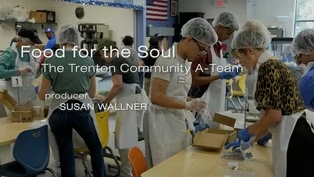
Food for the Soul: the Trenton Community A-Team
Video has Closed Captions
Clip: S44 Ep3 | 6m 28s | The artists of the Trenton Community A-Team show how creativity can foster resilience. (6m 28s)
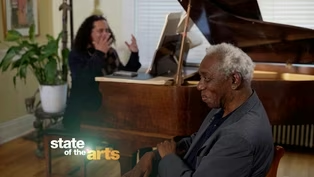
Oh God...Beautiful Machine: A work by Yusef Komunyakaa & Vince di Mura
Video has Closed Captions
Clip: S44 Ep3 | 8m 27s | Oh God...Beautiful Machine: A work by Yusef Komunyakaa & Vince di Mura (8m 27s)
Providing Support for PBS.org
Learn Moreabout PBS online sponsorship

- Arts and Music
The Best of the Joy of Painting with Bob Ross
A pop icon, Bob Ross offers soothing words of wisdom as he paints captivating landscapes.












Support for PBS provided by:
State of the Arts is a local public television program presented by NJ PBS