
The First Recording of Scott Joplin's "The Entertainer"
Clip: Season 53 Episode 13 | 4m 20sVideo has Closed Captions
Chris Ware and Scott Yoo discuss the first recording of "The Entertainer."
Chris Ware and Scott Yoo discuss the history behind the first recording of Scott Joplin's ragtime classic "The Entertainer."
Problems playing video? | Closed Captioning Feedback
Problems playing video? | Closed Captioning Feedback
Major series funding for GREAT PERFORMANCES is provided by The Joseph & Robert Cornell Memorial Foundation, the Anna-Maria and Stephen Kellen Arts Fund, the LuEsther T. Mertz Charitable Trust, Sue...
The First Recording of Scott Joplin's "The Entertainer"
Clip: Season 53 Episode 13 | 4m 20sVideo has Closed Captions
Chris Ware and Scott Yoo discuss the history behind the first recording of Scott Joplin's ragtime classic "The Entertainer."
Problems playing video? | Closed Captioning Feedback
How to Watch Great Performances
Great Performances is available to stream on pbs.org and the free PBS App, available on iPhone, Apple TV, Android TV, Android smartphones, Amazon Fire TV, Amazon Fire Tablet, Roku, Samsung Smart TV, LG TV, and Vizio.
Buy Now
Great Performances Newsletter
Subscribe to the Great Performances newsletter to keep up with the latest full episodes to stream, exclusive content, and more!Providing Support for PBS.org
Learn Moreabout PBS online sponsorshipIn Chicago again, I met graphic novelist Chris Ware.
He's meticulously restored his ragtime era house, where he collects original Joplin recordings.
So it sort of actually perfectly spans the ragtime era.
So when we go inside, am I kind of entering a Ragtime time machine a little bit?
I don't know.
That sounds kind of insane, but I mean, I do very much like the architecture and surroundings of the era.
I've tried to make it as accurate as possible.
Trying to be true to the house itself, to.
So the very first recording, actually, of the Entertainer was in 1928 by two guys, Nap Hayes and Matthew Prater, a African-American mandolinist and guitarist.
It's pretty clear they seem to have learned it by ear.
Interestingly, however, the piece, if you look at the original sheet music of the Entertainer, it's dedicated on the cover to James Brown and His Mandolin Club.
A lot of music was played by mandolin orchestras before that, banjo orchestras.
So if you listen closely to this, you'll hear the Entertainer, though, played in a slightly different way.
♪♪ Upstairs in his studio, Chris was working on a Joplin project.
This is the second time I tried to draw this particular, particular photo.
Do you feel like you get to know him by drawing him?
- Not really.
I feel like I get to know what a terrible artist I am by trying to draw people that, you know, I... I mean, you tend to think about the person as you're drawing them.
What kind of a guy do you think, Scott Joplin was?
Judging from Ed Berlin's biography, he was a quiet person.
He, I think, was he self-consciously apparently cultivated a refined way of speaking.
By all accounts, he was serious.
And I guess Brun Campbell, who was a white pianist, who reportedly took lessons from him way early on and in the late 19th century, early 20th century, said he you know, he'd have a drink occasionally and even might gamble every once in a while.
But he was very kind of you know, he you know, his priorities.
He knew what was important.
Mm hmm.
His whole his whole life was put into that music.
You know, actually, Rick was talking about how Joplin is such a uniquely American character.
And I would argue that Missourians and Saint Louis at the time, you know, Saint Louis was kind of the nexus of the Mississippi River and people sort of trying to migrate west to find a better life know there were all of that economic activity there.
And it's kind of where ragtime players went.
I mean, I just have to assume that it was people seeking a better life of dignity and some respect or something like that getting out of the South.
It seems to me like just trying to find somewhere where you could be a person, you know, and be considered respected and respectable, and that might maybe meant then going to Saint Louis because the opportunities for greater and then eventually Joplin came to Chicago.
Joplin didn't stay here very long and eventually settling in New York, I think for the best for the jobs, basically for trying to get some work as a composer.
And he wasn't as much of a performer, which is one of the things I've always loved about Joplin, is that his music is not performance based.
Even when you play it wrong, it's still good.
You can extract the happiness out of it and then people realize, Wait, if you play this a little slower, there's sadness.
And at the same time it's such a peculiar unstable molecule.
And I in the fact that all of those things are in the music, it's very much like baroque music where you could play Bach on any instrument and that emotion is still encoded into the music.
I never thought of it that way.
That's really interesting.
♪♪

Now Hear This – “Everyone Loves Joplin” Preview
Video has Closed Captions
Preview: S53 Ep13 | 30s | Scott Joplin was the king of ragtime, a new kind music for the turn of the 20th century. (30s)
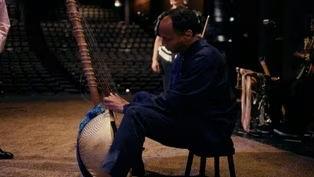
West African Instruments in "Treemonisha"
Video has Closed Captions
Clip: S53 Ep13 | 3m 9s | In this reimagining of "Treemonisha," the West African kora take center stage. (3m 9s)
Providing Support for PBS.org
Learn Moreabout PBS online sponsorship
- Arts and Music
The Best of the Joy of Painting with Bob Ross
A pop icon, Bob Ross offers soothing words of wisdom as he paints captivating landscapes.












Support for PBS provided by:
Major series funding for GREAT PERFORMANCES is provided by The Joseph & Robert Cornell Memorial Foundation, the Anna-Maria and Stephen Kellen Arts Fund, the LuEsther T. Mertz Charitable Trust, Sue...