Florida Road Trip
The Florida Keys
Season 2026 Episode 4 | 26m 46sVideo has Closed Captions
Travel the Overseas Highway through the history of the Florida Keys.
Join the ride through the Florida Keys, where ocean views, wildlife, and a single highway connect more than 100 miles of island stories. Explore the legacy of Flagler’s overseas railroad, a one‑of‑a‑kind undersea park, and efforts to protect sea turtles and Key deer. Florida Road Trip uncovers the people, places, and history that define the Keys.
Problems playing video? | Closed Captioning Feedback
Problems playing video? | Closed Captioning Feedback
Florida Road Trip is a local public television program presented by WUCF
Watch additional episodes of Florida Road Trip at https://video.wucftv.org/show/central-florida-roadtrip/
Florida Road Trip
The Florida Keys
Season 2026 Episode 4 | 26m 46sVideo has Closed Captions
Join the ride through the Florida Keys, where ocean views, wildlife, and a single highway connect more than 100 miles of island stories. Explore the legacy of Flagler’s overseas railroad, a one‑of‑a‑kind undersea park, and efforts to protect sea turtles and Key deer. Florida Road Trip uncovers the people, places, and history that define the Keys.
Problems playing video? | Closed Captioning Feedback
Where to Watch Florida Road Trip
Florida Road Trip is available to stream on pbs.org and the PBS app.
Providing Support for PBS.org
Learn Moreabout PBS online sponsorship>>This program is brought to you in part by the Paul B. Hunter and Constance D. Hunter Charitable Foundation, a proud partner of WUCF and the Central Florida community.
>>On this episode of Florida Road Trip, we're traveling the Florida Keys, where water, wildlife, and roadways come together to tell a stor that stretches across centuries.
>>The Keys are spread along 100 plus miles.
>>Where history lives beneath the surface.
From the nation's first undersea park to a hospital giving sea turtles a second chance.
>>We've returned over 3,000 turtles back to the wild since 1986.
>>Mile by mile the stories here surround you.
Join us as Florida Road Tri heads down the Overseas Highway to explore the Florida Keys.
♪♪ Hi there and welcome to Florida Road Trip.
I'm Scott Fais.
The Florida Keys are made up of more than 1,700 different islands, less than 50 of which are inhabited.
But there are plenty of stories stretching along the 113 miles of the Oversea Highway, connecting the people, place and spirit of the Florida Keys.
>>The earliest Spanish explorer we know to come through the Florida Keys area was Juan Ponce de Leon in 1513.
>>While Spain claimed the region, the islands remained difficult to settle.
The same waters that connected the keys to the world also made them quite dangerous.
>>The Spanish galleons and all the other ships would want to sail through the Florida Straits, follow the Gulf Stream current, you know, back towards Spain.
That's a wonderful highway in the middle of the ocean.
But on either side of i you've got jagged reefs lurking right belo and just waiting to claim ships.
>>By the early 1800s, the Keys entered a new chapter.
>>One of the big problems is that there was a lot of piracy in the area.
Pirates who were stationed off the north coast of Cuba, or Yucatan or Puerto Rico were taking advantag of the large amount of shipping that sailed by here on the Gulf Stream current, and they found that they could dash out, rob these ships, kill the crews, whatever, and get rich that way.
The U.S.
Navy's presence helped bring order to the waters, while setting the stage for Key West's growth.
>>That was putting a huge dent in the shipping economy which was a big part of the U.S.
economy at that time.
So for Key West to grow it required the suppression of piracy.
And so the Navy in 1823 sent Commodore David Porter down here to establish an anti-piracy Navy base.
And within three year they had largely done their job.
>>Then came one of the biggest turning points in Key West history: Henry Flagler's railroad.
>>When the railroad was completed in 1912, it really was a game changer because now the keys were really they weren't islands anymore.
They were connected to the mainland.
So you could have regular traffic coming in day and night via trains, an they could bring in passengers, but they also brought in goods and connected the, believe it or not, Key West further to Cuba, because now you have all these cargos coming in and steamships coming back and forth from Havana and from other ports in the Caribbean, and bringing in, you know, fruit and other goods and carrying it out by train.
>>But disaster reshaped the Keys once again.
>>You know, there's a terrible hurricane in the upper Keys in 1935.
Strongest winds, a massive stor surge came through and destroyed much of the upper Keys, including the railroad.
Chewed up some of the railroad bed, tore up the rails and the ties.
After that, the Florida East Coast Railroad system kind of too a look at everything and said, you know what?
Let's just give this up.
They had not been making the money they had initially hoped to.
And it just made no sense to rebuild.
At that point, the government stepped in and said, well, it might be nic to build a highway through here.
And so they wound up acquiring the railroads right of way and decide that they would build a highway from the mainland down to Key West.
In the mid to late 1930s, this highway being built, bridges from the railroa being adapted to automobile use.
And in 1938, the highway opens and people could drive from Miami to Key West unimpeded.
That was a game changer because now people wanting to visit can do so at their own pace.
>>These days, the drive is more than just a means between point A and B, it's the story itself.
Every bridge, every island, every stretch a stunning ocean view holds a piece of the past.
>>As you drive down the Keys, there's the history all over the place.
The one thing that I alway think about is you're actually passing sunken Spanish galleon as you drive down the highway.
>>That part of the Keys' story couldn't stay submerged.
As the Keys grew, protecting what makes these island rare took on greater importance.
>>People started looking at the reefs and that sort of thing.
And then in the 1950s, you really see the movement coalesce and people start wanting to actively protect the reefs.
How can we do that?
They start wanting to protect Key deer which were in terrible decline.
There were only 20 or 30 Key deer left in the world in the 1950s.
And Pennekamp Coral Reef State Park was established largely as a result of that.
And setting aside an area to protect.
>>Florida's coral reef stretches approximately 350 miles from the Dry Tortugas to Saint Lucie Inlet in Martin County.
The chain of islands protected by the reef are linked by one road and surrounded by open water.
>>I think you see some of the uniqueness among each of the communities largely happening because of the geography.
The upper Keys, you know, they're very influenced by fishing and snorkelin and all that, because the reefs are different up there than they are in Key West.
The Keys are spread along 100-plus miles, so there is a little bit of that isolation effect.
We are a chain of islands still, and each community develops at its own pace and for its own needs.
>>That's part of the fabric of the Florida Keys.
They're connected, yet never identical.
Mile by mile, the Keys reveal unique communities, different histories, and another chapter in Florida's story.
♪♪ >>Just beneath the Seven-Mile Bridge awaits a small island that played a large role in the history of the Florida Keys.
Well over a century ago, this was a hub of activity, as Henry Flagler believed he was building the eighth wonder of the world.
All right, Elijah, what is this?
>>This is a bell from a locomotive.
When you ring this bell, it can be heard all over Key West.
You want to give it a shot?
>>Let's go.
[BELL RINGS] >>There it is.
>>There we go.
>>All aboard!
>>At the turn of the 20th century, the sound of the railroad was more than transportation.
It was the sound of Henry Flagle trying to connect the mainland to Key West and chang the future of the Florida Keys.
>>When he first arrived in Florida, he had the vision to turn this wilderness that no one wanted to live int a Paradise and a vacation spot.
And it started with Saint Augustine, where he built his Ponce de Leon Hotel in 1888.
He then proceeded to buil hotels connecting his East Coast Railway all the way down to Miami.
And then Key West.
>>Flagler saw Key West as a powerful shipping connection, especially wit the Panama Canal on the horizon.
>>He thought that if he was able to get his railway over the ocean 128 miles, that any ship leaving the Panama Canal would come to the closest port of entry, which would be Key West, and then unload in Key West.
Use his rail cars to trade, and he was going to turn a profit off of this.
>>To get that plan on track, Flagler needed workers, supplies and a base of operation.
That base became Pigeon Key.
>>This was Flagler's main work camp, so 400 men lived here.
And that helped build the railway up and down the Florida Keys for Flagler Railway system.
>>For years, this tiny island was home to the men building one of the most ambitious rail projects in the country.
The setting may be beautiful today, but for the workers, isolation made everything harder.
>>You're on a little tiny five-acre island surrounded by open water, which means you're building for four years straight.
You're getting through four hurricane seasons.
Multiple hurricanes hit during that work era down here.
That definitely halted, slowed down work, but they were able to overcome that.
Not to mention resources, wate that we just assume is present.
Yes.
Saltwater, but not necessarily drinking water or construction water.
So all that had to be barged in.
Same with foods, construction materials, very isolated location to build a railway system.
>>Building across the water meant finding the environment at every turn.
>>This was an engineering marvel that had so many uphill battles that conditions 128 miles over the ocean.
Nothing like this, engineering wise has ever been completed.
Grand scale of it all was just unfathomable.
And then when you factor in conditions like being on the ocean, unpredictable weather, labor cost, it was just easy to doubt Mr.
Flagler.
>>That sense of doubt followed the project, with newspapers even giving it a nickname.
>>Flagler's Folly.
It hit newsstands like that.
It developed the name, Flagler's Folly, because it seemed like the Seven Mile Bridge and the logistics behin it all were bound to collapse.
>>Still, the work continued.
One heavy load at a time.
>>Imagine walking on that really narrow railway station and you got to balance this without spilling it, and then dump it over and do it again and again and again.
Meanwhile you have mosquitoes biting you, 105 degrees real feel with the humidity.
Fully clothed.
Yeah.
It was very harsh.
>>Today on Pigeon Key, the old work camp buildings still carry that history right down to their color.
>>We keep it historically accurate.
All the buildings you see we can do minor maintenance on.
But that is the main structure from what it was all the way back then in 1908.
So the majority of the buildings are that yellow what they call Flagler yellow.
So Henry Flagler insisted that the buildings be colored that way because it is a bright, happy, cheerful color that boosts productivity and increases morale.
Maybe that had something to do with the whole railway system getting completed one yea and one day ahead of schedule.
January 21st, 1912.
>>When the railroad opened, passengers could travel over the ocean in a way few had ever imagined.
It's been said that back then, when people were on these rail car and they looked over the side, they didn't see the railway.
They just seen the ocean.
So you were literally looking over top of the ocean as if you were flying over the ocean.
I'm sure it was just mind blowing.
>>Then nature changed the railroads future.
>>Labor Day of 1935, one of the worst hurricanes in recorded history comes through the Florida Keys.
There happened to be a bunch of World War One veterans that were staged up and down the Florida Keys that were about to start building a new highway system when this thing approached an the barometers dropped so low, they realized we got a reall bad hurricane about to hit us.
They call up to Miami radio in and say, hey, we're about to get hit by a hurricane.
Can you send a rescue train in?
Rescue train comes in, picks up as many of these veterans as possible.
Onn the way out, a 20-foot stor surge comes up over the tracks, takes the train off the tracks as they're exiting the Keys.
Everybody goes in.
Everybody drowns.
Absolutely devastating storm.
>>The railroad never returned to its former state, but today, parts still exist in the Overseas Highway.
Even the original materials were reused along the way.
>>A lot of the rails themselves were converte into handrails and guard rails.
When they converted the railway system into a highway system.
So a lot of those up on the Seven Mile Bridge now say Baltimore, Maryland, an the year they are manufactured.
So it's actually stamped into those rails.
They were going green before it was fashionable.
It's a good way to sav some money and reuse materials.
>>Th old buildings help you picture the workers who lived here and from the highway you can still see the path their work left behind.
>>So if you're driving down the Overseas Highway and you look over and you see the Overseas Railway, which used to exist, you can see what kind of engineering marvel it was.
And it is a reminder that through perseverance and persistence, the impossible can become possible.
♪♪ >>Sometimes Florida's history is just beneath the surface, and there's no place that's more evident than here at the nation's first state park, submerged underwater.
It's a living legac and a reminder that one person's advocacy can change history.
>>"Next time, explore our country's only coral reef in person."
"Yeah, let's do that.
Wait till I tell the guys about a park that don't need any seesaws."
>>That moment comes straight out of a 1976 Dennis the Menace comic book about Florida and the main characters visit to John Pennekamp Coral Reef State Park.
But long before the comic went to press, the reef needed someone to speak up for it.
>>Basically the reef was being dismantled.
And that's not just a Florida problem that was not just a Florida reef problem, but that was that.
That souvenir trad was taking its toll worldwide.
And that's one of the things that John Pennekamp did was, you know, he was the pen is mightier than the sword.
He wrote extensively about what was happening out at the reef and bringing awareness.
>>Pennekamp's path to the Keys started with newspapers.
He came to Florida as a journalist and found a cause that stayed with him.
>>He moved down to Miami, to Florida to cover one of the big stories of the day, which was the collapse of the Florida land boom.
He wasn't deterre by the mosquitoes and the heat.
He fell in love with the environment and became a palladium for not just the coral reefs, but Everglades National Park.
Pennekamp's influence and love for this natural space helped change how people saw the reef.
It became something to experience and protect for future generations.
>>People became aware of protecting what was going on, as opposed to just using it as a resource for fishing for the souvenir trade.
That's what was remarkable about what happened, because the tide kind of turned.
>>Today, the park opens a window into one of Florida's most colorful landscapes, much of i hidden beneath the water line.
>>You see sea grass.
You see tropical fish of every color.
It's such an incredible ecosystem.
A coral reef is one of the most intricate ecosystems on the planet.
>>One of the most famous sites is Christ of the Deep.
A nine foot tall bronze statue was placed beneath the water just off Key Largo as Pennekamp became the nation's first undersea park.
And as the park took shape, it name becomes part of the story.
>>That was the first undersea park, but not the last.
But that's what got the ball rolling.
And thanks to Pennekamp, because the park wasn't called Pennekamp.
In 1959, the idea gets brewing.
And when the park is being dedicated, John Pennekamp is there.
And the governor, LeRoy Collins, unbeknownst to Pennekamp, changed the name from the Cora Reef Reserve to John Pennekamp State Park.
What a great honor.
>>John Pennekam Coral Reef State Park reminds us that Florida history is not always sitting inside a museum or marked by a plaque.
Sometimes history is waiting just beneath the surface, growing on a reef.
And thanks to the people who believed this natural treasure was worth saving, the site is still here for every visitor who takes the opportunity to see it for themselves.
♪♪ Between Big Pine Key and Sugarloaf Key awaits a special chain of islands home to a species you can't find anywhere else on Earth.
Their history is rooted in the Florida Keys history, but their survival isn't guaranteed.
>>Thi is the only place in the world where you can find these endangered Key deer.
>>They may be smaller in size than a traditional deer, but Key deer are one of the most recognizable animals in the Florida Keys.
>>What makes the endangered Key deer special is that they're the smallest species of deer in North America.
Pretty much the size of a German Shepherd dog.
And they are amazingly good swimmers.
They are easily swimming from island to island in search of good forage and fresh water.
>>Their story goes back to a time when the Keys looked very different than today.
And as the area changed, the deer changed with it.
>>The Key deer have called Florida Keys home for thousands of years.
They were regular northern whitetail deer that crossed over from the mainland during the last ice age, when the Keys was firmly connected to the mainland by a land bridge.
>>When the rising seas separated the islands, the deer were left to adapt to a smaller world.
>>It took about 10,000 years for them to evolve into the small deer that you see here today.
The first written accoun of the little deer in the Keys was by a young, shipwrecke Spanish explorer in the 1500s.
During those times Key deer were hunted for food.
But hunting pressure increased in the 1900s.
Key deer were nearly wiped out by the excessive hunting and the habitat loss.
>>Their comeback occurred when a group of Floridians fought for the Key deer and secured the protections needed to give the species a fighting chance.
>>The saving of Key deer from total extinction is credited to one man.
Jack Watson.
He's a US Fish and Wildlif Service officer that was hired in the 40s, and he declare a one man war on the poachers.
But the establishment of the National Key Deer Refuge in 1957 and the Endangered Species Act that listed the Key deer as endangered in 1967, literally brought them back from the brink.
>>Key deer still share these island with people, roads and visitors.
For drivers in the lower Keys, slowing down can make a real difference.
And for anyone lucky enough to see a Key deer the best way to help is simple.
Admire them from a distance.
>>The leading cause of death and injury for key deer is motor vehicle strikes.
You have to just be very vigilant when you're driving on all the road between mile markers 16 and 33.
Also, it' a crime to touch or feed deer, and there's very good reasons for that.
Deer that are dead from cars or along roads, they lose their fear of motor vehicle and then so that increases their chances of being struck.
>>Key deer are one of the lower Keys smallest residents, but their story carries a big reminder: with a little care, a little space, an a little slower foot on the gas.
We can all keep their story growing.
♪♪ In Marathon, there's a hospital of another kind.
Sure, they have ambulances but the patients can't express what ails them.
Fortunately, there's a caring team that reflect the spirit of the Keys itself.
>>This is Cavalier.
She's a juvenile green turtle and is part of a recent group of turtle that came from other facilities.
>>The Turtle Hospital's story begins in a place built for visitors before it became a center for rescue and recovery.
This was part of an old motel.
>>The property here that we'r on was the Hidden Harbor Motel.
It was one of the little ma-and-pa motels that were so popular in the Keys.
Richie Moretti retired at age 40 and in the early 80s, bought that motel and came down basically to fish, not to save turtles.
>>But the old motel had something special.
A tidal pool connected to the open water.
Over time, it became a plac where curiosity started to grow.
>>And then that tidal pool i became where the fish would go.
After they fish, they'd bring them back for the pictures and put them into the tidal pool.
And in short time had a great collection of local sea life.
The local school found out about it and said, can we bring student to learn about local sea life?
And by now it's in mid 1980s Teenage Mutant Ninja Turtles, all the craze.
So the kids would ask to see a sea turtle.
Richie went to the state of Florida and said, I'd like to pu a sea turtle in my tidal pool.
And by then sea turtles were protected by the Endangered Species Act.
And they said, the only way you can do that is if you help the turtle.
>>That simple request turned into something much larger.
S>>o that was essentially the first permit to help sea turtles at the Turtle Hospital.
And then it became his life's mission.
>>As more turtles came in, the work became personal.
The motel helped fund the care, and the mission kept growing.
>>They'd have a handful o turtles and all that was going well until 2005, when Hurricane Wilma came through the Keys and it came up in the Bay side and flooded this facility.
5 to 6ft of water i all the rooms in the hospital.
And at that time, he did not have the the mean to get everything going again.
So rather than open the motel up, that is when the Turtle Hospital opened to the general public.
So those public admissions to come through the educational programs is what started paying for turtle care.
I started in 2012 and at that time we were seeing maybe 30,000 people a year, and in the height of season, there would be three programs a day with 20 people, and we are now up to 115,000 plus people a yea physically come to our facility.
>>Behind the tours, the medical work never stops.
On any given day the hospital may care for dozens of turtles from Florida and beyond.
>>We get an average of 100 turtles a year.
And to show you how much of an average is, I've gotten as many as 40 in one night.
Right now, we're currently treating 57 turtles here at the Turtle Hospital.
We have the largest capacity of any rehab facility for sea turtles in the world.
>>Still, their work is full of hope.
The best outcome is always a return to the ocean.
>>We've returned over 3,000 turtles back to the wild since 1986.
About 70% over all the turtles that come into the Turtle Hospital go back into the wild.
Our goal with every turtle that comes in is to try to rehabilitate it, to get it healthy enough to return to the wild.
>>Sea turtles have survived for ages, but their future is tied to the health of the water around them.
>>Sea turtles are the oldest animal known to man.
They are what we call a keystone or indicator species.
What we see happening to them is eventually going to affect all of life.
They're an indicator of our marine ecosystems here in the Florida Keys, helpin the sea turtles is really going to help all of the marine ecosystems and help us to understand wha we need to do to better things.
>>1,700 islands and countless chapters of Florida history.
The Florida Keys will continue to inspire for generations to come.
That's Florid Road Trip from the Florida Keys.
Thanks for joining us.
I'm Scott Fais.
We'll see you down the road on our next episode.
Until then, safe travels everyone.
♪♪ >>This program is brought to you in part by the Paul B. Hunter and Constance D. Hunter Charitable Foundation, a proud partner of WUCF and the Central Florida community.
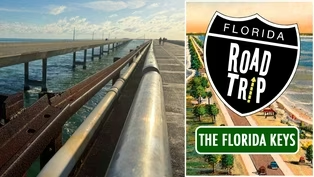
Preview: S2026 Ep4 | 30s | Watch a preview of the Florida Keys episode of Florida Road Trip. (30s)
Providing Support for PBS.org
Learn Moreabout PBS online sponsorship












Support for PBS provided by:
Florida Road Trip is a local public television program presented by WUCF
Watch additional episodes of Florida Road Trip at https://video.wucftv.org/show/central-florida-roadtrip/