
The Foundations of Home
10/1/2026 | 1h 2m 20sVideo has Closed Captions
The foundations of home, from humble mud bricks to a mountain with the world's most prized marble,
From humble mud bricks to an Italian mountain with the world's most prized marble, the series starts with the foundations of home. Some incredible itinerary stops include an earthen eco-retreat built from lava; Hampton Court Palace; Pasadena, California, where movie buffs will recognize an iconic American Craftsman home; and award-winning designer Yves Béhar in San Francisco.
Problems playing video? | Closed Captioning Feedback
Problems playing video? | Closed Captioning Feedback
The History of Home is presented by your local public television station.
Distributed nationally by American Public Television
The Foundations of Home
10/1/2026 | 1h 2m 20sVideo has Closed Captions
From humble mud bricks to an Italian mountain with the world's most prized marble, the series starts with the foundations of home. Some incredible itinerary stops include an earthen eco-retreat built from lava; Hampton Court Palace; Pasadena, California, where movie buffs will recognize an iconic American Craftsman home; and award-winning designer Yves Béhar in San Francisco.
Problems playing video? | Closed Captioning Feedback
Where to Watch The History of Home
The History of Home is available to stream on pbs.org and the PBS app.
(dramatic music) - [Nick] Home.
(child giggles) There's no place like it.
(dramatic music) From ancient castles, (dramatic music) to the eco-shelters of tomorrow, (dramatic music) throughout history houses have varied drastically in their construction, (dramatic music) style and design.
(dramatic music) But a home (dramatic music) is defined by so much more.
- There's the building itself, but there's the heart that goes into it.
It's a place that has soul.
- [Nick] Our homes embody our culture, (dramatic music) our environments.
- Our houses are a kind of jungle, full of things that we don't understand.
- [Nick] And our lives.
- All of life happens in the home.
This is the history of how humans live.
(dramatic music) - [Nick] Throughout the ages and across the world (dramatic music) the story of humankind is deeply entwined with where, (dramatic music) how, and why (thunder crashes) we build our homes.
(dramatic music) In this series, we'll journey from the deep past, to the distant future.
- What we learn from how we live in these extreme conditions is very useful in how we can start to think about living on another planet.
- [Nick] To answer the eternal question, (dramatic music) what makes a house (dramatic music) a home?
(dramatic music) In this first episode, (upbeat music) we start with the foundations of history.
The building blocks.
(dramatic music) (tree crashes) From cave dwellings of our earliest ancestors, (dramatic music) to the mud brick marvels of ancient civilizations.
(dramatic music) the stone strongholds of kings.
(dramatic music) to the soaring glass skyscrapers of tomorrow and beyond.
(dramatic music) Welcome to "The History of Home."
For most of human history, solid walls, and a roof over our heads were unfathomable luxuries.
Humans settled in cold tundras, (relaxing music) wet rainforests, (relaxing music) arid grasslands, (relaxing music) and blistering deserts.
(relaxing music) Our fundamental will to survive in these harsh environments shaped our shelters.
(relaxing music) Some things never change.
- [Cade] The southwest is vast area of expansive land.
It's real good and raw.
- A lot of our projects are set in Arizona and so the culture and the environment here I think has that resourcefulness and resilience and there's quite a level of pragmatism living in the desert.
I think we both find poetry in the pragmatic.
That will to survive, that ability to adapt.
- [Nick] Cade Hayes and Jesus Robles are the talented team that heads DUST, a studio comprised of craftsmen, builders, and architects.
They know a thing or two about making a home, even in a harsh desert environment.
(relaxing guitar music) - We joke a lotta times, certain parts of the desert it's inhospitable.
For me there's beauty in these things.
(thunder crashes) - [Nick] The desert wilderness provided a welcome challenge.
(relaxing guitar music) Leading the guys down a road to create a shelter as ambitious as it was remote.
- [Jesus] Right now we're in the San Rafael Valley in southern Arizona.
And once we get into that valley there's a strand that they call the Canelo Hills, and so that is the rim of the caldera.
So to me there's this history of time written in the landscape.
- [Nick] The connection to this rugged region is exemplified at Casa Caldera.
It's a self-sustaining, luxury retreat, built in the shadow of an ancient volcano.
Inspired by ancient methods, Cade and Jesus built this desert dwelling using the the earth itself.
- We start the thinking rooted in history pre-air conditioning.
If you look at anywhere in the world, indigenous structures were probably the most responsive and the most technically green structures.
So I think that's always an easy source of inspiration.
- [Nick] When finished, this high-tech earth structure will protect occupants from the inhospitable desert.
But our ancestors were not so lucky.
In extreme environments like this, shelters were not built, they were taken.
Caves provided refuge for our ancient predecessors.
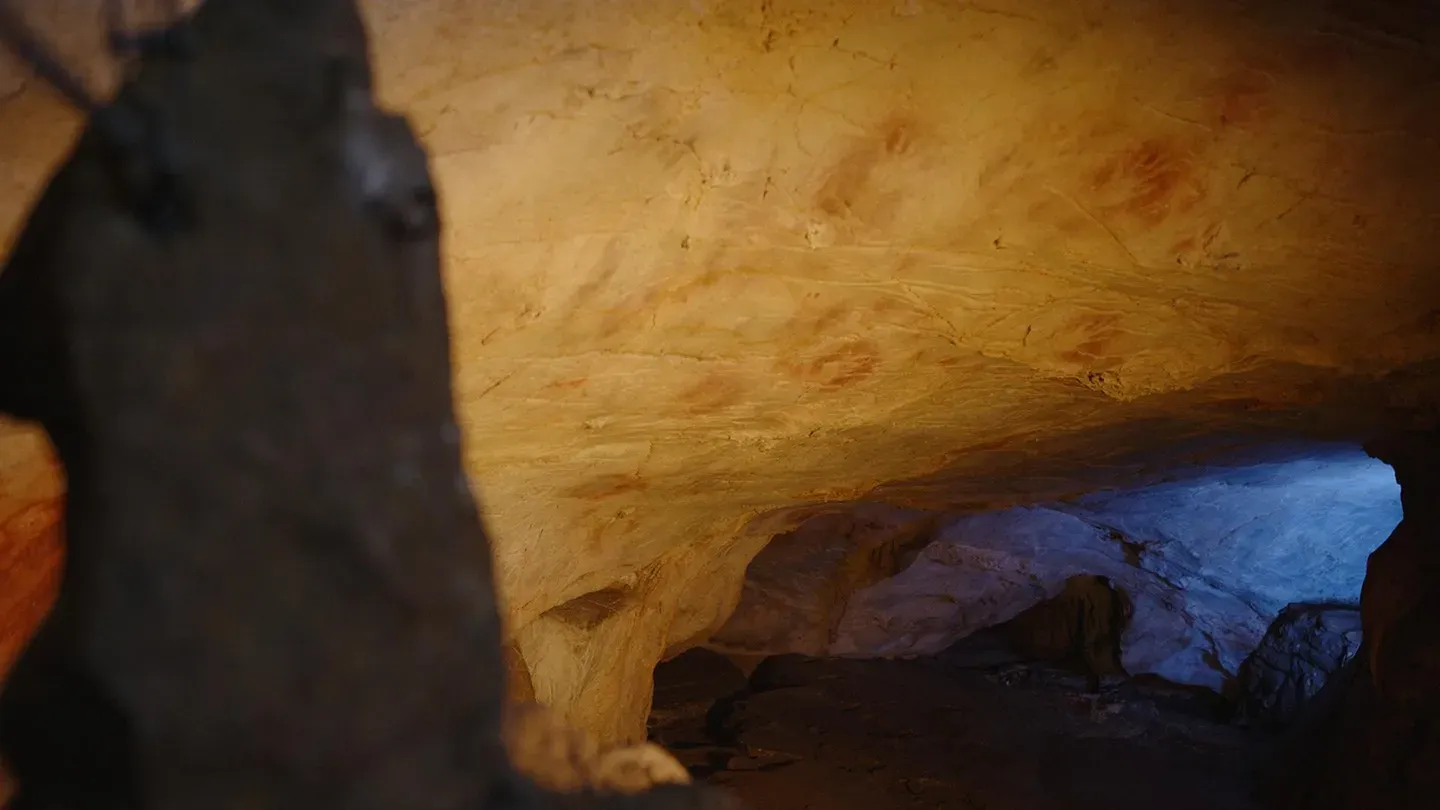
And in the mountains of northern Spain, remnants of fires, tools, and art, paint an incredible picture of home life in ancient times.
(Roberto speaking in a foreign language) - [Nick] These stratifications of earth represent 150,00 years of human history.
This was home base for roaming Neanderthals and early Homo sapiens alike.
(Roberto speaking in a foreign language) - [Nick] It wasn't just a shelter from freezing temperatures and howling winds.
(relaxing music) Our ancestors braved these depths to leave a trace of themselves and their lives, in a place they called home.
(water drips) (Roberto speaking in a foreign language) - [Nick] The artwork discovered on these walls is the oldest ever found.
(Roberto speaking in a foreign language) - [Nick] But the dawn of a new age, would drive nomadic people out of caves and onto the plains.
(dramatic music) Around 11,000 years ago, as early farming communities began to lay roots, humans became more sedentary.
(Roberto speaking in a foreign language) - [Nick] Early civilizations harnessed the resources of their environments.
And instead of taking shelter, we used the earth to make it.
- It turns out mud is the most common building material on the planet.
There are literally millions of houses in the Andes, but even earlier than that, on the coast of Peru, China, and also in central Asia and Africa.
- [Nick] Mud taken from the banks of the world's rivers was molded, shaped and dried into our earliest houses and settlements.
- And many people, especially people who live in the western United States or in Latin America, are aware of mold-made adobe bricks.
- [Nick] This tradition continues today.
(relaxing music) The America southwest is renowned for its architecture made of adobe, Spanish for mud brick.
For Native American architect Elizabeth Suina, (majestic music) there is no stronger link to the past, (majestic music) than the remains of Mesa Verde.
(majestic music) - Mesa Verde is the ancestral home to all of the 19 pueblos of New Mexico.
Standing in this space you can definitely feel some of the spirits of the people who dwelled here.
I can picture families, little children running through the paths, folks above the mesa top cultivating their harvest and possibly bringing that harvest down to store for next winter or the next year.
These are all typical things of the ancient homes.
- [Nick] The home design of Mesa Verde demonstrates ancient ingenuity and the evolution of building techniques.
- Wherever they would settle they would use the local materials.
There was the riverbed that contained a lot of mud and so they used that mud to create adobe brick and started to construct their homes out of adobe.
In the Mesa Verde Valley the sandstone is also very abundant.
- [Nick] The genius of this settlement reveals a unique understanding of the environment.
- We situate our homes to absorb the sun, heat in the winter and to cool the home in the summer.
It's funny I wanna say, us Native Americans have been practicing passive solar for thousands of years.
This is evidence that they were very skilled builders.
Looking back, I can definitely see the roles that women played in ancient villages like this and puebloid culturality really inspired me to become an architect.
Their skills really inspired me to become, not only a designer, but a builder of homes.
- [Nick] Here, the past does not seem so far away.
- [Elizabeth] They survived, they were resilient, I think that's what speaks to home and what home means to me.
- [Nick] Resilience is the name of the game when it comes to building a life in the desert.
(dramatic music) And, back with the guys at DUST Studios, (dramatic music) earth materials and passive solar design are a continuing source of inspiration for their modern architecture.
In building their off-the-grid shelter, Jesus and Cade drew on ancient materials but, with a twist.
(upbeat music) Casa Caldera was build out of lava.
This ground-breaking technique was pioneered by a cohort of Jesus and Cade, desert maverick Paul Schwam.
- I'm an architect by training, I would say I'm an innovator sort of at heart.
(dramatic music) This is a pile of, we call it scoria.
Scoria is actually volcanic cinder.
This is like the popcorn that comes out of a volcano.
And so what this is is this is porous rock.
- [Nick] Paul invented a unique machine which allows him to mix scoria with water and binding agents, for an original earthen material.
- We've been building out of earth for eons.
Part of what I'm doing here with the lava is to try to bring that back, but in an oddball way.
One of the benefits of this as a material is it provides insulation.
It'll provide structure, provide some color.
This is kind of high-tech earth and it introduces us to a better building material that I think has a real future for the next millennium.
That's why I'm in this thing.
- [Nick] Using this elemental new ingredient, DUST spent months building in the sweltering desert.
As Cade and Jesus know all too well, the climate is the chief challenge out here.
And the extreme highs and lows were made all the more difficult at Casa Caldera.
(relaxing music) - Client basically said he didn't want air conditioning in the desert, which is pretty crazy.
So we were tasked with that, having to kind of crack that.
How do we solve that?
(upbeat music) First in materials in the desert there's a flywheel effect.
During the day as the temperatures rise the walls absorb that heat and you want the walls thick enough, that as it cools down at the end of the day, you open the windows to neutralize it and the heat works itself back out.
And so that's part of the design of why these walls are 18 inches.
(dramatic music) - [Nick] But in this environment, they needed more than heat dissipating walls.
(dramatic music) They needed airflow.
(dramatic music) - One of our tasks was how do we ventilate this even when there's no air movement?
And part of it is this old vernacular that was used in Mexico and Spain, and probably even back to Iraq and Syria.
(relaxing music) Basically this becomes the lung.
So what we did is sorta organized everything around this protected outdoor space.
Bedrooms on one side and the living space on the other.
- You're able to then open certain apertures through the house to direct wind flow.
- When you open this whole house up then the ventilation just happens naturally.
(relaxing music) - [Nick] This sustainable home includes a water supply, tapping into natural wells and an efficient solar energy system.
(relaxing music) It's designed to last the test of time and do it in style.
(relaxing music) - You know ideally if we look at cultures that built here for centuries their primary building material was earth, stone, adobe, mud, so we feel that this is sort of carrying on that tradition and conversation, in taking a lava rock and pulverizing it and mixing it with cement.
We're able to achieve some more efficiencies, but still have a nod back to tradition and building with earth materials.
(relaxing music) - [Nick] With the earth beneath our feet, humans built homes, civilizations, and sleek, sustainable, desert sanctuaries.
(thunder crashes) But mud structures can't survive everything Mother Nature has to throw at them.
Humans in temperate regions depended on one of the most durable and adaptable materials on the planet.
Whether modest stick shelters, staggering, stilt longhouses, or lonely log cabins, wooden structures are a timeless tradition that spans the globe.
And if you build with wood, it's bound to be good.
(upbeat music) Nestled in the foothills of California, one wooden marvel stands alone, the Gamble House.
- The Gamble House was built in 1908 for David and Mary Gamble of Cincinnati, Ohio.
They were the second generation of the Procter & Gamble company.
This house allowed them, with their architects, to build something that was really an expression of the landscape, an expression of the climate, and something that would suit the family's needs.
- [Nick] Built by brothers and famous architects, Charles and Henry Greene, this is the crown jewel of Pasadena architecture.
If it looks familiar there's a good reason.
(videotape whirs) (upbeat music) - The filming of "Back to the Future" was a big milestone for the house.
And I'm sure that 35 years ago when they did it, they had no idea it would become this mecca for people who were fans of the movie.
- [Nick] But back to the present, Doc Brown's house is more than a nice place to tinker with your flux capacitor.
This home is the greatest illustration of an architectural movement.
- The Gamble House is considered a Craftsman-style house.
So the movement really was emphasizing the importance of handwork and the connection of people who make things and the materials they make them out of, and the people who they make them for.
- [Nick] Woodworkers cut, turned, carved, and joined this house together.
- It's so much to the importance of handwork in the Craftsman style.
When we look at the way the wood in the house is finished, we really see the hand of the person who made everything, to get that sense of someone having touched every single surface.
Each of these little pegs that you see in the furnishings, in the trim work, you can picture that person who was having to make every single one of those.
- [Nick] From the timber frames, to the sun-soaked shingles, the hand-carved paneling, to the decorative details, Gamble House is a cathedral of wood craftsmanship.
(upbeat music) - There are about 17 or 18 different woods used in the house, ranging from soft, local wood, like redwood, down to mahoganies and ebonies that are used for the details and the furnishings in the house.
Each wood is chosen for its particular qualities, whether it's the color, or the grain, or the durability of it, or its resistance to water.
So to be able to source those woods, find craftsmen who could really do those woods justice, was pretty extraordinary.
That kind of feeling of the warmth of wood, the scent of wood and the texture of wood, that kind of relaxed quality that the house has, that's something that's very inviting.
- [Nick] Here the Craftsman style reached its apex.
It is the culmination of a long history.
- The fact that the house is over a 100 years old, it's so special.
But the Craftsman-style houses of Pasadena and of the West Coast are really part of a much larger tradition of wood structures around the world.
- [Nick] The log cabin has made its mark in American history as the beloved home of brave pioneers, setting out to conquer the American west.
Though we love to think about the log cabin being as all-American as baseball, or apple pie, traditional log homes actually date back thousands of years, to the times of the Vikings.
(dramatic music) Halfway between Scotland and Iceland is a volcanic cluster of islands known as the Faroes.
- [Joannes] We're in the middle of the North Atlantic, way out in the ocean.
- [Nick] Ancient sagas suggest this remote landscape was colonized by the Vikings in the 9th century.
- So a lot of people are still very keen on also living the way you would have done in the old days.
But in those days of course, everything was about you could say survival.
- [Nick] And on this land, one homestead has survived almost 1,000 years.
- My name is Joannes Patursson and I'm a farmer here today and my family took over this farm in 1557, so we are today the 17th generation on the farm.
- [Nick] Through the four centuries it has been in the Patursson family, (relaxing music) this wooden house has survived avalanches, revolts, and a family feud or two.
It is a historic landmark for this tiny nation.
(relaxing music) - We just call it Kirkjuboargarour only means the farm in Kirkjubour.
It was simply the cultural and political center of the Faroes.
- [Nick] This log home is one of the oldest, continuously inhabited houses in the world.
- The oldest and the most original part of the house are these log walls themselves.
They are part of the original house according the the legend.
- [Nick] Building materials are scarce on an island barren of trees.
To build shelter here took extraordinary ingenuity and planning.
(dramatic music) - The legend of the Faroes claimed that in early 1300s they must have imported these houses as prefabricated houses from Norway.
So all the logs have been joined together, then they took it apart, sailed it across, and rebuilt it here.
- [Nick] So, almost a 1,000 years before Ikea even existed, Scandinavians were pioneering prefabrication and self-assembly.
(relaxing music) While the house has been renewed and maintained by the Patursson family over the course of the millennium, one room has remained almost unchanged.
- Many of these structures go way beyond 1550s.
The oldest part of the house, the interior log cabin, according to the legends, is almost 1,000 years old.
And this is the roykstova, which translates to smoke room.
So here, just exactly where I'm standing, my ancestors would have an open fireplace.
This would have been the main living room on the farm.
You would have bunks along the wall, six, eight, 10 people would probably sleep in this area as well.
So few people are left on a farm like this.
Still today we use it a lot also in our private life.
This is our home.
We don't consider it a museum or anything.
It's our home first and foremost.
- [Nick] Few homes can boast a legacy as long as this one.
But not all homes are quite so quaint.
(dramatic music) Sometimes they're all about power and strength.
And there's no mightier material with which to fortify this message, than stone.
(Florian speaking in a foreign language) - [Nick] France is full of castles.
But Guedelon is by no means typical.
This castle is being built from scratch.
(dramatic music) It's an experiment in action.
(Florian speaking in a foreign language) - [Nick] This ambitious archeological experiment took its inspiration from a nearby castle, Saint-Fargeau.
(dramatic music) Florian and his crew hope to uncover the secrets of medieval castle construction by building one of their own.
(dramatic music) (Florian speaking in a foreign language) - [Nick] The great societies and cities of the ancient world, those of the Egyptians, Greeks and Romans, these were civilizations built, not brick by brick, but stone by stone.
- It's important to learn the techniques and to do.
Because it is by doing it that you understand it.
- [Nick] Traditional building materials like mud and timber were easy to shape and use, but the use of stone, was a revolution in construction.
To succeed, it required a range of new and high-specialized technical skills.
- You need a lot of patience, a level of geometry, mathematics, and the most difficult thing in working with stones is the physical aspect of it.
- [Nick] The towers of Guedelon are a formidable ode to the brilliant architects who first erected castles, and the men and women seeking their wisdom today.
(Florian speaking in a foreign language) - [Nick] Castles are milestones in history.
Those that endure are links to a past of power, prestige, and beauty.
The stone to build Guedelon is quarried right on site.
But what we build with isn't always about what's convenient.
Sometimes, to make a statement, it takes something epic.
High in the Alps of Tuscany is one of the world's most coveted stones, an entire mountain of marble.
(dramatic music) The ancient Romans certainly didn't build Rome in a day.
But they did build it to last, thanks in part to their use of Carrara marble.
(Davide speaking in a foreign language) - [Nick] And the local economy has depended on the quarries ever since.
(woman sings in a foreign language) (Simone speaking in a foreign language) (woman sings in a foreign language) - [Nick] Durability is key.
But it's the style that makes marble a classic.
(Davide speaking in a foreign language) (woman sings in a foreign language) (Davide speaking in a foreign language) - [Nick] This pure, white marble was used for iconic buildings, like Rome's Pantheon, and carved into master works of art, like Michelangelo's David.
(Davide speaking in a foreign language) - [Nick] This eternally fashionable stone has been mined for over 2,000 years, and there's no slowing down.
More marble has been mined in the last 50 years than in the previous thousand.
But, like most beautiful things, marble can be hard to handle.
(relaxing music) (Davide speaking in a foreign language) - [Nick] Marble is difficult to extract, extremely heavy, and complicated to transport, and shockingly delicate.
Perhaps these complexities are what make it desired the world over.
(dramatic music) (Davide speaking in a foreign language) - [Nick] A countertop here, a bathtub there, for most marble is a material used sparingly.
Small statements of wealth and style decorating our homes.
But, what if you had all the money in the world.
(upbeat music) - My name is Trudy Coxe and I'm the Executive Director of the Preservation Society of Newport County, and we are standing in Marble House here in Newport, Rhode Island.
(upbeat music) Marble House was built by Alva Vanderbilt.
It was her 39th birthday present, can you imagine.
It is made of 500,000 cubic feet of marble.
So she loved marble obviously.
(upbeat music) - [Nick] The Vanderbilts were absolutely rolling in it, thanks to their wise investment in an up-and-coming invention called the railroad.
- In the late 1880s, when this house was being built, Alva had an aim, and that was to make a statement about the Vanderbilt family and their wealth, and what other way to make a statement than to build a palace made out of marble.
- [Nick] The house was designed by eminent architect of the era, Richard Morris Hunt.
But it was the lady of the house who ruled supreme.
- Alva, who was the real designer of the house, was very discriminating in her use of marble, and there are a variety of marbles.
The outside is Tuckahoe marble.
Within the interior of the house, we are surrounded by Siena marble and that came from an Italian quarry.
And there are some from Africa, Algeria.
She went with this wonderful beige, tan hue.
I think it does add a warmth to the entranceway.
And then in the dining room, you're going to see a pink, rose-colored marble.
And that would cast the right kind of glow on a woman's face, which was of course, very, very important.
- [Nick] But statement pieces, like this home, don't come cheap, even by Vanderbilt standards.
(dramatic music) The house was reported as costing $11 million, or about $300 million today.
(cash register rings) (dramatic music) - I think that the point was to be ostentatious and I think that it was understood, they had done well for themselves and they were going to let the world know that they were important.
(dramatic music) - [Nick] The Vanderbilt clan went on to commission even more extravagant homes, such as The Breakers, and Biltmore Estate.
This was the height of the Gilded Age, when the barons of the New World lived like the royalty of the old one.
(regal fanfare) What the rich would aspire to, royalty had invented and you didn't need a house of marble to show off.
- So this is Hampton Court Palace.
This palace is an example of the finest Tudor architecture.
Brick work was modern and exciting in the early 16th century.
- [Nick] Once upon a time, brick work was the height of fashion and modernity.
This is on display at Henry the VIII's notorious pleasure palace.
- This is one of Henry the VIII's many homes.
But one of his favorites, because this was the place that he used for entertaining.
- [Nick] Historian Suzannah Lipscomb is a former curator of Hampton Court Palace.
- It's like coming home, not that my home is like this.
But it's a place I spent a lot of time and it is always astoundingly beautiful, it's always so magnificent.
I don't know if you can listen to the sound of this gatehouse it's wonderful.
And then we get through and this amazing base port, this first courtyard is revealed.
It's just spectacular.
So he spent quite a lot of time here, but the court was big.
We're talking about a 1,000, 1,200 people.
So this would have been a place of activity.
So it's all quiet now, but you're gonna have to use your imagination.
You've got to imagine people arriving, large numbers of people.
(horse neighs) (horse hooves clop) It was a place that was used to project power, to impress those who visited.
So this as home had two kind of roles.
One is that role of being magnificent and impressive, and the other is being a place to have fun.
There was a bowling alley here, a tennis court, he could hunt on land from here to Windsor.
So it's a home that is used for his comfort and for entertaining.
- [Nick] This Tudor palace dominated political life in the 1500s, and the man himself, the king, loomed even larger.
- We have this image of Henry the VIII of hands on hips, a massive obese man by the end of his life, six wives, breaking with the Roman Catholic Church, but actually he is a more complex character than that.
When he started his reign, he was just about to turn 18.
He was considered to be very good looking at the time.
He was six foot two, when the average height of a man was five foot seven.
He was athletic, and he was incredibly fashionable.
So this is a man of many accomplishments and it's fitting that he wanted to be at home in a place that was the height of Renaissance achievement.
- [Nick] Sturdy, fashionable, and impressive, this was an architectural achievement.
(upbeat music) But brick is rarely associated with grand pleasure palaces and playboy kings.
To many, this is the building block of the middle class.
Here in Amsterdam, there's one red-light district and a whole lot of red brick homes.
- In the Netherlands we have a saying (Otto speaking in a foreign language), east west, home is best.
(upbeat music) - [Nick] Otto is as Dutch as they come.
And this proud Amsterdammer tours the city on the waterways which made it famous.
- I love living in Amsterdam.
I first started doing history tours because I'm a big history geek.
So Amsterdam to me is like an open-air museum with people living in there.
There's like history everywhere.
So lets go to the beginning.
Amsterdam started out as an old swamp, fishermen's village, on the Amstel River.
Around the year 1260 they built a dam.
The people around it were called the Amsteller Dammers.
- [Nick] From the 1200s on, this city grew and thrived.
So too, did Dutch ambition.
- In the 16th, 17th centuries we became the masters of the world seas.
We started trading in spices, coffee, sugar, and we became so filthy rich, that we're still bragging about it today.
- [Nick] The Dutch trading empire controlled the world's most valuable spices, (upbeat music) giving rise to a wealthy merchant class.
- These spice traders they would spend a lotta money on their houses.
And when something's very expensive call it peperduur, pepper expensive.
(relaxing music) - [Nick] Along the 165 canals running through the city, rich businessmen erected their family houses out of, you guessed it, brick.
But, even in this golden age, Amsterdammers were limited by the resources found in their environment.
- So if you look at The Netherlands it's completely flat, it's a river delta.
Which means we don't have mountains around here, but we have clay.
So you have to make your building materials, literally yourself out of clay.
They would have ovens where they would bake to make really durable materials.
- [Nick] The clay, dredged from the canals of the country, built a Dutch obsession with brick.
- If you look behind you over here, you would also note that all house in Amsterdam, they look a lot like me.
They're all tall, skinny, and very good looking.
(relaxing music) And why are they so skinny?
Because back in the day you paid taxes over how wide the front of your house was.
So you would build, narrow, deep, and high.
(relaxing music) If you look at the Amsterdam houses they are leaning and tilting, crooked in all kinds of directions.
A big part of that is by design.
We actually build them with a tilt, so you would not hit the building while you were hoisting up goods, damaging your fancy ornaments, your glass work, every expensive back in the day.
- [Nick] It wasn't just the brilliant building that was a game changer.
- If you look at these tall, skinny, Amsterdam merchant houses, they were really like built for a family.
(relaxing music) With the ground floor being public space and showing off to the world and then the top floor's really like a private space to share with your family.
- [Nick] In the 16th and 17th centuries, thanks to the newfound wealth, the artistic world began to flourish here.
Artists like Vermeer painted scenes that gave an intimate look inside these houses.
Their paintings focused on everyday people, doing everyday things.
These works of art are considered our first vivid glimpses into life at home.
- [Otto] Today we take for granted, but back in the day it was quite a new style.
(upbeat music) 400 years later and these brick homes are still standing.
- [Nick] Those who lived within these brick walls have made their mark on history.
A century after the Dutch golden age, bricks became the building block for another population of people, (upbeat music) the English working class.
- Right now we're at the Pullens Estate, or the Pullens Building.
Now these were built in 1886 by James Pullen.
They were sort of model-type housing, a mix between the live, work, sort of dichotomy as it were.
- [Nick] These flats are some of the last Victorian tenement buildings surviving in London.
- They were for artisans, craftsmen, essentially the lower classes, but those that were doin' all sorts of trades from shoemakers, to stationers, to those making ship's biscuits.
So multi-occupational, multi-functional, multi-use housing was extremely common during the 19th century.
- [Nick] Coal was the fuel of the industrial revolution.
And coal was hard on practically everything.
During the industrial period, bricks were not only hard-wearing, not only durable, they could stand up to pollution, but also they could be mass produced.
- [Nick] Bricks had always been made by hand, but the invention of the Hoffman kiln meant bricks could finally be produced consistently, and at scale.
For London, it was just in time.
- Brick was a very common material come the late 19th century.
And this is because there was a huge population boom.
The population rose about tenfold, from one to 10 million.
So it just shows how many buildings were needed, how many bricks therefore.
(upbeat music) London likely couldn't be the city that it is today if it wasn't for bricks.
Some our greatest architecture from our Georgian to Victorian terraces are brick built.
Stone was too expensive, timber was too expensive, therefore we needed brick.
- [Nick] However, there were limits to the versatility of this fire-forged material.
Brick structures could only be built so high.
But cities never stopped growing.
To keep up we needed to move on from our ancient stalwarts to the wonder materials of the modern age, glass, steel, and concrete.
(dramatic music) - Welcome to 35 Hudson Yards.
Hudson Yards is the largest, privately-held, real estate development in American history.
- [Nick] This behemoth used over 9,000 tons of steel, 1.7 million cubic feet of concrete.
Enough to build a sidewalk stretching from New York to Washington, D.C.
And it's staggering 1,000-foot-tall frame is enveloped in glass.
- This was originally actually the site of a rail yard.
So what we did was, we built a platform on top of the trains, and built up from that.
That required incredible engineering and incredible genius to figure out a way to build over the yards.
I don't think this could have been done years ago.
(dramatic music) - [Nick] Big buildings were built for big business.
Or for those with big money.
(relaxing music) - The building is about 1,000 feet high and we are on the 65 floor.
So you're probably in the neighborhood of 700 feet off the ground.
So you're really, absolutely engulfed by incredible views.
I have been in this business for many, many years.
Certainly having grown up in the city, I've seen tremendous changes.
When I was a kid, I remember the first condominiums going up.
So this was a city of co-ops and rental buildings and brownstones, and things totally changed, I guess in the 70s and 80s when luxury living became a part of New York City.
And I think this is quintessential New York City.
You don't forget what city you're living in.
(upbeat music) You're living absolutely in the lap of luxury.
- [Nick] Together this powerful trifecta of materials, glass, steel, and concrete, changed city skylines forever, allowing homes to reach barely believable heights of scale and luxury.
From mud to marble, sticks to steel, our homes reflect a changing world.
(upbeat music) But the building materials we use are just the foundations of home.
In the right hands, our abodes can be so much more, they can be art.
And architecture with artistic flare is on full display in Barcelona.
- My name is Miguel Angel.
I'm the leader of a big group of architects who try to go deeper in what it means architecture.
We really believe that architecture is an art, and the way that we try to understand ourselves.
- [Nick] Architects are not only builders, they're creators.
And through history, the great ones took the art of architecture beyond the realms of human imagination.
This city was home to architectural legend Antoni Gaudi.
While more famous for his cathedral and public projects, the houses he built here are unlike any found the world over.
- Gaudi, his homes are different from the other ones.
I think the first big theme of Gaudi will be always nature.
Nature was the main source of inspiration.
He wants to make architecture alive.
I think at the beginning it's like a flower.
- [Nick] In this city we find the first and final homes that Antoni Gaudi ever built, Casa Vicens and Casa Mila.
In the first home he designed, Casa Vicens, style and color dominated his design - Casa Vicens was start to be built in 1883.
(upbeat music) It's one of the first examples of Catalan movement of architecture and art.
He was playing with erotic style, with Japanese style, (upbeat music) trying to find which one was the way to express the Catalan society.
(upbeat music) Nature here is so based in what we call ornamentation.
(upbeat music) I think that after that house he feels more free to rationalize what it means architecture.
- [Nick] In Casa Mila, his final home, we see an artist using the home as the canvas of his cunning.
(relaxing music) - Perhaps for the architecture of Gaudi this is the top.
It was a residential apartment building, with the ground floor close to 1,600 square meters house.
I think the main reason that people are here standing up in front of the building is because it's strange.
The facade seems liquid.
It's flowing, it's changing all the time.
Everything is round and it's smooth.
And it is like a dream.
- [Nick] The strange delights of Gaudi's apartment building extend even to the design of the roof.
- You have the little chimneys, all the warriors, it seems like helmets watching the city, protecting the city.
You have the staircases.
Then on top in the attics, underneath the roof, you have the feeling of being in side a whale.
- [Nick] Antoni Gaudi died almost 100 years ago.
But his name is remembered thanks to breathtaking designs.
- If someone is a genius, Gaudi is a genius.
If you're an architect you really feel that he was a genius in all the layers of architecture.
- [Nick] Gaudi designed very few homes, but those he did, live on as places to learn, admire, and take selfies.
- I think that the main work of an architect must be the home.
I wanna make where the people live, sleep, and eat.
He was an architect.
He had that gift.
And for him he felt that it was a God gift.
He had to pursue this.
- [Nick] When it comes to home building, not all architects have time for artistry.
More often than not, they're solving problems of space and sustainability.
Fortunately they are not alone.
It is with the help of designers, engineers and innovators that the homes of the future will be made.
- So this is where I do some work.
But it's also where the kids do their homework and the shelving there is built so that the books and the pictures are away from the light, so they get less sun damage.
This piece is actually inspired by some of my industrial design work.
And it's a place where we hide the t.v.
- [Nick] For award-winning designer Yves Behar, designing for the future begins with his life at home.
- I have four kids, so part of the designing of this house was to build some cool rooms for them.
That's what they've been using since they were babies.
(playful music) - [Nick] His family home is a treasure trove of clever and future-focused design.
- To me the home is really the ultimate place to make a difference in people's lives.
As a designer, I really became obsessed with bringing technology in the home, but in a way that allows the home to be a place for human interaction.
I believe that technology can improve our lives.
Technology can also complicate our lives.
My goal is to use technology for this inherent good.
- [Nick] Over the last 20 years, Yves' company fuseproject, has helped pioneer home and product designs as a force for positive social and environmental change.
- The role of a designer is to accelerate the adoption of new ideas.
And if you wanna really impact the way people live, change the way people live in their homes.
I chose very early on to be a designer because I think the new ideas of the 21st century are important.
Ideas such as, we should live in a sustainable world.
The materials we use, the technologies we use, shouldn't destroy our own planet.
- [Nick] In the u.S., architects are only responsible for 2% of the homes built every year.
The rest are designed by the building industry.
In the past few years, Yves and fuseproject have turned their focus from life inside the home, to the housing industry itself.
I think rethinking construction, how buildings are made, is really important.
Here on the West Coast we have seen not enough housing and prices that are completely out of touch.
And one of the goals is to lower the cost of construction, lower the pain of construction, lower the harm and impact, and to accelerate construction.
Prefab house for example, creates 80% less waste because it's made in a factory, in a much more efficient way.
But at the same time, most prefab buildings are low-quality and I think are not really taking into account people's hopes and dreams for what their homes should be, open, efficient, durable.
And so what we really wanna do with the Plant Prefab home that we've designed is to elevate prefab.
- [Nick] In 2018, Yves partnered with Plant Prefab, a custom prefabricated house manufacturer.
(upbeat music) - It's just a really beautiful design.
It's steel frame, it's open floor plan, floor-to-ceiling glass.
It's what you would expect from an industrial designer.
It's a beautiful, beautiful home.
- [Nick] Developer Steven Glenn is driven to evolve our understanding of a prefab home, beyond the image of a trailer park.
- So Plant designs and manufactures sustainable, healthy, prefabricated homes.
We're focused on the custom market, so we do very high-quality, single and multi-family homes.
And our mission really is to make it much more easy and efficient to build great architectural projects.
- [Nick] On the factory floor there are between five and 15 homes being built at any given time.
From the foundations to the fittings, homes are put together piece by piece before they are shipped out.
And there's a larger mission at play.
- If you look at buildings as a category, versus all transportation, planes, cars, versus all factories, buildings use more energy.
There is increasingly bad climate change and we have a relatively short amount of time to dramatically change how we consume and how we build them.
And that means building buildings in a more responsible way with respect to energy and water and material resources.
- [Nick] These home builders are pioneers in reducing the carbon footprint of construction.
(relaxing music) - I hope we'll make it easier, more efficient for people to have great, sustainable homes.
I hope we'll build more affordably to make housing more accessible.
Integral into that which makes you successful are things that make you purposeful.
- [Nick] These lofty goals seek to transform the homes of the future, but also change the ways we use the materials of the past.
(dramatic music) - I think when we look at the history of homes we see a lot of changes.
But those changes have happened over a rather long period of time.
(dramatic music) The home is completely connected with the times, the culture, the history, of the way people live.
I think that change needs to accelerate.
- [Nick] Throughout history the materials we used to shape our houses, shaped our lives.
(people cheer) But the building blocks were only the beginning.
(dramatic music) It's the rooms inside that have transformed the way we think, we eat.
- The hearth is the heart.
- [Nick] We entertain, (dramatic music) and live.
- It's a place that has soul.
- [Nick] All this next time on "The History of Home."
(relaxing music)














Support for PBS provided by:
The History of Home is presented by your local public television station.
Distributed nationally by American Public Television