
The Fragile Threads of Power - V.E. Schwab
Season 9 Episode 5 | 13mVideo has Closed Captions
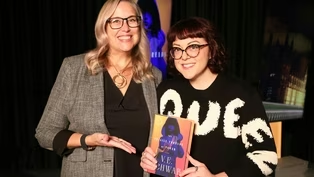
V.E. Schwab talks with J.T. Ellison about her book THE FRAGILE THREADS OF POWER.
V.E. Schwab talks with J.T. Ellison about her book THE FRAGILE THREADS OF POWER, the start of a new series.
Problems playing video? | Closed Captioning Feedback
Problems playing video? | Closed Captioning Feedback
A Word on Words is a local public television program presented by WNPT
The Fragile Threads of Power - V.E. Schwab
Season 9 Episode 5 | 13mVideo has Closed Captions
V.E. Schwab talks with J.T. Ellison about her book THE FRAGILE THREADS OF POWER, the start of a new series.
Problems playing video? | Closed Captioning Feedback
How to Watch A Word on Words
A Word on Words is available to stream on pbs.org and the free PBS App, available on iPhone, Apple TV, Android TV, Android smartphones, Amazon Fire TV, Amazon Fire Tablet, Roku, Samsung Smart TV, and Vizio.
Buy Now
Providing Support for PBS.org
Learn Moreabout PBS online sponsorship(typewriter pings) (upbeat music) - Hi, I'm V. E. Schwab and this is, "The Fragile Threads of Power."
(upbeat music) "The Fragile Threads of Power" is set seven years after the end of "A Conjuring of Light," the end of the last "Shades of Magic" series.
This book really focuses on Tes, a 15-year-old runaway who is hiding from someone or something, we don't know what.
She's opened a repair shop in London where she fixes broken things and sometimes makes other ones better.
And one day comes into possession of something broken that she needs to fix, unfortunately she doesn't know what it's supposed to be.
But as she sets out to fix it, we discover that it has the potential to unravel everything.
(gentle music) - I want you to explain the four Londons.
- [V. E.] Sure.
- How you conceived this absolutely magnificent idea that is now sustaining two series.
- Yeah.
- And where we are, as we pick up in "Fragile Threads of Power."
- Sure.
So the "Shades of Magic" series, the original trilogy, is inspired by the desire to write a portal fantasy.
You know, that Lewis-style portal fantasy tells you that there's a cupboard somewhere in your house that doesn't have a back to it.
I love having a point of departure from our world, so I wanted to write a portal fantasy but I didn't wanna write multiple distinct worlds.
I didn't want to need a map.
I'm the kind of reader that wants to fall into worlds and discover them as I need and so a map felt like homework at the beginning of the book.
And so I thought, okay, well, if I don't wanna write different worlds, what if I wrote the same world different ways?
And so what happened is, I designed four alternate realities.
There's the gray world, our world, where magic has been forgotten.
There's the red world, where magic is worshiped like a God.
And there's the white world, where magic has been enslaved and kind of bound to the whims of the people and is refusing to rise.
And there's the black world, where magic became so exquisite and so intrinsic, that it consumed the hearts and minds of all the people and it burned the world down.
And so what we have are a rare handful of figures, called Antari magicians, who have the ability to create doors between these worlds, which are no longer connected.
They were at one time but after the black world fell, the doors between the worlds all closed and now only people with a specific kind of magic can move between them.
And of course because that creates a have, have not element, there are always people who would like to move between those worlds, for their own gains and are unable to.
And so, the first series looked at a handful of characters who were thrown into this situation, some who had that power, some who did not have the power.
This new series, the "Threads of Power" arc, happens seven years later.
And so I wanted to write a sequel series but because I like to make things difficult for myself, I also wanna write it in a way that, one day "Shades of Magic" could be seen as a prequel series.
So you'll be able to enter the story at either point, at either cast.
And I really just wanted to move us forward seven years to look at the aftermath of one series on the next.
Because seven years is enough time that we regenerate, we manifest ourselves anew.
It's enough time that we can have the end of one era and the beginning of a next.
And I've always been fascinated in origin story and aftermath.
And they kind of go hand in hand.
Aftermath can be our present and origin story our past.
Or the origin story can be our present and the aftermath our future.
And so I'm always just really interested in cause and effect in narrative.
- Why fantasy?
- I cannot imagine writing reality.
I grew up wanting the world to be strange.
I am that kid that went hiking and looked for keyholes and cracks in the stone.
I am always wondering, what if?
What if there was more?
What if the world was weird?
You know, to separate the world into the two dead guys, right.
You have the Tolkien writers who write the kind of fantasy you'll only ever access through the pages of a book.
You'll never see "Middle-earth" any other way.
And you have the Lewis' who tell you, somewhere in the house there's a cupboard, no door and send you looking.
And I want those.
As a reader, I want that, so as a writer, I want that.
I want to make readers doubt their reality.
Even just a little bit.
If I can make a reader start to wonder, what if?
At two in the morning, when they're lying awake, you know, what if there's a curtain in the house that doesn't have a wall behind it?
What if there's a floorboard that's loose and leads down, past the boundaries of the house?
I know.
What if there's a moth?
- What if there's a tiny dragon?
What if there's a dive-bomb in this?
- Yes, what if there's a moth that's spying for a zombie?
You know.
Like, whatever it is, I just want everything to be wondrous.
I want there to be magic.
And I wanna trick readers into believing that there's magic.
And I don't think it's a trick.
I want to convince readers to question.
(upbeat music) About half the way through "Conjuring of Light," I realized I had a plot element that I couldn't resolve or I would've been able to resolve it but it would've been rushed.
And I thought to myself, I have an opportunity here, I can either rush the results, just to close that door or I can leave it cracked open.
And then if I ever do wanna return to this world 'cause it's a very large world and we've only done a very small piece of it.
If I wanted to have an opportunity, an option, it could be there.
And so the plot thread was, there's a captain of a floating market, it's essentially like, everything on this market is forbidden, shouldn't touch a single thing on it.
And the captain of the floating market does a deal with a character named Delilah Bard, in exchange for a favor, to be called in at a later date.
And the favor is never called in, in "Shades of Magic."
And by the time I finished writing "Conjuring of Light," I knew what the favor was and I knew how I wanted it to be called in and when.
And so essentially, when we start "The Fragile Threads of Power," we meet Tes, the girl on the cover, a 15-year-old runaway, who's running a repair shop in London because she has this exquisite and very rare ability to, not only see the threads of magic that compose our world but to manipulate them and to change them.
And the way that she uses this, is often to fix broken things.
And an object comes into the repair shop in disarray, to the point where she doesn't even know what it's supposed to be.
But she takes on the challenge of fixing it 'cause she's a naturally curious person.
Meanwhile, Lila Bard is called to the floating market by the captain and told, "Something has been stolen from my ship.
It's damaged but it's still dangerous.
Go get it back for me."
And of course, these are the same object in both cases.
And that's the collision course of "Fragile Threads of Power."
- These are incredibly complex and there are a million threads.
- Yes.
- How are you balancing all of that in your brain, at the same time, with the thousands of other things that you're doing?
- Not to be hyperbolic, it sometimes feels a little bit like "Atlas."
Like you design a world and then you're holding the world up.
The whole time you're drafting, you're like, "Don't drop it, don't drop it, don't drop it, don't drop it because it'll break."
And like, you don't feel a relief until you literally set that world down and you're like, "Okay, we have navigated."
On the one hand, I'm an extreme planner.
I am the opposite of somebody who flies by the seat of their pants.
I have a lot of anxiety.
And the way that that manifests in writing is, that I need to know that I have enough material, so that I don't wander a hundred pages in the wrong direction.
So when I sit down to write a book like "Fragile Threads," I have the entire book planned, beat by beat.
And the only thing that I don't have planned necessarily, is the narrative order in which I'm going to tell it.
So say there are eight perspective characters in the book with a different hierarchic level, let's say four of them are core.
I will know the chronological order of their story.
I know what their arc is.
I don't necessarily know how I'm going to lay that out for the reader.
I just know that by the end, here's all the information that we will have gotten.
And then a lot of the drafting process is about, kind of, figuring out, okay, if we start in red London and we can then go to white London and then we'll come back to red London and we'll go to gray London.
And I'll figure out like, which character to start with, which characters to follow for where, when two characters are together, which point of view we're gonna choose to align ourselves with, based on what those characters will notice.
And I kind of, amalgamate the story but it's this unwieldy tapestry, for most of the time that I'm writing it.
And the only thing that keeps me from going mad with that, is that I do know the ending.
And I do know where each and every character needs to end up when we get there.
(upbeat music) Books are time capsules of the people that we are when we're writing them.
And then the book becomes a book and we continue to grow.
And the book doesn't.
The book becomes a static object.
And so, the luxury of getting to return to a series and of carving in enough time in that series, that I age one for one with my characters.
'Cause I finished writing "Conjuring of Light," in 2016.
It came out in 2017 but I wrote it in 2016.
So for me, it was exactly seven years, from book to book.
And that was freeing.
'Cause I think one of the scariest things about returning to a beloved world or to beloved characters, is that I cannot write them the way that I did in 2016 because I am not the person that I was in 2016.
I have matured.
That's not a one directional thing.
Maturing doesn't mean I'm a better writer.
It means that I value specific things in my writing at this point, that might be different.
I am a much more character driven writer now, after "The Invisible Life of Addie LaRue," which my very first ever character novel, meaning that the vast majority of the conflict was internal, instead of external.
I have become very much convinced as a writer, that the characters as we meet them, are a product of every highlight and low light that has happened in their life up unto that point.
And so I start to go back and really start mining their past, whether it's the seven years that we were away or far back before that.
Mining the past for informative actions, those crossroads that change the shape of their lives.
And then I use that to inform all the decisions that they make at this point because that's how people work.
And my great goal, I've decided, besides making people doubt, besides making people wonder, my great goal, is making you believe that these are people and not characters.
And the difference being, that characters only exist while you're reading and that people's existence is not contingent upon reader's attention.
I want you to set the book down when you're done and believe that everyone you just read about still lives.
That they get to carry on and you simply don't get to follow.
And that's like, to do that, you have to be invested in them as people, with all of those flaws, with all of those dimensions.
And so, there's a lot of how I write that's changed.
And so when I went back to write "Fragile Threads of Power," the scariest day was also the best day, which was the day that I got to write Kell and Lila and some of the original characters 'cause they're very much a part of this.
I like to say that anyone who survived the first series, is in the second series.
- Is in the second.
- But they're such a part of me as well and I was really nervous that I wouldn't be able to write them.
- Yeah.
- That it would feel like cosplaying myself.
It would feel like writing a fanfiction of myself.
You know, trying to recapture the exact way that I wrote.
And then I realized, I don't need to capture the exact way that I wrote.
Kell is not the exact person that he was.
Lila's not the exact person that she was.
And I'm not the exact person that I am.
How can we all grow together?
- And they get nuance.
- [V. E.] Yeah.
- They get nuance that wasn't there in the first series.
- And I mean, again, nuance because, at 23, you have a different level of nuance than you do at 30.
- Sure.
- And like, we all grow and mature.
And in another seven years they'll be different people again.
And that's why a lot of people were like, "Oh, why write "Threads of Power?"
Because "Conjuring of Light" has a really well-loved conclusion.
To which I say, that, like, "Yes it does and I'm super proud of it.
And it's madness that I decided to then be like, let's pry the doors open again."
But, as long as we live, we're going to have new eras.
The only way that we don't have any more eras, is when our life's done.
And so, yes, I gave them a beautiful conclusion.
But I didn't end their lives, they were gonna continue living on.
And so as long as they were gonna live on, they were gonna have new hard days and new sad days and new beautiful days and new enemies and challenges and lovers.
And so, I don't see it as any way, reversing the conclusion or the closure of "Conjuring of Light."
It's just, sometimes we have to face new demons.
- Thank you so much for being here.
This has been so much fun.
- Thank you so much.
It's a joy, anytime I get to spend time with you.
- And thank you for watching "A Word on Words."
I'm J.T.
Ellison, keep reading.
(typewriter pings) - (Assistant) Do you need a tissue?
- [V. E.] No, I just have one eye that's just hating me.
It's fine.
It's just watering.
- [J.T.]
Oh, I thought I moved her to tears.
- [V. E.] Oh, that too.
That's what I meant, that's what I meant.
(everyone laughs) It was J.T.
(everyone laughs) It was J.T.
I was just getting emotional.
Definitely wasn't foundation in my eye.
The Fragile Threads of Power - V.E. Schwab | Short
Video has Closed Captions
Clip: S9 Ep5 | 2m 30s | V.E. Schwab talks with J.T. Ellison about her book THE FRAGILE THREADS OF POWER. (2m 30s)
Providing Support for PBS.org
Learn Moreabout PBS online sponsorship













Support for PBS provided by:
A Word on Words is a local public television program presented by WNPT