
The Future of Energy in Utah
Season 9 Episode 31 | 26m 45sVideo has Closed Captions
TBD
TBD
Problems playing video? | Closed Captioning Feedback
Problems playing video? | Closed Captioning Feedback
The Hinckley Report is a local public television program presented by PBS Utah
Funding for The Hinckley Report is made possible in part by Cleone Peterson Eccles Endowment Fund, AARP Utah, and Merit Medical.
The Future of Energy in Utah
Season 9 Episode 31 | 26m 45sVideo has Closed Captions
TBD
Problems playing video? | Closed Captioning Feedback
How to Watch The Hinckley Report
The Hinckley Report is available to stream on pbs.org and the free PBS App, available on iPhone, Apple TV, Android TV, Android smartphones, Amazon Fire TV, Amazon Fire Tablet, Roku, Samsung Smart TV, and Vizio.
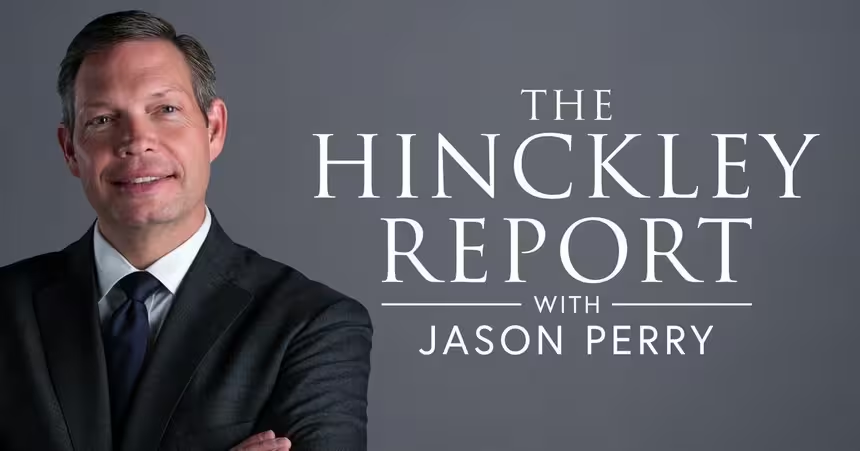
The Hinckley Report
Hosted by Jason Perry, each week’s guests feature Utah’s top journalists, lawmakers and policy experts.Providing Support for PBS.org
Learn Moreabout PBS online sponsorship(lively music) - Funding for "The Hinckley Report" is made possible in part by Merit Medical and by contributions to PBS Utah from viewers like you.
Thank you.
- On this episode of "The Hinckley Report, our expert panelists join us to discuss Utah's energy policy.
What new laws did state leaders pass this session?
How are leaders pushing innovation?
And what is the future of energy production in our state?
(lively music) (lively music continues) Good evening and welcome to "The Hinckley Report."
I'm Jason Perry, director of the Hinckley Institute of Politics.
Covering the week, we have Derek Miller, president and CEO of the Salt Lake Chamber.
Natalie Gochnour, director of the Kem C. Gardner Policy Institute at the University of Utah.
And State Senator Scott Sandall, a Republican from Tremonton and vice chair of the Executive Appropriations Committee.
So glad to have you all on on this very special episode all about energy.
You all bring such a unique perspective.
Our business leader for the state, our economist, our demographer here, and, of course, our state senator involved in all things energy.
This is gonna be an interesting conversation because so much of the direction of Utah is tied to this.
I wonder through that lens, through your individual perspectives, if we can just take just a moment and give us sort of the landscape, what you see in energy for the state of Utah.
Let's start with you Derek, please.
Through the business lens.
- You know, the best way that we can think about energy and particularly electricity is when we don't have it because we take it for granted so much.
So anytime that someone's power goes out, and now their cell phone can't be charged, the lights aren't on in their home, the food in their refrigerator's going bad.
Now take that on a massive scale.
We all need electricity and especially, of course, our businesses.
There is no job that I can think of in Utah that can exist without electricity, without power, without energy.
So to say it's important, I mean, we can't overstate its importance, especially to our economy and how our economy needs to continue to grow for us to be as prosperous as we'd like to be.
- [Jason] Natalie.
- I mean, I'll make two additions to that.
It's really important to our economy.
The energy sector's about 76,000 jobs direct, indirect, induced.
Also about a $10 billion industry in our state.
So it's important to just, you know, feeding our families, even separate from the fact that you need the energy to cook, and to do those things.
The other point I'd make is that Utah is a place where we have an abundant, diverse portfolio of energy resources.
Not every state in the country has energy, and we're one of 'em.
And not only do we have energy, but we have it all.
We have oil and gas, we have solar, we have geothermal, we have wind, we have storage, we have critical minerals.
This is a huge opportunity for our state.
In the words of a good friend of mine, economic development is energy development right now.
- [Jason] Senator Sandall.
- As Derek alluded to, we don't miss energy until we don't have it.
And as a legislator, I'm very concerned about low cost and reliable.
We want something that works when the switch comes on, you depend on it, you want it there as the demand increases across our state almost exponentially for power because we more and more crave power to do what we're gonna do in data centers and AI.
Those kind of things that create an exponential increase in our demand, very concerned about how that doesn't translate into higher rates for our normal rate payers.
That's something we've worked on this past session.
- Natalie, what's interesting is you start talking about growth in the state of Utah, and I wanna spend some time on that, but to get to that point, for a very long time, we were a net exporter of power.
That has shifted here in the state.
Talk about that.
What's happened and what is causing that really?
- Yeah, well, Derek was wise in his opening comments to make the case that, you know, often, when we talk about energy, we mean electricity, but when we talk about being a net exporter, net importer, they're actually taking all the measures of energy, oil and gas development, you know, solar, whatnot, all of the electricity and converting it to a Btu and saying, "Are we importing or exporting on net?"
And yeah, it's a new thing.
For 40 years, we were a net exporter of energy by that measure and now we're a net importer, just barely.
And I would say that's a super complicated number because we don't operate along state lines, as you know, with energy.
I'm making the state of Utah there, if you wondered.
- [Jason] I could tell that.
- You could tell that.
It's a regional phenomenon.
It's tied to the grid.
We're part of a grid that doesn't follow a state line, it follows a western regional line.
And so I actually worry less about being a net export of energy and more about are the underlying fundamentals strong that they're gonna be reliable, sustainable, dispatchable, all those kinds of things.
- This is something you've been working on, Senator, so talk about that, please.
- Yeah, we're tied in the western region, especially in the electricity, into the grid.
And what we do in our state affects Washington, Oregon, California, Nevada, Wyoming, Idaho.
We're all interconnected.
- [Natalie] Yeah.
And there's no Utah grid.
- There is no Utah grid.
- Yeah.
- It all interconnects in really, quite honestly, a brilliant way.
But it also leads us to the fact that we have Rocky Mountain Power who services most of our customers in the state who has to serve some political needs as well in West Coast states, Oregon, Washington, and California.
And that has led Rocky Mountain Power to try to make some decisions that are kind of tough in the past.
And two years ago, we actually went to Rocky Mountain Power and we said, "We want to make sure that we maintain reliable and low cost as our number one and two factors."
And that maybe changed the landscape a little bit.
We allowed them to keep Hunter and Huntington available rather than shutting them down.
And as far as electricity goes, I think we stabilized a lot.
- Yeah.
I wanna make a comment there, Jason.
So Rocky Mountain Power is an investor-owned utility, Berkshire Hathaway for people who don't know that.
It's about 80% of our electricity is through Rocky Mountain Power.
- [Scott] Yeah.
Yes.
- Does that sound about right?
- [Scott] Yeah, that sounds about right.
- And then the rest are gonna be the municipals.
I'm in Murray City, we have our own power company, and then you have your rural cooperatives.
But when you have 80% of your power through an investor-owned utility, there's an actual state interest in understanding that better, and not just trusting that out to the utility.
And that's what I've seen the state do is say right now with the demand for energy, with the importance of it to our economy, there's a state interest in being more involved.
And that's what I've seen the legislature do.
- So if there's no like real boundary on this as well, what happens with something like this for the state of Utah?
When there's a fire in another state, infrastructure is wiped out in another state, how's that impacting us?
Rocky Mountain Power is one of those particularly that's impacted, right, Senator?
- Exactly right.
So a fire happens in Oregon, and a lawsuit happens, and customers across their entire portfolio are somewhat responsible to pay some of those bills.
We've tried to do our best to insulate Utah from that by creating laws around the fact that we're gonna insulate you from some lawsuits if you do certain things.
If you're proactive in preventing your lines from causing fires, we're gonna allow you some ability to not be sued.
I think that's important for our rate payers to understand that we've taken some of those steps here in the state of Utah.
And quite honestly, we're positioning Rocky Mountain Power to possibly bifurcate their system, where in Washington and Oregon, they may have a different view of how they want their power produced, and what sources those come from.
And here in Utah, we may gather with Idaho and Wyoming, saying we have a little different tact on, we're still wanting low cost and reliable.
- When we talk about these costs, Derek, I remember 'cause you've been involved in this business recruitment for a very long time, bringing business to the state, growing businesses in the state as well.
This is one of those sort of talking points that you helped hone here.
That's the low cost.
Talk about that.
Is that still the conversation that needs to be had?
How important is this as you're trying to grow and recruit?
- So obviously, every business that's here cares about what their costs are.
Every business who may wanna relocate here cares about what the cost would look like.
And it still is a very good picture for Utah when you just look at what the power costs.
So 14, for when we look at what's produced, that's not gas fired.
When we look at the cost of our natural gas, we're in the lowest 10 states.
So very good, very competitive but we do have a challenge.
And that challenge is we're starting to hit the ceiling of our max production.
So electricity is interesting because it's different than you putting gas in your car and driving around.
In that case, you have a little power plant that you're driving around.
But when we talk about electricity, we're talking about a fixed power plant.
So you've heard Natalie, and you've heard Senator Sandall talk about the infrastructure.
It is huge.
I mean, you think about power plants, you think about the substations that you need, you need it in the neighborhoods.
You have to get that power to these places.
You have to distribute it.
So infrastructure is huge.
It's a huge cost, and we're producing now at about what we can max out on.
But yet our needs are still growing.
It's actually not growing too much just from population growth.
Most people that are watching this might think, "Oh well, it's because our population's growing."
That's somewhat true, but it's not the main driver.
The main driver is AI needs, cloud computing needs, and then more cars are being converted to electric cars.
And so we see that taxing the electrical, both the generation and the distribution.
So that's what we worry about.
And to answer your question specifically, it does, unless we solve it, it's going to create a cap, not just on recruiting businesses here, but the ability for the businesses that are already here to grow.
- And Natalie, break out a couple of these really, really great points 'cause I wanna talk about the part with our growth as a state, which is part of it, but there's also what Derek has mentioned, sort of our aspirational goals when it comes to AI, for example, sort of the IT world, which Utah does clearly want to be part of that.
- Yeah, I mean, I would say it that Utah's changing fast and it's not just demographic change, but it's economic change.
The structure of our economy's changing, you know?
We're becoming more and more of an information economy.
Information requires electricity.
Last time I looked, our prices, our electricity prices were about 30% lower than the national average.
That's a big deal for us.
Great for Utahns, great for business.
But the other point that I would make is that we have a reshoring of manufacturing occurring in this country.
And the current administration's accelerating that.
That also places a huge demand.
So you got cloud computing, you got AI, you got electric vehicles, you've got reshoring in manufacturing.
So the growth curve for electricity demand is accelerating.
And thank goodness we have the portfolio we have because perhaps better than any state, I mean, we could argue about it a little bit, but we have it all.
And with good policy, we can meet those needs and keep Utah prosperous.
- So it's interesting.
Traditionally, we would see 2 to 3% growth in our demand for electricity.
With AI, data centers, that bumps up, instead of this kind of gradual, to something very steep.
And we wanna make sure that we don't allow those costs to come in and translate across the rest of the system.
But also, if we want them to be here, we want those facilities here.
They bring billions of dollars of potential impact to the state of Utah.
And I think it's important.
I think we wanna be a player there, and I think we're going to find ways to satisfy that demand.
We are currently looking at the state, at the IPP facility in Delta that they were going to shut down.
I believe we're gonna keep that online, and we're gonna have that power here for the state of Utah.
- Can I talk just really quickly about sort of the emerging IT field there a little bit?
You know, there have been times when the state has talked about whether or not you want just a data center, right?
It doesn't take a whole lot of people to run it.
A lot of infrastructure, a lot of money right up front, but it's changed a little bit.
Maybe you can just tell a little bit.
It's because the data center is, I guess, tied to AI, it's tied to the compute now, which is the interesting thing for us.
Give us the policy considerations there.
- Yeah, I think the policy considerations is the country that controls AI is probably gonna be the country in the lead to control the world.
And do we want that here in the United States?
I do believe we want that.
Utah is uniquely positioned because of what Natalie said.
We have a lot of opportunity between geothermal, between our traditional fossil fuel, nuclear now that we're contemplating to supply the power to be a data or AI center across the US.
And I think there's a great power to that in addition to the fact that we do bring in high-paying jobs.
We bring 'em into construct the facilities, not as many to operate the facilities, but those facilities do generate property tax.
They generate a lot of good things across our state that I think there's way more positives than there are negatives to bringing in these facilities.
- And I would add that technology's helping us here.
The new data centers are not water, you know, consumptive.
They can be a large, massive data center and only require the water of two or three homes.
So it's an amazing field right now.
- So I agree that we need to be in the AI game.
To me the question is where on the food chain are we gonna be?
And President Randall here at the University of Utah wants to create an AI ethics center, an AI responsibility center.
So that's way up here on the food chain.
Some may argue that being the location for AI data centers isn't as far up the food chain.
And the reason that that's important is, as Senator Sandall pointed out, they do create some jobs, not a lot of jobs, but they do take a lot of power.
Now, my own personal opinion, and it's born out of a project that you and I worked on together, Jason when we worked for Governor Huntsman, and that was with eBay and they wanted to bring a data center here.
And we said, "Okay, bringing a data center is here great.
It takes a lot of power.
It takes, in those days, a lot of water.
In addition to bringing a data center that doesn't have a lot of jobs, we want you to bring one of your second headquarters here," which they ended up doing, which is why we have thousands of eBay jobs here today.
So if we can leverage the opportunity to bring those AI data centers as a gateway into something more for our economy, then I think it's a great thing for us.
- Another way to think of this is an environment of change, right?
Technological change, a changing energy sector and whatnot.
And in an environment of change, do you wanna sit back or do you wanna lean into it?
And what I hear both of these other guests saying is we wanna lean into it.
We wanna lean into it for economic development purposes, we wanna lean into it for public policy purposes.
And I'll just make a big pitch here for what solar means to this state.
So I'm an economist by training.
What I'm seeing in solar is the costs are going like this, more so than any other, you know, source in energy.
And there's a narrative that that's because of subsidies, but it's going like this all across the world in every country.
And what's happening is technology is delivering on solar panels that are low cost to this almost free energy source.
Now, it's not 24/7.
- Yeah.
- You know?
It's not at night, but battery storage is going up, up too.
And so what we have to do as a state is be on the leading edge of this rapidly evolving sector.
I don't think it's transitioning, I think it's evolving, and that's an important distinction.
I know that means a lot on Capitol Hill 'cause we're not leaving behind things, we're all of the above.
But do know that there's only about, I don't know, seven or eight western states that can make a claim to solar, and we're one of 'em.
- Yeah.
- Go ahead senator.
- Well, the intermittent part of it is the struggle in the short term because quite honestly, you're not gonna generate as much power when it's cloudy, and you don't generate when it's at night, and the footprint is quite large.
We typically do that.
I'm very concerned the footprint on a commercial solar farm is disrupting something else that we can put on that footprint.
That's a little concerning to me when we look at that in the fact that we still have to have something to back it up.
We still have to build a battery.
- What is sort of the current view of the legislature and policymakers?
And I know you're leading the space here on energy in this state, on sort of this all the above idea through the lens of this Operation Gigawatt.
You know, the governor has been talking about this is doubling our energy capacity over the next 10 years.
- In the short term, quite honestly, fossil fuels probably still have a major role to play because that's what we've been depending on.
If we could get the federal government to streamline some permitting processes, I think nuclear would come onboard very rapidly and very quickly.
And the further we get down that road, the lower the costs are becoming there, especially if we can get rid of some of the red tape that the federal government has wrapped around nuclear siting.
We're talking nuclear, not your traditional Three Mile Island nuclear, we're talking about nuclear that has done submarines, aircraft carriers where we drop in something on a semi trailer that doesn't require a lot, and produces a pretty good amount of power.
- [Jason] So go ahead, Natalie.
Talk about this.
- Well, love what you're saying there, and I just wanna add in just another bit of just economics in thinking about it.
So you've got a lot of change and you wanna meet the need.
There's something in economics they call the arrow replacement effect.
But it's this idea that you can't count on the big, entrenched, let's say suppliers to provide the innovation that's needed because they have to protect their existing capital stack.
And it's always people from the outside that come in and innovate and create, you know, the new progress, if you will.
And that dynamic's occurring in this state right now where you have the fossil fuel, you know, coal-fired power plants, I'm gonna do the natural gas conversion power plants.
They are our base load, they are essential.
And then you've got renewables coming in and creating new innovation, lower cost this, making a more diverse portfolio.
And it's gonna all work out, but in the process, there's gonna be a lot of tensions.
- [Scott] There there will be a lot of tensions.
- Tensions, yeah, and trade-offs.
And I use that term juggernaut.
Solar is the juggernaut because it is the one part of the energy sector that is innovating the most rapidly right now.
- Natalie, could I just also say that I agree with you.
It will work out, but it's not a guarantee.
And what I mean by that is we can see some states, even close to us, where it's not working out because they made policy decisions that did not reflect the reality that Senator Sandall has pointed out, which is 1/3 of our power comes from natural gas, 1/3 comes from coal, and then you've got a mix with the others, including 7% renewable.
But if we make decisions, policy decisions that force things that get out ahead of where innovation's going, then we suddenly start finding ourselves with brownouts, blackouts and then we'd be hard pressed to say it's working out.
- Yeah, which is all to say that there's a state interest here, and that's where the legislature is absolutely getting it right because it's not just a market phenomenon, there's a public policy interest in what we're doing.
- [Scott] Yeah.
- Give us a small comment on what you were referencing here on the small modular nuclear reactors 'cause it does seem like there is a push from our legislature, and maybe from our industry to look very seriously into those.
- The technology's available, it's proven.
Like I said, we've used it on submarines, we've used it on aircraft carriers safely for 50 years.
Now what we've gotta do is just make sure that we get it right, but that we employ that technology here in the state of Utah in spaces where it fits.
And technology is just getting so much better.
Idaho National Lab, just to the north of us, has been a great partner.
They've been in communication with the legislature.
We've taken tours up there, they've been down here.
We've created a partnership now with University of Utah, and Utah State to start developing, and doing kind of the groundwork to be able to get that kind of reactor here in the state that can help supply these needs.
- There's a keyword there in the nuclear, and that's the term modular.
- Yeah.
- And I'll just mention that also is modular in solar.
And what I mean there is we have a grid that's crowded, that's under invested, that's behind the times, and modular allows you to put things near where they're needed, and to do it incrementally.
So that's sort of a really fun thing about both nuclear and solar is that you can not have to be restricted by the grid.
- Derek, talk about this from the business perspective, the members of the chamber, the industry itself that's gonna be driving a lot of these innovations, I think connected with universities too, but largely industry.
Talk about what they want to see happen.
- Yeah, I mentioned earlier that we're about at our ceiling for what we can generate, which causes us concern.
And this didn't just happen yesterday.
We've seen this coming for a couple of years now.
And so working with Natalie and the Kem C. Gardner Policy Institute, the chamber put together a couple of years ago a report called "Utah's Energy Future: "A Business Perspective," addressing exactly the question that you've asked.
What do businesses want to see?
And the resounding answer was two things that Senator Sandall mentioned: affordability and reliability.
And then they added a third, which was sustainability.
Sustainability means we need to do this in a way that's understanding the environmental issues.
It doesn't mean that overnight we're gonna switch to renewable energy, but as Natalie's pointed out, we have it in Utah, it's growing, we've seen billions of dollars invested in it.
That's good, that's good for all of us.
It's the all of the above approach we've been talking about during this entire show.
But I also wanna say that the nuclear is important to the business community because that's the base load.
And there may be many viewers that aren't experts in electricity, they just wanna turn on their lights, they just wanna plug in their phone when they need it to be charged.
But base load is critical to it because you can't be in a business where there's waste, and electrons always have to be flowing.
So if you're producing more electrons than can be taken off the grid, you have a business problem.
So they're always trying to rightsize that.
And if they can rightsize it with a nuclear base load, right now we have natural gas base load, coal base load, if we can add nuclear base load to that, we will be in a very, very good position.
- Jason, on workforce, I wanna make the point also how important our research universities can be to solving this problem or addressing the opportunity.
I'll do it that way.
You think of the expertise that exists in our research universities, in engineering, you know, in physics, all of the research that's needed to solve problems.
And the whole thing about a state university is that they are here to serve.
And so I can see an argument for more state investment in research, and relying less on the federal government to fund our research.
- Senator, maybe you can take a second on that 'cause I know you talked about it, and you also talked about the workforce issues themselves.
It's one thing to bring these companies, you have to have people who know how to run them, how to operate them.
- We have not in the past focused a great deal on, especially in the nuclear space, nuclear engineers, technology, and those kind of things to home grow them here in the state of Utah.
We've done a lot of work in Idaho at the Idaho National Lab, but I think it's time.
I think we're gonna bring those programs and elevate those programs here in the state of Utah.
I can see us being maybe a hub for the western United States in nuclear.
I think we're that close to being to the edge of being able to do that.
- It's pretty cool.
- Last 20 seconds.
- Well, and 95% of the National Science Foundation research funding that's coming into Utah is going to Utah State, the University of Utah 'cause that's where the expertise is to do this.
And we have to recognize the contribution our research universities make.
- So insightful.
Thank you so much for your comments, and your help on this very important issue.
And thank you for watching "The Hinckley Report."
This show is also available as a podcast on PBSutah.org, YouTube, or wherever you get your podcasts.
Thank you for being with us.
We'll see you next week.
(lively music) - [Narrator] Funding for "The Hinckley Report" is made possible in part by Merit Medical and by contributions to PBS Utah from viewers like you.
Thank you.
(lively music continues) (lively music continues) (lively music continues)

- News and Public Affairs

Top journalists deliver compelling original analysis of the hour's headlines.

- News and Public Affairs

FRONTLINE is investigative journalism that questions, explains and changes our world.












Support for PBS provided by:
The Hinckley Report is a local public television program presented by PBS Utah
Funding for The Hinckley Report is made possible in part by Cleone Peterson Eccles Endowment Fund, AARP Utah, and Merit Medical.