
The Future of EVs/Fighting Anti-Asian Hate
Season 4 Episode 38 | 26m 46sVideo has Closed Captions
The Future of EVs/Fighting Anti-Asian Hate | Episode 438
Ford is unveiling its new all electric F-150 next week. Ceena Vang has taken the lead as Detroit area Asian Americans find ways to deal with the recent incidents where Asians are victims including the Atlanta spa shootings. And Detroit Police Chief James Craig announced his resignation this week, and there are hints he’s exploring a run for governor. Episode 438
Problems playing video? | Closed Captioning Feedback
Problems playing video? | Closed Captioning Feedback
One Detroit is a local public television program presented by Detroit PBS
The Future of EVs/Fighting Anti-Asian Hate
Season 4 Episode 38 | 26m 46sVideo has Closed Captions
Ford is unveiling its new all electric F-150 next week. Ceena Vang has taken the lead as Detroit area Asian Americans find ways to deal with the recent incidents where Asians are victims including the Atlanta spa shootings. And Detroit Police Chief James Craig announced his resignation this week, and there are hints he’s exploring a run for governor. Episode 438
Problems playing video? | Closed Captioning Feedback
How to Watch One Detroit
One Detroit is available to stream on pbs.org and the free PBS App, available on iPhone, Apple TV, Android TV, Android smartphones, Amazon Fire TV, Amazon Fire Tablet, Roku, Samsung Smart TV, and Vizio.
Providing Support for PBS.org
Learn Moreabout PBS online sponsorship- Hey, One Detroit.
I'm Christy McDonald and here's what's coming up this week on the show.
Our closer look at EVs.
From batteries, to infrastructure, to the future on how we drive.
Then One Detroit contributors Nolan Finley and Stephen Henderson take on the politics of the week.
And get to know Ceena Vang, an emerging voice in the fight to stop increased violence against the AAPI community.
It's all ahead this week on One Detroit.
- [Female Narrator] From Delta faucets to Behr paint.
Masco Corporation is proud to deliver products that enhance the way consumers all over the world, experience and enjoy their living spaces.
Masco, serving Michigan communities since 1929.
- [Male Narrator] Support for this program provided by the Cynthia and Edsel Ford fund for Journalism at Detroit Public TV.
The Kresge Foundation.
Community Foundation for Southeast Michigan.
- [Female Narrator] The DTE Foundation is a proud sponsor of Detroit Public TV.
Among the state's largest foundations, committed to Michigan focused giving.
We support organizations that are doing exceptional work in our state.
Visit DTEFoundation.com to learn more.
- [Male Narrator] Business Leaders for Michigan, dedicated to making Michigan a top 10 state for jobs, personal income, and a healthy economy.
Also brought to you by, and Viewers Like You.
(soft music) - Hi there, and Welcome to One Detroit.
I'm Christy McDonald Thanks for being with me this second week of May already and it's time to talk some politics.
With potential challengers to Governor Whitmer emerging and the Detroit Mayor and City Council races.
Our One Detroit contributors Nolan Finley, the editorial page editor of the Detroit News and Stephen Henderson, host of American Black Journal meet up.
Then it's Asian-American and Pacific Islander Heritage Month.
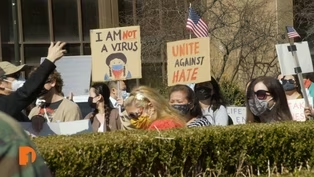
We'll introduce you to Ceena Vang, who co-founded a Detroit activist group to stop increased violence against the AAPI community.
But we are starting off tonight with a closer look at the future of electric vehicles.
Ford is unveiling its all new electric F-150, next week.
President Biden is reportedly coming to Michigan surrounding that announcement.
General Motors has pledged all light vehicles in their lineup will be electric by 2035.
And there is a push in Washington to invest $174 billion into EV infrastructure, charging stations, and retooling manufacturing facilities to meet an anticipated demand.
But upfront costs, range anxiety, and battery life are just some of the hesitations consumers have.
Will Glover has more on the future of EVs.
- [Will] Electric Vehicles or EVs create combustion engines for battery-powered motors.
These fast, - Oh my god.
- [Will] Quiet and high-tech vehicles are being pioneered by companies like Tesla and Michigan's own Rivian.
Amazon is moving toward an all-electric fleet of vehicles by 2030.
Ford is turning iconic brands like the Mustang into EVs.
General Motors has pledged to sell only electric vehicles by 2035 and has already sold the reservation for the first all electric comer to roll off the line at the Barrett-Jackson Scottsdale Auction for $2.5 million.
- [Auctioneer] And sold, for $2,500,000.
- [Will] According to the Edison Electric Institute, there were over a 1 million electric vehicles on US roads as of 2018.
Hannah and John have been driving their EV for three years.
- I was gonna have a kinda longer commute from Ann Arbor Ridge landing out to Detroit and back every day.
I wanted to take every opportunity I could to do my part to contribute to reducing greenhouse gas emissions and to do the thing, to move in the direction that it looked like as a society, we were gonna have to move eventually.
- [Will] John McElroy, the host of Autoline on the benefits of EVs.
- We're going to see a dramatic reduction in air pollution in cities.
We're going to see a reduction in noise pollution because these cars are far far quieter.
There's other issues that have got to be resolved.
We need to be able to recycle the batteries in mass volume and be able to do it at a profit 'cause we don't wanna end up just throwing these things into landfills.
So there's going to be some adjustments as well but overall for the general public and for the economy, the move to electric cars is going to be a positive.
- [Will] Other countries have already bought into electric vehicles, like Norway where 74% of vehicles are hybrid plugin or fully electric.
- Did you know that Norway sells way more electric cars per capita than the US?
Norway.
- [Will] And China, who's planning to transition to all electric or hybrid cars by 2035.
If passed, President Biden's American Jobs Plan will invest $174 billion into incentives for people to buy EVs and support to get 500,000 chargers installed across the country by 2030.
- The fear is that we're falling way behind China and Europe in this regard.
Especially when it comes to the supply chain of critical materials for batteries and motors.
The United States is way far behind and we know that this is going to be the future.
- [Will] In addition to the positive environmental impacts and potential market share, electric cars are efficient.
Associate professor of mechanical engineering at Wayne State University, Dr. Jerry KU explains.
- Having efficiency in the range of upper 80% to 90%.
Whereas combustion engine even was, all the turbo charging, all those kinds of things.
You probably could not get much more than 40, 45%.
So that means that for every gallon of fuel, there is only less than a half gallon actually contributed to driving the vehicle.
Whereas if you use electric vehicle, every kilowatt-hour of electric charge from your battery pack, you can use 80, 90% of it so there's less waste.
That has always been the case.
- [Will] As of 2019, there were over 2.8 million registered vehicles in Michigan but only 4,200 registered electric vehicles.
Of the 250 million vehicles on the roads in the US today, fewer than 1% are electric.
Why haven't EVs taken off in the States?
- Number one is the cost of the cars.
They tend to be more expensive upfront though over their life, their maintenance, and service costs are less so it'll end up being cheaper but you have that upfront hurdle to overcome.
Moreover, a lot of people live in apartments.
Where are you gonna plug in at night?
Or in a condominium or the like, and unless you have your own private residence or someplace to plug in at night, that introduces the concern of range anxiety, where people are like, "Oh my gosh, what if I run out of juice?
Where am I gonna plug in?"
- Like even the most advanced charger, it's level three people.
It's still talking about like on the map, on the magnitude of hours.
So, you take that long to charge the car fully and then you think about like if there's a line, then you have to wait.
- But also for those of us who live in the snow belt, you'll lose a lot of range in cold weather.
You might lose half your range if it's bitter cold outside.
So you lump all this stuff together.
And a lot of people are waiting for somebody else to take the plunge and learn from them before they decide to go electric.
- Oh, there's good apps that have all the stations and people add information about the stations.
Like how many chargers there are, how even what the speed of charging is at different stations.
So, you can plan really nicely.
- One thing that we learned just about the mileage is that it really depends on how fast you drive.
And I come from a part of the country that has lower speed limits that we have to here.
So, I'm not inclined to drive 80 plus miles an hour anyway.
But if you're somebody who is, you run through the charge a lot faster at 80 than you do at 70.
- [Will] Though Americans have been slow EV adopters, a 2020 Consumers Report survey showed 71% of US drivers said that they would consider buying an EV in the future.
And more than 70% agreed that automakers should offer variety, plugin EV pickups, and SUVs in addition to cars.
Automakers have taken different strategies to try and keep up with the sectors clear front-runner, Tesla.
(passenger screaming) - I'll buy it.
I'll take it.
- It's so far out in front of the rest of the industry, which is now scrambling to try to catch up.
But even amongst traditional automakers, we're seeing different strategies.
At the top, the most committed are Volkswagen and General Motors.
- [Will] But not every automaker has plans to go fully electric.
- Then you've got others like Ford, for example, that is saying, "Okay, we're not gonna make the full blown commitment, but we are going to electrify iconic products in our lineup."
Toyota, for example, is a big believer in hybrids, not electric cars.
Honda recognized it really doesn't have the capability of doing anything short term.
It's partnered up with General Motors for making electric vehicles in the United States.
So, depending on which automaker you're talking about, you're going to encounter a different strategy.
- [Will] Michigan ranged 29th out of the 50 States in Washington DC in a scorecard of State Transportation Electrification by the American Council for an Energy-Efficient Economy, preparations to make Michigan more EV-ready are still underway.
The Michigan Climate and Energy Department is working on projects like the Electric Vehicle Readiness Plan, to help townships, counties, cities, and villages become EV-ready through zoning and the optimized EV Charger Placement Plan to develop a fast-charging network for electric vehicle travel throughout Michigan by 2030.
At the federal level, President Biden's proposed infrastructure plan still has to make it through Congress.
For the United States, government, automakers, and consumers will have to be in sync as it hopes to charge into an electrified future.
- Turning now to some politics, Detroit Police Chief James Craig announced his resignation this week.
And there are hints he's exploring a run for governor.
Our One Detroit contributors, Nolan Finley of the Detroit news and Steven Henderson of American Black Journal have more on what this means for the city.
- James Craig's never given any evidence that's he's politically, he doesn't grab the camera, he doesn't grand stand.
You don't hear all that much for him.
Were you surprised?
- Not at all.
I feel like the reason they call him Hollywood.
He's always running in front of the cameras and you can watch him on conservative news programs all the time.
Talking about policing, talking about urban policy, he has made it really clear I think that he had ambitions for something like this.
And he's also made it really clear that he's a Republican.
I mean, he's a conservative guy.
I think, given the trouble that Republicans have had so far identifying really strong candidates to take on, Whitmer next year, I think he moves pretty close to the front of the line.
I think he will have to answer a lot of really difficult questions as all Republican candidates.
Well, about support for Donald Trump.
Whereas he stand on Black Lives Matter.
He manages the police department here in Detroit while all the protests were happening last summer there was a lot of conflict around that.
Does he support the idea of reforming policing?
I don't think it'll be an easy run for him but in Republican circles, I think James Craig is a name that people like.
He is the kind of black candidate that Republicans like.
Doesn't talk a lot about race.
It gets after other African-Americans about, "Personal responsibility."
Those are push buttons for Republicans.
- I think he avoids the Trump trap because in his position during the 2020 campaign, he really wasn't talking about presidential politics a lot, even off, so he's never really called on to express his support for Trump.
And he certainly was never get immersed in these conspiracy theories after the election that Trump was involved in.
So I, and a lot of other candidates in the Republican Party, potential candidates attached themselves to.
So, I think he escapes the trap that way.
And you know, quite frankly, there's nothing Republicans love better than a black conservative, in voting for a black conservative 'cause it validates in their minds that they're not really racist.
And I think that's an important factor here.
I think he can call us the Republican Party.
And if he could take that vote in Detroit which is 3.5% Republican for Bill Schuette in the 2018 election.
and take that into the teens or even higher and bring back MaComb County, which went Democrat in 2018.
I think he's got a really good shot.
- Yeah.
I mean, I would, I certainly wouldn't write him off.
I mean, I think if you're Republican's what you'd hope to do with James Craig is again, narrow that margin in Detroit.
You're not gonna win Detroit.
You're not gonna come close to winning Detroit but if you can move that 3.5 even to six or eight if you could double it, that would hurt Governor Whitmer.
And like you said if you could move MaComb in the, back in the column then you'd make it a real race for her.
I think he will have to answer for some of the things that people are just talking about now whether he was involved or not.
For instance, what does his stand on the January 6th insurrection?
Does he believe that Donald Trump health insight that January 16th insurrection.
Does he believe that the November 2020 elections were handled fairly and that Donald Trump lost that election.
I don't know what his answer is to those things, but I know at least one journalist is gonna be asking him those kinds of questions.
- Well yeah.
But I do think that his personal integrity, the transparency he's shown while in office, it stands in stark contrast to the current governor who seems to think she can answer questions of hypocrisy and ethical breach by saying, "I've said all I'm gonna say about that."
I think with James Craig in the race, she gonna have to say a lot more and going to have to be a lot more attentive to retail politics.
But Steve, a lot of other elections coming up.
Before we get to the governor's race, we got elected mayor in Detroit.
Is Mike Duggan well-positioned for re-election?
Or is that just a silly question?
- I just don't see anybody who is well-positioned to challenge them.
And I had a conversation with somebody last week about what Duggan's appeal really is about.
And I think it is that he has taken the populist retail political mantel in the city.
Mike Duggan is popular with Detroiters because he's in touch with Detroiters in a way that a lot of other politicians aren't.
He's receptions or whatever he's called them.
He's done in people's living rooms and backyards since he was a candidate for the job are an incredible way of connecting with Detroiters.
And if you look at what he's asked of Detroiters since he's been elected.
For instance, the $250 million dollar bond issue last year, which a lot of activists Detroit was against it passed by almost 70%.
And that's because he has mastered that retail politics side of things that really matters in Detroit.
If you think about the politicians who've done the best here they've all done that Coleman Young of course, set the template for it.
Mike Duggan in that way is more like Coleman Young and anybody else was on the political scene.
And again, in that way, he is, and that's what matters.
- And if he does, when he's going to be governing with a whole new council, lot of retirements, a lot of people leaving that council, what's that mean for the city and for Mike Duggan?
- So I, the turnover is not surprising.
We are in the third cycle I think, of the new council districts.
I do think that that lends itself to more turn over which is a good thing.
I think the question that we still have is whether the district system is producing that kind of grassroots grow up to politician thing that we hoped it would.
So, we see candidates who really do represent those areas of the city.
And I don't know enough about all of the candidates running yet to say that we've got there, but that is gonna be I think the real temperature taker for what we get this November - I'm surprised to see so many people leaving the council.
Those are generally considered jobs for life, once you get them.
It does create a whole new crop of potential leaders where Detroit Mike Duggan not gonna be mayor forever.
This probably is his last term I would expect.
And he's got to start growing new talent, growing a replacement field, if you will.
To keep Detroit moving in the direction it's been moving in.
- Yeah, so big political year in the city, I love that stuff.
Once it get, as it gets started, where are we go.
We're out of time now Nolan.
- Okay, thanks Steve.
(Stephen laughs) - May is Asian-American and Pacific Islander Heritage Month.
And in the wake of increased violence against members of the AAPI community here in the US, there have been demonstrations locally and across Michigan to raise awareness.
And that's where we met Ceena Vang.
She was an organizer of the first rally in Detroit after the Atlanta spa shootings where Asian women were targeted.
Ceena is among American, born here and a 2012 graduate of Troy High School.
And she tells us how she was motivated to start her activist group, Whenever We're Needed.
- [Male Speaker] So, this is amazing.
Thank you all for coming and without further ado I'd like to introduce Ceena Vang.
(crowd applause) - Hi everyone.
Oh my goodness.
- [Will] Just days after the Atlanta spa shooting, Ceena Vang stage her first rally in Detroit.
- Elaborate.
It is a mix of anger, frustration, sadness, mixed with feeling eager, feeling liberated, but truly the reason why we are here is bittersweet.
- [Will] The gathering offered a safe space.
The safety in numbers.
Vang, born here, Troy High School Grad Class of 2012.
- I don't think that I truly channeled the activist inside me until maybe a year ago.
When the Black Lives Matter protest had begun.
- It Sounds like you're not all that comfortable getting out there a lot.
- I haven't been comfortable going to most places in a while but I don't know, I get anxiety.
Just moist looking over my shoulder.
- We are called, Whenever We're Needed.
- [Will] Every We're Needed, downtown and around town started with friends, Zora Bowens.
- My partner Zora and I as well.
That's essentially what I'm also fighting for is so that we don't have to live in fear 'cause I'm tired of it.
- I hate that it had to become so loud and violent for us to speak about it.
- When the George Floyd protest started happening I just felt the weight of the world on me and not a lot of people asked if I was okay.
And so I just felt the need to like reach out to, like I reached out to my Asian friends but I reached out to Ceena first and I was just like, "How do you feel about this?
Like, are you okay?"
And she was like, "I'm not okay."
And I was like, "I want to protest."
And she was like, "I do too."
And I was like, "Okay, like, let's go."
- The focus of WWN originally was to bridge the gap between the black and Asian community, because there's a lot of anti-black hate in the Asian community.
And anti-Asian hate in the black community.
- Asian people are silent, we are silent.
That's why we have this problem.
- We didn't think that it was gonna be, big.
We really thought it would be like 50 people.
So, it was really incredible to see that many people come out and so many Asian people.
- My family and I came to the United States because our people were being persecuted because they were helping American soldiers in the Vietnam war.
- I'm Hmong, Hmong-American.
I'm first generation.
My dad came here when he was two or three.
- [Will] Refugees from Laos.
Hmong fought the North Vietnamese backed by the US.
Ceena Vang, a direct descendant of a renowned military leader.
- He's more like a grandpa figure.
His name is General Vang Pao.
He was the leader in the secret war.
- [Will] Vietnam fell.
Many tens of thousands of Hmong fled to Thailand.
- I have a lot of older relatives who had siblings who didn't make it because they were killed or their parents had to leave them behind.
It was just a really offload tragic time.
But I don't think that a lot of people know that story.
And I think it is important.
- [Will] It took time, but Hmong would come to the US, many to Michigan.
- We've been living in Detroit since the late 70s.
My grandpa worked for Ford as like one of his first jobs and slowly worked his way up.
My family also has own a bunch of Asian markets and still own a bunch of Asian restaurants.
Fun fact, Troy is actually one of the most Asian populated cities in Michigan.
- [Will] This protest in Vang's hometown, looking to activate more Asians where they live.
- My grandparents are survivors of COVID-19.
Throughout the pandemic, I've only been able to FaceTime them.
But tell me how their safety can be guaranteed when they leave their homes.
I feel like I've always had a lot to say, but being an Asian woman, it's not good to have too much to say.
It's better to not say much or say anything.
So I struggled, trying to express myself a lot growing up because family members always like, "Don't talk about things that don't concern you, just mind your own business."
And I always felt suppressed for a long time, but I think that because the world is changing at such a rapid rates, you gotta keep up with it.
- [All] Stop Asian hate.
- Racism is a mindset and it is a behavior that is learned and taught.
The root of it starts from home.
- [Will] The rallies organized by Whenever We're Needed, invite others to tell their stories.
- All my life.
I have struggled so much both with being stereotyped and living out of my stereotype.
- [Will] Young people, older too.
Some that remember a murder in the 1980s that galvanized Asian-Americans nationwide back then.
- So, Vincent Chin was a Chinese-American that was mistaken for Japanese.
And this is the time of xenophobia over the Japanese auto companies, and he was killed in Detroit.
Here- - Were you aware of the Vincent Chin story growing up?
- You know what?
I was not, I actually only heard about it a month ago.
My friend was telling me about it and I was like, "How would I never heard of this story in my life?"
- This is almost 40 years ago.
It feels like we're having the same conversations.
- I saw somebody with a sign at that first protest that you ran.
"You realize that could be me."
And it said sudden, "Boom, it's not that somebody is gonna spit at you or yell at you.
They might kill you."
And that's what I think that realization was with Atlanta.
And before that Vincent Chin.
- That was my sign that I was holding.
So, it's funny that you remembered that side.
I think that's why it hits home for so many of us because it very well could have been any one of us.
That we can have these workshops and whole healing spaces.
But at the end of the day, how do we really keep ourselves and each other's safe.
- Detroit Public Television, along with APIA vote Michigan will be holding a virtual live town hall.
Exploring the history of anti-Asian racism and how it continues to affect the lives of Asian-Americans here in Metro Detroit.
It's Wednesday, May 19th at 7:00 PM.
You can live stream it on Facebook and on YouTube.
And just head to onedetroitpbs.org to register and join us for that.
That is gonna do it for us this week.
Come back and see me on Monday for One Detroit's Arts and Culture and next Thursday for One Detroit.
Take care and be well.
You can find more at onedetroitpbs.org or subscribe to our social media channels and sign up for our one Detroit newsletter.
- [Female Narrator] From Delta faucets to Behr paint.
Masco Corporation is proud to deliver products that enhance the way consumers all over the world, experience and enjoy their living spaces.
Masco, serving Michigan communities since 1929.
- [Male Narrator] Support for this program provided by the Cynthia and Edsel Ford fund for Journalism at Detroit Public TV.
The Kresge Foundation.
Community Foundation for Southeast Michigan.
- [Female Narrator] The DTE Foundation is a proud sponsor of Detroit Public TV.
Among the state's largest foundations, committed to Michigan focused giving.
We support organizations that are doing exceptional work in our state.
Visit DTEFoundation.com to learn more.
- [Male Narrator] Business Leaders for Michigan, dedicated to making Michigan a top 10 state for jobs, personal income, and a healthy economy.
Also brought to you by, and Viewers Like You.
(soft music)
Video has Closed Captions
Clip: S4 Ep38 | 6m 40s | Meet Ceena Vang, who started a local activist group in response to anti-Asian violence. (6m 40s)
Video has Closed Captions
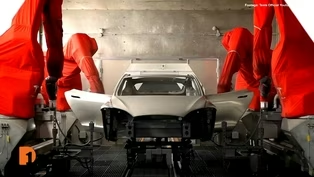
Clip: S4 Ep38 | 7m 46s | Will Glover has a report on the future of EVs | Episode 438/Segment 1 (7m 46s)
Video has Closed Captions
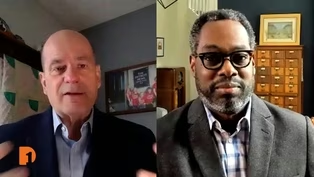
Clip: S4 Ep38 | 7m 12s | Stephen & Nolan talk local politics, including James Craig's rumored run for governor. (7m 12s)
Providing Support for PBS.org
Learn Moreabout PBS online sponsorship
- News and Public Affairs

Top journalists deliver compelling original analysis of the hour's headlines.

- News and Public Affairs

FRONTLINE is investigative journalism that questions, explains and changes our world.












Support for PBS provided by:
One Detroit is a local public television program presented by Detroit PBS