VPM News Focal Point
The Gap: Black-White Inequality | October 05, 2023
Season 2 Episode 15 | 26m 46sVideo has Closed Captions
We explore disparities and race-related myths to dispel fiction and illuminate facts
For centuries, America has grappled with stereotypes as well as real and perceived racial disparities in achievement and wealth. We explore persistent disparities and race-related myths to dispel fiction and illuminate facts.
Problems playing video? | Closed Captioning Feedback
Problems playing video? | Closed Captioning Feedback
VPM News Focal Point is a local public television program presented by VPM
VPM News Focal Point
The Gap: Black-White Inequality | October 05, 2023
Season 2 Episode 15 | 26m 46sVideo has Closed Captions
For centuries, America has grappled with stereotypes as well as real and perceived racial disparities in achievement and wealth. We explore persistent disparities and race-related myths to dispel fiction and illuminate facts.
Problems playing video? | Closed Captioning Feedback
How to Watch VPM News Focal Point
VPM News Focal Point is available to stream on pbs.org and the free PBS App, available on iPhone, Apple TV, Android TV, Android smartphones, Amazon Fire TV, Amazon Fire Tablet, Roku, Samsung Smart TV, and Vizio.
Providing Support for PBS.org
Learn Moreabout PBS online sponsorshipKEYRIS MANZNARES: Over the long arc of American history from the time Africans arrived at Hampton's Port Comfort in 1619 destined for slavery to the time enslaved Americans found freedom there 250 years later during the Civil War, and on to Jim Crow, the Civil Rights fight to today, there have been sizable gaps in the way Black and white Americans experience life.
We explore some of those differences and consider the reasons they exist.
You're watching VPM News Focal Point.
Production funding for VPM News Focal Point is provided by The estate of Mrs. Ann Lee Saunders Brown.
And by... ♪ ♪ KEYRIS MANZNARES: Welcome to VPM News Focal Point.
I'm Keyris Manzanares in for Angie Miles.
Whether we are talking about housing opportunities, incarceration, college attendance, or interactions with police, it can seem that America offers two different worlds depending on which side of the color line you live.
To begin our program, let's look at life itself, specifically, life expectancy.
Special correspondent A.J.
Nwoko visited areas of Richmond that are close in proximity, but according to a Virginia Commonwealth University study, are far apart in quality of life.
A.J.
NWOKO: They say age is just a number but according to a VCU study, the time we're afforded in life can be greatly affected by where we live.
And unfortunately, here in the River City, there's a sea of disparity in life expectancy outcomes within a very small radius.
A.J.
NWOKO: Leaf blowing isn't exactly what Alan Cooper would call exercise but the 76-year-old admits it does help to keep him active.
ALAN COOPER: I do go cycle, work the yard a little bit.
A.J.
NWOKO: Which one of the many reasons he says he enjoys his Westover Hills neighborhood and areas like it.
ALAN COOPER: Here, you can walk to a decent neighborhood grocery store.
There's a drug store you can walk to.
A.J.
NWOKO: But life in the hills is often more convenient than the reality experienced just a few miles north.
Jerry Cunningham will tell you.
JERRY CUNNINGHAM: They ain't got the killing and all this going on.
A.J.
NWOKO: The 57-year-old says he's lived in the city's public housing system much of his life, but he laments that in Gilpin, access to basic needs are hard to come by.
JERRY CUNNINGHAM: In the project, if it ain't no money, it ain't going to survive.
A.J.
NWOKO: These stark differences are particularly concerning to VCU Health's, Dr. Derek Chapman.
DEREK CHAPMAN: We identified a 20-year gap in life expectancy just four and a half miles apart between an area around the Gilpin Court in the north side of Richmond and Westover Hills.
A.J.
NWOKO: The society and health researcher knows this because of a life expectancy map he and his team helped develop using a combination of data from local health agencies, the CDC and the U.S. Census Bureau, which gives insights on how where you live can affect your health.
From this study, Westover Hills recorded the highest average to life expectancy in Richmond at 83 years.
But that same map shows Gilpin Court at just 63.
DEREK CHAPMAN: Just because you live in a neighborhood that has an overall lower life expectancy doesn't mean you're destined to have that outcome.
You need to start looking, we call upstream at the policies and drivers, the social determinants of health that are above and beyond individuals control.
A.J.
NWOKO: For VPM News, I'm A.J.
Nwoko.
KEYRIS MANZNARES: Dr. Chapman says, while the data from the life expectancy map wasn't broken down by income or ethnicity, the results show that people of color are much more likely to live in areas with limited opportunities.
Chapman wants the study to serve as a conversation starter for stakeholders to further consider leading causes of death and begin to address life expectancy outcomes in the lowest performing areas.
Find a link to the VCU study on our website, vpm.org/focalpoint.
KEYRIS MANZNARES: Our nation has been struggling with race-related issues since its inception.
We ask people across Virginia what they thought about the progress that's been made and where we still fall short.
Here's what they had to say.
ALEXANDER MCALLISTER: I definitely feel like Black Americans are treated less in business, in school, and pretty much every institution has sort of baked-in stereotypes that hold African Americans back.
And there are general inequalities for mostly economic reasons that have lingered for hundreds of years, and they haven't really been corrected.
KATRINA JONES: We can be educated and we can be smart.
We do have cars and, you know, money to take care of people and education, so... STACEY APPELT: I don't want any child out there to read a book and not see themselves 'cause I've been there before, not with race, obviously, I'm white, I see myself in books all the time but I can't imagine as a child reading a book, and being like, “Well, that character doesn't look like me, so I can't do that.
” KEYRIS MANZNARES: Representation in neighborhoods across America is another area where Black and white disparities are seen.
Homeownership is one of the many ways that families can build wealth, but the gap between white and Black ownership rates is wider now than it was in 1960 when housing discrimination was legal.
In 2022, 75% of white households owned their homes compared with 45% of black households.
That's more than a 29 point gap.
Next, I spoke with a family to explore the racial wealth gap through the lens of homeownership.
KEYRIS MANZANARES: Carcia and Kevin Santiago are unpacking their belongings in their new kitchen, trying to figure out where to put everything.
They have more cabinets here compared to the apartment that they just lived in.
The Santiago's are settling into this house they bought last month in Virginia Beach.
In 2021, a study by personal finance website SmartAsset found that in this part of Virginia, Black people are closing the wealth gap.
CARCIA SANTIAGO: Homes build equity over time, and that equity, either you can refinance, you can take out a HELOC on a home and, you know, use that money to purchase another home.
And it's just the amount of money that you can build in a home is very, very important.
KEYRIS MANZANARES: For Carcia, the importance of homeownership was passed down in her family.
CARCIA SANTIAGO: When my parents first bought their home in Byram, Mississippi, we were the second Black family in our entire neighborhood.
And at that time, you know, my parents also set us down and they explained to us why that was.
Right?
Because a lot of Black people couldn't afford homes.
Even though you think that redlining doesn't exist today, like, we still know, you know?
A Black family can put their house on the market and if you bring a white family in, you know, the house is going to appraise higher than versus the Black family.
KEYRIS MANZANARES: Historically, Black Americans have faced systemic challenges and discriminatory policies that have prevented them from achieving home ownership in Virginia.
LaTOYA GRAY-SPARKS: I think there are a host of historic events, policies and processes that have contributed to the disadvantage that African Americans are experiencing when it comes to wealth and home ownership.
A lot of it is rooted in redlining.
KEYRIS MANZANARES: Redlining is both a term and a practice.
It was used by mortgage lenders and realtors to grade neighborhoods, ranking them from least risky to risky, or from A to D. Places labeled D were marked on a map, like this one, of Richmond, signaling spaces not worthy of home ownership or lending programs.
The D areas were often where Black people lived.
LaTOYA GRAY-SPARKS: The urban planning.
KEYRIS MANZANARES: For LaToya Gray-Sparks, learning about urban renewal and redlining made her realize that the geographies where she grew up in Richmond were geographies of isolation,limiting access to opportunities.
Now, Gray-Sparks makes her own maps to reclaim the narrative, like this map where she used a directory to show the businesses and families that made up downtown Richmond before urban renewal.
LaTOYA GRAY-SPARKS: I think that's what led to just this deep dive into, like, Black neighborhoods within Richmond and finding that the places that were declared to be blighted weren't blighted at all.
There were streetscapes that existed that could rival what we see here in the Fan or Museum District, but they're no longer around because they were demolished to make way for a highway or whatever other project the city was interested in.
DAMON HARRIS: Fees and bills due to hiring them.
KEYRIS MANZANARES: Damon Harris, founder of Teal House Company in Richmond, says he's committed to reducing displacement, restoring equity, and finding ways to increase home ownership rates.
DAMON HARRIS: How much they're going to cost.
KEYRIS MANZANARES: Harris says redlining and discrimination still affect aspiring homeowners today.
DAMON HARRIS: In 2023, the Black home ownership rate is the same as it was in the '60s or early '60s.
It's almost identical in certain areas to what it was pre-Civil Rights Act.
And so what we see, we see a great gap of almost 40% in certain communities.
KEYRIS MANZANARES: But Harris says millennials are contributing to the rise in Black home ownership rates.
The Santiago's agree.
CARCIA SANTIAGO: It's really home ownership that you're going to be able to build that equity and, again, that generational wealth.
I feel like we always come back to generational wealth, but that's the goal.
Right?
KEYRIS MANZANARES: Teal House Company wants to keep increasing Black homeownership rates to narrow the racial gap.
They offer key services like a co-buying program and ethical home selling.
For more information, visit vpm.org/focalpoint.
ANGIE MILES: VPM News Focal Point is interested in the points of view of Virginians.
To hear more from your Virginia neighbors, and to share your own thoughts and story ideas, find us online at vpm.org/focalpoint.
KEYRIS MANZANARES: In 1916, a prominent American psychologist issued the first edition of an IQ test, Lewis Terman's assessment of intelligence, also called the Stanford Binet Test.
It has been revised many times, but it's still widely used today.
Terman made notable contributions to the field of education.
He was also an avowed eugenist who believed genius was inherited, and that some groups of individuals were naturally more intelligent than others.
Today, as we consider the persistent achievement gap between people of African or Latin descent versus those of European descent, Terman's work is viewed in a new light.
Black and brown children consistently score lower than their white counterparts on most standardized tests and other measures of intelligence and achievement.
But why, and what factors are at play?
Anchor Angie Miles explores the achievement gap in this report.
♪ Boats up river ♪ Wont come down ANGIE MILES: Corey Harris is part of an elite class of high achievers.
He's an accomplished musician, author, world traveler and instructor at the University of Virginia.
He is also recipient of the prized MacArthur Fellows Award also known as the MacArthur Genius Grant.
♪ And I wonder if my baby caught that train ♪ COREY HARRIS: It was quite a surprise but it was also very gratifying to realize that the labor that I'd been doing hadn't been for nothing that it actually led to something.
And it enabled me to take time off from playing music and to write my first book.
ANGIE MILES: Harris is one of just over 1,000 Genius Grant recipients in the 40-year history of the program.
When Harris reflects on his own history, he remembers when his artistic and intellectual abilities were not as apparent to some.
COREY HARRIS: I went to a suburban school where I was one of very few Black children, and so very early on, the teacher, without even assessing me or speaking with me, she was saying that I would be put in the section for the children who were slower, I guess you should say.
After the teacher had already pegged me as being someone in need of like this remedial help, it turned out that I was the only student who could read in the whole class.
ANGIE MILES: Harris went on to be identified in late elementary school as a gifted student due in part to the encouragement and advocacy of his mother and stepfather, who were both educators.
His experience has been repeated throughout the country for as long as there's been a system of education.
One estimate suggests as many as 75% of Black children who are in fact gifted are never identified.
Across the grounds from where Harris studies and teaches, Tonya Moon has been at work for decades studying issues related to inequities in gifted education and looking at the persistent Black-white achievement gap from a research perspective.
TONYA MOON: I try not to do a lot of condemnation of teachers because they have a hard job, but the reality of it is, is that teachers are humans and that they actually can have low expectations for kids, intentional or unintentional.
Most often it is unintentional, but those things do play into then what happens in classrooms.
ANGIE MILES: Moon says that the same implicit biases that exist in society as a whole will necessarily appear in school settings.
But she says in recent years, schools have worked intentionally to improve equitable access to opportunities.
Henrico County's gifted program is an example of this intentional reassessment.
In 2010, the division was targeted by federal investigators for alleged inequities in its gifted programs.
While nearly 40% of Henrico's students were Black, only about 10% of those participating in gifted programming were Black.
In the eastern part of the county with higher concentrations of Black students, identified students were in the single digits.
While in the more affluent western part of the county identified students numbered 100 or more each year.
TEACHER: Here's your next challenge, okay?
I want you to try and code something that uses force.
ANGIE MILES: Prior to that investigation, Henrico had already begun making changes to bring greater equity to gifted referral identification and participation.
And since then, Jenna Conlee has been on the team addressing gifted equity issues more directly.
JENNA CONLEE: So we're providing a lot of training in Henrico.
In fact, just this past summer we did something like 30 trainings, and I will say a lot of that was geared toward talent development and looking for underserved students.
We've used a new tool for our teacher perception inventory.
We know that, you know, we want teachers to see students in the context of the classroom and that too, sometimes gifted traits present in different ways, okay, culturally, in different groups, and so looking at an instrument that really does address how we spot students from all backgrounds.
ANGIE MILES: Giftedness is not considered an achievement status but rather relates to innate needs and abilities of learners.
Achievement, more broadly, relates to the acquisition of knowledge.
For decades, for as long as there has been standardized testing, Black students in the nation and in the state of Virginia have consistently performed below their white peers on the tests that measure achievement.
LaSHAWN PAYTON: Alright, would you like to have a try?
ANGIE MILES: LaShawn Payton says low expectations are a factor in this regard as well.
Her experience is consistent with studies that show teachers, mostly white women tend to have lower expectations for students with more ethnic names.
LaSHAWN PAYTON: LaShawn, the first time you see that name, you already probably have a perception of who I am.
You probably already made up in your mind that she's not going to learn anything, she's not going to be capable of anything.
Sometimes those things were said to me as a child, growing up in the education system.
ANGIE MILES: Payton has come a long way to the professional life she's chosen as head of the school she founded.
She attributes her history as a low achieving, high problem student to low expectations, but also to a school system that was both culturally and individually unresponsive to who she was and what she needed.
But she says this fuels what she does today.
LaSHAWN PAYTON: When I first went to school, I literally cried and the teacher put me in a coatroom for crying and left me there by myself.
As an adult, that's a traumatic experience.
I still think about that.
ANGIE MILES: Cedric Jennings is also an educator, a professor at Northern Virginia Community College and a PhD candidate at The Ohio State University.
25 years ago, Jennings was the subject of the Pulitzer Prize winning biography "A Hope in the Unseen" by Ron Suskind.
The book followed Jennings as a student struggling with achievement issues at Ballou High School in Washington D.C. ANGIE MILES: You went through some things we learned about in the book that would be challenging for anyone.
Could you describe that for us?
CEDRIC JENNINGS: Well, traumatic things like in terms of evictions, that was pretty embarrassing.
Walking home from school with your friends who live in the neighborhood and they see all your stuff out on the street and then not knowing, 'Where are we going to stay tonight?'
Or, 'What am I going to eat tonight?'
Having to go back to school and see the friends who saw my things out on the street.
That was challenging.
ANGIE MILES: And this brings us to what many consider the heart of the achievement gap issue.
Nationally, more than 12% of children currently live below the poverty line.
In the 1990s, that number was often higher than 20%.
A disproportionate number of children impacted by poverty are Black, growing up in families that don't have advantages of generational wealth and who are often caught in a time consuming and sometimes traumatic struggle to just live.
COREY HARRIS: And it's easy to talk about it in racial terms, because that's what is most obvious is race.
That's what we can see.
We can even see it from a distance.
You know?
But economics is something that is a lot more subtle.
You can't see it.
But I know that if we were to have a society where people had equal access to resources and the people had generational wealth and if it was widespread among all communities, we would not have an achievement gap.
I don't believe it.
KEYRIS MANZANARES: Understanding the impact of expectations, responsive teaching, and especially the role of economics, these are the elements we've considered in this report and examined further in part two of our achievement gap coverage, which you can find on our website.
KEYRIS MANZANARES: The U.S. Supreme Court ruled that segregation in public schools was unconstitutional in 1954.
Five years passed before a group of 12 students began attending Charlottesville's all-white schools.
Anchor Angie Miles spoke to one of those students about his experience.
ANGIE MILES: Tell us how you became part of the Charlottesville Twelve, why you?
CHARLES ALEXANDER: I became one of Charlottesville Twelve due to my awesome and dynamic mother, Ellen Elizabeth Taylor.
She made the decision to be part of a group of plaintiffs through the local NAACP to integrate our Charlottesville schools.
ANGIE MILES: So what do you remember the most about that first day?
What stands out in your mind?
It wasn't a matter that first day of going to an all-white school, just excitement about going to school.
And when I look back at the photo of me going up the steps at Venable, maybe had a little kick in my step that I was eager and ready to go into the building to learn.
ANGIE MILES: And what was the response?
How were you treated?
CHARLES ALEXANDER: Well, it was a few negative name calling.
Blackie was one, but Ms. Miller, who as I said, was sort of like extended grandmother, made it very clear to the class that we were all the same once you moved the top two layers.
She was white, but she was just really genuinely concerned about my well-being.
ANGIE MILES: What can you say about the racial divide in education today?
everybody was involved about the growth of the family and the community and the well-being of the child.
And we've lost that to an extent in terms of the breakdown of the family and not having family members and extended family members.
or you do not have that support network today that you had yesterday.
(upbeat music) ANGIE MILES: You can watch the full interview on our website.
KEYRIS MANZANARES: Segregation, issues of access and other racial disparities have all combined to form an unfortunate stereotype that many black people do not know how to swim.
Multimedia journalist Billy Shields caught up with a Henrico woman who is looking to change that after founding an organization called Black Girls Do Swim.
LaTONYA MOYER: Push.
(water splashes) I am the owner, CEO of Black Girls Do Swim, LLC.
Oh, you want to do it?
YOUNG STUDENT: I did it!
LATONYA MOYER: The purpose of the organization is to increase diversity in aquatics by teaching lessons to a demographic that is wildly underserved in Richmond area.
In this area, there were public pools, but they were closed after desegregation, and most of the pools that are available in Eastern and Western Henrico are club-based.
They're very expensive.
We don't have a large population of minorities that swim.
We don't have access to the proper facilities.
Even the high schools have swim teams or they offer swim teams, but they don't have the ability to compete because they don't have coaches, but I am focused mostly on adults.
They have a higher risk of drowning than kids do 'cause kids in the Richmond area are required to take swimming lessons in the second grade.
There's a difference in how you teach adults and how you teach kids.
(water splashing) With an adult, you need to explain to them what they're doing and why they're doing it, whereas a kid, you just tell them to do whatever and they do it, so you have to factor in the life experience.
You have to factor in that fear.
DARIA LOMAX: Pretty much the fear of drowning is preventing me.
It's like a mental block.
LATONYA MOYER: And it's much easier to teach a demographic when the instructors and the lifeguards look like them.
For me, I have a, unique take on swimming, since I didn't learn how to swim until I was in my mid-40s, and that was due to me moving into triathlon.
Triathlon is running, biking, and swimming, but I didn't know how to swim and I didn't own a bike, and so I went and joined a triathlon club, Central Virginia Endurance Triathlon, and the coach there taught me how to swim.
In triathlon, it's very non-diverse in that field, and it's because of swimming.
(water splashing) Make sure you're breathing.
My father has a fear of the water.
Most of my family has that fear of the water that's just been ingrained through generations of not being able to swim.
I am most of the staff, so I do everything.
I do the teaching.
I work a full-time job during the day, I teach lessons normally in the evening at the Y, I'll teach lessons on the side at my home.
In the summer, I could teach 100 people.
All this little body should be on the surface of the water.
DARIA LOMAX: Pretty awesome.
I know most older people, like once they get to a certain age, maybe even around my age, they just think, "Ah, forget it," and they don't even try, so it's pretty cool that she went ahead and did it.
KEYRIS MANZANARES: As America continues to grapple with issues of race, there are stereotypes that persist, beliefs that Black people have less because they work less or that they may be less intelligent than others or that they can't swim because of some deficit within the Black community.
All of these stereotypes begin to dissolve or at least come into clearer perspective when you have greater context.
We hope this program has given you some of the history and the facts to provide a deeper understanding.
For additional coverage on this topic, visit vpm.org/focalpoint.
Thank you for watching.
Production funding for VPM News Focal Point is provided by The estate of Mrs. Ann Lee Saunders Brown.
And by... ♪ ♪
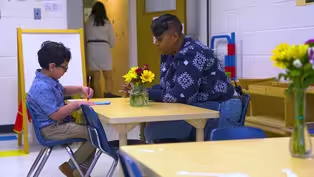
The Achievement Gap Part 2: Is it Race or Economics?
Video has Closed Captions
Clip: S2 Ep15 | 10m 40s | Our understanding of the achievement gap is informed by income disparities (10m 40s)

Does achievement have a color?
Video has Closed Captions
Clip: S2 Ep15 | 7m 55s | As many as 75% of gifted Black children are never identified. Explore the achievement gap. (7m 55s)

Henrico woman looks to end stereotypes in the water
Video has Closed Captions
Clip: S2 Ep15 | 3m 1s | A Black woman who learned to swim as an adult now seeks to teach others the same skills. (3m 1s)

In Richmond, life expectancy can vary by up to 20 years
Video has Closed Captions
Clip: S2 Ep15 | 3m 10s | Life expectancy varies widely across Richmond’s neighborhoods, according to a VCU study. (3m 10s)

A school integration pioneer recalls the end of segregation
Video has Closed Captions
Clip: S2 Ep15 | 13m 21s | The Charlottesville Twelve integrated schools more than a year before Ruby Bridges. (13m 21s)

Video has Closed Captions
Clip: S2 Ep15 | 4m 7s | How redlining is still impacting Black homebuyers. (4m 7s)
Providing Support for PBS.org
Learn Moreabout PBS online sponsorship
- News and Public Affairs

Top journalists deliver compelling original analysis of the hour's headlines.

- News and Public Affairs

FRONTLINE is investigative journalism that questions, explains and changes our world.












Support for PBS provided by:
VPM News Focal Point is a local public television program presented by VPM