
The Hands that Feed Us
Season 10 Episode 9 | 26m 46sVideo has Closed Captions
Chef Melanie Wilkerson honors her roots, and Ana Shellem brings the ocean’s bounty to top kitchens.
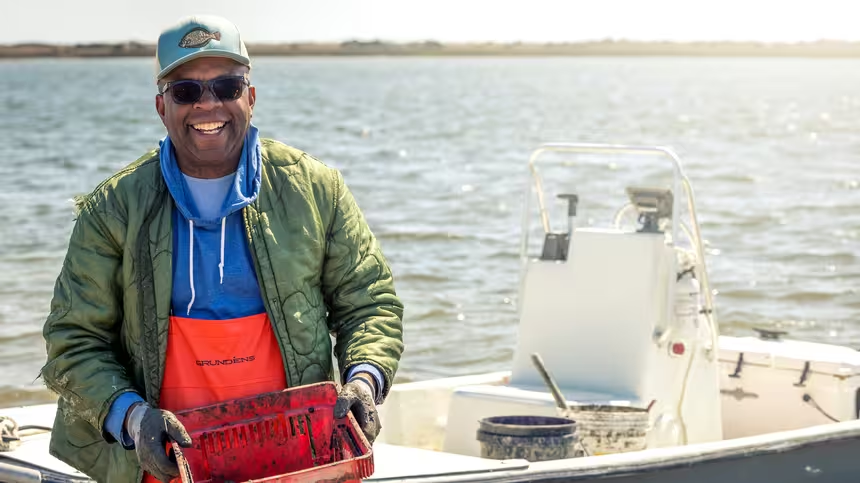
Join us as we follow two North Carolinians deeply connected to food, nature and tradition. In Durham, chef Melanie Wilkerson honors her roots with garden-grown flavors and a nonprofit that teaches children life skills through food. On the coast, sea harvester Ana Shellem of Shell’em Seafood braves the tides to bring the ocean’s bounty to top kitchens like Wilmington’s Olivero and Seabird.
Problems playing video? | Closed Captioning Feedback
Problems playing video? | Closed Captioning Feedback
My Home, NC is a local public television program presented by PBS NC
The Hands that Feed Us
Season 10 Episode 9 | 26m 46sVideo has Closed Captions
Join us as we follow two North Carolinians deeply connected to food, nature and tradition. In Durham, chef Melanie Wilkerson honors her roots with garden-grown flavors and a nonprofit that teaches children life skills through food. On the coast, sea harvester Ana Shellem of Shell’em Seafood braves the tides to bring the ocean’s bounty to top kitchens like Wilmington’s Olivero and Seabird.
Problems playing video? | Closed Captioning Feedback
How to Watch My Home, NC
My Home, NC is available to stream on pbs.org and the free PBS App, available on iPhone, Apple TV, Android TV, Android smartphones, Amazon Fire TV, Amazon Fire Tablet, Roku, Samsung Smart TV, and Vizio.
Watch My Home, NC on YouTube
Enjoy a unique look at the food, music, people and culture that make North Carolina our home on the My Home, NC YouTube channel.Providing Support for PBS.org
Learn Moreabout PBS online sponsorship[upbeat country music] - I'm Heather Burgess and for 10 years My Home, NC has traveled the state, sharing the stories that make North Carolina home.
What keeps you coming back out here after really bad days?
- The feeling that I get when I accomplish, that feeling is absolutely so rewarding.
- [Artist] Each one of my pieces have a certain narrative.
There's some sort of story, but I'm not so specific as like, this is what this means.
- [Heather] So join us as we honor the past, celebrate the present and turn the page on the next chapter of My Home, NC.
[upbeat country music] [bright music] - [Heather] Join us for a delicious adventure as we meet two talents who feed us with their hands and their hearts.
From harvesting shellfish and coastal marshes.
You do have the most killer name for a seafood company.
- This transition has been the greatest gift of my life.
And the last name just worked out.
- [Heather] To garden to table inspiration, in Durham.
- My cooking philosophy has always been let the food speak for itself.
You don't have to change what is already nature's gift.
- [Heather] It's all on My Home, coming up next.
[mellow banjo music] All across the state, we are uncovering the unique stories that make North Carolina my home.
♪ Come home ♪ ♪ Come home ♪ [mellow banjo music] [birds squawking] [rhythmic music] [boat engine whirring] - There's so much confidence and situational awareness that's required to be alone in nature and to know where to look for all of these beautiful pieces of shellfish.
[pensive music] You look at different soil textures and different grass and the way the mud smells and looks.
I've learned so much being alone out there looking at the moon and the tides and the wind direction, [pensive music] you just get to witness so much beauty.
[pensive music] You have to be so in the moment and it takes you out of your own mind.
[reflective music] Spending time every day, sometimes all day in the wild, it's completely changed my life.
It can be really, really challenging, but it's a safe place too, and no one's judging me.
I still judge myself, but I'm in control and that feels really, really good.
[reflective music] [water lightly lapping] My name is Anna Sheelem and I own Shell'em Seafood Company and my home is Wrightsville Beach.
[lively music] [waves gushing] [lively music] We live at a marina here and I work at Mason Bro Island, which is about five miles that way.
I've got some really wonderful chefs that I get to work with here and in town, and it's a beautiful place to live.
I ended up in North Carolina, actually, I came to shoot head shots and comp cards for actors.
I was kind of burnt out where I was and they put me up at this beach house with the waterfront view and I was like, "Why am I not living here?
I have to live here."
So I applied at a restaurant and got the job that day.
I ended up meeting John when I was bartending [laughing] and just thought he was a dream.
When I met him, I had no idea how to drive a boat.
He was living on a boat at the time.
So I'd come here, he would drive the boat to go harvest with me just for fun like day dates and we'd come back and cook it together.
I've always loved nature, but the connection I felt with the marsh, it was hard to get me back on the boat to come home.
So I was of course bartending and working in fine dining and just needed a change.
And at the time John was able to say, "Well, just figure out what makes you happy and go do it."
- [Heather] ey.
- Hey, beautiful.
- ]Heather] It's so good to see you.
- It's so good to see you, too.
- And it's a beautiful day.
- Oh my God.
- So pretty.
- [Anna] It is gorgeous.
I think we're gonna dive into some like tulip snails, fan clams, whelks.
- Well, you had me at tulip snail, so I'm ready.
This is gorgeous.
It's such a beautiful day.
- [Anna] Such a pretty day.
- Oh, we got a dolphin up there.
Oh, I saw it.
Oh, there's two.
- Every time I get so excited!
- Oh my gosh.
That's exciting.
Everything's so weather-dependent.
When you're dealing with a quantity that you need, how do you work around that?
- [Anna] Mother nature is always in charge and it's a different day every day and sometimes it's a really hard day.
Yesterday was a really hard day.
I had those thunderstorms approaching me and- - What keeps you coming back out here after really bad days?
- [Anna] When I come out here and feel lost, I still come home with abundance and that feeling of accomplishment, that work and that effort is absolutely so rewarding.
Sustainability and zero waste is super important to me.
I go out with exact orders that my chefs ask for.
And so there's never a time where something comes back that isn't going into hands that are excited and passionate about using that product.
There's a welk right there.
- [Heather] That welk is waiting for you.
- [Anna] It is for- - [Heather] It is absolutely amazing.
- [Anna] This welk is a PBS Whelk.
- [Heather] The My Home welk.
We're gonna grab it.
[Anna laughing] - When I see a welk, I often know that it's having like its last meal.
- Oh my gosh.
- Because it's probably, they eat clams and they eat things.
So I bet this guy is- - [Heather] He's eating something.
- [Anna] ating a clam.
- [Heather] Hmm.
- [Anna] I guarantee.
Oh!
- What is that?
[Heather yells] But I bet there's a clam.
- [Heather] He's not happy.
- I bet there's a clam.
There is a clam!
There is a clam down there.
So the welk was eating the clam.
- [Heather] Oh.
- The clam can stay.
We probably saved that clams life.
- Okay.
- And this whelk is gonna go to- - He's beautiful.
- A seabird.
- Aw.
- He is.
- In a dish, this is something that you could do in a stew or some type of seafood.
- This would definitely be like a stew or like a crudo.
The chef definitely needs to know how to handle the product.
- [Heather] Yeah.
- Which is why I work with specific chefs that know what to do with the strange things that I find out here.
- [Heather] Yeah, yeah.
- Dean does a Whelk sheel'em stew, and- - You do have the most killer name for a seafood company.
[Anna laughing] I mean, it's just amazing.
- That's crazy, right?
- Shellem, I mean.
It could not be more perfect.
- This transition has been the greatest gift to my life and the last name just worked out.
[water lapping] [ethereal music] [ethereal music continues] Solitude has always been something that I've thrived in.
I spent so much time alone, even as a child.
I started doing professional theater when I was eight and I went on tour with Disney when I was 12 and I went alone.
I was the only kid without a mom or a chaperone.
[ethereal music] That tour launched my acting career.
My mom's like, "Oh my God, you're gonna do great now.
We're gonna send you to New York."
So I went to New York for the first time at 13 and I was just by myself in the city.
It was so not my dream, but I was good at it.
I think it was so exhausting having to sell myself 'cause that's just auditioning.
You're constantly selling yourself and constantly rejected.
And you know, I'd call my mom and she'd say, "Well, what did you do wrong?
What's wrong with you?
Do we need to dye your hair?
Like, are your teeth white enough?"
I think that that's made me like super obviously hard on myself, but able to work hard and keep my chin up.
And even though those times were really hard, they've definitely given me a lot of strength.
[ethereal music] [wind blowing] [light upbeat music] We are on our way to Olivero to see my friend Lauren and deliver some wild mussels for her.
And then we'll go see Dean at Seabird and it's gonna be fun.
They're wonderful folks.
- [Lauren] You want me to get in or you wanna hand them?
- [Anna] I will hand them off to you.
The comradery that I share with my chefs is why I'm successful and we help each other succeed.
[all exclaiming] - Beautiful stuff!
- Yes, thank you, dear.
- Thank you, love.
- They put my name on the menu.
They involve me in every dish they make.
That mutual support really, really means a lot.
Good to see you.
- Good to see you, too.
- Had some fun out there.
Found some whelks for you.
- Nice.
Nice.
- Again, which always makes me happy.
And some tulip snails, too.
- [Dean] Look at that.
- Those mussels I brought you yesterday, how are people liking 'em?
- Love 'em.
They absolutely love 'em.
We're steaming them in beer and then we're doing a little fennel and Cara Cara orange and some toast.
It's really good.
People are loving it.
- [Anna] When I see my name on a menu, I feel pride and respected and you feel seen, you know, it's just nice.
It makes the hard work feel worth it instead of just having it fizzle into something that people don't really need to know about or care about.
- It is such a, like an honor to be able to get all of this from you and to be able to cook it and conversations they're able to have with guests here.
That's not every restaurant, you know?
It gives people a sense of place.
- Absolutely.
- It makes the food taste better.
And we wouldn't be the same without you and what you're doing out there.
[boat engine whirring] [ethereal music] - [Anna] As much as I thought being alone was so uncomfortable, it's such, I find so much strength in it.
Like being alone out there is, it just makes me really proud of myself.
John's just, he always reminds me like, "You built this from nothing."
When I think about not being able to drive a boat and not even understanding the industry and just falling in love with the fishing world, and it is play time out there.
I love not having to look perfect.
Like being muddy and messy is medicinal.
[water lapping] [gentle music] This job is more to me than money and how successful I could be financially.
Instead, it's successful for my heart and my brain.
I see Shell'em Seafood just passing with me.
I think when my body physically can't do it anymore, then I'll stop.
But I always want to be a part of that world.
[ethereal music] [ethereal music fades] [pensive piano music] - It started in a garden.
[pensive piano music] My life, my career, it all started in the garden on Plum Street.
[rhythmic soul music] The garden itself with my grandmother was very much that place where we had the time to talk about all the things that you don't normally have conversations with your parents or your grandparents with.
It was a small, what, four by four space.
It wasn't a huge space, but it was enough for us to, you know, feel the way we needed to and be able to grow, be able to cook together.
So that's also how I became a chef was that one day, you know, I always tell this green bean story, which is always crazy to people, but they're like, "What, that's how you became a chef?"
And I was like, "Yeah."
We were out there.
A green bean fell on the ground and it was dirty, but I picked it up and ate it and it felt like my world just opened up.
It was the freshest, most amazing thing that I'd ever had in my life.
And so I don't know if it was because I was just with her, if it was because it was that good, if it was because we grew it together.
But it made me just think about the world in a bigger way.
And so every single time that I build something, that I make something, that I put something on a plate, I always want people to feel the same feeling that I had when I did that.
[rhythmic soul music] My name is Melanie Wilkerson and my home is Durham, North Carolina.
[rhythmic soul music] I'm an Earth person, you know, I need to be grounded.
And so getting my hands in the soil, even as a kid, meant a lot.
My grandmother was the same way where it was a time for us to connect, that was our time in the garden.
For her, it was, how do I grow this young person?
How do I feed this young person?
And not just for myself, but for all of Plum Street?
For us, it was very much, the garden itself was, let me show you how to become the best person you can be.
[rhythmic swanky music] Plum Street was just an awesome place to live.
We had the run of the street.
And so it was one of those places where it's like, you know, you can be out there when the street lights are off.
And it was a place where everyone was like celebrated.
It was the first time that African Americans actually got to own their own homes.
I grew up with my grandmother and grandfather there.
Plum Street meant everything.
It was growing, it was teaching, it was care, it was love, it was all those things.
[rhythmic swanky music] [bright jazz music] My cooking philosophy has always been let the food speak for itself.
I'm not trying to make something what it's not.
I know for a long time or for maybe like the last eight years, chefs got into, "Oh, I'm gonna sphere something.
I'm going to foam something."
You know, everything just became what it was not.
We have such beautiful produce, especially here in North Carolina.
The fisheries and everything else that you don't have to change what is already nature's gift and just make sure that I celebrate all the people that made things happen to get to the plate.
And so that's really what my food philosophy is, is celebration of what nature's gifts are.
[bright jazz music] I look at, one of the dishes that I have on right now is very much my Sunday dinner with my grandmother.
So it is, you know, roasted chicken with turnips.
Something is always gonna be pickled on the plate because, you know, we're in the South, so you're gonna eat some pickles and you know, a cheer wine jus that's made with mustard seed.
She wasn't a soda drinker but every Sunday we got a soda, so it was gonna be cheer wine.
So I turned that into the sauce was for the dish.
But again, making it recognizable and nostalgic and so people can come in and they understand, no, this is what a Sunday dinner looked like.
[bright jazz music] [blues music] My grandmother is huge.
She's huge in all of our lives.
And she was grand.
And so that's what I always called her, was grand and not grandmother, but grand.
And just watching her, that evolution of how you go about creating a craft for yourself, what it meant to be dedicated to something.
And so she literally dedicated herself to her education, to her being a better person, starting at the age of five.
She was the oldest of 14 in her family, born in 1923, so we know what that meant as far as women, as far as, you know, Blacks and just during that time.
But she also knew early on in her life that education was gonna be the way for her to get out.
And so I don't know where she found this book, but of course at that time, you know, you weren't allowed to read, especially as a Black person, as a woman.
And so she would hide under her bed with a lantern and actually taught herself how to read.
And so from there she got herself into university.
So she went to Fayetteville State, she went to North Carolina Central.
She has degrees from Duke University.
And she knew that this was the only way that I can make myself whole, like be the person as big as she wanted to be.
And she was grand.
[bright blues music] [bright blues music continues] [mellow swanky music] When she passed away, that's when I decided to go to culinary schools because you know, I was like, I need to have the life that I want to have.
And she pushed me into that by thinking, you know, you only have one life.
You gotta make it as big and grand as you possibly can.
And so, you know, here I am.
[mellow swanky music] You know, I'm now at 21C, executive chef there.
My grandmother actually, that hotel was a bank.
At that time, she had an account at 21C and as a child I would go in there with her and she was doing her banking business.
Full circle moment for me is that going from the garden to watching her make things happen when you don't have very much, and being the EC there means the world to me.
I couldn't think of a better story for myself, a better story for my community and for my grandmother's legacy because that's where it all started.
[bright music] I'm co-founder of Kind Kitchen with my wife Sicily Sierra.
Kind Kitchen really is a hub for children, middle school, high school, to figure out what it looks like to manage, to learn, to teach.
It's culinary education.
But more than that, it's about teaching kids life skills and knowing that they can sustain themselves even if your parent is not necessarily there for you or you don't have the support that you need, that you are building a community of people that can support yourselves.
- So we take cooking and life skills, so like we'll do how to make the perfect scrambled egg or a pancake, but it's really a lesson in failure.
If we remove the finality of failure and you almost treat it like a science experiment, then who are you?
How do you glean from the things that you got wrong to say this is the direction that I want to go?
- Even at such a young age, I think that's really important these days with all that's going on.
And so that's where Kind Kitchen has come in and stepped in to make sure that those kids get those life skills.
It's not just about, I'm gonna teach you how to chop something.
It really is, how do I organize myself?
How do I work with someone else?
What am I feeling right now and how do I manage it?
[bright music] [reflective music] I had just had this conversation a couple of days ago with another area chef and we were going through thinking about who are the Black female executive chefs here?
And he said, "You literally are the one of one."
It's heavy.
It really, it's heavy.
But I'm proud at the same time because I know I'm not one of one because I've had so many people that came before me that laid the groundwork.
And really all I have to do is study, make sure that I stay true to what that is and be out in the community and hopefully build, you know, other area chefs and in particular Black female chefs that really are saying, "Hey, I didn't know that this was an avenue for me."
And so I really wanna make sure that Black females really understand.
No, there is a way, there is a lane, there is an avenue and it doesn't have to be so heavy because I really want to carry that and carry that legacy on.
[bright music fades] - [Heather] In 2024, we introduced you to Ricky Moore, the James Beard award-winning chef behind Saltbox Seafood Joint.
In that episode, Ricky joined another My Home friend, Anna Sheelem, for a day of harvesting in the coastal marshes.
What we captured that day couldn't fully fit into a single episode.
So now we're bringing you something special.
Come along as we return to the marsh, uncover more of its secrets and watch Ricky craft a dish straight from the day's harvest to add to the full flavor of that incredible day.
[gentle music] [lively music] - So Anna, so we're out here getting ready to harvest mussels.
- Yes.
- So tell us like exactly like what we need to look for.
What's the technique?
- Absolutely.
So they grow at the base of the marsh grass.
- Right.
- And they kind of grow like little blooming onions.
- Right.
- So you can see like this, we'll call it a family here.
- Right, right.
- They grow in these clusters and some have oysters attached and if we can't break those off easily, we leave 'em and put 'em back in.
- [Ricky] Right.
- But I like to use a hori hori knife.
- Right.
- So it doesn't disrupt the bed itself too much or the family itself.
- Right.
- So we're gonna put it right down the side.
- Right.
- Put it under and push up.
- [Ricky] Like this?
- [Anna] And it'll, yes.
- [Ricky] All right, cool.
Okay, sure.
- And then it'll bring them up to the surface more so we can, their beards are what's attaching them to the- Oh, there you.
- [Ricky] Oh!
- [Anna] Dang, they're excited to see you.
- Okay.
Okay.
- Once you get in like that.
- Right.
- You can use your hands afterwards.
- All right, alright.
- [Heather] Anna, what are you looking for when you're like, just kind of see 'em?
- [Anna] I look for the top of 'em, like their lips.
There's some right here that you can see.
After repetition.
- [Heather] My gosh, wow.
- [Anna] Your eye just gets used to it.
- [Ricky] Right.
- [Heather] That's like, where's waldo.
- It feels good to be out here with you.
It feels good to know that I have another opportunity to participate in this experience, so I just want to show my gratitude.
- I am- - Like real talk.
Right?
- Honored to have you here, man.
- This is good.
And hopefully folk connect with what we're putting down.
[lively music] [boat engine whirring] [shells clattering] [water spraying] At this point, after going out in the water in the marsh with Anna Sheelem and we harvested a bountiful amount of Atlantic rib mussels.
What I'm gonna do today is sort of like a Caribbean sort of riff on these Atlantic rib mussels.
And we also harvested something special, sea beans.
And that's gonna be the salt in the dish.
But we're gonna go straight into the pot.
When you're cooking these Atlantic rib mussels, the pot gotta be really hot, okay.
Really hot.
You wanna hear a sizzle.
I'm gonna add onions.
I'm gonna add garlic.
So the goal here is to start to build flavor.
[utensil scraping] Now I'm gonna add some butter.
And now at this point, I'm gonna add my coconut milk.
I'm gonna add some wine and I'm gonna add my sea beans.
They look like little small little grass, but I chopped them up so they're small.
I'm gonna use this as seasoning.
I'm gonna add my pepper.
Now we're gonna put the lid on and we're gonna let this come to a strong boil.
And once it's come to a strong boil and the mussels start to open, then we're going to add the herbs and the asparagus and a little zest of lemon.
And while you do that, I'm gonna do this, add in our ackee right inside.
We gonna work as a team here.
This is a Jamaican fruit.
What I'm gonna do is I'm gonna finish it with some local peanuts that I spiced up with a little spice rub and curry.
- [Heather] In doing this kind of seafood.
- [Ricky] Yes.
- In a pot.
It's such a great way to do something you've harvested from the ocean.
- Right.
The primary thing, traditional thing is always to cook it in some sort of flavored broth of some sort, you know?
And for me, I kind of felt that this was appropriate today.
So let's go up and start to enjoy this.
- [Heather] Yes.
- [Anna] Yeah.
- Get this thing plated up and eat.
- [Anna] Sounds good.
- Okay, all right.
[lively music] This is the result of marsh to table.
- [Anna] So beautiful.
- [Heather] Wow.
That is amazing.
- [Anna] Hmm.
- [Ricky] What you thinking?
What you thinking?
- [Heather And Anna] Hm.
- I love the firmness.
- Did we- - Of the asparagus.
- Perfect.
Perfect.
- Mm, oh my goodness.
Sorry we didn't wait for you.
[laughing] - Cheers.
- Cheers.
Cheers.
- Cheers.
- It's amazing.
Mm.
And the heat from your peanuts comes in at the end.
- [Ricky] Mm-hmm.
Oh boy.
- [Heather] Really good.
- The coconut has so much brine to it 'cause of- - That's right.
And it's a good, that coconut, you know, comes across sweet, but it isn't.
- [Anna] Mm-hmm.
- [Ricky] And so it does well with shellfish.
- Really balances it out.
- It's like marsh medicine.
Marsh medicine?
What do you think?
- Hmm.
I feel that.
- I really appreciate you having me out here.
It's been fun.
You gonna let me do it again?
- Yeah, you better come out with me again.
- Okay, okay, okay, okay.
- Please.
- Yes, yes, yes.
- Thank you for coming with me.
- Yeah.
Mm-hmm.
- All of you.
- This was fun.
- Amazing.
From marsh to table.
It's my new favorite thing.
- [Ricky] That's right.
- [Anna] Hm.
[gentle reflective music] [gentle reflective music fades] [mellow banjo music] [mellow banjo music continues] [mellow banjo music continues] [mellow banjo music continues] [mellow banjo music continues]
Preview | The Hands that Feed Us
Video has Closed Captions
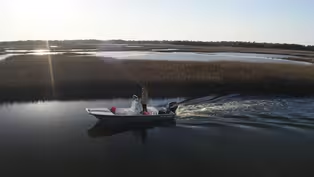
Preview: S10 Ep9 | 30s | Chef Melanie Wilkerson honors her roots, and Ana Shellem brings the ocean’s bounty to top kitchens. (30s)
Providing Support for PBS.org
Learn Moreabout PBS online sponsorship












Support for PBS provided by:
My Home, NC is a local public television program presented by PBS NC