On Stage at Curtis
The History: Horn - Jack Bryant
Season 18 Episode 11 | 27m 36sVideo has Closed Captions
Bryant takes viewers into their world, while sharing some fascinating horn history.
On this episode of On Stage at Curtis, Jack Bryant has always loved the horn and especially enjoys collaborating with fellow brass members at Curtis. Bryant takes viewers into their world, while sharing some fascinating horn history, and plans for his final act as a Curtis student. Featuring the works of Schuman at the prestigious Field Concert Hall at the Curtis Institute of Music.
Problems playing video? | Closed Captioning Feedback
Problems playing video? | Closed Captioning Feedback
On Stage at Curtis is a local public television program presented by WHYY
On Stage at Curtis
The History: Horn - Jack Bryant
Season 18 Episode 11 | 27m 36sVideo has Closed Captions
On this episode of On Stage at Curtis, Jack Bryant has always loved the horn and especially enjoys collaborating with fellow brass members at Curtis. Bryant takes viewers into their world, while sharing some fascinating horn history, and plans for his final act as a Curtis student. Featuring the works of Schuman at the prestigious Field Concert Hall at the Curtis Institute of Music.
Problems playing video? | Closed Captioning Feedback
How to Watch On Stage at Curtis
On Stage at Curtis is available to stream on pbs.org and the free PBS App, available on iPhone, Apple TV, Android TV, Android smartphones, Amazon Fire TV, Amazon Fire Tablet, Roku, Samsung Smart TV, and Vizio.
Providing Support for PBS.org
Learn Moreabout PBS online sponsorship- [Narrator] In partnership with the Curtis Institute of Music, WHYY presents the following program.
(french horn playing) (french horn playing continues) - My name's Jack Bryant.
I play the horn and I'm studying, I'm graduating from Curtis with my master's degree.
(classical music) Both of my parents are musicians, so I kind of always grew up around music.
And my dad was a high school band director for 30 years and now teaches college.
So he always placed students on instruments.
And ever since I was little, he would say, oh, I think you'd make a good horn player.
So pretty much that was kind of my destiny.
I was like, oh, I guess I'll play the horn then.
And I guess he was pretty dead-on with his assessment, it seems.
My mom, she's a professional flute player.
She was always playing piccolo, which is really loud and shrill and penetrating the walls and the piano, you know, is like shaking the whole house.
And the horn's not a very quiet instrument either.
So, because my whole family are musicians, my sister's also a pianist.
It was difficult sometimes to find a quiet place to practice 'cause everyone else is also practicing in the house and you can't really move a piano around to a quieter place.
So it was noisy, I would say.
My favorite part is probably getting to travel and see a lot of interesting places.
You know, whether you're going on an orchestra tour or just the schools that I've attended have led me to live in two different interesting cities that I wouldn't have had the chance to live in otherwise.
So I really like that aspect, but my least favorite aspect is probably, well, specific to playing the horn, maybe, you have to be really careful with what you eat, and it's difficult to play in the morning if you don't get a good night of sleep, or if you don't drink enough water, or if you eat something too spicy or too salty, you know, you have to be watching the condition of your lips always.
And if you bite your tongue while you're eating something, that's a real problem.
So it's... - [Producer] That can affect how it sounds?
- Oh yeah.
It makes it really hard to play if you've bitten your lip or, you know, you bite your cheek or your tongue or something while you're eating.
Or you drink some hot coffee and scald your tongue or eat a piece of pizza and you burn the roof of your mouth.
All of that is a problem.
I think a lot of people are just confused about what exactly you do.
I think most people are maybe familiar with the french horn because it's kind of a unique-looking instrument.
You know, if you've seen one, you probably remember what it looks like.
Even if you don't know that it's a french horn in particular.
I think a lot of people don't, you know, they always wonder, why do you put your hand in the bell?
Or, you know, what are you doing with your valves?
Or how do you play all the different notes when you only have four buttons?
Something like that.
So you get a lot of interesting questions.
(bright piano music) (french horn playing) Most of my friends are also musicians, of course, doing something similar.
(classical music continues) It's a weird way to make your life blowing into a tube professionally.
I'm always aware of that fact that it's really special what we get to do.
And it's a unique lifestyle and I'm grateful for that.
(classical music continues) So in my recital, I played three works.
The first one was a Sonata written by Luigi Cherubini, who was primarily an opera composer.
And this work was, it's really kind of like a fancy etude of sorts.
And I played, I was able to perform it with a string quartet with some of my friends from Curtis.
So it's a very virtuosic, and as you might imagine, operatic piece for the horn.
So it's, you're really kind of singing in the slow section.
And then in the fast section it's supposed to be very showoffy and just kind of fun.
So yeah, I loved playing that.
(classical music) (classical music continues) (classical music continues) (audience applauding) Horn players that have inspired me, particularly a big fan of Barry Tuckwell, who's a legendary horn player who made probably more recordings than any other horn player in history.
But I grew up listening to his recordings and I've always appreciated his really individual kind of stylish playing.
And of course he has amazing technique and great sound, but I've just always loved that he plays with such bravado and such confidence, and I've really tried to emulate that in some ways in my playing.
This horn is a pretty typical instrument that you might see in America, people play in American orchestras, but there are other designs of horns that people would play more commonly in Europe or in other countries.
So this recital is actually a project that I've been working on for a little while to earn my master's degree from Curtis.
I think I might be the first person to do this.
I'm gonna give a little bit of a talk about kind of the choices, the repertoire choices I made, and the question that I sought to answer by preparing this recital.
So all of these pieces that I'm playing were written for the natural horn, not the valve horn, which I have been playing on and will play the Weber concertino on.
And the natural horn, as you might have noticed, doesn't have any valves which really changes the way that you have to play it, of course.
So all of this music was written in the span from maybe 1775 to 1850 or so, when horn soloists were actually some of the, you know, nowadays when you think of famous soloists, you think of pianists, violinists, things like that.
But in these days, actually horn soloists were some of the more famous soloists.
So, and they were performing on an instrument that looked a lot like this without valves.
This horn was made by a very famous horn maker, Carl Geyer, who actually designed this way of configuring all of the tubing.
And it became the kind of the standard design.
And a lot of people have copied this design and made various improvements on it.
But this is an original instrument made by Carl Geyer himself in the mid 1950s.
I feel very lucky to have this horn that's kind of like a historically significant example of the kinds of horns that have really caught on as the standard.
So I've included a picture of a Holton H179, which is the horn of choice for many school band programs.
And it's for all intents and purposes, pretty similar to the horn that I play now.
It's a double horn in F and B flat.
And as you can see, it has valves.
And you might, in sixth grade when you start playing, look at a fingering chart, something like this, and you would think, okay, you know, you're trying to learn your scales or whatever, and you think to play a D, okay, I put down the first valve, to play an F, but you know, you just look at the fingering, look at the note.
You don't think too much about how they're all related, but like most other instruments, flute, clarinet or whatever, you look at a fingering chart and you think putting down this button means that I can produce this note.
You have to love music and you have to love playing your instrument because you're gonna spend a lot of time doing that.
And I think also you have to really love, well, to be an orchestral musician, you have to love working with other people.
It's a very collaborative art form.
(french horn playing) (classical music continues) If you're doing it just to make yourself feel better or because you wanna look good as a individual.
That's not really what it's about when you're playing in an orchestra.
It's about the collective product.
(classical music continues) The second work I played was Mozart's second horn concerto, which is probably the most, certainly one of the most significant pieces of the horn repertoire.
You play it on every audition for everything, every horn player will know it.
So, you know, getting to perform that in a, I think I talked about this in the recital, but getting to perform that in the context of a recital was actually a fairly unique experience because I spent so much of my time practicing it, but never actually performed it.
So it was really special to get the chance to play that and really just enjoy the music rather than thinking, okay, how am I gonna play this for this audition?
Or, you know, it's really a different experience and I think it, the next time that I do have to play it in an audition, I'll be able to think of that and think, you know, this is just great music.
It's not just the audition piece.
(classical music) (classical music continues) (classical music continues) (classical music continues) Curtis has been such a great experience for me and it's really been a place where I think I've developed so much as a musician and as a horn player.
So I think it's just the experiences that I've had playing in orchestra and playing in the repertoire classes that we have with the faculty, many of whom are members of the Philly Orchestra.
I've learned so much about the orchestral repertoire and how I can improve as a musician and horn player.
And I think that all of those experiences will hopefully serve me well as I start to play in professional orchestras.
I would tell my younger self to just keep at it, sort of, and don't get discouraged because it can be pretty discouraging to take orchestra auditions.
And if, you know, I took 22 auditions before I won one, and many of them I didn't advance outta the first round.
So the vast majority of them probably.
So, you know, I think it's important to keep a positive attitude and, but also be realistic about the work you have to do to get to the next level.
I would tell my younger self to trust your instincts and to stick with it basically.
And know that if you're doing the work the way you know it should be done, that things are gonna work out.
And then my future self, I don't know, I would say, I guess just to keep, I think, keep alive the love of music and performing.
I think that can be a challenge when you're playing a heavy schedule with a professional orchestra playing three concerts a week for 42 weeks.
You know, it's a pretty, it's a lot of playing, a lot of rehearsal, so it can be a bit draining sometimes physically and emotionally.
And I think it's easy to slide into, ugh, I have to go to work, you know, like, I don't want to do this right now, that kind of thing.
But I think it's important to always remember that we're really lucky to be making a living, playing this music and getting to, you know, play the horn for a living is really special.
So I think it's important to always keep that in mind and stay grateful for what you have the opportunity to do as a professional orchestra musician.
(french horn playing)
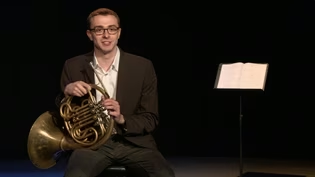
The History: Horn - Jack Bryant
Preview: S18 Ep11 | 29s | Jack Bryant takes viewers into their world, while sharing some fascinating horn history. (29s)
Providing Support for PBS.org
Learn Moreabout PBS online sponsorship
- Arts and Music
The Best of the Joy of Painting with Bob Ross
A pop icon, Bob Ross offers soothing words of wisdom as he paints captivating landscapes.














Support for PBS provided by:
On Stage at Curtis is a local public television program presented by WHYY