
Thought-Provoking Conversations on the Creative Arts
Season 5 Episode 52 | 26m 46sVideo has Closed Captions
CCH Pounder shares her art collection, 'Queen' exhibit, and her thoughts on Black art
Marvel comic author Saladin Ahmed has a captivating conversation with One Detroit editor Chris Jordan about his latest Spider-Man series and representation in comics. Then, senior producer Bill Kubota talks with Ray Gray, one of Michigan's longest-serving inmates, after he's free. Plus, associate producer Will Glover chats with actor CCH Pounder about her new art exhibit titled "Queen"
Problems playing video? | Closed Captioning Feedback
Problems playing video? | Closed Captioning Feedback
One Detroit is a local public television program presented by Detroit PBS
Thought-Provoking Conversations on the Creative Arts
Season 5 Episode 52 | 26m 46sVideo has Closed Captions
Marvel comic author Saladin Ahmed has a captivating conversation with One Detroit editor Chris Jordan about his latest Spider-Man series and representation in comics. Then, senior producer Bill Kubota talks with Ray Gray, one of Michigan's longest-serving inmates, after he's free. Plus, associate producer Will Glover chats with actor CCH Pounder about her new art exhibit titled "Queen"
Problems playing video? | Closed Captioning Feedback
How to Watch One Detroit
One Detroit is available to stream on pbs.org and the free PBS App, available on iPhone, Apple TV, Android TV, Android smartphones, Amazon Fire TV, Amazon Fire Tablet, Roku, Samsung Smart TV, and Vizio.
Providing Support for PBS.org
Learn Moreabout PBS online sponsorship- [Man] Just ahead on One Detroit, a look at some of the most interesting people we've profiled on the show.
We'll meet a man who was released from prison after serving 48 years for a crime he says he didn't commit and we'll get a look at what kept him inspired behind bars.
Also, actress CCH Pounder talks about her love for art that depicts the beauty and strength of black women.
Plus, we'll catch up with award-winning comic book author, Saladin Ahmed to hear about his new Marvel series.
It's all coming up next on One Detroit.
- [Woman] From Delta Faucets to Behr Paint, Masco Corporation is proud to deliver products that enhance the way consumers all over the world experience and enjoy their living spaces.
Masco, serving Michigan communities since 1929.
- [Man] Support for this program is provided by the Cynthia & Edsel Ford Fund for Journalism at Detroit Public TV, the Kresge Foundation, Community Foundation for Southeast Michigan.
- [Woman] The DTE Foundation is a proud sponsor of Detroit Public TV, among the state's largest foundations committed to Michigan-focused giving.
We support organizations that are doing exceptional work in our state.
Visit DTEFoundation.com to learn more.
- [Man] Business Leaders for Michigan, dedicated to making Michigan a top 10 state for jobs, personal income, and a healthy economy.
Also brought to you by and viewers like you.
(upbeat music) - On this week's One Detroit, we're bringing you some of the thought provoking conversations we've had involving the creative arts.
Coming up, Detroit-based comic book author, Saladin Ahmed talks about his new Marvel Spider-Man series and how he uses comic books to spark discussion about real world social issues.
Plus, we caught up with actress and art lover, CCH Pounder when she visited Detroit for the opening of an exhibit featuring works from her art collection.
She talks about the emotions and stories behind the art pieces.
But first up, after nearly half a century in prison, Ray Gray was released last year.
We spoke with him about his claim of innocence in the crime that landed him behind bars and how art helped him get through years of incarceration.
(upbeat music) Late May, Muskegon, Ray Gray checks out of state prison after a 48-year stay although he's always maintained they had the wrong man.
Days later, Gray and his wife Barbara talk about his release to attorney and podcast host, Mike Morse.
- If you would have lied 10, 20 years ago and told the parole board or somebody that you were involved, do you think you would have gotten out sooner?
- Yes in fact, I was offered a plea of 10 to 20, but I refused it and I often point out to them that my position of innocence has never been helpful.
It's a matter of principles and I realize that a lot of people would have submitted that you're crazy for holding on to that.
- [Man] Grey agreed to a no-contest plea, still not admitting guilt for that murder a half century ago.
- With this situation, they made some adjustments to get me out.
Everyone says making a deal with the devil or nothing, but it was a situation where I couldn't just say I did something I didn't do.
- [Mike] Right.
- [Man] We first told you Gray's story on One Detroit last fall, an acclaimed artist behind bars with friends on the outside who believed in his innocence.
- Art has helped a lot.
That was sort of like my salvation and her.
- [Man] Ray met Barbara in the late '70s.
She was an art teacher working with inmates back then.
- In the last year and a half, we've had one visit.
- [Man] In Muskegon, Ray kept painting through the pandemic.
(indistinct) - The COVID and the world with a mask.
- We have such respect for the first responders, many of whom lost their lives because of trying to help others.
So this is a nurse with the weight of the world on her shoulders and the vaccine was just starting to take hold when he did this.
- [Man] Well, tell me about when you painted that, what was going on in your life at that very moment?
- At the time I was painting that, the prison that I was in, it was 99% positive for COVID and it was the worst in the United States.
- [Man] At age 69, somehow Ray didn't catch it.
He's in search of art supplies.
- Yeah, you might not have ever seen this.
This is called Medium W. You can mix this with any oil paint and make it more soluble.
- Okay.
That store was amazing, in fact, every day has been and it's like a little touch of heaven.
- [Man] An incarcerated artist goes without, long handled brushes forbidden inside.
They could be weapons.
- [Ray] The easel is something that I always wanted.
At one time we could have them, but then they made that outlawed too because they were made out of wood.
- They usually had bunks and he had the top because it allowed him a little more room.
He would be painting late into the night when the rest of the prison would be mostly going to sleep or whatever.
So he keeps remarking, this is so much than top bunk.
- [Man] The Grays are on their third week together in person at an apartment in Livonia.
- She and I collaborate a lot.
Now that I'm actually here, I may be able to convince her to pick up a paintbrush again.
- I love watching him anyway.
It's just been a long time since I was able to.
He has a technique that's quite impressive.
Sky that he's working on his has certain beauty to it already.
- [Man] What's this gonna be Ray?
- Well this is the one where I'm coming home, and this is the vision of the city, but it's gonna be vague 'cause it always was vague, never clear and it always felt like I was on a different planet.
- [Man] Detroit, 1973, a lone witness said Gray was the killer and still claims that today though others testified Gray was somewhere else at the time.
Gray's advocate, Bill Proctor asked Ellis Stafford for help.
- There was no physical evidence.
One witness only, no, this can't be true.
This is what really got me, Mike.
The warden allowed two retired investigators to come see a man in prison.
Why did you allow us to do it?
Well, I found out later when I got there, they didn't believe Ray did it.
They believed he was innocent.
So we do what we always do (indistinct) interview thousands of witnesses, suspects, and victims in my career with the state police.
But we interview Ray for three and a half hours.
- In fact initially, I thought they were interrogating me for some other crime or something.
And they were extremely hard.
(indistinct) some hard questions.
But the truth can stand up to hard questions.
- And those techniques which we use to detect deception, we didn't see any.
- [Man] What year was this?
- About 2012.
- This was about 2012, yeah.
- [Man] Almost 10 years ago.
- And I was blown away.
I'm like, wow, but what could I do?
I didn't know what to do.
(indistinct) - [Voiceover] Enter your new four to nine digit password.
- [Man] So many new things, new surroundings, new friends, it's all changing.
What about Ray's work?
- [Man] Will it look different?
- Yeah.
- Yes, - It's gonna look different.
It's gonna definitely look different.
- [Man] More paint than water.
- You kind of evolve in periods, like Picasso had his blue periods and he had his cubist period and all this sort of thing.
So you go through these different transitions.
- [Man] Here, still in progress, going home, the first new piece created on the outside.
Ray Gray free, but not exonerated.
If he were, he'd be entitled to a very large payment for being wrongfully convicted.
- I'm not happy about this at all, but I'm learning from Ray Gray.
I need to stop grinding my teeth and pounding the table and help him enjoy his freedom while we consider what next steps to take to find true justice for Ray Gray.
- I'm able to fight better without chains on my legs and wrists.
I never had them here, chains here, they were always here, but now that then they're released and I'm out among the free people, I can fight better.
I can fight better here than there.
(upbeat music) - Let's get started with where we expect to get started.
You are a wildly successful actor.
You've had success from Avatar to the NCIS series in your career.
You beautifully restore homes around the country.
- [CCH] Thank you.
- That I, I genuinely enjoy that.
- [CCH] Thanks.
- And you are a very well-respected art collector.
Does it just come naturally to excel in other forms?
- Well, I don't know about everybody else, but for me it came fairly naturally and it kind of goes hand-in-hand.
Interiors, my mother bought a house for $27,000 and made all of her children paint and fix it up for the summer so that we could have money to go to school.
- Wow.
- Lessons learned because it wasn't as if paint this, no, no, no, no.
Get the corners, get that.
And so and attention to detail started very, very young.
I wanted to be an artist, a visual artist in the beginning, and I had this conflict with wanting to be an actor.
I had a mentor, Stella Cara and I always give kudos to her because she said sis, she said, well, Carol, acting is for young people.
As long as you have your hands and your eyes, you can be an artist.
And so I said, well then I'll do the first half of my life as an actor and then the second half of my life as an artist.
Well, of course it doesn't really all fall together like that.
I mean, acting took a long time to manifest itself as a working person and then all of a sudden it was there.
And it was there relentlessly for what now?
45 years straight.
So I haven't stopped acting professionally.
And while I was doing that, I started introduce my friends who were artists to people who did movies, to people who became chefs.
So immediately, there was a kind of, you ought to know so-and-so and she ought to know you and he can put that up on your wall of your restaurant and we had this wonderful sort of symbiotic activity going on within the arts.
And so that's really how I started and how I continued.
- Does your acting and your experience through the career so far, does that influence how you interact and approach with and pick art?
- No, it's not the same, except in the sense that when you see the work downstairs, you will know that I'm interested in storytelling and you can see it in almost every single painting that there's a story to be told.
And it's not particularly complicated because there is strong emotion in almost all of the works.
And so that is obviously my attraction where I see something that speaks to me and I can literally almost feel the story.
- [Will] Right.
- And that's what makes it, I think, really perfect for the type of audience that sees my work.
- And what about the pieces that you select that, what is it about those pieces that makes you say this is it like I have to, like, this is the story that I have to have it.
I get that tingle down my spine.
- Well, I remember my late husband saying to me, I'm only married to one woman, look at all these women in here, and I tend to gravitate to the female subject.
And I feel as if the emotion of the painting that I'm seeing gives me a story that I can tell, and I can actually translate it even into characters that I've played.
- Right.
- I've even gathered strength from paintings.
Like there's an incredible painting of Harriet Tubman and it's a mean painting.
because she's standing over a man with a gun, and she's basically saying, if you don't get up and get us north, I will shoot you myself and you can see it in her face.
And I just went I just have to take that home.
So there is a moment that I connect, that's deeply personal.
- What was the motivation in bringing or if it wasn't a motivation, what was the reason for bringing this collection to right here in Detroit?
- Well, obviously Neil Barclay.
And I'm not saying that just because he's in the room, but obviously I had a relationship with Neil Barclay in New Orleans.
I knew him then when he ran another institution and he introduced the unusual and I was somewhat fascinated by that.
And when he came here, I decided that this was a great place to start a completely different phase of my collection because I had been talking about I don't want it to end up in a basement.
I don't want it to be part of my will that ends up in the basement of a museum and that gets trotted out Black History Month or a particular happening and then it's like, wouldn't it be appropriate if we went and got a couple of those paintings.
- Right.
- I wanted the idea that this was living matter and it could be seen now and it could travel and other people could see it, be inspired by it, take a look at how we looked back then and what we're doing now and what the future holds for us.
Within the collection, all three of those things exist.
There's the historic, there's the present, and there's the future.
(upbeat music) - [Saladin] Hi guys.
- Hey.
- Hey, how are you?
(indistinct) - [Man] Good, yeah.
- Wow, that is so wild.
Saladin Ahmed, this has been a very exciting time for your work.
Comic fans know you as now the long time writer of Miles Morales, but now this year, you branched out to two other Spider-Man series and you just launched Copper Bottle, your subscription service for indie comics.
Spine tingling Spider-Man, brand new, first issue just dropped end of October.
You're writing three different iterations of that character.
What makes this one different?
- I've always loved Peter Parker.
I've grown a very powerful relationship with Miles Morales writing him the past few years but of course, Peter was the Spider-Man I knew growing up and to me, he's always been at his most inspiring when he's got the toughest odds against him.
And then the fact that horror stories, which I also dabble in a lot are really about the odds being against you, sometimes overwhelmingly, right?
And that's where the sense of horror comes from.
I went to Marvel and basically was like, I really wanna do a horror book featuring Peter Parker and they were very supportive of it.
I've lucked out extremely by getting the artist, Juan Ferreyra, who's just astonishing talent.
And that's the thing that we always have to talk about when we talk about comics is art makes the comic.
I can have all the ideas in the world and it's just an idea until somebody draws it.
And Juan took the thing to another level.
It's super important to me to talk about the world around us, even whether I'm talking about aliens or elves or vampires, I'm still talking about our world and our time.
And I think we have a responsibility to do that as storytellers.
We're part of a larger world and dire things are happening in that world right now to a lot of people.
If we don't talk about that stuff as much as we're able to in the arenas that we're able to, I think we're falling down on our duties as human beings.
- In Abbott, the way that page one of that comic is Abbott breaking the story of the police killing of a black teenager, it really hits home to our world now.
- Abbott was my first creator-owned comic and it's the story of a female black journalist in the 1970s working at a white newspaper and it's a story about race, it's a story about gender.
As much as anything, it's a story about Detroit.
I'm from Dearborn, right?
I'm from a Arab enclave in Dearborn, from an immigrant community there that raised me, but I was always raised with a love for and respect for Detroit.
And also, I was raised with an awareness that Detroit had been slandered.
The kind of predominant narrative in the suburbs was sort of Detroit's so dangerous and it's fallen apart.
It used to be great.
And it's a transparently racist sort of take when you strip away just a layer of kind of why people felt that way about Detroit.
And so to me, one of the most important things writers do is to expose lies and tell the truth.
It's why I made a journalist the hero of my story rather than a police officer or a detective.
On the one hand, Abbott is a fun, scary story, hopefully about a woman using magic powers to hunt evil wizards in a darkness that is haunting the land but it's also very much a story about the history of Detroit and about the way in which Detroit in the '70s even as people were saying it was falling apart or was going to the dogs or whatever, was a place of renaissance, of true cultural renaissance, of emancipation.
- Growing up in Dearborn and near Detroit, how does that translate over for you into these other stories that are set outside Detroit?
- I knew that I wanted to create Michigan heroes, Detroit heroes when I went to Marvel.
So the first character that I created with Detroit roots was in Miles Morales: Spider-Man and her name is Tiana Toomes, AKA, Starling.
When I started to think about who this character was, Detroit called out to me.
And so we got to do some really great scenes about in her origin issue with her practicing her wings flying above the Detroit River and flying around the Renaissance Center and stuff like that.
And then I did have to represent my own Dearborn, Michigan and Arab Americans.
And so I created there Fadi Fadlalah also known as Amulet in the pages of Ms. Marvel.
And he's a kind of big beefy, good, thick boy who's a football player with a heart of gold and he comes to New Jersey, which is where Ms. Marvel's adventures take place from Dearborn, Michigan.
- It is so important to have that representation on and off the page and making comics like just a more diverse medium.
- I appreciate the distinction between on and off the page because they're definitely separate things.
I think that we've made strides, not as many as we could have, but we've made strides representing better what our culture looks like, right?
There are Muslim characters on TV, there are trans characters in video games.
There are things that when I was a kid just playing weren't there.
I can remember how desperate I was to latch on to characters that had any bit of Arabness or Muslimness and no matter how cheesily and slightly stereotypically it might have been rendered, right?
My kids, when I talk to them about representation and I talk about how cool it is that character X is of Y racer, they're just sort of well, yeah, of course.
It's not as big a deal to them, but the fact that it's not a big deal is the big deal.
- Totally.
- And represents some progress that I think we've made.
We still live in a white supremacist country.
We still live in a country that is patriarchal.
We still live in a country where working people are treated like things rather than people and our stories are going to reflect that.
Some of us are working very hard to make the stories reflect a different reality and try and shape us toward another reality, but that will always be an uphill battle.
And so that brings up the kind of second part of the equation, which is what's happening behind the scenes.
And it's often pretty ugly.
Most of these fields are still incredibly male dominated, whether it's video games, whether it's TV, whether it's comics, I've been in those writing rooms.
I've been in those meetings with executives and really seen what the real powers in these worlds look like and they look pretty much like they've always looked, a few more women but not many and here and there, a face of color, but not many.
We always also have to be pushing for different kinds of faces behind the scenes.
The creators have to because it's a question of political power and of resources, right?
- And with Copper Bottle, kind of your mission statement with that is the creator-owned independent comics kind of with really like a focus on a lot of creators of color and women.
- Copper Bottle is my pop-up imprint as we're calling it, dedicated to my creator-owned comics.
Now, I'm publishing a couple of titles, one called Starsigns and one that's called Terrorwar.
Terrorwar drawn by a local artist, Dave Acosta, Detroit's own and we are producing work that we own is the simplest version of it.
It's we're trying to move toward comics where if you've drawn that comic, if you've written that comic, you'll have ownership of whatever that comic becomes so that people feel invested in the work that they're creating.
And to me, that's just, it's an extension of what I think we need to be doing as a culture generally.
- [Man] That will do it for this week's One Detroit.
Thanks for joining us.
Make sure to come back for One Detroit Arts and Culture on Mondays at 7:30 PM.
Head to onedetroitpbs.org.
For all the stories we're working on, follow us on social media and sign up for our weekly newsletter.
(upbeat music) - [Woman] From Delta Faucets to Behr Paint, Masco Corporation is proud to deliver products that enhance the way consumers all over the world experience and enjoy their living spaces.
Masco, serving Michigan communities since 1929.
- [Man] Support for this program is provided by the Cynthia & Edsel Ford Fund for Journalism at Detroit Public TV, the Kresge Foundation, Community Foundation for Southeast Michigan.
- [Woman] The DTE Foundation is a proud sponsor of Detroit Public TV, among the state's largest foundations committed to Michigan-focused giving.
We support organizations that are doing exceptional work in our state.
Visit DTEFoundation.com to learn more.
- [Man] Business Leaders for Michigan, dedicated to making Michigan a top 10 state for jobs, personal income, and a healthy economy.
Also brought to you by and viewers like you.
(upbeat music)
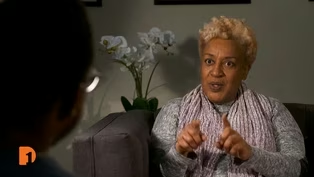
CCH Pounder Discusses Her Art Collection & 'Queen' Exhibit
Video has Closed Captions
Clip: S5 Ep52 | 6m 23s | CCH Pounder shares her art collection, 'Queen' exhibit, and her thoughts on Black art (6m 23s)
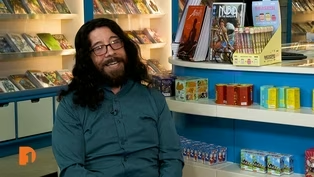
Marvel Author Saladin Ahmed Discusses New Spider-Man Comic
Video has Closed Captions
Clip: S5 Ep52 | 9m 4s | Saladin Ahmed discusses his new Spider-Man series and the role of representation in comics (9m 4s)
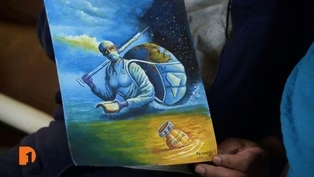
One of Michigan's Longest-Serving Inmates, Ray Gray is Free
Video has Closed Captions
Clip: S5 Ep52 | 7m 23s | Ray Gray is free. He shares how freedom feels and that he's still fighting for innocence (7m 23s)
Providing Support for PBS.org
Learn Moreabout PBS online sponsorship
- News and Public Affairs

Top journalists deliver compelling original analysis of the hour's headlines.

- News and Public Affairs

FRONTLINE is investigative journalism that questions, explains and changes our world.












Support for PBS provided by:
One Detroit is a local public television program presented by Detroit PBS