Ken Kramer's About San Diego
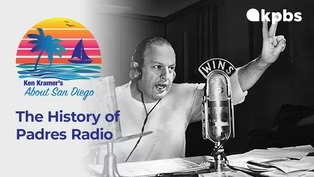
The History of Padres Radio
Clip | 6m 32sVideo has Closed Captions
Discover the charming and surprising history of a clever broadcasting trick,
Discover the surprising history of a clever broadcasting trick, and the legendary San Diego announcer, Al Schuss, who mastered the art of filling in details of a game that was happening a thousand miles away.
Problems playing video? | Closed Captioning Feedback
Problems playing video? | Closed Captioning Feedback
Ken Kramer's About San Diego is a local public television program presented by KPBS
Ken Kramer's About San Diego
The History of Padres Radio
Clip | 6m 32sVideo has Closed Captions
Discover the surprising history of a clever broadcasting trick, and the legendary San Diego announcer, Al Schuss, who mastered the art of filling in details of a game that was happening a thousand miles away.
Problems playing video? | Closed Captioning Feedback
How to Watch Ken Kramer's About San Diego
Ken Kramer's About San Diego is available to stream on pbs.org and the free PBS App, available on iPhone, Apple TV, Android TV, Android smartphones, Amazon Fire TV, Amazon Fire Tablet, Roku, Samsung Smart TV, and Vizio.
Providing Support for PBS.org
Learn Moreabout PBS online sponsorship(peaceful piano music) - [Announcer] Here's, "A Little Something About San Diego", with Ken Kramer.
- Gonna tell you a story now that requires you to go back in time.
If you've been in San Diego for a while, you might know the Padres used to play in the minor leagues.
They played throughout the western part of the United States.
And back in those days, the games were not on television.
They weren't televised, they were on the radio.
And that's where our story begins.
You ever listen to a baseball game?
I mean, on the radio, listen to it.
- [Radio Broadcaster] Hi, everybody, it's Philadelphia Phillies baseball time.
- [Ken] A good baseball broadcaster on the radio could make you feel like you were right there with them at the stadium.
- [Commentator] Here's the strike one pitch.
A bunt up along third base say falls down and the ball's gonna stay there for a bunt single.
- [Ken] But what if the announcer wasn't at the stadium, didn't travel with the team at all, and everything you were hearing during road games, all the sounds, the crowd, everything, was made up?
From the 1940s up to 1968 when the team was playing out of town, the Padres couldn't afford to send an engineer and an announcer and all the technology to Seattle, or Oakland, or Honolulu, to broadcast the game in real time.
So what did they do?
To find out, we paid a visit to Bill Swank, San Diego baseball historian.
- Hello.
- [Ken] He says it's true.
Years ago, he'd listened carefully to the radio announcer during Padre road games and he began to notice something.
- When I really became aware, I thought, "Wait a minute, there's something wrong here."
And I finally figured it out that, that it was a recreation and he wasn't actually there.
- That's right, a recreation.
The announcer was back in San Diego in a studio with a microphone and a bunch of sound effects records.
They had the sound of cheering, booing.
- Concessionaires in the stands.
You know, "Hot dogs get your red hot dogs."
- Okay, you got the sound of the crowd and the microphone.
You're ready to describe the game, but the game is like a thousand miles away.
How do you know what's going on?
How do you know what to say?
At every away game, there to always be somebody at a teletype sending out real-time information for whoever needed.
It might be a newspaper, whoever.
- They would send little telegrams just very short.
- I mean really short, like just the batter's name and ball, strike, base hit, left field.
Wasn't much, but if your radio station back home had a receiving teletype and most of them did, a clever announcer could recreate the game happening somewhere way across the country.
Only thing, let's say the message comes in, "Padre's got a base hit to left."
- They had a bat just hanging from a string or a rope from the, from the ceiling.
They had a stick, a wooden stick, and they would hit the bat, and that made the sound of a ball hitting the bat.
- Here's the pitch, and it's a base hit to left field.
What if it's a ball or a strikeout?
You need something that sounds like a ball hitting the catcher's mitt, oh, piece of leather, maybe an old shoe.
- And they would hit it with a stick and it sounded like a ball being caught.
- Strike three, struck him out.
- And it sounded pretty real.
It sounded pretty real.
- [Ken] All over the country, baseball announcers were recreating games that the teams couldn't afford to send them to.
Based on very little information coming into the studio, maybe just a word or two, every now and then.
- Ball one.
(shoe patting) Ball two.
(shoe patting) Base hit.
Left field.
(bat cracking) - Now imagine, the announcer back in San Diego knows that it's been a ball, but he doesn't know was it high?
Was it low?
Was that base hit a line drive?
Was it a fly?
No way of knowing, so the announcer just makes a lot of things up.
That's where his creativity came in.
Oh, it's a beautiful day here in Seattle.
Was it really?
That pitch just caught the inside corner for a strike?
Well, maybe, maybe not.
You see, baseball recreators, they had so much time to fill, they had to be really good storytellers.
- Every town thinks theirs was the best, but we probably had the best, Ken, and his name was Al Schuss.
- [Ken] Al Schuss, former announcer with Milwaukee, the Chicago Cubs, and Brooklyn Dodgers, came to San Diego and was so good at recreating out of town games.
It's too bad that, so far as I can tell, there are no existing recordings of him doing them.
Well, they were all live.
So we have to imagine him painting pictures right out of his own mind while waiting for the next bit of information on his teletype.
And if the machine broke down, well... Oh, it looks like we're having a rain delay here, folks.
But that reminds me of a story.
- It's all out of his mind, his creative mind.
- [Ken] And most listeners had no idea - They'd see him in town.
They'd say, you're supposed to be in Seattle.
Well, I had to fly back for business because he said after a while, it just got too hard to explain to everybody.
- [Ken] Gotta say, I was listening to baseball on the radio growing up back then.
Never noticed anything.
- I guarantee you heard a recreated game.
I guarantee it.
If you were listening to baseball games and if you were an Angels fan or a Stars fan up in LA, you were listening to some recreated games, but they were very good.
- Fly balls, a deep left field, way back, way, way back.
And there it goes.
- And there it goes.
And everybody knew what that meant.
- [Ken] It was Al Schuss signature Padre Home Run Call Bill Swank has written several books about San Diego baseball history, and he says, the days of recreated games on the radio were simpler times when a few sound effects and hitting a bat hanging by a string created the outline of a picture in our minds.
(bat cracks) (crowd cheering) And looking back, for those of us in San Diego, it was Al Schuss who filled in all the color and all the details, - And he was very good at it.
- [Ken] We can only imagine.
Strike three, and the Padres win this one on the road, four to two.
Goodnight everybody.
We'll see you around and about San Diego.

Video has Closed Captions
Clip | 8m 13s | A volcano in San Diego County? It’s true. Also the history of the highest spot in the city. (8m 13s)
Video has Closed Captions
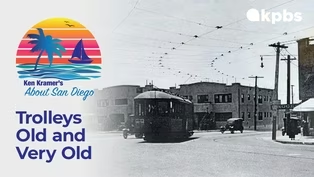
Clip | 6m 27s | A restaurant built from a trolley car and a peek at when you could take the trolley to Balboa Park. (6m 27s)
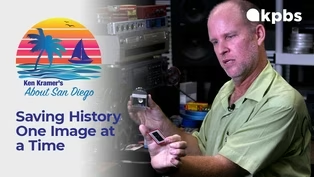
Saving History One Image at a Time
Video has Closed Captions
Clip | 7m 14s | The story of Pea Hicks, who discovers old bits of history in cast off film video, slides, and photos (7m 14s)

Sandy the Sea-lion Guy & Ramona Grassland
Video has Closed Captions
Clip | 7m 49s | An underwater photographer and a visit to the Ramona grasslands. (7m 49s)
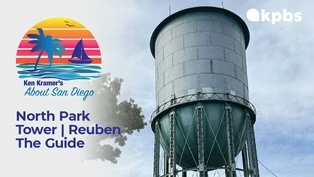
North Park Tower & Reuben The Guide
Video has Closed Captions
Clip | 8m 55s | The story of North Park's Water Tower, and meet the city's 1st tour guide. (8m 55s)

Video has Closed Captions
Clip | 6m 42s | Join Ken aboard the majestic Star of India, the world's oldest active sailing ship. (6m 42s)

The Impossible Railroad & A 100-Year-Old Candy Shop
Video has Closed Captions
Clip | 9m 1s | Journey back in time with the Pacific Southwest Railway Museum and see the "Impossible Railroad." (9m 1s)
 Now Playing
Video has Closed Captions
Clip | 6m 32s | Discover the charming and surprising history of a clever broadcasting trick, (6m 32s)
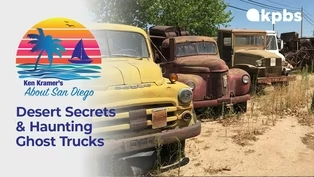
Desert Secrets & Haunting Ghost Trucks
Video has Closed Captions
Clip | 9m 36s | Take a fascinating journey to two remote San Diego County destinations. (9m 36s)
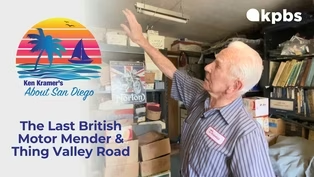
The Last British Motor Mender & Thing Valley Road
Video has Closed Captions
Clip | 7m 29s | Meet Dennis Tolley, a British mechanic and local treasure. Then the story behind Thing Valley Road. (7m 29s)
Providing Support for PBS.org
Learn Moreabout PBS online sponsorship














Support for PBS provided by:
Ken Kramer's About San Diego is a local public television program presented by KPBS