One-on-One
The importance of self-expression and LGBTQ+ stories in film
Clip: Season 2025 Episode 2784 | 13m 45sVideo has Closed Captions
The importance of self-expression and LGBTQ+ stories in film
Senior Correspondent Jacqui Tricarico speaks with Stella Lopresti-Busick, LGBTQ+ Activist and Subject of the Film, "Ben in Bloom," about the importance of LGBTQ+ stories in film, the stigma surrounding youth identity and expression, and building safe spaces in unlikely places.
Problems playing video? | Closed Captioning Feedback
Problems playing video? | Closed Captioning Feedback
One-on-One is a local public television program presented by NJ PBS
One-on-One
The importance of self-expression and LGBTQ+ stories in film
Clip: Season 2025 Episode 2784 | 13m 45sVideo has Closed Captions
Senior Correspondent Jacqui Tricarico speaks with Stella Lopresti-Busick, LGBTQ+ Activist and Subject of the Film, "Ben in Bloom," about the importance of LGBTQ+ stories in film, the stigma surrounding youth identity and expression, and building safe spaces in unlikely places.
Problems playing video? | Closed Captioning Feedback
How to Watch One-on-One
One-on-One is available to stream on pbs.org and the free PBS App, available on iPhone, Apple TV, Android TV, Android smartphones, Amazon Fire TV, Amazon Fire Tablet, Roku, Samsung Smart TV, LG TV, and Vizio.
Providing Support for PBS.org
Learn Moreabout PBS online sponsorship(upbeat music) All right, folks, my colleague, Jacqui Tricarico, the senior correspondent here at One-on-One, sat down with Stella Lopresti-Busick, talked about a whole range of important issues that often get talked about in sound bites, but are more complex, more important than people realize.
Here's Jacqui.
- Hi, I am Jacqui Tricarico, Senior Correspondent for "One-on-One."
I am on location here at the NJEA Convention in Atlantic City, and so pleased to be joined now by Stella Lopresti-Busick, who is the subject of a film, a documentary that we're seeing here called, "Ben In Bloom."
It's so great to have you with us, Stella.
- Hi, it's nice to be here.
Thank you for having me.
- Thank you for taking the time.
So, tell us about this documentary, "Ben In Bloom."
It's being shown here to educators.
Describe for us what the film is.
- Absolutely.
So, this film is, at its core, a story about my life as a activist in Bucks County, Pennsylvania, so a very contentious place that is home of a lot of political warfare, I'd say, because it's a microcosm of sort of the country as a whole, as it's the swing county of Pennsylvania, often decides the election, as we just saw.
- Yes, we were just coming out of this just a few days after the presidential election, and we saw a lot of people are saying, yeah, that Pennsylvania was the state that made sure that Trump was elected president again.
- Yes, yes, and so growing up in that environment, in that landscape, it was really important for me to make change and be the voice of change and the voice of reason even as young as 13-years-old.
So, I got into activism when I was 13, and I was working with great groups as I went through high school, like The Rainbow Room in Doylestown, Youth for Unity, all of these fantastic groups.
And the film just follows my story there about growing up in Bucks County, some of the more specific events and work that I did and looking forward into the future, towards what I am hoping the landscape of this country and the world can look like.
- [Jacqui] And a lot of the film focuses on LGBTQIA+ rights.
- [Stella] Yeah, for sure.
- Talk about that, and you're talking about your activism.
Give us some more examples of some of the things you're even doing today, but some of the things that you're hoping people take away from the film in that regard.
- Yeah, absolutely.
I think what I really want people to take away from this film, and I was actually just talking about it when we did our talk back, is that the power that we have, we, as humans, as people, especially in this political landscape, the power that we have lies in our voices and our actions, and the voice that we have can't be taken away by anybody.
And so being able to use that voice for good and being able to disrupt the status quo that's comfortable for a small group of people but ostracizes a large group of alienated, marginalized, and minority communities, it is really important that people take away the power of their voice, 'cause so often I see, even with this election most recently, I had friends that are under 18 that were like, "My voice doesn't matter," and I'm like, "Yes it does.
"It is the most important thing someone can use."
And it's really important to me that people are taking that away.
And the film follows me doing activism in Bucks County.
And one of the events that it closes in on is an open mic night event that I did, where- - [Jacqui] Oh, was that through The Rainbow Room?
- Yes, that was through The Rainbow Room.
I partnered with The Rainbow Room, 'cause I had been going to The Rainbow Room.
The director of The Rainbow Room is someone I love very dearly, Marlene Pray, and we were talking about the state of affairs in Bucks County and Pennsylvania and the US.
And when I was a, gosh, a sophomore in high school, I told Marlene that I wanted to platform young, queer people.
And the way that I wanted to do it was through art and music, because I grew up on music.
I'm a singer.
I'm in an acapella group at UC San Diego, where I go to school, and I compose music also.
So I wanted to get an avenue for queer youth to exude their joy via their art.
And so that was an event that we started.
It started as an a small open mic night through The Rainbow Room and then evolved to a much bigger event that we did that really got all of the community involved, and so that's something that the film really closes in on.
And it's something that we started when I was, it would would've been the summer after my sophomore year of high school.
And then it happened when I was a junior and when I was a senior, and it continues to happen now even with me in San Diego.
- So talk about The Rainbow Room.
And you say early on in high school, what was going on in your life at that time and how was this organization, this place that you could go to, how did that really help you throughout that time in your life?
- It was really important for myself and the people around me to have a space that was validating and safe, because Bucks County was super unsafe for queer and trans teens, of which I'm both, and it was very important for there to be a space where not only people were physically safe, but also emotionally safe and their identity was safe, and could be around people that not only validated them and talked with them and spoke with them and were there for them, but understood them.
And that was something that was really important to me when I started attending The Rainbow Room.
And I found this community of people that really resonated with me, that I really resonated with, and it was really, really important for that community to exist.
And The Rainbow Room started with Marlene Pray back in the very early 2000s in Doylestown when there were almost no gender and sexuality alliances in Bucks County, in Pennsylvania, really anywhere.
And Marlene sort of created that space that still lives on and is a very important resource to young, queer, trans people in Bucks County, but all over Pennsylvania, even into the New Jersey area.
- I wanna ask you, as a trans person, a lot of the times, we're here at the NJEA convention, so a lot of focus is on young people and people in high school, middle school, and there is a lot of controversy, or a lot of issues around parents, teachers, others, caregivers, saying that young people are given too much information, too much exposure to think that maybe they wanna be one thing when there's something else, and we shouldn't really be playing into that at such a young age.
What do you say to those people who think that way or feel that way?
- Yeah, so I think a person's individual experience is their business and their business alone, right?
When we're talking about queer and trans identities, the idea that students or young people are given too much information about gender identity, sexuality, exploration is preposterous in my opinion.
And I will invoke the idea that trans and queer people have existed for thousands of years.
Since humanity began, trans and queer people were there right alongside the dawn of humanity.
And when people invoke the idea that students are getting too much information via social media, news, whatever, they are often saying that trans people just sort of cropped up in the past couple decades.
And while there is a very...
The reality of the situation is trans people have existed since the dawn of time, like I mentioned, but what I urge people to think about when they're engaging in this school of thought that the transgender people are erupting from the age of social media is thinking about another historical example.
And what I'm thinking about specifically is left-handedness versus right handedness.
For a very long time, people that were left-handed, their dominant hand was their left hand when they were writing, were considered to be like spawn of Satan, especially when there was a lot of Christian iconography starting to be really, really prevalent in the world, especially in the United States.
That was something that was widely believed.
So, people would have iron gloves to try to force themselves to make their right hand dominant.
Well, when society started to accept that handedness has no hand in any sort of spawn of Satan, the rates of people that reported being left-handed went all the way up, not because people that were left-handed just started emerging, it's because society stopped ostracizing them, and the same thing is happening here.
Trans people have existed forever, but in the past few decades, it has become a safer place for trans people to exist openly, and that is why we see higher reporting of trans and non-binary people existing.
And so that's why the idea that students are getting too much information is preposterous, and that identity exploration comes from within.
As someone who experienced all of it, it comes from right here.
When I started experiencing it, I didn't even have the language to explain what was going on within me, I just knew there was something.
And so, I encouraged people to think about that, but also, stepping away from the idea of having to have empirical evidence surrounding everything.
Being compassionate and empathetic costs literally nothing, and what other people are doing with their own bodies, their own minds, their own selves, is frankly nobody's business but their own.
- So my last question for you, so I recently watched, I have a feeling you probably saw it too, "Will and Harper," a documentary that came out on Netflix.
And it's Will Ferrell and his friend Harper and their journey together, because Harper transitioned in her seventies, kind of playing on that wasn't comfortable early on in her life.
And something that she said that stuck with me, she said who she was before and the male name that she had before was actually not really her, and Harper is really who she is.
Do you feel the same way about being Stella?
- This is a great question, and it's something that I've given a lot of thought to.
And I think that I'm the same person in the way that everybody is the same person that they were when they were 13.
Everybody evolves, right?
So the version of someone now, I'm 19 now, so the version of me now and the version of me at 13 are the same person, but a lot of evolution has happened.
So I'm not gonna say we're different people with different identities and different experiences, because that experience underscores my entire existence.
What I will say is adopting my identity and my name, specifically, helped me be a more authentic version of myself.
It's not like anything changed within me, but rather allowing myself to project more authentically to other people and being perceived more authentically to who I am.
That person, when I was 13, that scared but hopeful person is exactly who I am in here.
Just like people who are 70-years-old are still the same person that they were when they were 13, but have gone through, oh, I've never been very good at math, you know, 50, 57 years of transformation, and I feel the same way.
So in the sense that, am I the same person?
No, 'cause I've evolved.
Is the person within me the same?
Yes.
If that makes sense.
- It does, it does.
Thank you for sharing that, and thank you for sharing your story with us and with so many other people through this documentary, really important.
People can check it out, "Ben In Bloom."
Check it out online.
You can find it there.
Thank you so much, Stella, for joining us and for taking the time to speak with us.
- Thank you for having me.
- [Narrator] One-On-One with Steve Adubato is a production of the Caucus Educational Corporation.
Funding has been provided by Kean University.
The New Jersey Education Association.
New Jersey Sharing Network.
The Turrell Fund, a foundation serving children.
Wells Fargo.
RWJBarnabas Health.
Let’s be healthy together.
The Port Authority of New York and New Jersey.
EJI, Excellence in Medicine Awards.
And by Community FoodBank of New Jersey.
Promotional support provided by New Jersey Globe.
And by BestofNJ.com.
- How long you been waiting?
- About a half hour.
- Brutal.
This keeps up, I'm gonna miss my pickleball game.
- I've been waiting eight years for a kidney.
What can you do?
(gentle music) - [Narrator] Over 100,000 people in the US are waiting for a life-saving transplant.
But you can do your part in an instant.
Register as an organ donor today at NJSN.org.
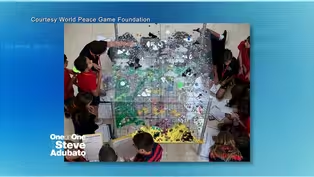
Exploring a unique approach to education
Video has Closed Captions
Clip: S2025 Ep2784 | 13m 5s | Exploring a unique approach to education (13m 5s)
Providing Support for PBS.org
Learn Moreabout PBS online sponsorship
- News and Public Affairs

Top journalists deliver compelling original analysis of the hour's headlines.

- News and Public Affairs

Today's top journalists discuss Washington's current political events and public affairs.












Support for PBS provided by:
One-on-One is a local public television program presented by NJ PBS