
The Legacy of a Wall's Racist Past/The Future of EVs
Season 5 Episode 12 | 23m 57sVideo has Closed Captions
The Legacy of a Wall's Racist Past/The Future of EVs | Episode 512
A simple cinder block wall built 80 years ago in Detroit is a lasting symbol of racism. The Biden administration wants to invest $174 billion into EV infrastructure to meet anticipated demand. Detroit Future City CEO, Anika Goss, talked with Stephen Henderson about the latest findings in the annual report about Detroit’s economic equity. Episode 512
Problems playing video? | Closed Captioning Feedback
Problems playing video? | Closed Captioning Feedback
One Detroit is a local public television program presented by Detroit PBS
The Legacy of a Wall's Racist Past/The Future of EVs
Season 5 Episode 12 | 23m 57sVideo has Closed Captions
A simple cinder block wall built 80 years ago in Detroit is a lasting symbol of racism. The Biden administration wants to invest $174 billion into EV infrastructure to meet anticipated demand. Detroit Future City CEO, Anika Goss, talked with Stephen Henderson about the latest findings in the annual report about Detroit’s economic equity. Episode 512
Problems playing video? | Closed Captioning Feedback
How to Watch One Detroit
One Detroit is available to stream on pbs.org and the free PBS App, available on iPhone, Apple TV, Android TV, Android smartphones, Amazon Fire TV, Amazon Fire Tablet, Roku, Samsung Smart TV, and Vizio.
Providing Support for PBS.org
Learn Moreabout PBS online sponsorship- Hi, I'm Christy McDonald.
Join us this week for One Detroit.
Coming up a closer look at the history of the Birwood Wall in Detroit that still exists today.
And how segregating a neighborhood influenced a generation of Detroiters.
Plus a big EV goal this week from the Biden administration, from batteries to infrastructure, to the future of how we drive.
Also ahead a report on the State of Economic Equity in the City of Detroit, and then the Concert of Colors.
It's all coming up this week on One Detroit.
- [Announcer] From Delta faucets to Behr paint, Masco corporation is proud to deliver products that enhance the way consumers all over the world experience and enjoy their living spaces.
Masco serving Michigan communities since 1929.
- [Announcer] Support For this program provided by the Cynthia and Edsel Ford Fund for Journalism at Detroit Public TV, the Kresge foundation, Community Foundation for Southeast Michigan.
- [Announcer] The DTE Foundation is a proud sponsor of Detroit Public TV, among the state's largest foundations, committed to Michigan-focused giving.
We support organizations that are doing exceptional work in our state.
Visit DTEFoundation.com to learn more.
- [Announcer] Business leaders for Michigan, dedicated to making Michigan a top 10 state for jobs, personal income and to help the economy.
Also brought to you by and viewers like you.
(upbeat music) - Hi there and welcome to One Detroit.
I'm Christy McDonald.
Hope you're enjoying the summer days here in August.
This weekend Respect, the Aretha Franklin movie drops nationwide and the start of he school year is creeping closer.
There is a lot we have coming up for you, including the push out of Washington for more electric vehicles by 2030.
Plus Stephen Henderson catches up with Anika Goss.
She is the CEO of Detroit Future City.
And they talk about the new report on the large opportunity gap here in the city of Detroit and some possible solutions.
Then the Concert of Colors, back live this year and billed as the largest free world music and diversity festival.
You'll get to enjoy some of that coming up.
But we're starting off with a closer look at the history of the wall in Detroit that segregated a neighborhood and exists still to this day.
It's called the Birwood Wall, the Eight Mile Wall or the Wailing Wall.
Our partners at Bridge Detroit teamed up with NBC News, researching the people who lived near it decades ago.
And our One Detroit Senior Producer, Bill Kubota learns more of that legacy, something many still know nothing about.
(children squealing) - [Woman] If you see it today, you happen upon it, you just assume it's there for decorative purposes.
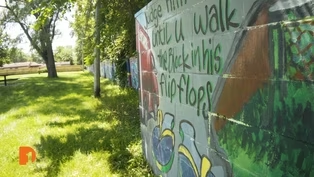
- [Bill] A cinder block wall with a few different names, the Wailing Wall, the Birwood Wall, the Eight Mile Wall.
It's just south of Eight Mile Road, built by a real estate developer to separate people by race 80 years ago.
- I thought about it a lot.
- [Bill] Torre May's been here 20 years.
- It just makes you angry.
- [Bill] One Detroit partner, Bridge Detroit, teamed up with NBC News to tell the wall's story which caught former Detroiter, Johnnie Smith's eye.
She's with your children visiting from California.
- Actually, there was a write up about the Eight Mile Wall, and I thought it'd be very interesting to have the kids come and see how Detroit was segregated not many years ago.
- Detroit was growing really, really rapidly.
- [Bill] Erin Einhorn and Olivia Lewis spent six months investigating the legacy of the wall.
- How did you get onto the store in the first place?
- Yeah, actually it was last summer, during the height of the protests and George Floyd had been killed, and then there were all these other viral videos.
And we were really struck by how differently people were viewing these events, like completely different lenses.
You know, specifically white folks were viewing it very differently from black folks.
We were just kind of talking about, well, why is it?
And it's actually pretty obvious why that is.
You know, like here in one of the most diverse countries in the world, most Americans live in a segregated neighborhood.
- [Bill] In 1941, the developer had to keep his houses separate from an adjacent black neighborhood to get a government loan.
Up went a wall between Birwood and Mendota streets, the embodiment of redlining, lending money, but leaving out African Americans.
- If you lived in that house-- - [Bill] More recently, Elizabeth Warren made a campaign stop and Gerald Van Dusen wrote a book about it.
- You think Detroiters even know about this wall?
- Most people living on Mendota and Burwood don't know about the origins (chuckles) of the wall.
That's what I found quite stunning.
People were so used to when they moved in, having this concrete backing, they assumed it was a lot like the kind of barriers you, you see maybe behind stores, you know, running maybe east and west on Eight Mile.
- I knew about the wall.
My mom had told me about the wall when I was younger, because she grew up in a neighborhood close by.
- My family also has ties to the neighborhood.
My father grew up a half a mile south of the wall.
Some of the people we interviewed for the story were my father's elementary school classmates.
And this was actually for me, a pretty revealing discovery.
I think all of the white folks that we interviewed, none of them knew that a wall was there when they were kids growing up.
- [Bill] There's been stories done about this wall before, but yours had some new information that probably was a revelation to a lot of people in Detroit.
- You know, I think one of the things that was really interesting about our story and what makes it a little bit different is that there is this ongoing story about one family.
- [Bill] The Crews family came from Alabama in 1918 to the area near Eight Mile Road.
It was Greenfield Township back then.
They settled here in a tarpaper shack.
- We talk about a family who comes to Detroit, sets up their own neighborhood essentially, and is fighting for housing rights and access to housing early on.
And then to see that play out over decades, I think is really important.
- when we were getting started on this project, you know, we were trying to figure out well, okay, who built the wall?
And we talked to experts and nobody seemed to know, and this was surprising because the wall's as you said, gotten a lot of attention in recent years, but missing from that narrative has been who built the thing.
- [Bill] A dive into the archives, revealed the developer, a prominent Detroiter from a prominent family, even today.
- [Erin] James T. McMillan and his two sons were the people who built the wall.
James T McMillan's grandfather was James McMillan who represented Michigan in the United States Senate around the turn of the 20th Century.
- It's important to know who was behind things, just so that we can go back and see how history played out.
I think that people want to know not only who was responsible, but to hold people accountable and see how can we move forward and how have we moved forward?
And so I don't think it's necessarily always a standpoint of blame, but how can we learn from this and do better in the future?
- [Bill] During the war, Detroit attracted more factory workers causing a massive housing shortage.
As the Birwood Wall went up, so too, the Sojourner Truth federal housing project, meant for African-American war production workers on the northeast side.
Trouble was white people showed up when they tried to move in.
That particular incident, the riot, maybe even that is lost to history for a lot of people in Detroit.
- Pretty much, pretty much lost as well.
It's still stands.
And I went over there one day fairly recently, and I was talking to the current manager of the public housing unit.
They had no idea of the history of that structure and what had taken place during the war years.
- [Bill] Gerald Van Dusen wrote a book about the Sojourner Truth riot too, a riot instigated in part by a priest at a nearby Polish Catholic church.
- And the arrests were primarily of blacks, even though whites were doing just as much of the pushing and pulling and rock throwing and the like.
- [Bill] As the country united against the Germans and Japanese, in Detroit, the arsenal of democracy, a fight was on to keep society segregated.
- And the rules simply said, this, that if you're gonna put up housing, public housing, if the neighborhood is predominantly black, then the housing will be exclusively black.
If it's predominantly white, it'll be exclusively white.
If it's a mixed neighborhood, well, theoretically it could be mixed, but never was it mixed.
It was gonna be one or the other, and typically it was in a mixed neighborhood, it was white.
- [Bill] Sojourner Truth became a rallying cry, a conflict over housing and race heard nationally.
- The Birwood Wall incident, the Sojourner Truth incident, and then the hate strikes at the Packard plant and other factory plants really precipitated the race riot of 1943, the biggest riot of the war.
- You know, I was driving recently down a broad boulevard that had a grassy median down the middle, right near the border of Detroit and Grosse Pointe and thinking like, oh, I understand why this was here.
A lot of those broad boulevards with grassy medians were built for the same exact reason this wall was built.
We have all these legacies in all these different places, and we may not even know they're there.
- To you see the entire report from Bridge Detroit and NBC, just head to our website at onedetroitpbs.org.
All right, turning now to the future of electric vehicles and news out of Washington.
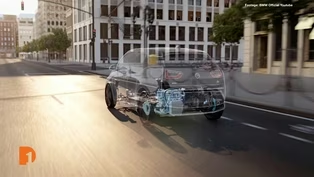
This month, President Biden's signed an executive order aiming for all new vehicles sold by 2030 to be electric, but upfront costs, range anxiety and battery life are just some of the hesitations that consumers have.
Will Glover has more on the future of EVs electric.
- [Will] Electric vehicles or EVs trade combustion engines for battery powered motors.
These fast-- - Oh my God!
- [Will] Quiet, and high tech vehicles are being pioneered by companies like Tesla and Michigan's own Rivian.
Amazon is moving toward an all-electric fleet of vehicles by 2030.
Ford is turning iconic brands like the Mustang into EVs.
(exciting music) General motors has pledged to sell only electric vehicles by 2035 and has already sold the reservation for the first all electric Hummer to roll off the line at the Barrett-Jackson Scottsdale auction for $2.5 million.
- [Announcer] And sold for two million five hundred thousand dollars!
(audience cheering) - [Will] According to the Edison Electric Institute, there were over one million electric vehicles on US roads as of 2018.
Hannah and John have been driving their EV for three years.
- I was gonna have a kind of longer commute from Ann Arbor Ypsilanti out to Detroit, and back every day.
I wanted to take every opportunity I could to do my part, to contribute, to reducing greenhouse gas emissions and to move in the direction that it looked like as a society, we were gonna have to move eventually.
- [Will] John McElroy, the host of Autoline on the benefits of EVs.
- We're going to see a dramatic reduction in air pollution in cities.
We're going to see a reduction in noise pollution because these cars are far, far quieter.
There's other issues that have got to be resolved.
We need to be able to recycle the batteries in mass volume and be able to do it at a profit 'cause we don't want to end up just throwing these things into landfills.
So there's going to be some adjustments as well, but overall for the general public and for the economy, the move to electric cars is going to be a positive.
- [Will] Other countries have already bought into electric vehicles like Norway, where 74% of vehicles are hybrid plugin or fully electric.
- Did you know that Norway sells way more electric cars per capita than the US.
Norway (laughs).
- And China, Who's planning to transition to all electric or hybrid cars by 2035.
If passed, President Biden's American Jobs Plan will invest $174 billion into incentives for people to buy EVs and support to get 500,000 chargers installed across the country by 2030.
- The fear is that we're falling way behind China and Europe in this regard, especially when it comes to the supply chain of critical materials for batteries and motors.
The United States is way far behind.
And we know that this is going to be the future.
- [Will] Addition to the positive environmental impacts and potential market share electric cars are efficient.
Associate Professor of Mechanical Engineering at Wayne State University, Dr. Ku, explains.
- Having efficiency in the range of upper 80% to 90%, whereas combustion engine, (combustion exploding) even with, you know, all the turbo charging, all those kinds of things, you probably cannot get much more than 40, 45%.
So that means that for every gallon of fuel, there's only less than half gallon actually contributed to driving the vehicle.
Whereas if you use electric vehicle, every kilowatt hour of electric charge from your battery pack, you can use 80, 90% of it.
So there's less waste.
That has always been the case.
- [Will]] Of 2019 there were over 2.8 million registered vehicles in Michigan, but only 4,200 registered electric vehicles.
Of the 250 million vehicles on the roads in the US today, fewer than one percent are electric.
Why haven't EVs taken off in the states?
- Number one is the cost of the cars.
They tend to be more expensive upfront, though over their life their maintenance and service costs are less, so it'll end up being cheaper, but you have that upfront hurdle to overcome.
Moreover, a lot of people live in apartments.
Where are you gonna plug in at night?
Or in a condominium or the like.
And you know, unless you have your own private residence or someplace to plug in at night that introduces the concern of range anxiety, where people are like, oh my gosh, what if I run out of juice?
Where am I gonna plug in?
- Like even the most advanced charger, it's labeled level three.
It's still talking about, like on the magnitude of hours.
So you take that long to charge the car fully.
And then you think about like, if there is a line, then you have to wait.
- But also for those of us who live in the snowbelt, you lose a lot of range in cold weather.
You might lose half your range if it's bitter cold outside.
So you lump all this stuff together, and a lot of people are waiting for somebody else to take the plunge and learn from them before they decide to go electric.
- Oh, there's good apps that have all the stations and people add information about the stations, like how many chargers there are, even what the speed of charging is at different stations.
So you can plan it really nicely.
- One thing that we learned just about the mileage is that it really depends on how fast you drive.
And I come from a part of the country that has lower speed limits than we have here.
(Hannah laughing) So I'm not inclined to drive 80 plus miles an hour, anyway.
- Right.
- But if you're somebody who is, you run through the charge a lot faster at 80 than you do at 70.
- [Will] Though Americans have been slow EV adopters, a 2020 Consumers Report survey showed 71% of US drivers, said that they would consider buying an EV in the future.
And more than 70% agreed that automakers should offer variety, plugin EV pickups, and SUVs in addition to cars.
Automakers have taken different strategies to try and keep up with the sector's clear front runner, Tesla.
(car revving) - Ohhh, ohhh, ohhhh!
I'll buy it!
I'll take it!
- They are so far out in front of the rest of the industry, which is now scrambling to try to catch up.
But even amongst traditional automakers, we're seeing different strategies.
At the top, the most committed are Volkswagen and General Motors.
- [Will] But not every automaker has plans to go fully electric.
- Then you've got others like Ford, for example, that is saying, okay, we're not gonna make the full blown commitment, but we are going to electrify iconic products in our lineup.
Toyota, for example, is a big believer in hybrids, not electric cars, Honda recognized it really doesn't have the capability of doing anything short term.
It's partnered up with General Motors for making electric vehicles in the United States.
So, you know, depending on which auto maker you're talking about, you're going to encounter a different strategy.
- [Will] Michigan ranked 29th out of the 50 states in Washington, DC, in a scorecard of state transportation electrification by the American Council for an Energy-Efficient Economy.
Preparations to make Michigan more EV-ready are still underway.
The Michigan Climate and Energy Department is working on projects like the Electric Vehicle Readiness Plan to help townships, counties, cities and villages become EV-ready through zoning and the Optimized EV Charger Placement Plan to develop a fast charging network for electric vehicle travel throughout Michigan by 2030.
At the federal level President Biden's proposed infrastructure plan still has to make it through Congress.
For the United States, government, automakers and consumers will have to be in sync as it hopes to charge into an electrified future.
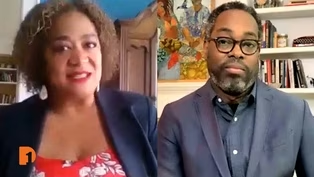
- Detroit Future City is out with its annual report on the state of economic equity in the City of Detroit.
And the bottom line is not good.
The opportunity gap remains, especially in education and unemployment.
Detroit Future City's CEO, Anika Goss, talked with Stephen Henderson on American Black Journal about the findings and some of the recommendations.
- The new report suggests that we still have these tremendous gaps in opportunity, in outcomes for people of color here in Detroit.
Tell us what the picture looks like in 2021.
- The data is what did Detroit look like in the context of the region prior to COVID?
And I think that that's really important because we are under the impression or the narrative right now is that everything was great, and then COVID hit and wiped everything out.
The numbers that are gonna come out for '20 and '21, and later this year in '21 and in '22 are gonna be really bad.
They're going to show further job losses, further losses in small business.
We also really, really wanted to focus this report on opportunity.
And the reason that we focused so closely on opportunity for middle-class is because at Detroit Future City, we really believe that this can't be a narrative that just says, are we ticking up slowly against the poverty barometer without any opportunity for people to go someplace else once they reach a certain income level?
- As you pointed out, the numbers are gonna get worse because of COVID that, you know, the devastation that all of us have experienced here in Detroit, is gonna show up in every assessment of 2020 and 2021.
So we'll be further behind.
- Yeah.
- What are the things we should be doing in anticipation of those numbers, which reflect a reality that people are living right now?
- We actually come up with a set of recommendations of things that we really want people to focus on and where we believe at DFC, where we can make change and move forward.
And one of those is the combination of education, employment and wealth, right?
Income and wealth.
What we've learned from this is that there is such a gap Stephen in education, the only jobs that have been growing in Detroit are low wage jobs for jobs in Detroit.
The jobs in the region are middle wage jobs.
Now you could say, well, a low wage job is better than no job, but if those are the only jobs that are growing, right, then that's gonna be problematic for everyone.
- Yes (audio distorts) trapping people in poverty, right?
- Exactly, exactly, trapping people in poverty.
And furthermore, if our education attainment is so low that the majority of Detroiters, and when I say majority, I mean like 78% of Detroiters do not have at least an Associates Degree, then we need to have more jobs without needing a degree.
On the other side of that, we have got to really be pushing for higher education attainment, community college, CTE, four-year college, because the average wage is double.
It's $17 an hour if you don't have a degree.
It's $32 if you do have a degree.
It's slightly lower if you're African-American and it's extremely lower, if you're a woman, which is a whole other conversation, because the majority of households in Detroiters are single women.
And then the final thing that I really feel like is going to be critical for us unless we change this trajectory is how we look at our neighborhoods.
So middle-class households, in particular, black middle-class households are not seeing Detroit as a place to raise their family.
And that is hugely problematic for a city that's 78% black!
And the only neighborhoods that are growing right now are also white upper-middle-class households.
So we need to be able to focus on that trajectory as well.
- For more on that report, plus stories from American Black Journal, Great Lakes Now, and our partners at Bridge Detroit, just head to our website at onedetroitpbs.org, and you will find it all there.
All right, let's end the show with a little bit of music.
Crowds enjoyed the Concert of Colors, back live this year, It's 29th year running.
So we're going to leave you with one of the performances.
Enjoy it.
I'll see you next week, take care.
♪ When I get up in the morning ♪ I just can't make it ♪ What kind of spell is this ♪ I just can't break it ♪ Like a monkey on my back ♪ And I can't shake it ♪ I'm calling you baby ♪ Tell you I can't take it ♪ See I got this heartache ♪ In my soul - [Announcer] You can find more onedetroitpbs.org or subscribe to our social media channels and sign up for our One Detroit newsletter.

Video has Closed Captions
Clip: S5 Ep12 | 37s | An excerpt from Melvin Davis & United Sound performing "Chains of Love". (37s)
Detroit Future City Report Shows Persistent Opportunity Gap
Video has Closed Captions
Clip: S5 Ep12 | 4m 36s | The bottom line isn't good when it comes to education and employment. (4m 36s)
Video has Closed Captions
Clip: S5 Ep12 | 7m 46s | Will Glover has more on the future of EVs. (7m 46s)
The Legacy of a Wall’s Racist Past
Video has Closed Captions
Clip: S5 Ep12 | 7m 7s | A simple cinder block wall built decades ago in Detroit has a legacy connected to racism. (7m 7s)
Providing Support for PBS.org
Learn Moreabout PBS online sponsorship
- News and Public Affairs

Top journalists deliver compelling original analysis of the hour's headlines.

- News and Public Affairs

FRONTLINE is investigative journalism that questions, explains and changes our world.












Support for PBS provided by:
One Detroit is a local public television program presented by Detroit PBS