The Louisiana Strawberry
The Louisiana Strawberry
3/2/2026 | 54m 34sVideo has Closed Captions
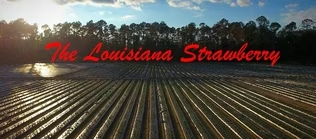
In Louisiana, the strawberry is more than just a sweet treat.
Through the voices of past and present growers, the documentary highlights both the pride and the pressures of modern farming. Their stories reveal how knowledge, resilience, and tradition have allowed the strawberry industry to endure across generations, shaping not only a local economy but a shared cultural identity.
Problems playing video? | Closed Captioning Feedback
Problems playing video? | Closed Captioning Feedback
The Louisiana Strawberry is a local public television program presented by LPB
The Louisiana Strawberry
The Louisiana Strawberry
3/2/2026 | 54m 34sVideo has Closed Captions
Through the voices of past and present growers, the documentary highlights both the pride and the pressures of modern farming. Their stories reveal how knowledge, resilience, and tradition have allowed the strawberry industry to endure across generations, shaping not only a local economy but a shared cultural identity.
Problems playing video? | Closed Captioning Feedback
How to Watch The Louisiana Strawberry
The Louisiana Strawberry is available to stream on pbs.org and the free PBS App, available on iPhone, Apple TV, Android TV, Android smartphones, Amazon Fire TV, Amazon Fire Tablet, Roku, Samsung Smart TV, and Vizio.
Providing Support for PBS.org
Learn Moreabout PBS online sponsorshipStrawberries is unlike any other crop.
It's like having a bunch of little kids out in the field and has anybody that has children.
You know that every day you got to go and you got to look at them.
You got to take care of them and you got to help them when they're sick.
It's nowhere near planet.
Forget it.
I was privileged enough to be able to wake up every day and walk out of my front door and into a strawberry farm.
My grandfather started, and then my parents joined in with them.
And so every everything revolved around strawberry season and it wasn't just a hey, we're only in the springtime situation.
Started all year.
Round.
My daddy and my uncle and my grandpa raised strawberries.
So it's it's what I know.
It's in my blood.
I'm gonna.
I've been around them since I've been born, so I was raised here with it, and I love it.
The Louisiana strawberry is a beautiful red color, and I think it has to do with the soil content, obviously.
And then the humidity, the amount of sunlight and the amount of rain that we get here, I think makes a completely different strawberry than what you're going to get in Florida or what you're going to get in California.
You don't have to ship for 4 or 5 days.
Wait for them to get here, pick them green, green for them to last.
We can get these strawberries in the stores that day or the next day.
If you pick a strawberry when it's green, it's going to have a dark taste.
So you might bite into and say it don't taste well.
It's not going to really taste.
If it's green, you want it to get bigger and sweeter, and that's what it takes to stay on that vine out there.
It can be argued that strawberries and strawberry farming rescued Louisiana Florida parishes from economic oblivion.
At the end of the Civil War, this region was in despair.
The area was crushed.
Congress had no interest in rebuilding the area.
You know, as it was said, there was no Marshall Plan for the defeated South.
Many northern adventurers came south, and many of them had been soldiers here, and they'd seen the timber that stood here, the vast forests of yellow pine.
And so they got very busy cutting it all down.
And for a while that provided very low paying jobs and everything to people in the area.
But quicker than they had expected.
The trees were all gone.
The companies that came in and cut them did no reforestation.
They made no efforts at getting the stumps out of the ground, etc.
so the land was essentially a wasteland.
The only thing that made any money for anybody was cotton.
And so we call it the cotton trap.
And most of the farmers in the area, and of course, nearly 80% of the people who lived here were farmers, got caught in the cotton trap, which meant they became sharecroppers.
Many of them had been independent landowners on their own before the war and everything they lost the land, taxes, etc.. Others had been big landowners, and they carved their land up into small plots.
But the bottom line is, most of the people who'd been small farmers ended up forming other people's land for a share of the crop.
And it got worse and worse and worse at the end of the year.
Each year they had to borrow to eat from a furnishing merchant.
They would go to settle up with him, and they found that their cotton crop didn't pay him off.
The person that owned the land had already taken a half of the cotton crop, so that it wasn't working for them, and people were going further and further into poverty.
So they began trying different things and other ways to to restore economic vitality in this region.
They tried things like cattle farming and it looked like that would work.
But then along came the Texas fever tick.
And when that drove this scrawny type cattle, the emaciated looking cattle, they just couldn't sell them much.
They flirted with dairy farming early, too, but it suffered from some of the same types of problems.
And then most of them got pushed back into cotton again.
And then here came the boll weevil.
And it was like the misery of the people in the area could not have gotten worse.
So some enterprising people began to experiment with other crops.
And by the late 1880s and into the 1890s, in the first years of the 20th century, New things were being tried, and among them were strawberries.
Where our strawberry business started.
Printed in the June 1927 issue of the Illinois Central magazine, the first strawberry patch in tangible, a parish in what is now the famous fruit region of eastern Louisiana, was planted in 1876 on the outskirts of a village called Uncle Sam.
The name of the village was later changed to independence and is now the premier.
Berry shipping point on the main line of the Illinois Central System.
Doctor Wilson, one of the early settlers of the town, father of Harry D Wilson, the present Commissioner of Agriculture and Immigration for Louisiana, was the man who planted the first strawberry field and introduced an industry which now utilizes more than 16,000 acres and brings in gross returns of about 3.5 million annually.
The first field contained two acres.
And very quickly it became evident that strawberries not only grew well in the soil of this area, but they had a rich, remarkable taste that was distinctive and, many would argue, superior to strawberries grown anywhere else.
They used pine straw and, straw to mulch the berries, to slow the grass from coming up.
And you'd have to break your straw, haul the straw to the field, and then you had to shake the straw and the berries did motion.
Polar bear plants through the straw and didn't wait on the season for the harvest time.
And as soon as people started tasting how wonderful these berries tasted, how well they grew, the size they could reach and everything, and how easy it was to grow them, and that we had such a long growing season around here.
So they had more time to grow more berries.
Plus the fact that the New Orleans Jackson railroads ran right adjacent to this region.
It was like a godsend.
Strawberry farming started slow, but then it took off and it it did something for the economy that wasn't just keeping people farmers, it allowed.
Strawberry farming facilitated a prototype industrialization of the area.
To most, the families in the community were strawberry farmers, or they formed and they very few family members were part of the industrial community.
They lived in raised strawberry and vegetables and they, they sold to the local markets and to some of the fruit was shipped by, by rail to other parts of the country.
But it was naturally a family oriented business.
And as it created jobs and caused money to flow in the area, it began to change the character of the people.
Because, you know, this is the old days of Bloody Trench below and the bloody trench below era, you know, began in the 1880s.
It raged through the 1890s, and then it continued on into the first decades of the 20th century.
But to show a whole parish descended into an utter abyss of near chaos where the legal system was compromised, governmental authority failed the people, and it sustained some of the highest rural homicide rates ever recorded in American history.
And it was a virtually horrific type situation for the people that live there, because it was a time when violence became not merely an accepted response to certain situations, but an expected response to certain situations.
It was just people in a very difficult type of situation, both economically, politically and every way you can think of.
And here came strawberries, and one of the politicians famously said at a gathering, trying to celebrate it, Amy, what the arrival of strawberries meant.
He began his speech by saying, our bloody days are over now our only red is the rich red strawberry.
So the towns begin to build their identity around them, and it began with Hammond.
Because Hammond was such a railroad hub, you know, the confluence of two railroads right there when southeastern emerged and built its football stadium, you know, named it strawberry Stadium.
But the dynamics of strawberry forming began to shift a little further south towards the Ponchatoula area and then out into Livingston Parish.
It was because of the soil content, and it just proved perfect for strawberry farming.
In 1972, there was a group which I was one of them.
We had some from the Chamber of Commerce and some from the Jaycees.
It wanted to do something to still promote the strawberry industry and recognize the farmers, and they were called strawberry Bonanza.
A total of 15, 20,000 people that showed up and participated in the activities they had.
I can't remember exactly how many booths here, but not near what they they do today.
So that was the beginning in 1972.
And then as time went on, it grew and more people got involved.
What could they show?
I wish something good.
It was a clean family event.
I. Now can dump the strawberry top, the Ponchatoula Strawberry festival.
It's extremely important.
I think a lot of people.
Never mind.
This is when the season starts.
Even though we are able to grow strawberries and offer them to the public earlier in the season, this is really when it's on the top of mind for them.
And so that is when demand is high.
And soon there were arguments and disputes and competitions and everything that this Ponchatoula berry tastes better than the Hammond Berry.
And then the Albany Berry was better than both of them together and everything.
And so you started seeing this whole new dynamic where Ponchatoula begins flirting with their own strawberry queen, you know, in the Strawberry Festival and everything.
And people found that strawberries aren't just great as they're eating, they make wonderful preserves.
They can be used in all kinds of dishes and things and desserts.
And and they made a powerful bust head, as they called it, strawberry wine.
They got very popular.
So strawberries arrived and transformed the regional identity just as much as they were a reinvigoration to the regional economy.
Hello and welcome to the LPB Studios, everyone.
I'm James Fox Smith, publisher of Country Roads magazine.
Joining you today for a film about your favorite Louisiana crop and mine, the Louisiana strawberry.
When you think of homegrown favorites, I bet strawberries are pretty much high of everybody's list.
And so that's why a documentary like this one is so insightful, because we're learning so much more about the history, the hard work, and the farming traditions that have made this fruit such a popular staple in our kitchens and our culinary culture.
You're in for a treat, because we're joined today by the filmmakers behind The Louisiana Strawberry in just a moment.
But first, we want to ask you to support LPB's mission so that we can continue to share films such as this one.
You make the difference.
Your contribution today ensures that LPB can continue to present stories that matter.
So simply call or text give to 888-769-5000 or become a member online at lpb.org.
Or scan the QR code on your screen and consider becoming a sustaining member with an amount that fits your monthly budget.
So let's hear about the sweet thank you gifts that we have for your pledge of support during this broadcast.
It is viewers like you who make the difference.
Become a member to support the Louisiana stories you love on LPB.
For $20 a month, receive the Louisiana Strawberry Combo, which includes the official 2024 Ponchatoula Strawberry Festival poster by artist Emily Borne.
A pair of Louisiana strawberry tea towels and an LPB Strawberry Campfire mug.
Support LPB at $10 a month and choose the pair of Louisiana Strawberry Tea towels, perfect for any Louisiana kitchen or for just $8 a month.
Receive the LPB Strawberry Campfire Mug.
So take advantage of those great thank you gifts today.
But now I've got some special guests that I'd like to introduce.
Paul Catalonotto is the writer and director of Louisiana Strawberry and is also a film professor teaching at LSU.
And Brandy Miller is the producer of the documentary and is also a lifelong resident of Ponchatoula, brandy.
You're an educator.
You're a community leader and an advocate for the Louisiana strawberry heritage.
Tell us a little bit about how this project came to pass.
So I'm currently serving in the role of the president of the Louisiana Strawberry Preserve Society.
But when this first came to be, I was actually the historian and preservation chair.
We wanted to find another way to educate and promote, so that people kind of understand how we go from farm to table with our state fruit.
So I reached out to Paul and we started discussing again some different options.
We decided we really wanted to highlight that farmer and go forward, and that's how this came to be.
I reached out to like Livingston Parish Tourism Tangipahoa Parish Tourism, the Louisiana marketing board in the Strawberry Festival, and we all got together.
Their financial contributions helped us make this possible.
Wonderful.
And, Paul, this is really an enormous part of Louisiana's agricultural heritage and history, particularly in that southeast Louisiana area, isn't it?
Tell us a little bit about the story that you found that was there to tell.
What amazed me most about this particular story was, I'm I'm like anybody else.
Or prior to this, I was like anybody else.
I just thought of the strawberry, something that I bought in the store.
What I was amazed was there's more to every individual fruit that comes to your table.
There's a whole story there.
That's the farmer's legacy there.
That's their story.
You█re buying, And that's what really amazed me was that it wasn't just one fruit.
It was the farmer's identity, their livelihood, their future.
It was all these things in one, one particular fruit, one strawberry thing, and another thing, brandy.
And I'd hadn't known this is that in 2001 you played a fundamental role, didn't you, in taking this and making it a very different thing about what is Louisiana's fruit?
Absolutely.
Originally, the state fruit for Louisiana was the cantaloupe.
And no offense, it's not the strawberry.
So, representative, Tate Powell and I kind of showed up when they were voting on the state fruit with some berries in hand.
And helped persuade everyone to vote on it.
And we absolutely got the strawberry as the state fruit back in 2001.
Fabulous.
Well, look, don't forget again, let's have another look at those thank you gifts.
And then we'll have a little bit more of this story to show you.
For $20 a month, receive the Louisiana Strawberry Combo, which includes the official 2024 Ponchatoula Strawberry Festival poster by artist Emily Born, a pair of Louisiana strawberry tea towels and an LPB strawberry campfire mug.
Support LPB at $10 a month and choose the pair of Louisiana strawberry tea towels, perfect for any Louisiana kitchen or for just $8 a month.
Receive the LPB Strawberry Campfire Mug.
Become a member at any level for a chance to win a Ponchatoula Strawberry Festival gift basket featuring the official 2026 poster and t shirt, plus delicious farm fresh strawberry specialties from Louisiana Family Farms.
Thank you to the Louisiana Strawberry Preserve Society.
Support LPB during this broadcast for your chance to win.
Now, we've just seen how this halmark Louisiana crop started on just two acres and now encompasses 16,000 acres.
Let's talk about how the strawberry became such a vital part of the agricultural economy of southeastern Louisiana.
That's my favorite story in the entire documentary, and they're just so eager to try new things.
So along comes the strawberry.
And this fruit brings them into the modern era.
Really?
The strawberries.
What brings them from those dire times to today?
Yeah, yeah.
And I mean, but a big part of it, and this was fascinating to me, was that the, the Illinois Central Railroad line ran directly through Hammond in the north and was for all of these crops that were grown in these wonderful Louisiana, growing conditions could be sent up to markets all throughout the Midwest.
Right.
So that was a tremendously important part of why it took place then and there.
Yes, sir.
Actually, at one point, Hammond was a strawberry capital and Ponchatoula We kept getting a few more, I guess, coming into our area, and we wanted to make sure that we were kind of known for Strawberry Capital.
You wear the crown very, very well, so that's marvelous.
Well, look, thank you so much for, sharing this archive with us.
It's a wonderful documentary and a way of getting a greater appreciation of a huge part of Louisiana's cultural and culinary, history and really enriching our experience of our appreciation of living in Louisiana.
Let's have another look at those thank you gifts.
And then we'll be able to go on to more of the program for $20 a month, receive the Louisiana Strawberry Combo, which includes the official 2024 Ponchatoula Strawberry Festival poster by artist Emily Born, a pair of Louisiana strawberry tea towels and an LPB strawberry Campfire mug.
Support LPB at $10 a month and choose the pair of Louisiana strawberry tea towels, perfect for any Louisiana kitchen or for just $8 a month.
Receive the LPB Strawberry Campfire Mug.
Become a member at any level for a chance to win a Ponchatoula Strawberry Festival gift Basket, featuring the official 2026 poster and t shirt, plus delicious farm fresh strawberry specialties from Louisiana Family Farms.
Thank you to the Louisiana Strawberry Preserve Society.
Support LPB during this broadcast for your chance to win.
We're getting ready.
We're preparing our fields.
We're getting ready.
We just put fertilizer down and lime.
We get LSU air comes in, we do small samples off everything.
We get certain types of fertilizer, and that's what we're doing right now.
We're hoping for rain to get moisture into our ground so we can lay plastic, and it stays firm.
Once we lay in it.
Don't fall.
We'll start getting very plants in here at the end of September.
There's a lot of prep work to get into this thing, and then a lot of pampering and babying these things every day with water and making sure that stuff don't drive out.
It's with this heat right now and we're going through some unbelievable heat right now.
Hundreds takes a lot of prep work.
It's just not picking strawberries.
Well, for me, I need 50 to 60,000 just to start.
People always.
Oh, you pick a lot of berries.
You make your money.
Not always.
Well, you got the plastic to drip the gas for less and chemicals.
It's just stuff we use.
We got to pay for the all the labor contracts.
Do different contracts up front, pay for that.
We got to pay them when they get here for travel.
So it starts you know it starts adding up.
Tell everybody we're professional gamblers because you put all your money on the table at the beginning and then you wait for the good Lord to give you the weather to be able to do what you do.
Some years it works out, some years it.
No, I like to put it if I break even at the end of the year, I lost my labor, myself and my wife.
But I'm still ahead to be able to do it another year.
The years that we do make a profit, you stick it to the side for the years that you don't make a profit.
But what was about 12,000 then?
When I quit in 2020 with about 22,000, you had to a shack to get your next crop.
Don't throw your man at $202,000 before you made a nickel.
The cost of a flat of berries has not increased in a very long time, but everything else has.
As far as labor, as far as your plant, your boxes, your pint, everything, all that has gone up.
I remember ten years ago we were selling a flat of berries for $20, and it's the same now.
You know, when we're packing heavy, we're we're selling a flat of berries for roughly around $20.
So nothing has gone up as far as what we're making.
But everything else, as far as what we're putting into it has gone up.
The prices have stayed pretty consistent from what we can get at market, you know, to direct to consumer, because I think the consumer has a certain price point in mind.
They are able to get cheaper strawberries out of state or out of country, but our costs have only gone up.
And so we are operating on thinner and thinner margins every year, which is why events like the Strawberry Festival is so important, because we're able to recoup some costs, we're able to meet people face to face, and they get to really know us and know why they should buy local strawberries.
Our first little adventure behind our house, we planted 20,000 strawberries.
Him and I did all the work, absolutely everything, and we made $3,000.
So we said, hey, no mom and dad's weight 100,000.
They make an $100,000.
Well, the more you have more expenses, your house and you have the labor involved, everything else was pretty much the same.
But the laborers very consuming of everything.
If you can't figure out a way to mitigate those labor costs and to be super efficient, it's going to put you out of business.
I've told congressmen and senators in Washington and in every time I could get in front of somebody, would you rather import your food or import your labor?
Because that's the one thing that if you import your food, you're at the mercy of whoever's growing.
And if you import your labor, at least we can grow it here locally.
They control what's going out and what the customers are taking into their bodies.
It's regulated.
It's healthy and fresh.
It's a blessing for us to have this labor.
We have H-2a labor that comes in from Mexico.
And it's always it's not always easy.
Sometimes they get stuck over there dealing with visas and and getting their passports and stuff ready to get over here.
I'm blessed.
Behind me I have Jose who's been here for he turned 40 yesterday and he's been over here working for for another former I started he's been over here for 20 years.
We're just going to give you a little update.
On the past freezes that we had, we were very fortunate.
We, had double covers on our plants.
Although we still do have some damage.
You can see over here some of the blooms that were damaged.
If they have black centers on them like that, that means that the frost has gotten to them.
So this will not make a berry.
This.
This one's gone.
We like to look at some of the newer blooms right here that are really yellow and pretty.
So you'll see that's what we're looking for.
These are bad.
These are good.
We probably had maybe a 35 to 40% loss, which is a blessing considering that we had several days below 20 degrees.
See where that's turning black?
This bloom may have made a berry, but it would have been what we call crippled or deformed.
And once that happens, we don't put that in our berries.
For instance, this berry right here.
Okay.
See how it's got the green on it?
All right.
You see this little spike?
You see how it's kind of funny looking that's a deformed or a cripple berry.
And that was because maybe a raindrop hit it when it was in this stage.
And if it hits right in the center, if a raindrop hits it and it gets that part of the center gets an image, then that's what you get.
We like to see berries that are like, well, see, this is another one that has some cold damage on the on the talus right here.
The berries fine.
But it's just that, that careless sustainment.
But they still taste good.
They called it nice.
And when they coated in ice.
The berry and.
The bloom that temperature stayed just above freezing when it was posing.
Nice.
And I never could understand that, but that's that's what that's what done.
That was going to go out.
It would take him one hour to walk the rose where the sprinklers were, and he wear jumpsuit like the hunters where zipped up all of mine.
And when he got to my back door, he'd unzip the suit and it would stand there by itself because it was froze.
He'd come in and get a cup of coffee or a cup of hot chocolate and go make the rounds again every hour on our.
We've had times last year where we stayed covered for three weeks straight.
You'll uncover not knowing what you got at the end of it.
One time last year we uncovered and surprisingly saved pretty much the whole crop.
Then three days later we get flooding coming in hard rain for three days straight, lost everything that we saved for three days that we worked on.
The flood of 2016.
We got that bad floods.
It was March, the end of March.
Whenever we were picking so many berries, the water came in and it took all the fields except for my front field here.
Yep.
And we lost pretty much everything.
Yeah, mad.
The trees, your plants.
You know, you had to fight by 2 to 3.
Could control you.
Now you're just picking going.
The picker wasn't making no money and you weren't making no money.
And you just have to quit.
I've had, rain, ruined ground twice in the peak season.
And our marijuana bucket food and a trailer load and dump them in the woods and it's.
Our dough will come that.
Way in the beginning of March, coming into strawberry season.
A lot of fruit.
Going on.
If you look out here, we still have a lot of fruit in the fields, a lot of balloons.
Just preparing, you know, for the peak, which is the end of March.
May and April.
But I just want to show you all the devastation, what rain and fog does when the fall comes in at six, seven in the afternoon, it stays all the way to eight.
The next day.
That strawberry stays in water all night long.
So that callous.
And let me show you, this is a callous.
If anybody understands this is a strawberry, but this callous right here is going to stick to that strawberry.
And that's what I call stem that, that, it just sticks and causes them to get brown.
So let me show you what happens.
This is all for five acres of strawberries.
And that's not all of them.
We don't put them in the woods to.
That's the devastation of fog.
If you don't take all these strawberries off these grains, it's holding that black, this brown in it.
All that's going to do is keep ripening and turn red.
And it's going to be a huge one.
And all the nutrients are going into a bad strawberry.
So we got to pull all this off.
This is a huge amount of strawberries.
This is probably 500 to 1000 flats.
We lost.
Welcome back.
I'm James Fox Smith, publisher of Country Roads magazine and host of LPB's Art rocks.
And I'm happy to be joining you today for the film The Louisiana Strawberry.
Meaningful programs such as this that share the stories about the people that make Louisiana so special.
This is what LPB is all about.
For 50 years, viewers like you have called in their support and become members because they, like you, have believed in the power of LPB to connect the citizens of our state.
As LPB celebrates its 50th year on the air.
We know that you will want to be part of this great legacy.
Whether you love films about Louisiana, historical dramas, learning about a sports legends or a young heroes, LPB has it all and it makes it so easy for you to be part of our public television family with budget friendly monthly membership options.
So call or text give to 888-769-5000 or go online at lpb.org or scan the QR code on your screen.
It's LPB, so there's always a little lagniappe there for our members.
Let's take a look.
It is viewers like you who make the difference.
Become a member to support the Louisiana stories you love on LPB.
For $20 a month, receive the Louisiana Strawberry Combo, which includes the official 2024 Ponchatoula Strawberry Festival poster by artist Emily Born, a pair of Louisiana strawberry tea towels and an LPB strawberry Campfire mug.
Support LPB at $10 a month and choose the pair of Louisiana strawberry tea towels, perfect for any Louisiana kitchen or for just $8 a month.
Receive the LPB Strawberry Campfire Mug.
So do take advantage of those thank you gifts.
And we're back with writer and director Paul Catalonotto and Brandy Miller, producer and I might say presence of royalty.
One time, Louisiana strawberry queen.
To talk a little bit more about this wonderful documentary that teaches us so much about a huge part of the state's agricultural heritage.
Brandy.
Darryl, the farmer responsible.
Let's not forget for these beautiful select strawberries.
Says in this in, he points out that for a Louisiana farmer like a strawberry farmer, essentially they are just gamblers.
They're professional gamblers that put everything they have on the crop and that that really comes through in this program.
Can you tell us a little bit about that from your own perspective coming out of that tradition?
So 40 years of a farmer's daughter, it absolutely.
It is everything plays a role whether or not our help was able to do it, whether the weather played a role in it.
It's always a chance whenever you do that.
Obviously, you always want the beautiful outcome of a berry like this, but you never know with with the dice is going to throw your way.
So you always have to be prepared and ready.
And, part of wanting to get this documentary started was just to see, I mean, different things that were happening, and we wanted people to be able to catch that on film so that we could have that for generations to share.
Sure.
Paul, you saw it.
You really saw some of the things that farmers go through, right?
As the film came together and you understood more about what goes into producing a crop like that and getting this end result in a lot of strawberries.
You know, I like to think I see I saw just about everything that a farmer goes through, new appreciation for being a farmer.
I saw them go through freezes.
I saw them go through fog.
Who would imagine that fog is devastating to a berry.
That could have been in jeopardy for $1 million.
I would have missed that question.
A hundred times, but it absolutely is devastating to them.
Fog freezes disease when you don't think about it like a berry that's isolated from all these other farms can still get like funguses and other blights that just completely wiped them out for a season.
And we've seen we saw that.
And, but what I think is the most important thing is they deal with all of this, yet they still show up.
They still make that berry.
They still get that berry to the table.
And they endure for not just us, but for their families and for the future, identity of this state, this Louisiana Strawberry.
It's all tied up in that crop, isn't it?
It really is.
And that's part of what LPB is here to do, is to share those stories.
So we have a deeper appreciation, understanding of the stories that make us who we are.
Now let's just say we have a member challenge taking place during this break.
Member Therese Nagem is honored to support LPB programing and challenges viewers this hour.
To donate now.
In honor of LPB's 50th anniversary Therese will match.
Dollar for dollar, the first $1,500 donated during this program, only effectively doubling the impact of your contribution to LPB.
Well, thank you, Therese for your support of this program and everything that LPB does.
And now let's take another look at those thank you gifts that are available today.
It is viewers like you who make the difference.
Become a member to support the Louisiana stories you love on LPB for $20 a month, receive the Louisiana Strawberry Combo, which includes the official 2024 Ponchatoula Strawberry Festival poster by artist Emily Borne.
a pair of Louisiana strawberry tea towels and an LPB Strawberry Campfire mug.
Support LPB at $10 a month and choose the pair of Louisiana strawberry tea towels, perfect for any Louisiana kitchen or for just $8 a month.
Receive the LPB Strawberry Campfire Mug.
Become a member at any level for a chance to win a Ponchatoula Strawberry Festival Gift Basket, featuring the official 2026 poster and t shirt, plus delicious farm fresh strawberry specialties from Louisiana Family Farms.
So take advantage of those great thank you gifts that we have available today.
Now, in the meantime, Louisiana's a storyteller.
That's LPB.
His role here and we love showcasing stories and the work of talented Louisiana based filmmakers like, Paul himself.
Paul Brandy, let's talk a little bit about why it's important that LPB is is still has the ability to show and showcase stories like this and share them with a statewide audience.
Well, I love it that they are statewide because obviously most of my film takes place in Livingston Parish and Tangipahoa parish, but strawberries are all across the state of Louisiana.
I know there's some big farms up in the Ruston area.
When I went to school there, I was so impressed with like, oh, okay, I didn't know.
I only assumed it was here.
So LPB and showing this story can actually get, I guess, more awareness of where all of our farms are across the state.
Absolutely.
And I'm and I also find, you know, I live in Saint Francisville and the excitement in the local grocery store when those flats of strawberries first show up in April and they're from Ponchatoula, you know, they're from Livingston, you know, that those are going to be this wonderful crop.
And everybody clamors for them.
And it's an event, you know, when you have something that seasonal, like that, it's an event that makes that special time of year.
Paul, from your perspective as a filmmaker working in Louisiana, what does it mean to you for to have the opportunity to fill these gaps in people's understanding of where their heritage comes from?
I'll say this.
There's my favorite quote in the movie is strawberries are as important to Louisiana as the crawfish.
I'd like to say that LPB is just as important to Louisiana as both of those, and for our film to air on LPB, it's important to me as a filmmaker because that means we reach that quality.
We we are important enough to be shared with the people of Louisiana.
So as a filmmaker that I think that's everything.
I was excited that we could just show the passion statewide of what our farmers go through.
Again, that farm to table is what is so important, and everyone's wanting to live healthier and better.
And I mean, this is classic.
A Louisiana strawberry has no taste like no other.
So obviously, whether it says Ponchatoula or Springfield or Holden, it doesn't matter.
It needs to say Louisiana berries, strawberries.
It's just part of our culinary culture and our heritage, isn't it?
Thank you both so much for sharing those thoughts.
And let's take a look at those thank you gifts again.
And then we'll go back to the show for $20 a month, receive the Louisiana Strawberry Combo, which includes the official 2024 Ponchatoula Strawberry Festival poster by artist Emily Borne a pair of Louisiana strawberry tea towels and an LPB strawberry campfire mug.
Support LPB at $10 a month and choose the pair of Louisiana strawberry tea towels, perfect for any Louisiana kitchen or for just $8 a month.
Receive the LPB Strawberry Campfire Mug.
Become a member at any level for a chance to win a Ponchatoula Strawberry Festival Gift Basket.
Featuring the official 2026 poster and T-shirt, plus delicious farm fresh strawberry specialties from Louisiana Family Farms.
Thank you to the Louisiana Strawberry Preserve Society.
Support LPB during this broadcast for your chance to win.
Every time this day is over they'll have so many blessings on them.
They'll they won't have to go to confession.
No.
The purpose of asking is asking God's blessing for a good harvest.
That's really it in a nutshell.
Giving thanks to God but asking God for a good harvest.
All holy Lord and father, you have commanded us to work the land and to cultivate it.
Your devoted people.
Now pray that you will grant us an abundant harvest from our fields and your goodness.
Protect our lands from wind and hail and excessive rain, and let a rich crop grow here we bless this field in the name of the father, son, and of the Holy Spirit.
Amen.
And we ask this through Christ our Lord.
Amen.
My brothers and sisters, may God, the source of every good, bless you and give success to your work, so that you may receive the joy of his gifts and praise his name now and forever.
Amen.
Name of the father, son, and of the Holy Spirit.
Okay, first the planting.
When you get your planting and get them planted.
And if it's a good plant and you have good weather, you're going to have a great season.
You're going to pick good, you're going to do good.
And you just got to stay on your game, you know, keep going.
Even if you get bad weather, lots of rain.
You just got to keep going.
Don't give up.
I grew up, although I always said a strawberry farm is the only thing that'll that'll make you happy in the morning and evening.
So it just it's one of those things.
Some mornings you wake up and everything's beautiful, everything's going great.
You're picking yourself, and then by the evening you've picked more than you thought, or a rainstorm came in and you think it's the end of the world.
And then the next morning is still the end of the world.
And then you get back to picking and selling and everything gets good again.
So it's a constant rollercoaster.
Five things don't happen the farm and the hour.
Hey, don't be the mom and pop now.
PA is in a major.
I don't see you that I'm expanding.
I'm not planning on cutting back on.
My son is wanting to come into the business, so I have to get to a point where I have to prepare for him.
And if my daughters decide they want to come into the business, then I'll have to get to a point where you know, an acreage that's comfortable for all of us to live off the farm, which that's the history of farm.
If everybody can just pick lots of strawberries, everybody would do it.
But you got heartaches to get to the blessings, you know what I'm saying?
So feel free to come out here.
Anybody wants to do what I tell them or come see.
I look forward to it.
We need more farmers.
You got to have money.
You got to have support.
But do it.
But do it for the passion, the tradition, the.
This is what our little town was made for.
Don't do it because you think you're going to go in here and be $1 million strawberry farmer, because that's not the reality.
But understand.
Your expectations.
But do it for the passion.
I told my wife the other day, if I brought a business person in and overlooked our boots, they tell me I was crazy, but it falls back to you.
Do what you love.
And I am someone that believes strawberries are always going to be a part of our culture here.
Now it's true.
It will undoubtedly continue to change.
There'll be fewer people, but I think we're going to see something a little bit different that we're going to see less and less of the old family farm that's been four generations in their family and things like that.
Instead, we're going to see some of those people hang on by adjusting to the way the world works today.
In the future for us, harder to form.
And, you pick as far as overcoming some of the larger cost that we have, because when we do our new big, we have no labor involved in that aspect of it.
They're diversified.
And I don't mean just planting other crops in the off season.
They're doing things like setting up pumpkin patches and, you know, and little visitor places where you come and you see the farm and everything.
You get to pick your own and and come in there setting up, you know, fun little places, walking trails through the farm and everything.
And by doing that, I think that strawberry farming will always hang on.
And as long as you have a core of strawberry production in an area that makes the world's best berries, like this place right here, you're going to see strawberry farming survive.
It may be transformed, but it will endure.
Welcome back.
One last time during the Louisiana Strawberry, I'm James Fox-Smith, publisher of Country Roads magazine and host of LPB's Art rocks volunteering today in support of LPB.
And that's what we're asking you to do right now to support LPB.
With a generous donation, everything LPB brings you each and every day.
From documentaries like this one to Antiques Roadshow to PBS, nature is on the air.
Thanks to contributions from you, our viewers.
We invite you to pledge or renew your support and consider becoming a sustaining member with easy monthly contributions.
That way, we'll know that we can depend on your consistent support throughout the year.
We'll hear final thoughts from the filmmakers in just a moment, but a reminder that the number to support LPB is on your screen right now.
So call or text give to 888-769-5000 or become a member online at lpb.org or scan the QR code on your screen.
We have incredible gifts to thank you chosen just for this broadcast.
So let's take a look.
It is viewers like you who make the difference.
Become a member to support the Louisiana stories you love on LPB.
For $20 a month, receive the Louisiana Strawberry Combo, which includes the official 2024 Ponchatoula Strawberry Festival poster by artist Emily Bourne.
A pair of Louisiana strawberry tea towels, and an LPB Strawberry Campfire mug.
Support LPB at $10 a month and choose the pair of Louisiana strawberry tea towels, perfect for any Louisiana kitchen or for just $8 a month.
Receive the LPB Strawberry Campfire mug.
Paul, I've just got another couple of questions for you and Brandi both.
Just to take us out of this wonderful documentary.
So tell us, during the course of filming, what are your favorite memories?
What favorite anecdotes do you just stick out to you from this project?
Probably my favorite thing was, my wife constantly saying, so what are you doing this weekend or what we doing this weekend?
I'm going to the strawberry farm this weekend.
There were a many, many a weekends.
I was on the strawberry farm because, I mean, I had to get it every stage of the way, you know, every step.
So anytime something happened, they would either message Brandi or they would message me directly.
Hey, this is going on this weekend.
You have to be there, right?
Yeah.
And then I also thought to, the blessing of the berries is something new that the preserve society created.
And I thought that was a new way to introduce that, because it hasn't been around as long as the festival or anything else of that nature.
But we've been, you know, the last.
I think this is the fourth year we go to the farm and we give them a blessing.
We sprinkle the holy water on them.
Our deacon says a prayer and, you know, we just want a Bountiful harvest for our farmers.
And I thought that was something you need to share, that it's not always seen in the public eye.
Absolutely.
I'm sure that's something that very few people understood was a part of the process, but I can see how much appreciated that must be by the people who put their heart and souls into it.
Yeah.
Brandy.
What about growing up on a strawberry farm you grew up.
You'll do earliest memories.
Tell me about some of those memories that, I mean, the traditional child would wake up one Saturday morning and, you know, want strawberries for their cereal.
And their parents would either have to go to the store or do whatever.
And I literally walked out of the front door and I got to enjoy that.
So my entire life was built on a strawberry farm.
And, you know, whether we went on vacation was determined by the weather or the berries or anything like that.
So being able to share my life story is kind of what I feel this project is as well.
And you, were you appeared as the Louisiana Strawberry Queen in 2001, the 30th annual Congress annual.
It was super exciting.
I actually my probably favorite memory of that, besides changing the state fruit over, would be I got to travel to Washington, D.C.
for the Mardi Gras ball, and I got to meet President George W Bush in the first election that I actually voted in.
So very cool opportunities.
What a fabulous life story that's turned into.
Thank you so much for sharing those marvelous stories, all of which came out of this process of producing Louisiana state fruit, the Louisiana strawberry.
So it's been a tremendous joy to share it.
And now let's take one last look at those thank you gifts again.
It is viewers like you who make the difference.
Become a member to support the Louisiana stories you love on LPB for $20 a month, receive the Louisiana Strawberry Combo, which includes the official 2024 Ponchatoula Strawberry Festival poster by artist Emily Born, a pair of Louisiana strawberry tea towels and an LPB strawberry campfire mug.
Support LPB at $10 a month and choose the pair of Louisiana strawberry tea towels, perfect for any Louisiana kitchen or for just $8 a month.
Receive the LPB Strawberry Campfire Mug.
Become a member at any level for a chance to win a Ponchatoula Strawberry Festival Gift Basket, featuring the official 2026 poster and t shirt, plus delicious farm fresh strawberry specialties from Louisiana Family Farms.
It's a last chance to take advantage of those gift opportunities, but a little bit of mo more conversation with our filmmakers who, responsible for this.
Paul, Writer and director and Brandy producer.
Last closing thought from you both.
Paul, this was a wonderful look at Louisiana's strawberry crop and the history and heritage that brought it to where it is today.
What kind of feedback do you get about the ways in which that this production documentaries like this connect with its audience?
Everybody's been pleased.
I know the board was pleased I had a chance, working on a shoot with state Representative Coates.
She was talking about this documentary with a constituent, and she didn't know that I had made it.
And I got to even turn.
Did you see this documentary?
I was like, yeah, I made it.
And Representative Coates is the representative for the Tanigipahoa area.
Yeah, exactly.
Oh, wow.
And she was like, oh, so you made it.
It was a great documentary.
So I appreciated that feedback.
You know, that's the best feedback when someone doesn't know who you are or how you relate to a project and is just talking about the process, that's how you know it compliments genuine, isn't it?
Right?
Yeah.
And Brandy, and this is not just something that that exists out there in the world, is that this is something that the general public, anybody who loves strawberries and loves Louisiana heritage, can participate in contact.
Oh, absolutely.
Tell us how, obviously the Strawberry Festival is always held the second full weekend in April, and they have what's called Farmers Row.
So they're certified signs above the farmers on their little booths that tell you that they've been placed with the organization.
They're Approv accredited farm, and you want to support local farmers.
So the strawberry Festival is a great way.
A lot of our farmers set up on the side of the road, and you can just buy from them and then check your grocery stores, look for those Louisiana strawberries because it does make a difference.
And you know what?
They taste a whole lot better than.
Yes.
Absolutely.
Yeah.
Well, Paul, Brandy, any final thoughts you'd like to share with the audience here tonight?
I mean, I hope I did my farmers proud.
I hope that the audience enjoyed kind of understanding where we come from, what we do, and how hard it is to get to this product that we all love so much.
And then, you know, my appreciation for Paul, for being on the call that every time I'm like, hey, you know, we had this happen, can you grab this on camera?
Can.
And he was there for me.
Paul, anything else I want to say?
I agree that LPB is for Louisiana storytellers.
And if the Louisiana strawberries playing on LPB and we are part of the Louisiana story, and I'm proud of that fact and thank you for having me on this project.
And I look forward to more, and I look forward to any Louisiana story that I get to tell.
It's a wonderful story, and we're delighted to have been able to share it to you.
We can do that because of the support of viewers like you and the contributions you make, to LPB.
So thank you very much.
Do take advantage of those thank you gifts.
And again, thank you for watching Louisiana Public Broadcasting for $20 a month, receive the Louisiana Strawberry Combo, which includes the official 2024 Ponchatoula Strawberry Festival poster by artist Emily Borne, a pair of Louisiana strawberry tea towels and an LPB strawberry campfire mug.
Support LPB at $10 a month and choose the pair of Louisiana strawberry tea towels, perfect for any Louisiana kitchen or for just $8 a month.
Receive the LPB Strawberry Campfire Mug.
Become a member at any level for a chance to win a Ponchatoula Strawberry Festival Gift basket featuring the official 2026 poster and t shirt, plus delicious farm fresh strawberry specialties from Louisiana Family Farms.
Thank you to the Louisiana Strawberry Preserve Society.
Support LPB during this broadcast for your chance to win.
Video has Closed Captions
In Louisiana, the strawberry is more than just a sweet treat. (29s)
Providing Support for PBS.org
Learn Moreabout PBS online sponsorship













Support for PBS provided by:
The Louisiana Strawberry is a local public television program presented by LPB