
The NC Schools Where Students Have No Grades
Clip: 10/16/2026 | 7m 8sVideo has Closed Captions
NC schools are experimenting with letting students earn credit by finishing tech projects.
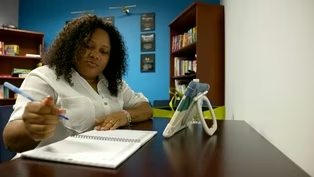
In Sampson County, most students grow up around farms and factories. Those industries are not going away, but the work inside them is changing fast. In one classroom at Union High School, students learn AI, cybersecurity and software development at their own pace, with no grades and no bells. One local employer is already interested in the outcome.
Problems playing video? | Closed Captioning Feedback
Problems playing video? | Closed Captioning Feedback
ncIMPACT is a local public television program presented by PBS NC
The NC Schools Where Students Have No Grades
Clip: 10/16/2026 | 7m 8sVideo has Closed Captions
In Sampson County, most students grow up around farms and factories. Those industries are not going away, but the work inside them is changing fast. In one classroom at Union High School, students learn AI, cybersecurity and software development at their own pace, with no grades and no bells. One local employer is already interested in the outcome.
Problems playing video? | Closed Captioning Feedback
Where to Watch ncIMPACT
ncIMPACT is available to stream on pbs.org and the PBS app.
Providing Support for PBS.org
Learn Moreabout PBS online sponsorship- From the outside, Union High School here looks like just about every other public school in North Carolina, except for one classroom inside.
Inside that classroom are no letter grades, no bell schedule, just students doing real high-tech work, earning credit, building portfolios, and chasing careers that did not used to feel possible.
More than 70% of students here qualify as economically disadvantaged.
Can a single classroom change what's possible for them?
I'm David Hurst.
This is "ncIMPACT."
[pensive music] [horn honks] [vehicle whirs] [horn honks] Inside this room, the rules are different.
- What the robot car does, it's self-driving and it has ultrasonic sensors.
- [David] Students like Sophia King choose what they want to learn.
- I really don't really care about the grade situation, but I also like that it's not based on your grade, because I feel like if it was, I feel like I'd have more pressure and make more mistakes.
- Where you can experiment, make those mistakes in here and not worry about- - Not worry about getting, like, a test grade, or you did this wrong or something.
- [David] Sophia is a freshman at Union High.
She has never taken a computer science class, but right now, she's building a self-driving car.
- I want to build inventions and help the world, like, get easier for everybody.
- The room is part of a state-funded program called SparkNC.
Students pick from fields like AI, cybersecurity, and software development, and work at their own pace.
What do you like about this program that regular school doesn't offer?
- I like how it's student-led, very student-led.
So instead of, like, the teachers telling you what to work on and stuff, you get to choose what subject.
You get to choose which unit you choose on, like, there's Makey-Makey.
There's soundtrack for a game, where you can make soundtracks, and if you're uninterested in a certain unit, you can always leave it and go straight to another one.
- Some of our projects are digital builds.
- [David] Ashley Knowles is the Spark Lab leader at Union High, and in her class, getting it wrong doesn't cost you.
- If they finish and they receive all six units and they get the credit, perfect, that's what we want, but if they don't, no harm, no foul.
We're not holding it against them.
There's no numerical value assigned to SparkNC.
You either get the credit because you've completed or you don't get the credit because you didn't complete, but when you leave, you have learned something.
- [Computer] Sad.
Sad.
- But how do you convince a school board to sign off on something like this and scrap everything they know about school?
This is a pretty innovative model.
Was there any skepticism or pushback initially?
- Yeah, I think there's always skepticism with something new.
You know, it's, why are we doing it?
You know, it's, what are the outcomes?
And sometimes you gotta just say, "You know what?
What we're doing isn't working, so we gotta try something new."
- [David] More than 70% of students at Union High come from low-income families.
On state tests, fewer than one in four pass math and fewer than half pass English.
When SparkNC came to Sampson County, Superintendent Jamie King had seen enough of what wasn't working.
- My job is looking at how do we reach those kids that we're not reaching?
How do we change outcomes for kids that we're not being successful for?
And so this was one of those, you know, "Hey, everybody says great things about it.
Let's try it.
Let's see how it works."
[machinery whirring] - [David] In Sampson County, most students grow up around farms or factories.
Those industries aren't disappearing here, but the jobs inside them are changing fast.
- Maybe our students don't necessarily want to leave Sampson County, but Spark Lab gives them that opportunity to really embrace that technology and kind of get that experience, and that's just one more avenue that we can provide for rural Sampson County.
- [David] And tech jobs aren't just coming to Sampson County.
In some ways, they're already here.
Star Communications has run fiber internet through rural Sampson County for decades.
Now, they're partnering with Union High and watching to see who comes out the other side.
- It gives them an opportunity that, if they want to stay around home, they would have a employer that would employ them within the technology field because we're constantly evolving and growing.
- [David] But SparkNC didn't start here in Sampson County.
It started with a moment North Carolina wasn't ready for.
- Apple is coming to the Triangle.
The company has promised to invest more than a billion dollars in North Carolina.
- [David] On April 26th, 2021, Apple announced it was building a campus in Research Triangle Park.
The company promised 3,000 jobs with an average salary of $187,000, jobs in some of the fastest growing fields in the world.
That same day, the founders of SparkNC were writing their proposal.
- Social media kind of went on this buzz of all those jobs will go to people from California.
They won't be from people in North Carolina.
We won't be qualified for those jobs.
So the dream was that our students would be the ones walking through those doors to get those high-wage, competitive jobs.
- But those doors are in the Research Triangle Park, not in Sampson County.
The question was whether a program like SparkNC could change that.
Is this for all students or are there some students who struggle with the autonomy and gravitate more towards that structure?
- We do believe it's for all students.
Students will make a choice around how they want to learn it.
So you'll see students pairing up in a team where other students really like to work individually.
So when you go into a Spark Lab, you may see all kinds of things going on at one time, and we just have to sit down and say, "What's your goal?"
- But can a model this different actually deliver?
State lawmakers have the same question.
They're funding SparkNC at $3 million a year, so they brought in the Friday Institute at NC State to find out.
The report came out in March of 2025.
It showed that 78% of students said SparkNC made them more interested in a tech career, and 59% had a portfolio, internship, or certification by the time they were surveyed, but the report leaves one question open.
Do these students actually get tech jobs?
Well, that data won't exist for years.
So what does success look like right now here in Sampson County?
Has it changed at all sort of benchmarks in terms of student success?
- What's grand about Spark is Spark gives that student the opportunity to, one time, in their lives, pick the educational route that they want to go, and that's what you're gonna see in the difference in what Spark provides our students is intrinsic motivation of them sitting and saying, "I want to do this, therefore because I want to do it, I'm gonna be successful."
Instead of the teacher saying, "I'm gonna hold a grade above your head."
- It's an idea that landed for students like Sophia King the moment she walked through the door.
Is it tough to go back to a regular class after being in here?
- It is.
It really is, because in here, I'm, like, more keeping to myself and, like, no rules and stuff.
- You're able to be creative in here?
- Yes, and be able to be myself.
- [David] For students like Sophia, something shifted the moment she walked in.
Whether it changes what comes next is still to be determined.
For "ncIMPACT," I'm David Hurst.
Video has Closed Captions
Three NC schools are doing things schools don’t normally do, from childcare to disaster housing. (20s)
Providing Support for PBS.org
Learn Moreabout PBS online sponsorship New Episode
- News and Public Affairs

Top journalists deliver compelling original analysis of the hour's headlines.

- News and Public Affairs

Today's top journalists discuss Washington's current political events and public affairs.

 New Episode

 New Episode


 New Episode


Support for PBS provided by:
ncIMPACT is a local public television program presented by PBS NC