At Issue with Mark Welp
The Need for Foster Families
Season 4 Episode 2 | 24m 30sVideo has Closed Captions
Central Illinois faces a critical shortage of foster families for children in need.
Thousands of Illinois children are in foster care, and Central Illinois has a significant need for more foster families. Mark Welp talks with Cathy Newbury of Let It Be Us about why the shortage matters, how foster care works, what prospective foster parents can expect, common misconceptions and the difference a stable, supportive home can make.
Problems playing video? | Closed Captioning Feedback
Problems playing video? | Closed Captioning Feedback
At Issue with Mark Welp is a local public television program presented by WTVP
At Issue with Mark Welp
The Need for Foster Families
Season 4 Episode 2 | 24m 30sVideo has Closed Captions
Thousands of Illinois children are in foster care, and Central Illinois has a significant need for more foster families. Mark Welp talks with Cathy Newbury of Let It Be Us about why the shortage matters, how foster care works, what prospective foster parents can expect, common misconceptions and the difference a stable, supportive home can make.
Problems playing video? | Closed Captioning Feedback
Where to Watch At Issue with Mark Welp
At Issue with Mark Welp is available to stream on pbs.org and the PBS app.
Providing Support for PBS.org
Learn Moreabout PBS online sponsorship(upbeat music) (upbeat music continues) - On any given day in the US, there are roughly 365,000 children in the foster care system.
That's more than the populations of Peoria and McLean counties combined.
Here in Central Illinois, there are plenty of children in need of foster care, but there aren't enough foster families for them.
Here to discuss the issue is Cathy Newbury.
She's the Director of Foster Home Recruitment for Let It Be Us.
Cathy, thanks for coming in.
- Thank you for having me.
- Tell us about Let It Be Us.
- So, Let It Be Us is a nonprofit organization that works with families who are interested in learning about foster care.
We also do placement for some agencies and we work with an Adoption Listing Service as well.
- And you're a licensed child welfare- - Agency.
- Agency too.
- Yes.
- We should say that.
So, how are you different then or how do you work with an organization like DCFS?
- So, what we do, I partner with different programs in Illinois.
Centrally, we work with Children's Home.
I help them with the recruitment efforts because a lot of the agencies, they're overworked, understaffed, they don't have the time to do the recruitment.
What my team and I do is we talk with families, answer their questions, kind of handhold.
A lot of them don't know where to start, don't know how to do the paperwork or where to even start.
So, that's something that we do.
My husband and I have been fostering for 20 years and when we started there wasn't someone like us and I didn't know what to do, I didn't know where to begin, I didn't know where to start, didn't know where to ask questions, didn't know where to get resources, and that's a lot what we do.
For example, if you were interested, I would answer your questions, help you get the paperwork started, and refer you to, in this area, Children's Home to get licensed with.
They would be your licensing agency, they would be the placement agency, but I'm still around to help you with just resources.
- So, unfortunately, like you said, when you were first starting out, you didn't know who to talk to.
- Yeah.
- Somebody may say, "Okay, I was interested, but this is too difficult, forget it."
- Yes, exactly.
- I mean, that's sad.
- And a lot of times, unfortunately, agencies, like I said, they don't have the resources to do what we do so families slip through the cracks and then they just get discouraged because they're like, "Well, I didn't hear from anybody."
So, we try to eliminate that.
- Sure.
I want to talk about that a little bit later, how families can get more involved in this, but let's talk about the need.
How bad is the need, especially here in central Illinois?
- Well, just to go off of what you said, in Illinois, there are over 15,000 youth in care.
And the Tri-County area, Peoria, Tazewell and Woodford, are among the highest.
Peoria County is among the highest of having youth in care.
We do not have enough families for these youth, and what we're trying to prevent is for the kids to be sleeping in offices or maybe put into group homes or residential facilities because there's no home for them.
- Mm-hmm.
- And it's really not difficult to take a child in and help them.
- Do you have any clue as to why Peoria County and the Tri-State area is so high compared to the rest of the state?
- I don't know.
I honestly don't.
In the years that my husband and I have fostered, it seems to be a lot of the youth are from Peoria that we get and placed in our home or Pekin, and I don't know, I don't know why.
- And when kids are placed in the system, we hear that term a lot- - Right.
- The system.
Typically, what is the situation?
Is it something like maybe they don't have parents, maybe their parents are incarcerated, can't take care of them?
What kind of things are you seeing?
- The way it goes is someone reports an incident or something to a DCFS hotline.
An investigator goes out and determines if it is a safe environment.
It could be a lot of different things.
It could be maybe there's a mental health issue, maybe there is a drug issue, maybe there's an abuse issue, it's really hard to say what, but it has to be something that's an unsafe environment for the youth to stay in.
And then the investigators would remove them and place them into state custody.
- So, that could be temporary?
- Could be temporary, yes.
We always say that when a youth comes into care, could be six months to a year.
The system is about reunification to get the youth back to their bio parents.
So, during that time, they're trying to help them, get them into classes, get them, unfortunately if they need rehab, something like that to help them get their children back.
And during that time, the youth are also getting services that they may need to help them get through this because it's traumatic for them.
- [Mark] Mm-hmm.
What happens when a child goes to a foster home?
Is there a set time limit for that or is it until there's no more need for it?
How does that work?
- There's no set time limit.
We'd like to say about a year from start to, if the bio parents do everything they're supposed to, we'd like to say about a year, but it really is if the bio parents are getting the services they need and attending them, doing everything they need to do and the courts can see that, then they'll go back as soon as the courts deem that they can.
- So, do you have any kind of statistics?
You mentioned the number of kids in foster care in Illinois, but how many of those are temporary possibly and how many are permanent?
- The last time that I researched it, it honestly was about 50/50.
About 52 returned home and about 48 did not.
- Okay.
- So, it's really hard to say because it's up to the bio parents to do what needs to be done to get the kiddos back.
- And let's talk a little bit about the demographics, the ages of the children, are we talking birth to, is it 18 or 21?
- 21.
- Okay.
- So, when you were to get licensed, you will be licensed for birth to 21.
You can set preference, like, "I really only want older children," "I only want younger."
We're seeing more youth that are middle school, like 10 and older that come into care.
Younger children tend to go to family members- - Okay.
- Usually.
And there's the new Fictive Kin program that they're really trying to get youth to stay within family.
- And the older kids, let's say the teenagers, I'm guessing some of them might have issues too that unfortunately- - Yeah.
- Some foster parents may not want to deal with.
- Yes, it can be difficult.
Even, I mean, not even just teens, but kids across the board when they come into care, they're traumatized, they've been taken away from the only thing that they know, so all of the kids get therapy no matter what age, whether it be when they're little, they get play therapy, or as they get older, they speak to counselors and therapists.
If they need medication, they get medication.
- Okay.
For someone who is interested in becoming a foster parent, kind of walk us through the process.
Once they find out initially- - Oh, sure.
- How to do that, what do they have to do?
How long does it take?
Things like that.
- Sure.
So, if you were interested, you would reach out to myself and we would set up a time to talk.
I first start with saying, you know, like, "Where are you in the process?
Have you researched anything?"
So I can kind of see.
The process goes with lots of paperwork.
There's lots of paperwork.
The initial is background checks, initial application, initial foster care application.
Once we get that back, I send it to an agency that we've discussed that fits your needs and then that agency will reach out to you.
They'll come out at least three times.
And again, like I said, there's lots of paperwork.
The first time they meet you is like a meet and greet and they're just getting to know you.
They're going to look over the house really quickly, answer any of the questions that you may have because there's always going to be questions.
About the same time, they're telling you you need to get your physical done because you'll need a TB test and a physical.
They'll tell you where to go to get your fingerprints done.
So, anyone that's 18 or older gets fingerprinted and background, 13 and older just gets a simple background.
So, they're telling you where to go to get that done.
They're also setting you up for the classes that are done online, and those can be done at a self-pace or a live webinar.
And they're roughly 27 to 30-ish hours.
They're revamping them so they're kind of changing.
Again, more paperwork with that.
Once all of that is done, your classes are done, your background is done, your paperwork, they come out and do your home study.
This is very lengthy because they're really jumping into who you are as a parent, your experiences as a parent, your background, your wife's background, who you want to use for pediatrician, who you want to have for daycare.
At the same time, they're going to look over the house to make sure it meets what's called the 402 Standards.
And that is just making sure it's basically a clean, calm, safe environment.
So, they're going to check to make sure there's no peeling paint, no holes in the walls, holes in ceilings, make sure cleaning supplies are on a higher shelf or medicines are on a higher shelf, smoke detectors work.
If you have a pool, they talk about pool safety.
If you own firearms, they talk about firearm safety.
They're going to make sure you have enough space for the youth.
They need to have their own room or they can share a room, but it must have a window, a door, storage of some kind.
If you live in a one bedroom, that just doesn't work because you can't give up your bed.
So, once all that is done, everything is back, they send it to Springfield to issue your license.
The workers come out at least three times, their licensing worker.
Roughly six to eight months, background checks take a while to come in, so.
- And is there anything like continuing education or things that the parents have to do?
- Once you're licensed, your license is good for four years.
If you are a traditional foster parent, you have to do 16 continuing ed hours throughout the four years.
And that can be done by going to seminars, reading books, and DCFS website has a tremendous amount of educational things that you can do.
If you're specialized in any way, I believe it's 16 hours a year.
I might be wrong on that, but there's so much more you have to do for specialized care.
- Okay, and by specialized care, do you mean kids who may have developmental disabilities or health issues?
- Could be that.
There's several different types of specialized.
So, there's specialized, there's therapeutic, and then there's like emergency foster care.
So, specialized could mean someone who has severe learning disabilities, they might have a medical condition that could be maybe they're hearing impaired or at the most could be like wheelchair bound, so there's lots.
They might be a large sibling group that would consider being specialized or maybe they might have been moved a lot, and that would make them specialized.
Emergency foster care is we need someone right away and it could be a short term, they might be 30 days, 90 days.
And that's a whole nother program that best way to word it is that there's a monthly stipend whether you have a child in your home at all or not at all because you're leaving your home open so that I could call you and be like, "Mark, I have this child and I'm bringing them to you right now."
Traditional and other specialized, you can be like, "I can't.
It's not something that I can handle."
And you have the option to say that.
With emergency, you have to be open to any child.
- Sure.
Let's talk about money a little bit, and that could be something that affects people's interest in this.
How does that work in terms of money that the foster parent might get to take care of that child?
- So, it is broke down by age, and I should have brought that with me, but there's a stipend that you get every month about a month after the youth is there.
So much of it is to be used for like room and board, so much is to go to clothing, so much is to go toward allowance for the youth, and then so much toward transportation.
The older the youth, it's a little bit more than the younger of the youth.
- Does that typically cover everything that the child might need or does the foster parent need to typically pitch in their own money?
- Usually that will cover what they need for clothing and allowance.
If there's a special, like there's something they want to register for at school and it's a lot more money, you can request that from your agency that you're licensed with then.
Like I said, we've been doing this for like 20 years and we've never had a financial hardship with having youth in our home.
- Okay.
Let's talk about maybe some misconceptions that are out there about foster care.
- Sure.
- What are some of those big ones that you might have to overcome if you're talking to someone about being a potential foster parent?
- The most thing is that people are worried about getting attached.
They are worried that, "Oh, I'm going to love this child and then they're going to be taken away."
First of all, if you told me that you're not going to get attached and you're not going to love the child, then you're not the right person to be in foster care because they need to be loved and they need someone to support them and become attached to them.
We've had youth that come into our home and who have returned home and we're still in touch with them.
We had a little one who went home and was adopted by her aunt.
She's now 12 and we see her every once in a while and we know how she's doing.
So, we want you to become attached.
These kids need to know that someone cares for them.
So, that is a misconception that the child's going to be yanked out of their homes.
They're not yanked.
It's usually a process because there's court involved and you're going to know if it's heading toward the youth returning home, and they'll offer you services to help you as well.
- I was going to say, and you've been a foster parent yourself in the past, and I always wondered that about the attachment part- - Yeah.
- Because I've looked into fostering pets, not kids.
- Yes, (laughs) yeah.
- And I'm thinking to myself, "Man, I'm going to love this animal so much that when they leave, I'm going to be heartbroken, I wouldn't know how to handle it."
- But it's not so much when the child leaves you, they're not leaving your life.
If you've got a good relationship with the agency and the bio parents, because at that point when they're about to return home, you're establishing a relationship also with the bio parents because sometimes in certain cases you're also mentoring and helping the bio parents in a lot of cases.
So, if it seems possible, you can have a relationship with that bio parent.
And like I said, we're in touch with a lot of the kids that leave, and even the ones who are grown now, we are still in contact with them.
- How often do foster situations turn into an adoption situation for those kids that you know for a fact are not going to go back- - Yeah.
- To their biological parents?
- Every case is different and every situation is different, and to put a number on it's very hard.
If you look it up online, about 48% of the youth end up in an adoption situation.
You are the first one they're going to contact, being the foster parent, about becoming the legal parent for this child.
And there's a whole slew of questions that they ask you to make sure that you would want to adopt this youth.
It happens, it's just hard to say how often because each situation is different.
- Now, once your agency has helped with the process, when it comes to doing follow-ups and things, is that more DCFS or is that something that you guys still do?
- So, do you mean like once you're licensed and?
- Once you're licensed and once you have a foster child.
- So, that would be the agency you're licensed with.
So, if you went through Children's Home, they would be your agency that places the youth and then they are the one that works with the youth and works with the family.
My agency is there at that point more for any resources you might need.
So, for example, if you have a child that's 5 or younger, they automatically get WIC, and then I could kind of walk you through how to go about that.
Lots of programs out there that help families with youth in care.
- So, once you get licensed, it's specific, like say I get licensed with Children's Home, but then I decide to move to Pontiac, I have to get licensed again with an organization up there?
- Yes, but it's not licensed again.
If you're still licensed, it would just be transferring.
So, you go through- - Okay.
- A little bit of the process they would still, because your license is licensing you as well as your home.
So, your license would go with you and then the agency there would come out and make sure your home was adequate.
So, yeah.
- Gotcha.
Any other misconceptions that you'd like to bust?
- I don't know if it's a misconception, but a lot of people feel like it's just too hard and it's just too hard on their heart, but it's really not.
In today's world, these kids need us to help them see that they are valued and they're worthy of being in this world.
And I think that's, unfortunately, we get a lot of families who are wanting younger children and there's a lot of teens out there that are amazing, great kids that just need great mentors.
- What happens when someone in the system turns 21, some call it aging out.
- They age out.
- What happens to that person?
- Unfortunately, they age out and they no longer have medical insurance and there's no longer any stipend to help them.
I know that's something that DCFS is trying to work on to help kids acclimate into adult world because unfortunately a lot of them don't know how to even get an apartment or how to do a checkbook.
So, us as foster parents really need to be helping youth with that and advocating for that.
- Sure.
DCFS is always under a lot of scrutiny and it seems like whenever you hear about them in the news, it's negative and really negative.
- Unfortunately yes.
- Do you think that impacts some people who are looking to foster, just hearing those negative stories?
- I think so.
I think so.
In DCFS, Heidi Mueller is the new Director and she's doing amazing things.
The thing to remember is DCFS is the umbrella, so they cover all of Illinois and all of the other agencies in Illinois.
So, they set the rules, the regulations and the standards for all the other agencies.
And Heidi Mueller is really trying to improve things within DCFS and for the youth in Illinois.
So, unfortunately the news does tell us the bad stuff, but she's doing a lot of good things as well.
- What in your opinion makes a good foster parent?
Because you can obviously- - Yeah.
- Be well off, have a nice house and- - That means nothing, no.
It means someone who is empathetic, who's understanding, willing to open your home and listen to a child, listen to the bio parents as much as you can, be willing to help them and not be judgemental.
Sometimes the kids come in and they're angry at you because they think you took them and you have to realize that they have the right to be angry.
A lot of them, even teenagers are like, "I don't understand why I was taken away."
This is what they grew up with, they don't really know that it's any different, so you have to be understanding, openhearted.
- Yeah.
When you first started fostering, you mentioned it was a little difficult to find out information, but once you did, what did you personally get out of the experiences of fostering?
- To me, I've always wanted to help kids be better in life, to see their value, see their worth, to know that they matter to somebody.
And for me, that if I could help one child, then I've accomplished something.
And that's just what I want to continue to do.
My husband and I, like I said, we've been fostering for 20 years, we're still fostering.
I just want to help others see the value in this.
It's not about money and it's not about saying, "Oh, look at me.
I'm a foster parent."
No, it's about a youth who could be a productive person in this world with the right parent or the right mentor or to help break the cycle of their life.
- How many kids have you fostered over those 20 years?
- I knew you were going to ask me that.
And my husband and I, we tried to figure it out and I don't know.
- Ballpark.
- Probably maybe 20 to 30.
We've taken in a lot of sibling groups that they've needed emergency care to keep them together.
And when we do that, honestly, I can't do four or five kids at a long period of time, I still have one at home, but.
So, quite a few.
(laughs) - Sure.
- Quite a few.
- You said you had one at home.
- Yeah.
- Is it a biological child?
- No, my daughter isn't- - Okay, just foster.
- Yeah.
- Okay.
- We actually adopted her through foster care.
- Sure, if you have multiple foster kids, is it, I guess, is it easier if they're biological siblings or is there a difference if you have two kids who don't know each other all of a sudden they're living in the same home?
- Yeah.
Actually, no, because sometimes bio siblings, the older youth of the group take the role on as the bio parent, like as the parent.
And sometimes you have to help them realize that they're not the parent and that it's okay to let somebody else take care of that child, and so sometimes that causes issues.
And then, even if you have two different youth in your home that are not biologically related, they get along well and sometimes they don't.
It's just like with your own children.
- Yeah.
Do you keep in touch with any of the kids that you fostered?
- Yeah, all the time.
Yeah.
- [Mark] Well, that's got to feel good.
- It's wonderful to see how well they're doing.
One youth that we are in touch with is going to be graduating this year.
I keep encouraging her, "You can do this."
She's struggled through school and I'm so proud of her.
I can't wait to go to her graduation in May, so.
- Real quick, is there anybody who is automatically disqualified from being a foster parent?
- If you have certain felonies that we can discuss, so don't be disheartened by that, we can talk about those.
If you do not have the space in the home, that would definitely disqualify you, or if you do not have an income.
- Sure.
- So, those are some things, but don't hesitate to reach out to me though, because we can always discuss them and talk through them.
Something that happened maybe 20 years ago, you were 18 and something, we all do dumb things when we're kids, it may not disqualify you, so.
- Okay, how can people find out more about Let It Be Us?
- They can go to our website, which is letitbeus.org, or they can reach out to me, cathynewbury@letitbeus.org.
- In a few sentences, explain why fostering would be good for a parent, a person.
- It's helping the community.
It's helping the world.
It's opening your home and showing that there is still good out there.
- All right.
Cathy Newbury is the Director of Foster Home Recruitment for Let It Be Us.
We appreciate your time, and thanks for all you do- - Thank you.
- For the kids.
- Thank you.
Thank you for having me.
- No problem.
And you can watch this segment again, maybe share it with somebody who's considering being a foster parent.
Just go to wtvp.org, click on Local Shows and then click on At Issue.
We thank you for joining us.
Have a good night.
(upbeat music) (upbeat music continues) (upbeat music continues)
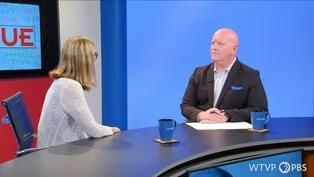
Should Foster Parents Be Afraid of Getting Attached?
Video has Closed Captions
Clip: S4 Ep2 | 1m 3s | Getting attached to a foster child isn't the problem. Cathy Newbury explains why. (1m 3s)
What Makes Someone a Good Foster Parent?
Video has Closed Captions
Clip: S4 Ep2 | 44s | Money and a big house don't make a good foster parent. Cathy Newbury explains what does. (44s)
Why Central Illinois Needs More Foster Families
Video has Closed Captions
Clip: S4 Ep2 | 42s | A shortage of foster families is leaving Central Illinois children without homes. (42s)
Providing Support for PBS.org
Learn Moreabout PBS online sponsorship New Episode
- News and Public Affairs

Top journalists deliver compelling original analysis of the hour's headlines.
 New Episode
- News and Public Affairs

FRONTLINE is investigative journalism that questions, explains and changes our world.
 New Episode
 New Episode
 New Episode
 New Episode
 New Episode
 New Episode
 New Episode
 New Episode
Support for PBS provided by:
At Issue with Mark Welp is a local public television program presented by WTVP