Unspun
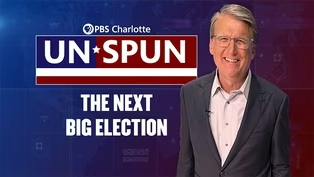
The Next Big Election | Unspun
Season 1 Episode 139 | 26m 25sVideo has Closed Captions
The Senate race that everyone’s already watching: a high stakes fight that’s here in NC.
The Senate race that everyone’s watching: a high stakes fight that’s here in NC. Seen as their best chance to recapture Congress, can Democrats convince their dream candidate to run? Are Republicans having second thoughts about the Senator they already have? We’ll talk with Jessica Taylor from the Cook Political Report about the State election that could decide who controls the Senate nationwide.
Problems playing video? | Closed Captioning Feedback
Problems playing video? | Closed Captioning Feedback
Unspun is a local public television program presented by PBS Charlotte
Unspun
The Next Big Election | Unspun
Season 1 Episode 139 | 26m 25sVideo has Closed Captions
The Senate race that everyone’s watching: a high stakes fight that’s here in NC. Seen as their best chance to recapture Congress, can Democrats convince their dream candidate to run? Are Republicans having second thoughts about the Senator they already have? We’ll talk with Jessica Taylor from the Cook Political Report about the State election that could decide who controls the Senate nationwide.
Problems playing video? | Closed Captioning Feedback
How to Watch Unspun
Unspun is available to stream on pbs.org and the free PBS App, available on iPhone, Apple TV, Android TV, Android smartphones, Amazon Fire TV, Amazon Fire Tablet, Roku, Samsung Smart TV, and Vizio.
Providing Support for PBS.org
Learn Moreabout PBS online sponsorship(bright music) - [Announcer] This is a production of PBS Charlotte.
(bright music ends) - This week on "Unspun," the next big election.
It's the US Senate race that everyone's already watching, the high-stakes fight right here in North Carolina.
Democrats see it as their best chance to recapture the Senate, but can they convince their dream candidate to run, and are Republicans having second thoughts about the senator they already have?
We'll talk with Jessica Taylor from the Cook Political Report about the state election that could decide who controls the Senate nationwide.
Plus, I'll count down the top five special interest groups giving millions to politicians that politicians do not like to talk about.
(upbeat music) In today's America, welcome to the spin game.
Believe me, I know.
I'm Pat McCrory.
When I was governor and mayor, I played the spin game.
I was played by the spin game, but aren't we all done being spun?
Let's take the spin out of the world we're in here on "Unspun."
(dramatic music) Good evening, I'm Pat McCrory, and welcome to "Unspun," the show that tells you what politicians are thinking but not saying.
With Donald Trump back in the White House and two-term senator, Thom Tillis, running for reelection, you would think North Carolina Republicans would be sitting pretty in next year's US Senate race, but here's the reality.
Trump and some Republicans may not be sure that Tillis is the senator they really want.
They worry that Tillis isn't MAGA enough.
Meanwhile, Democrats are hoping that their dream candidate, former governor, Roy Cooper, can flip the seat and win back the Senate in 2026, but Cooper's not even in the race yet, and Tillis is already taking aim at him over the state's slow response to all the hurricanes under his watch.
- Governor Cooper has now transitioned from office, but his administration was abysmal in remitting funds and getting it out the door.
I have complained about this for about as long as he was in office, for nearly three different major storms that have come into North Carolina, and we're about to hit the same speed bump in Western North Carolina.
We can't afford to.
- [Reporter] Union members lined the streets outside the Carolina Country Club while Senator Tillis was hosting a 2026 campaign kickoff luncheon.
The Tillis campaign responded in part by saying, "It's no surprise that extreme left-wing groups or organizing protests outside of the senator's events."
- Following the protest, Tillis' office also released tapes of threatening phone messages left after his votes in favor of President Trump's cabinet choices, but on the flip side, Tillis is also getting criticism from his own party for breaking with Trump on key issues and making too many deals with Democrats.
In fact, The New York Times wrote recently, "That North Carolina showdown in the Senate will be closely watched and bitterly fought."
And a story in the Cook Political Report says, "Tillis is between a rock and a hard place," with both Democrats and fellow Republicans working against him.
Jessica Taylor covers the US Senate for the Cook Report, and she authored the story about Tillis running for reelection.
Taylor's a former political reporter for NPR and a political analyst who's frequently quoted in The New York Times, The Wall Street Journal, and The Washington Post.
Jessica, thanks for joining us here this week on "Unspun."
- Thanks for having me, Governor.
- First of all, what are the Republican insiders in DC saying about this most important Senate race in North Carolina?
- I mean, when I look at the overall Senate map, it's one that's very favorable to Republicans because, really, the only seats as of now that they're going to have to defend are Susan Collins in Maine, who sits in the only seat carried by a Republican up this cycle that Trump won, or excuse me, that Biden won, and then Thom Tillis, who, you know, North Carolina's forever very perpetually close state.
Trump only won it by a couple of points, and Tillis, of course, has had very close reelection races.
So I think even out of those two, Tillis is sort of seen as the most vulnerable even, that kind of goes against the conventional wisdom when we look at the two states and their, you know, national political makeup at the presidential level, but what everyone is waiting on, of course, is former governor, Roy Cooper, and what he's going to decide to do.
I mean, Democrats have to get recruits in these races.
We rate both North Carolina right now as lean Republican and Maine as lean Republican, and certainly, if Cooper were to get into the race, that would be a tossup race, and, you know, because, again, Democrats don't have a lot of places to play, they need four seats overall to win back the majority.
I think the House is certainly in play in 2026, and we know sort of the history of how midterms go against a president, one who's seeing some of his approval ratings drop, particularly on the economy, and, you know, Tillis is someone who marches to the beat of his own drummer a little bit, more so than anyone.
He's sort of, I put it he's sort of caught between a rock and a hard place because he can't sort of anger that right flank, or, you know, he's been threatened with primary challenges before, and he's sort of backed off particularly on the vote to confirm Pete Hegseth, the Secretary of Defense.
He was certainly wavering up until, you know, the 11th hour, and he's also spoken out against some of the tariffs and things, so, he has some separation from the party, but he can't take too much distance from Trump, even though that's something that could benefit him in a general election.
- So Jessica, the big question might be, is there talk in DC of the Trump White House going against Tillis in a primary and backing another candidate because, believe me, I know Trump's endorsement makes a big difference in a Senate primary.
- Yeah, I mean, I think that he is better off than some of the other senators that have drawn key primary challengers in Louisiana.
Bill Cassidy, of course, voted to convict Trump in his second impeachment trial, and in fact, the laws were recently changed there.
That makes it easier to knock him off.
If it had stayed an all-party primary state, then he would've had a better chance, and, of course, we have a big primary in Texas against John Cornyn, the attorney general there, Ken Paxton.
You know, you have to have someone to run against Tillis, though.
You know, I think there's a couple of congressmen that have been named.
Pat Harrigan has been named, but I'm not sure that he's going to do it.
You know, Michele Morrow, who ran in the superintendent's race and lost, has mentioned it, but, you know, again, to come out and beat someone like Tillis that has strong fundraising, and North Carolina's primary is also different than these other states because to win, it is a runoff state, but it's only a 30% runoff state, so you don't have to get a majority, you can still just get a plurality, and I think Tillis is well within doing that.
- Plus independent voters can vote in the primaries.
So that's another interesting twist in North Carolina, which could give Tillis more of an advantage 'cause he'd appealed to the more centrist voters.
Well, let's talk about the Democrats.
The Democrats have a history of giving up on the Senate race.
Even when they have perceived good candidates, they withdraw their money at the last minute and move it to someplace else.
Do you anticipate, regardless who the Democrat nominee is, are the Democrats, is Schumer, Chuck Schumer, gonna really give money to it or give up on it?
- I think that if it's Cooper, they're not gonna give up on it.
This could end up being the most expensive Senate race in North Carolina history if it is Roy Cooper because he would be a top recruit.
He's someone that has, of course, won statewide twice, even as Trump carried the state, but running for governor and running for senator are two different things.
I mean, this is why, when I look at the governors, you have a Republican governor in Vermont, you have a Democratic governor in Kentucky and Kansas.
The voters will split their tickets in that way because when you're voting for governor, you're not voting for which party you want to control Washington.
There's no prize for having the most Democratic or the most Republican governors.
This could have an impact on the Senate control or at least narrow Republicans' majority.
They set it at 53/47 right now.
If they narrow it, then even if they don't win the majority, that can give them a better chance in 2028, but, you know, again, I think Cooper would not run if he were not assured that this would be a top-tier state, and I think, again, just sort of given Democrats' small field of opportunities, North Carolina stands out as the most possible.
Now, if there is a weaker nominee, if Cooper passes, and a candidate is not able to raise money, you know, I've heard, if he doesn't run, of course, we know the former congressman, Wiley Nickel, is in there, but he's sort of not the guy that people want in DC.
I think there would be an effort to get Attorney General Jeff Jackson to run, Lieutenant Governor Rachel Hunt, but, of course, they were just elected to sort of give up.
They wouldn't have to give up their seat, of course, but, you know, those were two big statewide races that Democrats won, sort of helped by now Governor Stein.
So, I mean, I've also heard, you know, the former EPA secretary, Michael Regan, who, of course, led the environmental services there in North Carolina, but none of those rise to the level, I think, that Roy Cooper would bring to the race.
- Now Roy Cooper's already being attacked, which he really wasn't attacked as governor on two big issues.
Already, his response to three different hurricanes that occurred under his watch, the most recent, Helene, and then also, even the transgender issue, which had a big impact on him being elected the first time, has kind of flipped in public opinion, where corporate America is now staying away from that.
Tillis and some super PACs are bringing up those issues.
What do you think about that?
- Yeah, I know that the, yeah, the Republicans have already put in over a hundred FOIA requests for the Cooper administration on different things, and I think you hit exactly on the top two issues that Republicans are talking about.
They're going to hit him on hurricane response.
It's not just Helene, but a few others, and then you're right, the transgender issue has certainly changed since 2016, and that's something that we saw.
I think Democrats did not think it was going to be as effective as it was in 2024, but I think, again, one of Trump's most effective ads was he's for you, and she's for they/them, when attacking Harris, and I saw that pop up in Texas races, in Ohio races, across the country in Michigan, you know, other swing states that are akin to North Carolina.
- Okay, tell, in the remaining minute and a half here, tell the people of North Carolina, where will the Washington money be coming from for the Democrat and the Republican?
Give us the inside scoop.
Who are the big Democratic money people out of DC giving to, and who are the big Republican donors that Tillis is after?
- I mean, Tillis, you know, he's a senior Republican there in the state.
I think that he's gonna get a lot of ones from financial services, from PACS and things that are gonna donate either to him or to Republican PACs, and I think you're gonna see Cooper getting labor support.
I think he is someone that could raise, we, of course, see Democrats doing a better job at raising small-dollar donors.
You know, he's not as, I think, you know, he's not someone like AOC, or even Gretchen Whitmer, that might be able to sort of rally a crowd and sort of become a national figure, so that could be a little bit difficult for him.
He's kind of more of a vanilla kind of guy, so will he excite online donors is something I'm looking to see, but I think you're gonna see a lot of financiers both from the left and the right in these places.
You know, Koch brothers coming in in North, I'm sure 'cause, you know, Americans for Prosperity is very, very active there, of course, in North Carolina, and I think you'll see, you know, Soros money certainly coming in for either Cooper or National Democratic PACs.
So I think this isn't, of course, candidate money always goes further because you get the lower ad rate, but I think we're gonna see a lot of super PACs, maybe candidate-specific or just large super PACs coming in too.
- Jessica, in the final 10 seconds, where will the crypto money coming in, to all of a sudden, that's the second largest donations in Washington are coming from the crypto industry.
Is that gonna go to Tillis, or is that gonna go to the Democrat nominee?
What do you think?
- It could, they are playing more in races.
So I think that they would certainly look at Tillis' votes.
He's not seen, I think as someone that's as much of a champion on crypto, but he could certainly, you know, someone like Cynthia Lummis or now new senator, Bernie Moreno, has had more ties to that, but this is a state, if they want to make a difference and keep a Republican Senate to help a Trump administration that's been more friendly to them on regulations, they could absolutely spend in this race.
- Jessica, it's been an honor to have you on "Unspun."
Thank you very much for taking the time.
- Thank you.
- Next up, PBS Charlotte's Jeff Sonier takes "Unspun" on the street, talking to North Carolina voters in the middle of the next big political battle.
- Yeah, it's a simple question this week, or maybe not so simple.
Do you prefer the politician who stands by their beliefs no matter what, or the politician that's willing to make a compromise or a deal with the other party, even if it means, you know, giving up something?
(intriguing music) - It depends.
- [Jeff] On what?
- Well, I mean, if they're gonna compromise in a favorable way, which is not the way it's going right now, or if they're willing to compromise to if it's gonna make it better, one party takes over one side, and then they don't wanna give to the other side.
- So you don't need to compromise your values, but at the same time, you know, if you want to see this country move forward, you need to start look for where the commonalities are between them, so we can actually hop, bridge that gap.
- And I feel like that's kind of backwards 'cause you are working for the people, you know what I'm saying?
Like you're here for the people.
Even though like you're in office, you make the final decision, you're still here for your country, your people.
- Doesn't mean that you have to agree to everything that they're saying, but we need to have a mutual respect to sit down and talk.
- Everybody's subjected to their own opinion, but it is nice to broaden your opinion, to see what everybody else opinion is, and then come together as one.
- [Jeff] What's your preference?
Which of those types of politicians do you prefer and why?
- I mean, I like people that have something that they stand behind, that they hold firm to, but I think compromise is necessary eventually to get to the end goal.
I just think there's a very clear divide.
There's people, opposite ends of the spectrum from a political standpoint these days, and I think, there needs to be more compromise, there needs to be more understanding and talking between parties to share different ideas.
(upbeat music) - Yeah, what we're hearing in our answers this week is that compromise is the way that the world works, even if it's not necessarily the way that Washington works.
Pat?
- Thanks, Jeff.
So what do you think about the issue?
Let us know by tagging PBS Charlotte when you post on social media about this week's show.
Let us know what you like and don't like about tonight's program.
(exciting music) All right, tonight on our "Unspun" countdown, the top five special interest groups giving millions to politicians, that politicians do not like to talk about whatsoever, especially to the voters of North Carolina.
Let's start out with number five.
Number five, university political action groups.
Some of the biggest money being donated, especially to state politicians, are from universities, but now that Trump's cutting back on research money, more and more money is gonna be coming to politicians from universities, trying to put pressure on Trump to reverse those decisions.
Number four, for-profit and non-profit hospitals.
Hospitals are big money, and they have huge political donations to both state and federal politicians because both the state and federal government are creating policy that either benefit or hurt hospitals.
Number three, ah, the marijuana industry, the pot industry.
They have some of the biggest lobbyists in DC and also in our state capitals, but politicians don't like to talk about taking what we call pot money or pot donations in politics.
Number two, the gambling industry is huge.
You see commercials about gambling every day by some of the biggest stars in sports.
The gambling industry is trying to expand even more, and they're giving money to politicians to do just that, but the public is very divided on gambling.
So politicians don't like to talk about where they're getting all this gambling money from.
And number one, the crypto industry.
Politicians don't like to talk about this either, 'cause, frankly, they can't explain crypto whatsoever.
(exciting music) PBS Charlotte's Jeff Sonier joins me now for "Unspun," a one-on-one.
- Talking about running for the Senate, good memories or bad memories for you?
- I've tried to forget about it, forget about it.
- There's a mental block, right?
- As they say in "The Sopranos."
(chuckles) - Well, I wanna start this week by, to talk about or ask about something.
We heard in your interview with Jessica Taylor from the Cook Report, a hundred FOIA reports already requested by the Republicans.
FOIA reports are public records and documents about the Cooper administration.
Boy, Cooper's not in the race, but the Republicans are apparently planning to run against him or think they're gonna be running against him.
- This is amazing, and it's not unusual because when you run for US Senate, the super PAC money will pay for things that the reporters wouldn't go after while someone served in office.
It happened to me, but Roy Cooper's unique because during his 16 years as attorney general and eight years as governor, he has said he never used email.
Well, that's what you usually get is email.
Well, then how did he respond or correspond with internal administration and external people?
Did he use another type of message communication link?
Believe me, the super PAC, Republican super PACs, will try to find out anything on the record from 60 years as Roy Cooper as attorney general and eight years as governor, something that we've never seen in public at this point in time.
- They're looking for things that the press hasn't dug up, but their intent is to hand it to the press in the middle of this campaign.
- Exactly right, and then the press will take credit for the reporting.
That's how politics works now with the media.
They're handed information, and then the media will go, "We've reviewed all these documents, and this is what Cooper said or didn't say and who they said it to," which could have a big impact politically, especially on the two issues that could hurt him the most in this campaign, and that is hurricane response, and also, surprisingly, the transgender issue, which some say was the result of my defeat and his victory, but now, that has reversed in public opinion.
- I know that Jessica Taylor said that the Democrats are still gonna be focused on North Carolina no matter what, but if Cooper's not in the race, that interest has to fall off.
- I'm not sure.
You got Jeff Jackson, you got Rachel Hunt.
- [Jeff] Yep.
- The daughter of Jim Hunt.
- [Jeff] Yeah.
- Where a lot of money will come, trial lawyer money will come big.
Jim Hunt was very good at raising money, and I wouldn't be surprised if he can still dial the phone for dollars, so, the trial lawyer money also is very, very powerful in North Carolina, so, it'll probably be the most expensive US Senate campaign, not only in North Carolina history, but it could be the most expensive Senate campaign in US history.
- Yeah, Tillis' last campaign was the most expensive Senate campaign in US history at the time.
Let's talk about Tillis.
He was elected to the Senate two years before Trump got to the White House.
If he's elected this time, he'll be in office four years after Trump leaves the White House.
When you're in office for that long, does it get tougher and tougher to navigate the changes, politically, even in your own party?
- Well, I think Elizabeth Dole found that after one term, but Tom has come back to North Carolina an awful lot.
That was something my friend Elizabeth Dole was accused of, not coming back home to the state.
Tom can't be accused of that.
So the interesting thing is what will happen with Senate leadership during the next four to six to 12 years, as Tom will move up through the ranks.
He had a history of, he was speaker of the House in North Carolina after only serving four years in the House of Representatives, so he knows how the inside works regarding gaining power and strength and prestige.
That's one of his great strengths is working the system from within, but his biggest issue is gonna be the Trump White House, and believe me, I know that endorsement makes a great deal of difference.
- Well, that kinda leads me to my next question.
How likely is it do you think that the Trump White House would actively recruit someone to run against Tillis in the primary?
- It would be a high-risk move for them because the Trump White House needs this Senate seat more than anything else, and Collins is the other seat in Maine.
So they vote with Trump more with him than against him, but will they have 100% purity test?
But the Trump endorsement makes a difference in a primary.
They call it the McCrory impact.
I mean, Ted Budd was in third place, 30 points behind, until the Trump endorsement, and that pulled him ahead of me and Mark Walker, who was in second place.
So, that will probably still hold true within the next two years.
- As we ramp up, is there anything different in this next campaign in 2026 from when you ran in 2022, something that's changed on the landscape that'll make this race perhaps more difficult or maybe easier for- - When I ran in the Senate, there were a lot of other Senate races going on.
This will be the Senate race that the Democrats will spend tens of million dollars on, and the Republicans will too.
That was not the case in Budd's general election.
When Budd ran for general election, the Democrats withdrew from North Carolina.
Even though it was only a two to three point race, they put all their money in Arizona, and they won that race.
- When there's nowhere else to bet, you bet on the race you've got in front of you, I suppose, yeah.
- Absolutely, absolutely.
- And everything's magnified then too, right?
Not just the money, but also the flaws of a candidate on either side.
- We'll see a lot of negative ads against both the Republican and Democratic candidate, and maybe in the primaries too, and that could raise the negatives, and so the question is, how negative can someone be in order to get reelected?
- We'll be watching over the next two years.
Thanks, Governor.
- Thank you very much.
(upbeat music) In the last election, there was a long list of issues that candidates were talking about and that voters cared about, inflation, immigration, crime, tariffs and taxes, foreign policy, abortion, our healthcare, our schools, our democracy, but here's an issue that wasn't on anybody's list of voter priorities, cryptocurrency.
So why did almost half of all corporate donations in the last election come from crypto corporations and their political action groups?
You know, The New York Times says crypto backers spent over $130 million in 2024 on candidates in both parties, and they won 53 out of 58 congressional races.
The crypto industry also gave $18 million to help pay for President Trump's inauguration.
Now that's the kind of big money that potentially buys big political influence in Washington.
Now we're starting to see signs of that influence with crypto-friendly bills in Congress, politicians flip-flopping on their opposition to crypto and a presidential order promoting and protecting the crypto industry, plus crypto campaign money is now moving to the state capitals too, including Raleigh.
You know, most of us don't know much about crypto.
We've seen news stories in the past about crypto fraud trials and Super Bowl commercials with celebrities endorsing crypto, but here's what we're now learning about crypto after the last election, that even when it's not in the headlines or the media, even if it's an issue that doesn't matter to you, crypto still matters more to the politicians you voted for, especially, especially when it was crypto's big donations that helped them win their votes.
I've said it before, and I'll say it again, in politics, when the question is why, just follow the money.
Well, that's the reality is I see it.
I hope you'll come back next week, as we tell you what politicians are thinking but not saying, right here on "Unspun."
Goodnight, folks.
(upbeat music) (bright music) - [Announcer] A production of PBS Charlotte.
(bright music ends)
The Next Big Election Preview | Unspun
Preview: S1 Ep139 | 30s | The Senate race that everyone’s already watching: a high stakes fight that’s here in NC. (30s)
Providing Support for PBS.org
Learn Moreabout PBS online sponsorship
- News and Public Affairs

Top journalists deliver compelling original analysis of the hour's headlines.

- News and Public Affairs

FRONTLINE is investigative journalism that questions, explains and changes our world.












Support for PBS provided by:
Unspun is a local public television program presented by PBS Charlotte