On Stage at Curtis
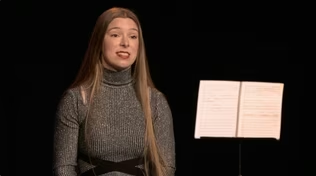
The Originator: Composer - Leigha Amick
Season 18 Episode 6 | 28m 8sVideo has Closed Captions
Find out how Leigha Amick took her unique works from page to stage.
On this episode of On Stage at Curtis, as a composer, measures and beats are constantly top of mind, especially for someone like Leigha Amick. She’s finally realized a lifelong dream of hearing her original compositions play out in concert halls. Find out how Amick took her unique works—including “Cascade,” “Gossamer Depth,” and “Rhiannon’s Condemnation”—from page to stage.
Problems playing video? | Closed Captioning Feedback
Problems playing video? | Closed Captioning Feedback
On Stage at Curtis is a local public television program presented by WHYY
On Stage at Curtis
The Originator: Composer - Leigha Amick
Season 18 Episode 6 | 28m 8sVideo has Closed Captions
On this episode of On Stage at Curtis, as a composer, measures and beats are constantly top of mind, especially for someone like Leigha Amick. She’s finally realized a lifelong dream of hearing her original compositions play out in concert halls. Find out how Amick took her unique works—including “Cascade,” “Gossamer Depth,” and “Rhiannon’s Condemnation”—from page to stage.
Problems playing video? | Closed Captioning Feedback
How to Watch On Stage at Curtis
On Stage at Curtis is available to stream on pbs.org and the free PBS App, available on iPhone, Apple TV, Android TV, Android smartphones, Amazon Fire TV, Amazon Fire Tablet, Roku, Samsung Smart TV, and Vizio.
Providing Support for PBS.org
Learn Moreabout PBS online sponsorship- [Narrator] In partnership with the Curtis Institute of Music, WHYY presents the following program.
(bright violin music) - My name is Leigha.
I'm a composer.
I play some piano and some violin.
(suspenseful music) It's very strange to spend so much time imagining something in my head, And you know, yeah, I'll play it on the piano or play parts of it on violin, but it's not the same as like working with live musicians and hearing them bring it to life.
So the time period when I'm in my head is very solitary and very hypothetical, and that's the least favorite part because it's still hypothetical and it's still in my imagination and hasn't actually been realized yet.
And then once I actually hear people work on it and bring their own musicality to the piece, then it's alive.
And that's so rewarding and that's the fun part.
I just assumed that that was an interesting thing to do in your free time and a normal thing to do with all of your free time when I was little.
So that's what I did.
I didn't even think about the fact that that was something to be before I started doing it.
When I was really young, my parents wouldn't play very much music around the house, but I would sing things and constantly make up melodies and sing them to my mom.
And then as soon as we got a piano when I was seven, I continued making things up and would sit down and play piano and just make up music on the piano.
And after that I started lessons.
So composing, just making music was always something I did.
Both of my parents played some classical music when they were kids and enjoyed classical music.
So I was always around it.
Like if there was music playing in the house, it was often classical.
And I grew up going to orchestra concerts in Boulder, Colorado, and there's a music festival called the Colorado Music Festival there that I would hear.
So I was always around that and it just felt like the natural thing to do was to create that.
I think they expected it from a young age because that's what I was doing a lot of.
But I also was really engaged in math and did like math competitions and calculus bowl and the works, and I still hadn't made a final decision as to whether I was going to do math or music until it came time to pick where I was going to college.
And they were very gracious and supportive of letting me pick where I went.
There are so many different elements that go into composing besides just the composing itself.
Usually I'll spend my mornings writing, this is most often at the piano.
I'll start pieces, you know, playing things to myself, singing things to myself, writing down sketches on manuscript paper.
And then as the piece goes along, I'll start to like solidify sections and move to typing it up on the computer as it's in its final stages.
But that's what mornings look like.
The rest of the day time spent with other composer scores and checking out what they did and pieces that I love that really helps me give me perspective on what I might want to do study and counterpoint.
So the relationship of how different lines of music go together is one of my favorite things.
And it can be like abstracted to so many different parts of the music and then playing music, whether that's violin or piano, just to be involved in the physicality of what it's like to make music also matters to me.
(bright violin music) So my piece from the first year of my masters is called Cascade.
(orchestral music) Cascade.
Hmm.
(laughs) Cascade was loosely inspired by a piece for organ and electronics called Mae Yao by Carl Stone.
(audience applauding) In that piece, it begins with these really like disparate kind of off kilter rhythms and sounds and gradually morphs into the most like transcendent thing you ever heard.
(suspenseful orchestral music) And because of the electronics and organ, he can do that really, really gradually over the course of the whole piece so then I thought, well, could you do that with an orchestra?
And it doesn't work exactly the same way, so it's not like, you know, a copy of the piece per se.
But I took that feeling and started with a bunch of really intense percussion and then gradually line by line, the piece morphs one light at a time into a thick tutti full orchestra like cellos and horns melody section at the end.
(bright orchestral music) (orchestral music continues) (orchestral music continues) (orchestral music continues) (orchestral music continues) (orchestral music continues) (orchestral music continues) (orchestral music continues) (orchestral music continues) (orchestral music continues) (orchestral music continues) I wanted to do a music camp up in the mountains in Colorado and I was going to go to camp for piano, but I saw that there was a scholarship for composition and I thought, well, okay, I could write a piece and send it in to them for that.
And I took one of my piano sketches and orchestrated it for string orchestra since that's the ensemble that I knew the best and sent it into camp.
And I got to go to music camp as a composer for that.
And I think that's what gave me the, like the awareness that this was actually something I could do and that being a composer was something that you could do as a job title, not just your hobby that you did in your free time anyway.
And that piece got a pretty good response.
Then I revised that same piece my freshman year of high school and submitted it to a composition competition where the Orlando Philharmonic played the winning pieces.
And it was so fun to hear what I had sketched, like come to life with that ensemble that I wanted to keep doing it and I did.
(bright music) Most of my friends in middle school and high school already knew me as someone who was constantly writing music.
My school orchestra directors let me write pieces for my middle school orchestra and for my high school orchestra.
So they all knew me as the composer anyway.
I've always really admired Bjork because she pulls from so many different sound worlds and creates these just wild, unique tracks.
And that creativity and color within her music is something that inspires me even in a classical realm.
(audience applauding) Every year the Curtis composers put on an orchestra concert where each of us puts on an orchestra piece, and that's always my favorite recital of the year because so many people are coming together to create a huge sound and collaboration.
And seeing my friends put work into taking the ideas on the page and bringing them to life is really exciting.
Gossamer Depth was inspired by the Hubble space telescopes image of the Orion Nebula, and there are a bunch of different elements in the piece.
There are these huge chords that span the range of the orchestra from the, you know, piccolo all the way down to the contra bassoon.
And these are representing the whole, you know, vastness of the nebula.
Then there are a bunch of like fast swirling lines, especially in the strings, but also in the winds.
And this is like all of the swirls of space dust and gases that are in the nebula.
(orchestral music) And then there are these accented notes, especially in the winds, brass and percussion that come out as the stars in the piece.
(orchestral music) (orchestral music continues) (orchestral music continues) (orchestral music continues) (orchestral music continues) (orchestral music continues) (orchestral music continues) (orchestral music continues) (orchestral music continues) (orchestral music continues) Curtis has been an incredible place to get to collaborate with really talented musicians and to get to write for orchestra because it's a very rare and special thing for young composers to get this many chances to write for orchestra.
And that's my dream.
You know, I just, I love that ensemble and the variety of sound it can create and how many extremely talented people are putting efforts into creating this total.
So Curtis is an excellent springboard to get that chance of working with the orchestra and working with such incredible peers.
When I think about my younger self, I think she had a lot of really strong opinions and like clear vision.
And as we keep going in music, sometimes it can be easy to just in the general day to day, forget why we started doing this in the first place.
So I think my younger self would tell me to listen for what music I want to hear and make that, and because that was the entire reason that I did any of this in the first place, was that there was music I wanted to hear.
So I made it.
(orchestral music)
The Originator: Composer - Leigha Amick
Preview: S18 Ep6 | 29s | Find out how Leigha Amick took her unique works from page to stage. (29s)
Providing Support for PBS.org
Learn Moreabout PBS online sponsorship
- Arts and Music
The Best of the Joy of Painting with Bob Ross
A pop icon, Bob Ross offers soothing words of wisdom as he paints captivating landscapes.













Support for PBS provided by:
On Stage at Curtis is a local public television program presented by WHYY