
The Politics of Education
1/18/2024 | 26m 46sVideo has Closed Captions
North Carolinians discuss banned books, LGBTQ studies, history education and whitewashing.
Eight North Carolinians come together to discuss banned books, LGTBQ studies in elementary schools, how to teach controversial events in American history and the concept of whitewashing.
Problems playing video? | Closed Captioning Feedback
Problems playing video? | Closed Captioning Feedback
The NC Listening Project is a local public television program presented by PBS NC
Funding for The NC Listening Project is provided in part by High Point University, Sidney and Rachel Strauss, and Julia Courtney and Scott Oxford.
The Politics of Education
1/18/2024 | 26m 46sVideo has Closed Captions
Eight North Carolinians come together to discuss banned books, LGTBQ studies in elementary schools, how to teach controversial events in American history and the concept of whitewashing.
Problems playing video? | Closed Captioning Feedback
How to Watch The NC Listening Project
The NC Listening Project is available to stream on pbs.org and the free PBS App, available on iPhone, Apple TV, Android TV, Android smartphones, Amazon Fire TV, Amazon Fire Tablet, Roku, Samsung Smart TV, and Vizio.
Providing Support for PBS.org
Learn Moreabout PBS online sponsorship- At High Point University, we are focused on preparing students for the world as it's going to be.
- Hi, I'm Cynt Marshall, and I am proud to be High Point University's Sports Executive in Residence.
[lively music] - [Presenter] Funding provided by Sidney and Rachel Strauss, Julia Courtney, Scott Oxford, and viewers like you.
[lively music] - It's not a forum to try to change anyone's position on anything, but to open up an avenue for conversation.
- And let's just go out on a limb and try something new and different.
- I have very strong opinions about things that I feel are ruining the dynamics of this country.
- I have opinions.
[chuckling] - Having a book like this is a way to foster understanding across differences.
- I'm fundamentally against teaching things that are not related to the education of children.
- Can we define what gender queer is?
- To me, gender queer and non-binary are not interchangeable.
- It's difficult for me as a native person to move forward and heal without at least addressing the trauma that's happened in tribal communities.
[lively music] - Another area where government's been involved or we think government's been involved, in book banning, or parents wanting books banned.
I hold up this one, "Gender Queer."
It's on a list in many school districts to be removed or to not allowed in.
This one I read as a teenager, "To Kill A Mockingbird."
I know many attorneys that ended up being an attorney because of Atticus Finch, the way Harper Lee told this story on the South.
It is now on some lists to not be allowed.
And then this by Nikole Hannah-Jones, "The 1619 Project."
We know it has created incredible controversy in North Carolina and beyond.
Why do you think that's the case?
- It's fear again, it's fear.
- Fear?
A lot of you have read this or seen the movie.
It's an amazing story.
- [Panelist] Tragic.
- Is this a threat to children?
- It doesn't need to be taught in schools but I don't see why it should be... - So you would allow it to be taught in schools or you don't want it taught in schools?
- No.
- Okay.
- Can I ask why?
- Because I'm fundamentally against teaching things that are not related to the education of children.
Like teach literature, yes, teach the classics.
Teach, you know, history as in history, we can talk about stuff in history class, but I- - I mean, all due respect, what are the classics?
Because in every generation that changes.
- It probably does.
You're probably right- - But also, I think earlier, there was discussion that we need to address the underlying causes of bullying.
And part of that is fostering understanding across differences.
And having a book like this is a way to foster understanding across differences so that the kid who doesn't quite fit in, who may ultimately identify as gender queer, may actually get a little bit more understanding and grace from their colleagues.
- But God forbid we brought the Bible in and said, let's teach biblical- - That's not really true.
In Wake County, as an example, the Bible can be used as, in a history or religion class, and in a theological class, in public schools, not to promote one religion over another, but to inform everybody in the class.
Same way with the Quran.
It can be used.
So I- - My point was, she was talking about it in the context of bullying, and I'm saying if you use biblical principles, you could defeat that idea of bullying by saying loving people that are not, don't look, act and talk like you.
I mean, that's what the apostles did all the time.
- Can we define what gender queer is?
- To me, gender queer and non-binary are not interchangeable.
My wife from time to time does identify as gender queer.
Someday she'll show up in a dress and heels and in a necklace, and someday, she'll show up in like khakis and a button down.
And she's the same person.
Nothing's changed about her personality, it's just how she presents.
- Let me read what it says, if I may.
In "Gender Queer," Maia Kobabe has crafted an intensely cathartic autobiography about her path to identifying as non-binary and asexual and coming out to her family and society by addressing questions about gender identity, what it means, and how to think about it.
The story also doubles as a much needed, useful and touching guide.
- And non-binary means not necessarily male or female.
So that's the gender binary, or masculine feminine, sorry, male/female is biological sex.
See, I still, I messed this up a lot too.
I'm definitely- - To many people, this book is disturbing.
To many people, "The 1619 Project" is disturbing.
- What is that one?
- This is Nikole Hannah-Jones.
She was a reporter with the "New York Times."
This is a major years long project about how the first African Americans were brought to this country.
What happened in their transport, what happened after they arrived.
It's basically the 400 years of slavery and race relations in this country.
- I think we need to implement, and I'm sorry for saying this 'cause I understand those topics are interesting to a lot of people and are very important.
Like, not knowing anything about Native American culture at all was such a shock 'cause we had a side conversation at lunch and I didn't know half of it.
But like when I think that what makes America different than other countries is that we're such a blended mix of cultures that we don't have a cultural identity.
The only heritage we have is revolution and that sort of thing.
And, you know, we've got Spain, we've got France, we have England, and then all the other migrants that came over, immigrants that came over.
And when you go to other countries and you talk to, like, I worked for an international company and they had such pride in their own country.
They had their kings or they had their leadership.
France is completely, like, they are French and they have an identity.
And while they have all these subdivisions and a lot of hatred and lots of other stuff about what they won't teach at school because there's violence associated with it, but like they have, they are French and they own it.
And you go to England, they are British, they are English, they own it.
But you go to America, we're wailing about this book, we're wailing about that book.
We look like a bunch of saps who don't have any pride in American culture and we don't teach patriotism anymore.
- Do you think it's that simple?
- It is but can we spin it in a way that we're proud of ourselves instead of killing ourselves over mistakes that were made in the past?
- [Panelist] Those mistakes are still impacting people still today.
- But why don't we talk about something good?
Why don't we talk about how we are- - America is founded in a lot of bad.
- All countries are.
Did you hear about what happened with France during the- - In order for you to move on and heal as a country, you have to understand and address what has happened in the past.
It's difficult for me as a native person to move forward and heal without at least addressing the trauma that's happened in tribal communities throughout the state of North Carolina.
And it's still happening today.
So like for myself, digging in, reading the book, you know, understanding, I think we all need to, as we were talking earlier, understand more about what makes each other, what impacts each other so that we can move forward and heal.
But we can't turn a blind eye to what has happened because then you start where you're not even, you know, knowing how to even address or have right relationship with any other group because you refuse to address or understand what they've gone through.
- But I understand.
But you look at the Jewish community, right?
And you see what happened in Nazi Germany and how Israel's been attacked year over year, after year, after year by all different people.
But Jewish people don't hang on it.
They are resilient.
- Well, I was just there and saw tens of thousands of people protesting in downtown Tel Aviv.
So it depends on maybe the lens of where you are at any given time.
- If you look at "Anne Frank" and you read that book, you look at resilience, you look at, like for instance, my family, we did very badly after Gandhi decided to free the country.
You know, like the taxes went sky high.
It hurt our family, it hurt our lifestyles, it hurt everything.
- Did that not benefit others?
- I don't care about anybody else because this is my culture and this is what everybody else is saying.
Well, how does it impact me, me personally, right?
How does it impact you?
Yes, you're a Native American.
Yes, your people have been completely eliminated from history books other than little pieces.
But you're only caring about your lens and you're not caring about the patriotism of the entire country to say we should be proud Patriots.
- I mean, Native Americans served this country in military more than any other race in the United States.
- [David] That's correct.
- We have sacrificed ourself for land that was taken from us.
So for you to say that is just- - Sorry.
- It's not, to me, like that's not, that's because you don't understand about the history.
And that's what I think, going back to understanding like the book, the 1619 book, can help have a deeper understanding and appreciation about what's gone on.
And it is hard and it is difficult and it's hard for my own self to even sit and listen, and listen and learn about my own culture because it is so devastating and heartbreaking.
Because our people were slaughtered, they were burned at the stake, the men were burned alive, the babies were fed to dogs.
I mean, it is horrific.
And I think that- - It happens in every country though.
In India, they were at war with- - We're talking about, we're talking about in America.
And it doesn't mean that, and in India I'm sure it's bad there too.
I mean just because it happened, doesn't mean we don't get to.
- Was just in, and- - address and talk about it.
- The first book that you picked up, it raised more questions.
And in spite of, you know, your forum and quorum here, being educated, people are all lost.
And then, you know, democracy.
And we elect our government with the idea that they're better for us.
So you can't argue with, every individual cannot say, well this is what I like and this is what they like.
I think the governments do the best for the people to the best of their ability.
they cannot please everybody at the same time.
And then with the issue of even Lee could not Express, So for me, I'm lost again, even though you read what this book meant for, but this is the first time we are coming across this.
So how does that, what percentage of the students in the class need to know about that percent of people?
And how is that benefiting?
And if that is not taught, for example, I'm just trying to grow up with the idea because I'm trying, this is something completely new to me.
I've not come across such, I've come across diversity and other things.
But this was, this is something new to me.
And with this book, of course it is the history.
You cannot progress without knowing the history.
You have learned the other part of the history.
This is the hidden part of the history, which makes sense I think.
But the other things is trying to grow up with the idea without a proper definition, how are you going to teach the children what it defines?
- And I would just add that I think what's wonderful about the United States is that we are all of these things, and maybe we can be the nation that's willing to face our sins of the past and grow from them.
- In those eight words, in order to form a more perfect union, what word is the most important to you?
- More.
- Union.
- [David] Union, more, union?
Are we, perfect.
- Union.
- Sacrifice.
- I'm a union person.
- Union.
- I would say form.
- Form.
- Because we're forming, we're actively working towards- - We seem to want perfection right now.
- See, I'm going for more because we're identifying that it's not, we're identifying that it will never be.
We've already identified what we're going to do, but we already know that it's never going to be perfect, we can only do more to make it better.
- Can we say, hey, we hurt this entire generation of people and we've redeemed it a little bit and now we're all kind of coming together to work together to find something better?
But it doesn't necessarily mean we have to sow seeds that are going to hurt the students, ultimately.
- I don't think you can because that's denying and whitewashing the fact that these things happened.
- Yeah, but let's whitewash.
But there are a lot of things that happened to me that I'm not gonna tell my children.
- Who's arbiter of history at this point?
If we whitewash the things that we've done in the past, that gives us room to do these things again in the future.
- I'm gonna circle back to mental health, because I think that what you're talking about of not, I heard you say acknowledge, but not addressing the history, - Naming it.
- and you pushing all that down.
Like you gave the analogy about your family and all the things maybe you've gone through.
If you continue to push that down it's gonna come out in some way.
- Having a book written by a specific author is going to put it in the lens of that author.
And if we're trying to- - We have an author right here who wrote a book with specific- - Yes, and I wrote a book too, a children's book too.
It's just, what are you trying to spin in the books that you're pushing for our children?
And that's all I'm saying.
- I would encourage the use of a different word than spin.
- That's all it is.
- History is spin?
- No, it's those types of books.
I'm not saying, I don't remember "To Kill a Mockingbird" being anything, it's just, it's what are you feeding our children and is it angled?
Because everything's angled these days.
It's not, hey, this happened 'cause in our history books, this happened.
- If we don't continue to teach history of what the failures of the past or triumphs of the past, like, it's gonna end up repeating itself.
I think every culture, every country has had land took, has had people killed, had slaves.
It's not a white thing, it's not a black thing.
It's nothing, like it's everybody.
It's the world history.
- Well I was just curious about Anna's thoughts.
As a former teacher.
- Personally, I enjoyed when the students went into the library and they would choose different books and we'd discuss them.
I like to hear different viewpoints of it because every so often we would actually choose a book that we would all read together.
And then they all had to give their own book reports.
You know, you've had your book reports to do, and they picked up on different points of view, different things, And that's just the interesting part about it is I could read that book and go through it, I'm like, oh, and I hone in on one thing, whereas Lee maybe be homing in on something different.
And to at least expose them to different things, to educate them so that they could make an informed decision of things, that's great.
Whereas it came to the history stuff that we were reading about, I really enjoyed the fact that we could, like Jake was saying, that, you know, if you don't know what your history had been, the theory is about every 20 years history repeats its cycle.
Yes, there's some things that really shouldn't be out there for the kids that is harmful to the betterment of them, to the betterment of society, that maybe it's not appropriate to put it in one type of library, but it could be in a public library, or somewhere else where the parents can help screen some of those choices.
- In terms of, let me be the advocate for the young mothers that I work with, you know, southern mothers.
So they are saying what about their rights?
They also have a right to choose what their children want to study.
So why are you putting it on the table and making everybody to read?
And they said this is not right.
So perhaps they can do is to give them the right for and get them, I think there was some system they wanted to adopt, watcher, if you want to take your kid and go to that you're own school, you're welcome to do so.
Maybe that could be a solution.
So that's where the friction arises, because again, when we talk about the rights, every parent have their rights.
And they, in their own heart, have the best interest of their children.
You can't deny that, just as somebody else would.
And so you give them the right, make them comfortable perhaps that, and of course the history, you know, history is a part of learning.
So you just cannot say, well you cannot compare that terrible thing happened over there, so let's just forget about the entire history, no.
Every world had that terrible history, so we learn from the mistakes and the hope is that we will not commit that again.
- So around the table we heard respect four or five times, heard value five or six times.
That's what we aim for, right?
So at this core and the fundamentals we're talking about, we're trying to get at where we are, why we're there, and a better way to discuss it, very open.
I thank each of you for having an incredibly valued open conversation for this past almost two hours.
This was hard work, meaningful work.
And I thank you.
I thank you.
- [Interviewer] How you feeling?
- I feel pretty good about this so far, doesn't seem to have been a problem.
Nobody's rage flipped the table or anything like that.
I'm happy with it.
[vibrant music] - What do you make of where the use of pronouns have become?
- I was raised he and she.
There weren't others, and I still feel that it's very difficult for me to honor and respect that.
I'll just be honest.
It's difficult.
- Why?
- I'm not really sure, other than just tradition and what I've been taught and my upbringing.
And I don't oppose them wanting to be something else and different, that's fine.
But underneath the clothes there is a defined person who you are.
- I'm a bottom line person.
Let's just get the work done.
I'll call you by your name.
We're confusing the work environment, the school environment, the interactions everywhere by pronouns.
And for me, I'll call you by your name.
- I am a grammar nerd through and through and I have really struggled with they/them pronouns.
I still do.
But you know what?
If you tell me that you identify as they, so it's a little bit of discomfort for me.
That's not a big sacrifice on my end.
- For me right now, it's just for sporting, going to shoot targets, you don't have to reload as much.
So why do I not be able to protect my family if something happened at my house?
But a government official can sit there and have the same magazine that I've been banned from having.
So if it's not good for my family, why is it good for theirs?
- Does anybody need that kind of weapon?
This is a genuine question.
I mean, other than for sport.
- Sporting and protection, if something ever did happen, - I feel like what doesn't come up with this discussion around the Second Amendment is the underlying crisis, which is our mental health crisis.
That is what we need to be talking about.
And our mental health care system is virtually non-existent.
And if we could address some of that, I think the gun stuff would probably improve.
- It's just a vehicle, like the gun is just a means to an end, it's the outlet.
- But the difficulty happens when we see there has been just in the first few months, there has been so many massive shooting in the schools, which is really hurting.
So there was some talk about mental health.
We need to go to the core of the matter and then only we'll get a solution.
If we just talk about incidents, then it doesn't help us more than finding a solution.
- I've had several health issues and basically they came about after I got the vaccine.
Now I can't prove that that's what caused it, but in my head I wonder, you know, was it because it revved up my immune system to work a certain way and I got sicker, or did it keep me from dying when I did get COVID?
- I understand people's concerns and objections around being forced to take the vaccine.
As a society, one of the tenets that I think that we have lost is the notion that we have to take care of each other.
And part of that is, pardon my French, sucking it up and getting the shot so that you can give herd immunity to those folks who are compromised and won't be able to mount a good response to the vaccine no matter how many doses.
- So when we talk about the COVID vaccine, because I felt at the beginning I was like, oh, it's only me thinking differently from the others.
Because for me it was, when they said vaccine, yes we need to take it, so never had a different thought.
And today I was a little hesitant when everybody was talking the opposite.
Yes, and of course looking to the other side of bringing politics into it, bringing the economic gain from pharmaceuticals when for me it was like a public health issue that we needed to tackle.
- [David] You think it's that simple?
- It is, but can we spin it in a way that we're proud of ourselves instead of killing ourselves over mistakes that were made in the past?
- Those mistakes are still impacting people still today.
- But why don't we talk about something good?
Why don't we talk about how we are- - America is founded in a lot of bad.
- All countries are, did you hear about what happened in France during the- - Right, for you to move on and heal as a country, you have to understand and address what has happened in the past.
It's difficult for me as a native person to move forward and heal without at least addressing the trauma that's happened in tribal communities throughout the state of North Carolina.
And it's still happening today.
So like for myself, digging in, reading the book, you know, understanding, I think we all need to, as we're talking earlier, understand more about what makes each other, what impacts each other so that we can move forward and heal.
- The only real hard moment that I can think of was watching Neisha and Ashley go back and forth about history because that same whitewash history affects me too.
I can pretend if I have to not to be part of the LGBT community, there's no way I'm wiping off the skin.
So I, there's nothing I can do about that.
So trying to say, you know, we need to do something about this history and make it more positive doesn't seem like the right thing to do.
- I think multiple people misunderstood me.
I wasn't saying get rid of history books.
I was saying put history in a way that we can appreciate the truth but also appreciate the fact that we're, you know, we should be proud of our identity.
- We're all here for the same reasons.
Try to be open and learn something.
It's not a competition, we're not winning anything.
It's just try to learn from everybody.
- [Presenter] Coming up on The NC Listening Project.
- I'm not saying building a wall was the appropriate thing.
Maybe it is, maybe it's not.
- [Presenter] Funding provided by Sydney and Rachel Strauss, Julia Courtney, Scott Oxford, and viewers like you.
- At Hight Point University, we are focused on preparing students for the world as it is going to be.
- Hi, I'm Cynt Marshall, and I am proud to be High Point University's Sports Executive in Residence.
[upbeat music]
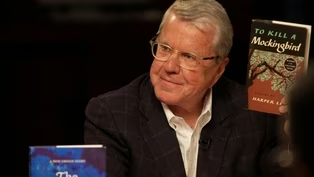
Preview | The Politics of Education
Video has Closed Captions
Preview: 1/18/2024 | 30s | North Carolinians discuss banned books, LGBTQ studies, history education and whitewashing. (30s)
Providing Support for PBS.org
Learn Moreabout PBS online sponsorship












Support for PBS provided by:
The NC Listening Project is a local public television program presented by PBS NC
Funding for The NC Listening Project is provided in part by High Point University, Sidney and Rachel Strauss, and Julia Courtney and Scott Oxford.