Unspun
The Politics of Labels and Language | Unspun
Season 1 Episode 125 | 27m 54sVideo has Closed Captions
Does changing the name of a controversial policy also change the way we look at it?
The politics of labels and language. Does changing the name of a controversial policy or program also change the way we look at it? Or vote for it? What special interest groups say to turn their issue into everybody’s issue, and how politicians weaponize their words to spin public opinion.
Problems playing video? | Closed Captioning Feedback
Problems playing video? | Closed Captioning Feedback
Unspun is a local public television program presented by PBS Charlotte
Unspun
The Politics of Labels and Language | Unspun
Season 1 Episode 125 | 27m 54sVideo has Closed Captions
The politics of labels and language. Does changing the name of a controversial policy or program also change the way we look at it? Or vote for it? What special interest groups say to turn their issue into everybody’s issue, and how politicians weaponize their words to spin public opinion.
Problems playing video? | Closed Captioning Feedback
How to Watch Unspun
Unspun is available to stream on pbs.org and the free PBS App, available on iPhone, Apple TV, Android TV, Android smartphones, Amazon Fire TV, Amazon Fire Tablet, Roku, Samsung Smart TV, and Vizio.
Providing Support for PBS.org
Learn Moreabout PBS online sponsorship(bright music) - [Announcer] This is a production of PBS Charlotte.
- This week on "Unspun," the politics of labels and language.
Does changing the name of a controversial policy or program also change the way we look at it or vote for it?
How politicians weaponize their words to win support and spin public opinion.
Our special guest is national pollster and political strategist Mark Penn.
Plus I'll count down the top five political acronyms in our political language.
(bright music) In today's America, welcome to the spin game.
Believe me, I know.
I'm Pat McCrory.
When I was governor and mayor, I played the spin game.
I was played by the spin game.
But aren't we all done being spun?
Let's take the spin out of the world we're in, here on "Unspun."
(bright music) Good evening.
I'm Pat McCrory and welcome to "Unspun," the show that tells you what politicians are thinking, but not saying.
You know, political correctness may or may not be correct, but it's definitely political.
You see it in nearly every major campaign and nearly every major issue.
Just look at the border debate.
Those who enter the US without documentation are violating US immigration law.
In fact, our legal code refers to them as "illegal aliens," but supporters of open borders use terms instead like "undocumented immigrants" or "victims of a broken system."
And immigration critics have a different political language.
It isn't just about protecting our borders anymore.
It's about protecting our jobs and protecting our safe neighborhoods.
It's a similar story with the abortion issue.
In fact, back in 1992, it was President Bill Clinton who first coined the phrase "safe, legal and rare."
But now supporters define abortion as a common medical procedure that everyone should have access to.
And pro-choicers now call themselves "supporters of reproductive rights."
Pro-lifers, meanwhile, are reframing the overturn of Roe versus Wade as a states' rights issue that gives control to people instead of the Supreme Court.
The issues aren't new, it's the way we talk about them and how we react to what politicians are saying.
It's the way those words turn people who disagree with us on one issue into enemies on every issue.
In fact, rioters at the Capitol after the 2020 election are called "patriots" by the right.
And we describe violence in the streets after the George Floyd murders as "peaceful protests" by the left.
It's a war of words on both sides in both parties.
To paraphrase what Martin Luther King Jr once wrote, "War is a poor chisel for carving out a peaceful tomorrow."
He wasn't referring to politics, but it still sounds like fair warning for a divided nation trying to get along in the next four years.
Joining us now to talk about the politics of labels and language is Mark Penn.
He's a top political pollster and political strategist who worked for both Bill and Hillary Clinton.
Former British Prime Minister Tony Blair was also a client.
You've also seen him for years on Fox News, CNN and MSNBC.
Mark, it's great to have you on "Unspun."
- Thank you.
- Mark, what are the words or messages that worked first for Donald Trump and some of the messages that worked for Kamala Harris?
- Well, look, any campaign really has to have, if it's a good campaign, an effective slogan, a bio of some sort, some issues, some targeting and some edge against the competition.
And so you evaluate these things in terms of, did these campaigns have these crucial elements?
So obviously, "Make America Great Again" is one of the greatest slogans of all time.
It would, it did not actually originate from Donald Trump, but he popularized it.
And, you know, did "The New Way Forward" really come up to that kind of effective slogan?
No, because it had credibility problems from the get go.
It was a misfit.
She's representing an administration and you can't pretend that the administration doesn't really exist at all.
So on a slogan to slogan basis, even though he, MAGA was a retread, and he did at the very last week, switch to I think something like, "He'll fix it."
And that was not bad either, to be honest.
- I didn't even realize he had switched it at that time because it was so effective with the MAGA term.
So what words didn't work that concerned you while Trump was campaigning?
Were certain words turning off voters based upon your pollster work?
- Well, it's kind of interesting because Donald Trump won those voters that made between $30,000 and $100,000 dollars.
Kamala Harris won those voters who were college educated and made over $100,000 dollars.
And she also won those voters who made under $30,000, more concerned about government transfer payments.
But if you kind of look at her core constituency, words that Donald Trump would utter that would cause elites to cringe, right?
When he would call people, you know, idiots or stupid or communists or criminals or whatever it is, he would do that.
But, it seemed to resonate with the working class and middle class voters.
And, you know, I used to take these political ads and show them to our funders, our donors.
And I used to say, "If anybody here likes this ad, there must be something wrong with it."
Because they're not the intended argument, intended target.
So I really do think that we don't fully understand how Donald Trump's communication works, because we're not in the core group of people it really works on.
- Has messaging changed?
You may have already answered this question.
How has messaging, political messaging changed since you helped with Bill Clinton and Hillary Clinton?
- Well, I think the answer is that in many ways, it really hasn't.
I think that Donald Trump ran a campaign primarily on issues.
He said immigration was his number one issue.
Inflation was his second issue.
Crime and migrant crime was his third.
And I think there was no question and left to any kind of, if you gave him five minutes, he would wander over to the immigration issue.
Harris was really running more of an identity type campaign.
Vote for me because, well, if you're a Black man, you should vote for me.
Or if you're a woman, you should vote for me.
And so her language tended to be around trying to group identities.
And I think in this campaign, issues trump identity messaging.
And I think that the two campaigns operated quite differently.
Donald Trump's messaging worked most effectively with Latino men.
That's where the big change in the election was.
And it worked for a very simple reason.
Those Latino men were struggling with the economy.
And very high proportions of those Latino men who were struggling on the economy switched their vote.
He reached them, regardless of their identity.
- What about the political messaging in the TV commercials on both the internet and through network TV?
Was there anything unique or special there that surprised you based upon your incredible experience?
- Well, I thought some of the closing Trump ads were much better.
They clearly used short declarative sentences that were, they were easy to understand.
I think kind of the most interesting ad of the season really was the ad in which the women are hiding their votes from the men and they're winking at each other in terms of, "Hey, we're not gonna listen to these guys.
We're voting for Harris."
Now, that was an interesting ad.
It got noticed, but what the polling shows is that it was quite the opposite, that the women were right out front about who they were voting for.
And it's the men who were winking at each other, voting for Trump, never telling their spouses or partners what they were doing in a million years.
- How about who were the messengers?
Trump had certain people messaging for him, surrogates and also on commercials.
Harris had some very famous celebrities from Springsteen to Beyonce, for example, or Julia Roberts who spoke in one of those ads.
What was the difference in this campaign and the impact?
- Well, you want endorsers who have either some experience in an issue or have some relationship to the presidency or issues.
I think, I have never been a fan of Hollywood-type endorsements in campaigns.
When I was running campaigns, I threw them out of the convention.
You know, we're not putting on the Oscars here.
We're putting on an issue fest, not a Hollywood film.
And, I think voters disregard those endorsements because they look at them and they say, "Well," they say, "Taylor Swift, I love her music, but I kind of doubt she's struggling with the economy, the way that I am."
And so I think ultimately celebrity endorsements backfired.
I think the Musk endorsement in my polling was very effective, Kennedy with certain groups.
Tulsi Gabbard, not really known by that many people, but the number one interesting endorsement of the political season was Elon Musk not only endorsed, not only issued statements every day on X, but actually went on the stump.
That was unprecedented.
- And yet this was a billionaire, that for whatever reason, appealed to the working class.
Explain that messaging.
- Because America oftentimes loved billionaires.
We loved the Kennedy family.
We loved the Roosevelt family.
George Washington actually was one of the richer people in America when elected.
We often think that rich people are not corrupt because they don't need money.
So, they probably need to have their head examined to be dealing in politics if you're rich.
And so oftentimes, we give rich people more credit.
But no, we don't have a class prejudice against rich people running.
And that should be pretty obvious by now.
- So in the remaining 30 or 40 seconds, which words work the best and which words don't now, in politics?
- Well, I think that the words that work best are those that are clear and declarative.
I used to do studies in which were words that were more bite-sized and didn't frighten people work.
But I think in this case, you know, those words that say that we are going aspirationally going to remake the country, I think that the voters who voted for Donald Trump wanted not just change, not just reform, they wanted more upheaval, they wanted more disruption.
And so, and Elon Musk, he was the ultimate disruptor.
So if I were going to coin one word that I think was working, it's disruption.
- Did that surprise you that it worked?
- It's not the usual mood for America.
- Yeah.
- Right?
But when you're dealing with Joe Biden, and who had a 40% approval, inflation, and immigration off the charts, America, you know, it would not be unusual for them to vote the ins out, bring the outs in.
But I do think he brought a lot of people who felt that they were disenfranchised, not really heard in politics, didn't even participate in politics, you know, into that, on this theme of disruption.
- Mark Penn, it's an honor to have you on the show and give some unique perspective.
Thank you very much.
- Thank you.
- Next up, PBS Charlotte's Jeff Sonier takes "Unspun" on the street exploring whether political messaging is making politics harder for all of us to talk about.
- Do we have less respect for other people's opinions than we used to?
And does the language used by our leaders trigger some of that disrespect?
Well, those are the questions we're asking folks here in Pleasant Midwood this week.
- I think the language that has emerged around politics has become more vitriolic.
- Something is gonna offend everybody.
It doesn't matter really what it is, it's gonna offend someone.
And that's too bad.
I mean, it's a shame.
But this is America and we have that right to freedom of speech.
And that's part of it, is you can criticize.
- [Jeff] It just seems to take on a different tone these days though.
- It's more aggressive and mean.
Pretty mean now.
- Name calling kinda ramps it up.
If you call me a name or I can call you a worse name, that kind of thing.
I think it bothers me that in politics, there are people beside, behind the candidates who are recommending phrases, things to say.
Yes, that's terrible.
- When you hear the phrase "politically correct" or "cancel culture," what's your reaction to that?
- Well, I believe that everybody has the right to their opinion, and as long as nobody's doing harm in expressing their opinion, it's a way to actually be aware of how others are feeling.
And if we can't take that into account, how will we move forward?
- I think there's a difference showing respect for different political opinions and then being told to respect someone who doesn't respect others' identities.
I think there's, that's a pretty key difference that needs to be acknowledged.
- People are voicing their opinion in not a very positive way, not being respectful of other people's opinions.
That's my personal opinion.
- Do you think that's different than it used to be?
- Yes.
- Maybe triggered by the campaign that we just went through?
- Yes.
Yes, I do.
I have, my family friends are all onto different sides of the fence with politicalness and we just don't talk about it, right?
If you think about it, you just say, "Let's just keep that off the table," because people get so passionate about it.
- Yeah, this is one issue that a lot of folks had strong opinions on, because while everybody wants to be heard, nobody wants to feel like they're being herded.
Pat?
- Thanks Jeff.
So it's very honest feedback.
So what do you think about the issue?
We'd love to hear from you via email or video.
Send your comments on the politics of labels and language to unspun@wtvi.org.
(exciting music) All right, tonight on our "Unspun Countdown," we've got my list of the top five political acronyms in our political language.
Now before I mention these five acronyms, it, they might stir up, I want to give you a warning, they might stir up your political emotion.
Don't attack the messenger.
These acronyms now are used in political dialogue every single day.
So let's be honest and talk about 'em.
Number five, BLM, Black Lives Matter, BLM, Black Lives Matter.
It became a very popular acronym and very much used acronym, especially after the tragic George Floyd murders in Minnesota.
Let's go to number four.
Number four, RINO.
Oh, just recently I was walking down the street and someone yelled, "McCrory, you're a RINO."
That means Republican in name only.
I didn't know what it meant the first time I was called that, but it's often a term used by people who support Trump, call other people who are critical of Trump, whatsoever, a RINO.
Very effective term in arguments within my political party.
Let's go to number three, LGBTQ+.
This is, term's actually been around in a while, and it's a term that's actually combined sexual orientation with gender identity and gender expression.
It's very effective and it brings two groups of people together in a very complex and controversial political argument on both sides of the aisle.
Number two, D-E-I, diversity, equity, and inclusion.
This term brought up in the presidential election an awful lot during the past six months.
It was used also in controversy in business community.
Diversity, equity, and inclusion.
Very interesting, rather new political term.
And let's go to number one.
Number one, MAGA.
MAGA.
It's even controversial now during NFL football games.
Make America Great Again.
But as Mark Penn said, it's been used far in the past.
In fact, Ronald Reagan actually used "Make America Great Again" as a campaign theme, but no one termed it in the acronym of MAGA like Donald Trump.
(exciting music) PBS Charlotte's Jeff Sonier joins me now for "Unspun 1-on-1."
- You know, I ask the questions, you answer 'em.
They're all based on- - Alright, I have no warning what the questions are whatsoever.
- This week's topic and from the news, and this one actually is kind of a golden oldie.
I'm gonna read you, I've got a bill here, an old bill from the General Assembly.
I'm gonna read you the title of the bill.
"An act to provide for single sex, multiple occupancy bathroom and changing facilities in schools and public agencies, and to create statewide consistency in regulation of employment and public accommodations."
That doesn't sound like something you do a lot of news stories about, but you know better.
Tell me about this bill and how the language, the, you know, the- - That's- - The political language changes.
- That's a five hours story, which actually started right here in Charlotte, North Carolina with the Charlotte City Council, where there was an issue regarding, it's the gender identity issue.
Which by the way as a country, we've got to resolve this issue regarding gender identity and gender expression.
But we've gotta do it in a respectful way.
We've gotta do it in an honest way.
And we've gotta understand how both sides feel about this issue regarding gender expression, gender identity, but also privacy.
And sooner or later, probably in the 1965 Civil Rights Act, we've gotta clarify the definition of man and woman.
- But this bill was better known as HB2.
It was better known as "the bathroom bill."
And a short, catchy name kind of made the difference in terms of it becoming not just a local issue, not just a state issue- - Yeah, yeah.
- But a national issue.
- Well, the critics were very smart to define it as "the bathroom bill," when in fact it had to do with a lot of public facilities, including locker rooms, even women's sports, even women's prisons, which was becoming an issue for me at the time because I was having male prisoners wanting to move to the female prison.
And that was quite controversial for me regarding what decision to make for the privacy of even the female prisoners.
So it drew a lot of emotion and was very difficult for me and my family.
- So, someone else defines a bill- - Yeah.
- In their terms.
How important is being first out of the gate?
You should, I mean, letting someone else define something versus you or your party or your government defining it for yourselves.
- Oh, branding, get outta the gate quick and brand the bill.
- Mm-hm.
- And then get the media to catch onto it.
It becomes part of the common language now.
And that's exactly what happened in this bill.
And what's ironic, the controversy hasn't ended.
- Mm-hm.
- In fact, there's controversy on that issue right now in the congressional halls in Congress.
- So behind the scenes are people working on not just the bill details, but also the bill, you know, branding or labeling?
I mean, is, are there two different, or do you, does it get forgotten perhaps?
And maybe that's where the controversy comes from?
- Sometimes the brand occurs by accident, by someone accidentally staying it, saying it.
It's kinda like a nickname for a football player.
Sometimes it just happens off the cuff by an announcer.
Sometimes it's extremely well coordinated, measured, and surveyed as to whether or not it works.
- Mm-hm, I was thinking about how it might backfire too.
I mean, we heard a lot during the campaign about the Inflation Reduction Act, right?
- Yeah.
- But, which didn't reduce inflation.
Mistakes can be made if you're not thinking about how people are hearing what you're saying, right?
- Well, they, the reason they called it, the reason the Biden administration and the operatives said, "Let's call it the inflation act."
- Mm-hm.
- Because we wanna show people we're fighting against inflation.
Although the critics then went, "It's doing just the opposite."
So the sometimes branding does not work.
- Yeah, by using the word inflation, you're almost inviting criticism.
- Exactly, exactly.
You know, it's just like certain advertising you see on TV.
Some advertising works, some doesn't.
And you saw that in the political messaging between Harris and Trump.
Some messaging caught on.
Some, they threw it away as quick as possible and try to re-pivot to something else.
- A short catchy name or an acronym name like we saw in the the top five, it's a way to kind of make an issue more powerful because it's a way, isn't it a kind of a way to plant that seed in people's heads in a simple fashion.
- Absolutely.
In fact, my first political message when I was running for mayor, it was when Charlotte crime was very high and taxes, a lot of people were complaining about the taxes.
So my political campaign theme was "Vote for McCrory, Safe and Affordable."
- Hmm.
Two simple words.
- Two simple words.
And I repeated it and repeated it and repeated it.
I'm surprised no one's used it in the last 30 years.
"Safe and Affordable."
- So, social media magnifies things, enhances things, I guess short, direct, easy to remember messages work even better in social media?
- You never know.
- Hmm.
- You never know.
But one word that we've talked about in one of our first programs was fighting, "I'm Fighting for You."
It shows action when in fact, politicians never fight.
They argue, they debate, they complain.
They whine.
They don't fight.
Sometimes they get angry and that shows a fighting spirit.
But sometimes overreacting can have a backfire on you too, by being over emotional.
- It's gotta be authentic.
Authenticity is part of this whole language.
- It's just like right now, some people probably in the next presidential campaign will try to repeat what Donald Trump says.
No one can do it but Donald Trump, you gotta be yourself.
- And, there's not gonna be another person that can, you know, be Donald Trump 2.0.
They've gotta be something else 1.0, I suppose.
- They're gonna have to be their own person because if you try to be someone else or act, you won't come across as authentic, you will be caught.
- And last question.
When you brand something or you label something effectively, doesn't that also make it an easier target for your opponent?
Something to aim at specifically as opposed to a big issue with a lot of tentacles?
- If you brand yourself wrongly- - Mm-hm.
- The opponent will use that brand against you in the commercials and you'll go to your political consultants, "What were you thinking?"
(Pat laughs) - There's no right or wrong answers in this area.
- You don't know.
Yeah.
Listen, it's no exact science.
Political science is not an exact science.
It's a guess.
It's very similar to sales and marketing.
Some words you use to somebody to buy a product work.
And sometimes what you're saying doesn't work and actually turns the buyer off.
And what you're selling is not only yourself, you're selling a product.
- Yeah.
Well, we're outta time.
Thanks again, governor.
That's this week's "1-on-1."
- Thank you very much.
(bright music) During the past decade, sadly, our cancel culture has been alive and well, not just in politics, but also in business, education, sports and entertainment with people being purged because of their beliefs.
Believe me, I know.
I was canceled by the left when they disagreed with me on gender issues in restrooms, locker rooms, and on sports teams.
And then I was canceled by the right because I was a Republican who dared to criticize Donald Trump's language, of all things.
Suddenly I was labeled a RINO and the invitations to GOP events stopped coming.
But with the political purging also came verbal assaults and physical threats right here in Charlotte, targeting me and even my family.
In fact, it still happens today, years after I served as governor of this great state.
So when PBS Charlotte approached me about this show, I warned them that they may get hit from all sides.
And guess what?
They have.
But because of our viewers who appreciate the unique way we talk about politics, we stand strong and fair and transparent.
I want to say thanks to all of you who stand with us as we wrap up our final show this year.
Because of you, we'll be back with new shows in January, I promise.
And one final thing, during the holiday season, enjoy and love your family and friends, even if they voted differently than you.
Don't cancel the ones you love over politics.
Be better than that.
Be the best of America and humanity.
Well, that's the reality as I see it.
Thanks for joining us this week on "Unspun," where we'll tell you what politicians are thinking but not saying.
Goodnight, folks.
(exciting music) - [Announcer] A production of PBS Charlotte.
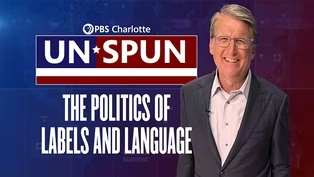
The Politics of Labels and Language Preview | Unspun
Preview: S1 Ep125 | 30s | Does changing the name of a controversial policy also change the way we look at it? (30s)
Providing Support for PBS.org
Learn Moreabout PBS online sponsorship
- News and Public Affairs

Top journalists deliver compelling original analysis of the hour's headlines.

- News and Public Affairs

FRONTLINE is investigative journalism that questions, explains and changes our world.












Support for PBS provided by:
Unspun is a local public television program presented by PBS Charlotte