Utah Insight
The Politics of Redistricting
Season 2 Episode 6 | 26m 2sVideo has Closed Captions
As Utah leaders prepare to redraw legislative boundaries, what's changed since last time?
For the first time in a decade, Utah will redraw its legislative boundaries for both state and federal representation. In 2011 the process was contentious and, some argue, overly political. What’s different in 2021? And how are everyday people influencing the outcome this time around? We bring together stakeholders from both sides of the aisle to discuss the impact across the state.
Problems playing video? | Closed Captioning Feedback
Problems playing video? | Closed Captioning Feedback
Utah Insight is a local public television program presented by PBS Utah
Utah Insight
The Politics of Redistricting
Season 2 Episode 6 | 26m 2sVideo has Closed Captions
For the first time in a decade, Utah will redraw its legislative boundaries for both state and federal representation. In 2011 the process was contentious and, some argue, overly political. What’s different in 2021? And how are everyday people influencing the outcome this time around? We bring together stakeholders from both sides of the aisle to discuss the impact across the state.
Problems playing video? | Closed Captioning Feedback
How to Watch Utah Insight
Utah Insight is available to stream on pbs.org and the free PBS App, available on iPhone, Apple TV, Android TV, Android smartphones, Amazon Fire TV, Amazon Fire Tablet, Roku, Samsung Smart TV, and Vizio.
All Episodes Now Streaming
Hosted by Jason Perry, each week’s guests feature Utah’s top journalists, lawmakers and policy experts.Providing Support for PBS.org
Learn Moreabout PBS online sponsorship(bright ethereal music) - [Announcer] Funding for "Utah Insight" is made possible by viewers like you.
Thank you.
- [Raeann] Tonight on "Utah Insight," the politics of redistricting.
- Here was this urban center in Rose Park that, all of a sudden, was peeled off, and we no longer had a voice.
- [Raeann] For the first time in a decade, Utah will redraw legislative boundaries for both state and federal representatives.
- I don't want them the biggest, loudest voice.
I just wanna be heard by somebody in Salt Lake.
- What's different this go round?
When redistricting is happening and how you can get involved.
(bright upbeat music) Welcome to "Utah Insight."
I'm Raeann Christensen.
In a few months, new district boundary lines will be drawn by our state legislature.
Where those lines end up can impact every resident.
It will decide who represents you in Congress, the state legislature, and the state school board.
Here's a look at the current congressional districts in Utah.
We have four.
All four current congressional representatives are members of the Republican Party.
If you take a closer look at the current maps and Salt Lake County, three or four of the districts currently split the county.
Joining us to talk about redistricting, Utah state representative Carol Spackman Moss, representing District 37, and joining us by Skype, Dr. Rex Facer, chair of the Utah Independent Advisory Commission on Redistricting, and Ernie Gamonal with the Utah Coalition of La Raza.
Thank you so much for joining us here today.
An important conversation we will have, and I wanna start.
This as a process we go through every 10 years, but new this year, we have the voter-created Independent Redistricting Commission, which, Rex, you are the chair of.
So we wanna understand, will the legislature actually listen to the commission?
- Well, we certainly hope so.
The members of the commission are not giving their time and all their efforts just to go unheard, and so we expect that the legislature will listen to us and that they'll take advantage of the work that we're doing in engaging voters and people across the state.
- Tell me, Rex, a little bit about your process.
You guys are gonna be drawing some maps?
- Yeah.
So eventually, we'll draw maps.
That won't start until after the middle of August when we get the data from the Census Bureau, and so before then, we're in a process of gathering data and information to understand communities of interest, among other things.
We'll hold a series of about a dozen public hearings across the state to gather input from the citizens to make sure we're hearing them and that we understand their preferences and priorities because after all, this is a process that we want to be informed by the citizens and not just those who are in political power.
- Okay, and Representative Moss, you're with the legislature.
Do you believe that they'll take into consideration all different aspects before making final decisions?
- I do think they'll take it into consideration, but how much consideration, I'm not sure of.
I think there'll be a good deal of pressure on the legislature because it was a voter initiative, Proposition 4, Better Boundaries, and because that initiative was changed by the legislature to make it advisory and not binding, and there were a lot of people unhappy about that.
I think the public pressure will probably come to bear, and I'm certainly hoping that's the case.
- Okay, and Ernie, do you feel that the legislators will listen to residents at public meetings or the Independent Redistricting Commission?
- Thanks for having me, and yes.
The legislature will certainly listen.
In my experience with legislators on both sides of the aisle, they listen.
The question is are they going to act upon what they hear?
And if we go back 10 years ago, the legislature had 17 meetings across the state, and part of the reason that the citizens initiative passed is the people who participated in those meetings across the state felt like they participated for no reason.
Right now, with the Independent Redistricting Commission established and chaired by Dr. Facer, that is the champion of the people's voice.
So part of what Utah Coalition of La Raza is working to do is promote public participation so that when they come up with the 12 maps that they have to draw based on the statute, that the legislature takes them as the champion of the people's voice and takes the voice a little more seriously.
- Why do you think that they actually downgraded the commission to just being advisory?
- And Representative Moss could speak to this more, but it seems like the legislature in the past five, six years and maybe longer have worked to consolidate power under their branch of government.
In the past two years, we saw them strip a lot of power out of the executive.
They haven't really gone after the judiciary, and I don't wanna besmirch any of your colleagues on the legislature, but it seems like some of the people in leadership act a little capriciously, and I'm really hoping a groundswell of public participation with the Independent Redistricting Commission makes the commission's recommendations and their 12 maps considered serious.
- Okay.
Do you wanna respond to that?
- Yes.
(clears throat) I was part of the ad hoc committee that was selected to negotiate to keep Proposition 4 in 2020.
And it was a tough negotiation.
We had the legislative attorney representing the majority party, and their job is to represent the legislature's point of view, and they kept insisting that it was the legislature's, their duty to make the decision.
I say we, the Better Boundaries people, and I was on their side, had their own attorney, and I'm not an attorney.
At one time, I was a high school English teacher, and one of the Republicans, Senator Vickers, is a pharmacist.
And after the meeting, I said, "If they'd just let us decide (laughs) and get the lawyers out of the way, we might be more productive."
But we did bargain very hard and came up with advisory, and I got some criticism.
I was the sponsor.
House sponsored that bill.
And it was either nothing or something, and that's what happens when you have a super majority, and you have to compromise, but everybody got something instead of nothing.
So I do think in good faith, they will look at this.
Do I think they'll, in the final decision, go if the commission's quite different?
I have my doubts.
- Okay.
And we asked you on social media, lawmakers are working to redraw Utah's political boundaries.
What should they do to make sure Utahns' votes and voices are heard?
Steve Williams writes on Facebook, "Redrawing boundaries is only done for one reason, to serve the party in power.
It's never done to be more effective for the voters, and it's time that changed."
And Rex, do you think that this commission, the Independent Commission, is part of that change?
This is the first time we've had it.
- Sure.
I certainly hope we're part of the change, that we are leading the effort to engage with people.
We're gonna try and do things differently.
We've got volunteers that will be out in a couple of community festivals here in the next few weeks, trying to get citizens to draw their communities of interest.
So we're trying to engage people in different ways, trying to be part of a change that helps their voices be heard.
- And Ernie, what do you think about that comment?
It seems like a common sentiment.
- I've been watching all of the commission's meetings, and I'm really excited about some of the progress they've made in the past month.
One of the things that I know the commission's going to be doing is reaching out to counties and cities across the state, looking for partners to help them get this done.
When the legislature established the commission, they gave them a million dollar budget which seems like a lot of money.
But when car rentals are 90 bucks a day, that money's gonna go quick.
So they can't really hire a bunch of staff to go across the state, and it is vital that the cities and counties, when the commission comes asking for help, that the cities and counties step up to help the commission, not just Salt Lake County, but our rural areas, Southern Utah, because the process will not be worse if more people are involved.
- Okay, and turning to another social media comment, Kathleen Kirby says simply, "Hey, stop gerrymandering."
So Rex, can you explain what is gerrymandering, and does it happen here in Utah?
- Sure.
Gerrymandering is the drawing of political boundaries to a political advantage for a particular group, and it in part depends on whose perspective you're looking at, but most independent observers would say that we have had gerrymandering occurring in Utah, that the boundaries have been drawn to benefit a particular political party.
And we hope that by having a broad set of criteria, that we're not going to be falling into that trap of simply trying to draw boundaries that are politically advantageous to one group over another.
- Okay, and Representative Moss, has the changing of the boundaries affected you at all?
- Yes.
I have just finished my 21st session.
So when I was elected in 2000, 2002 was the year that they changed, and I was a political novice.
I didn't even know that was going to happen when people said, "Oh, you'll have a new district in two years.
Don't pass out these maps of your district."
I said, "What?"
And I did.
It took a lot of the area where I was elected, where I'm known, where I taught school, where I've lived for 46 years in the city of Holladay and divided that up.
And then the second time around was 2002, and instead of moving me eastward as they had before, they moved my district west quite a ways from where I live.
So I represent two cities, Holladay and Murray.
And just to tell you how those legislative districts are divided, the city of Holladay, which has about 33,000 people, and at that time you had to have 33 to 36,000, has three representatives representing 'em divided between three and two Senate districts.
Murray, which is a larger city than Holladay, currently has four state representatives representing parts of Murray and two, no, three senators.
So it's hard for a city to have one person that will advocate for their interests because those people extend into other cities as well.
So yes, I have a lot of experience with it, and I have seen over the last 20 years that the majority party's always looking out for their incumbents, and they don't hesitate to put two Democrats together, which they've done before.
And they say, "It's because the area you represent on the east side doesn't have as large a population growth," and they're looking at that this year.
So no, I don't have a lot of faith when it comes down to it because I've seen the practical application.
- Okay, and Hispanic and Latino residents make up the largest minority population with about 14%, according to the census.
It seems like we are splitting up communities of interest.
How could local boundaries impact representation for those residents here in Utah?
- So in the introduction today, there were a couple of gentlemen from Rose Park talking about how their voice has been diluted, and what they're referencing is the Senate district, represented by Senator Weiler that takes all of Bountiful and then carves out a little nook in Rose Park.
When that happens, then Senator Escamilla's district, and I'm going to 10 years ago, Senator Escamilla, who had basically all of Rose Park, got stretched out all the way to Magna, which is different from what she was elected.
And there's examples across the state, and I'm just gonna break into the elephant in the room.
Our congressional districts.
So the boundary line between 2 and 4 cuts West Valley and Glendale and Rose Park into two.
Well, that is the highest concentration of geographically large Latino population.
So now the folks in Rose Park are sharing a congressional representative with the folks in St. George and Hurricane.
The folks in West Valley are sharing their congressional representative all the way down to Eagle Mountain and Santaquin.
So I think that UCLR is concerned about all the boundaries, and once this process is over, we're gonna continue to look at local boards and local city councils.
I think that, again, I've gotta put my faith back into the Independent Redistricting Commission, and they will, I am sure, draw some fair maps.
- Okay, we actually wanna hear from some residents that are affected by what you were just talking about.
We wanted to see how residents' redistricting impacts voters who are in the same district but live hundreds of miles apart in Utah.
Liz Adeola shares the concerns of three Utahns from Congressional District 2.
- [James] The farm is definitely something that I've always wanted.
- [Liz] From the brush to the bright red barn, Utah farm life on full display is quite the experience.
- It's a way of life, and it's great to be surrounded by a tight knit community.
I enjoy the hard work part of it.
The way alive is important to me, raising kids, teaching kids how to work, teaching kids is value of work.
- [Liz] And to appreciate the unquantifiable value of nature's beauty.
- On a clear day, you can see about 100 miles in either direction and from the back of the pasture, which is amazing.
- You go out, and the pivots are running, and the water's spraying everywhere, and crops are growing, and it's just a beautiful, calm time, and it's the best blood pressure medication I guess you could have.
- [Liz] Dusty Wiseman is a fourth-generation Utah farmer at L&W Ranch in Milford.
He lives and works more than 250 miles south of James Ord and Steve Hempel's hobby farm in Harrisville.
They all start the day on the farm the same way.
- First thing I do is I go check all my water to make sure everything's running.
- We get our water.
One time during the day, so 10:45, and one time that's night.
I don't enjoy it, but I enjoy this.
- [Liz] This five-acre farm that's home to a turkey, (James gobbles) horses, goats, and cows.
Meanwhile, at L&W Ranch, another sound fills the air.
- What I do, I run a hay baler, which is what makes the squares and puts a string around it all.
This was actually a really good crop, and we're feeding our family with the same things that we're producing.
Our hay turns into mill, basically, and all the seeds in the ground at the beginning and the result at the end, it's fulfilling, and to have that, to see that progression.
- [Liz] Many Utahns are anxious to see the progression or outcome of a different type of seed that has been planted over the last few years, the seed of progress and change that will soon grow out of the process of redistricting.
- I think it's a tough problem with the population.
If you just say, "All right, we're gonna put Beaver County down here in their district," population wise, we really don't have a chance to have a voice.
You have to lump us in somewhere to give us a good voice.
- [Liz] Dusty lives in Congressional District 2, and despite the location of their farm, Steve and James also registered voters in Congressional District 2.
- Here was this urban center at Rose Park that, all of a sudden was peeled off, and we no longer had a voice.
- [Liz] When they're not here on the farm, the couple lives and works from home with their family on the west side of Salt Lake City.
- We don't meet the mold.
We don't fit the mold, right?
I'm Latino.
We're an LGBT couple.
One of our kids identifies as LGBT.
I understand the difference between urban and rural, but the problem is that our leaders don't.
- [Liz] Dusty can also spot the disconnect when districts are disconnected, so to speak, on the map and in day-to-day life.
- I think it's crazy how they do chop it up, and that's part of the process, I guess.
They have just different issues.
It's just crazy that the amount of diversity that's in the state and to try to weave all that together and keep everybody somewhat satisfied, I don't know if that's possible.
I think they do a fair job.
I wouldn't want their job.
- [Liz] They all say a big part of our job as residents of Utah is to get involved in the process.
- I think that's the place where you make those working relationships that actually lets your voice be heard.
- [Liz] No matter the issue or lines drawn on the map.
- Everybody can be represented.
I don't want the biggest, loudest voice.
I just I just wanna be heard by somebody in Salt Lake.
- Okay, so rural Beaver County sharing the same representation as those in Salt Lake County.
Rex, do you see this changing?
Why is it this way?
- Well, part of the challenge is we have over 3.2 million people in the state of Utah.
Each congressional district has to have about 818,000 people so that we can have equal representation across the state because every voter has to have the same weight of representation.
And so part of the challenge is, even in a county like Salt Lake, that we can't keep the entire county in one district because it's too big.
And so figuring out how to split the state really is part of the art that we want input from the public on because it's not going to be an easy challenge, and there are certainly going to be differences of opinion on whether it's best to have urban concentration in a congressional district or if it's better to have an urban-rural split.
It would be very difficult to have one district that was exclusively rural given that over 80% of the population lives along the Wasatch Front in an urban setting.
- Okay, and Representative Moss, it would seem like rural and urban issues, they're not the same.
So do you feel that people can get fair representation living in those areas?
- I do not.
In the last redistricting, 2012, they debated having one more urban district that took in more of Salt Lake City, and then they went with the pizza pie, they call it.
So every congressional district, all four have a little slice of Salt Lake County or the more urban Utah, Salt Lake county, and then go into these huge swaths of rural Utah, and I don't think that's accurate.
You could have one, at least, that was more urban and then several others that took in the rural, but they're so different.
I think the rural people, unless they had one big district where somebody really concentrated on issues that were of paramount interest to them, maybe that would be fair, but I think that Wasatch Front is getting short shrift in the system they've used in the past.
- Okay, and it does seem that communities of interest are being broken up in districts, and Ernie, do you feel new political boundaries could help communities that are often overlooked?
- Yes, I do.
I think that the primary principle behind drawing fair maps for people to vote in is that when I vote, my vote is going to have as much weight as the next person's vote.
And when my voice is diluted with rural counties and rural communities, my representative doesn't represent my urban interests.
One of the greatest successes that the state of Utah ever saw was when Senator Bennett brought back money to bring in the TRAX line and the FrontRunner line in Utah.
Definitely benefits the urban areas.
A congressional representative representing the urban areas could also do that, particularly with the idea that we're trying to get the Olympics again.
And then the other thing, too, is that while all of Salt Lake county can not have a representative, Salt Lake county represents approximately 1/3 of the population of the state of Utah.
So why does 1/3 of the population of the state of Utah have to get split up between four different congressional representatives?
It doesn't make logical sense to me.
- Okay, and turning to one more social media comment, Donna Sparks Williams says, "Amusing that you think anyone cares that our voices are heard.
We voted in several elections for referendums that have simply been overturned by the legislature."
Now I wanna get to how residents can have their voices heard because this is such a common sentiment.
Rex, what can residents do to make sure that you're listening?
- Well, they can speak to us.
We have an email address, uirccomments@utah.gov, where they can send us their comments, and all the members of the commission will see those.
We also will have a webpage where they can go and draw maps that's gonna be live here shortly.
And they'll be able to submit those maps to us so we can see them.
But also, they should be on the lookout for us at community festivals around the state where we'll have volunteers and some of our interns that will be out trying to gather their input, the input from the public.
And so reach out to us, but also be on the lookout for us.
We wanna hear your voices.
- Okay, and Ernie, how important is it that people weigh in?
- It's absolutely vital.
So again, the legislative leadership could completely disregard the Independent Redistricting Commission, but if the Independent Redistricting Commission comes with a wave of public sentiment and a commitment from people who have participated, then I can't see the legislature ignoring it.
- Okay, and we are out of time.
Thank you so much for joining us.
I appreciate it.
Such an important conversation, and make sure we have our voices heard.
So next week on "Utah Insight," Utah is the second worst state in the country when it comes to recycling.
We look at why this is and what we can do to turn it around.
And we wanna hear from you.
Share your thoughts using the methods on your screen, social media, email, or call in.
Thank you so much for watching "Utah Insight," and we'll see you back here next week.
(soft up-tempo contemplative music)
Video has Closed Captions
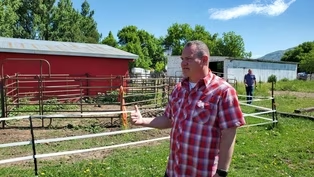
Clip: S2 Ep6 | 4m 34s | Three voters in Utah CD2 who live hundreds of miles apart weigh in on the process. (4m 34s)
The Politics of Redistricting - Preview
Preview: S2 Ep6 | 30s | On the next Utah Insight, redrawing legislative boundaries. The goal? Fair representation. (30s)
Providing Support for PBS.org
Learn Moreabout PBS online sponsorship
- News and Public Affairs

Top journalists deliver compelling original analysis of the hour's headlines.

- News and Public Affairs

FRONTLINE is investigative journalism that questions, explains and changes our world.












Support for PBS provided by:
Utah Insight is a local public television program presented by PBS Utah