
The Power of Inspiration and Seizing an Opportunity
Season 5 Episode 2 | 26m 48sVideo has Closed Captions
A story of the power of inspiration and seizing opportunities.
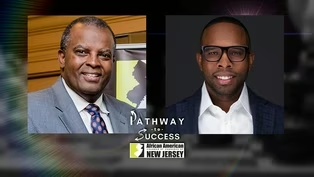
Host John E. Harmon, Sr., Founder, Pres. & CEO of the African American Chamber of Commerce, talks with William Bowie, CEO/Founder of Empower Construction, about being inspired and mentored, being a mentor himself and how seizing one opportunity changed the trajectory of his life. Produced by the AACCNJ, Pathway to Success highlights the African American business community.
Problems playing video? | Closed Captioning Feedback
Problems playing video? | Closed Captioning Feedback
Pathway to Success is a local public television program presented by NJ PBS
The Power of Inspiration and Seizing an Opportunity
Season 5 Episode 2 | 26m 48sVideo has Closed Captions
Host John E. Harmon, Sr., Founder, Pres. & CEO of the African American Chamber of Commerce, talks with William Bowie, CEO/Founder of Empower Construction, about being inspired and mentored, being a mentor himself and how seizing one opportunity changed the trajectory of his life. Produced by the AACCNJ, Pathway to Success highlights the African American business community.
Problems playing video? | Closed Captioning Feedback
How to Watch Pathway to Success
Pathway to Success is available to stream on pbs.org and the free PBS App, available on iPhone, Apple TV, Android TV, Android smartphones, Amazon Fire TV, Amazon Fire Tablet, Roku, Samsung Smart TV, and Vizio.
Providing Support for PBS.org
Learn Moreabout PBS online sponsorship- Support for this program was provided by Horizon Blue Cross Blue Shield of New Jersey, Berkeley College Education drives opportunity.
Be inspired.
- Hello, this is John Harmon, founder, president, and CEO of the African-American Chamber of Commerce of New Jersey.
And thank you for tuning in today to Pathway to Success.
Our guest today is one of a number of amazing members that represent the African-American Chamber of Commerce.
He has come from rather humble beginnings and started the enterprise that is competing at the highest level I speak no other than Mr. William Bowie, president and CEO of Empower Construction, LLC.
Mr. Bowie, welcome to Pathway to Success.
- Pleasure to be here, John.
Thank you for having me.
- So let's start.
So Mr. Bowie, you know, share a little bit about your upbringing and just slowly walking to where we are today.
- Yeah, thanks John.
You know, come from a, let's say a mid-range family, mid-size family.
You know, grandmother had seven kids, three boys, four girls.
Grandmother worked three jobs.
My mother, who was one of those seven children, she had two children of her own, and we all were raised in the same house.
So it was about 19 of us living in one house when I first was born, you know, back in the, the, the seventies and the eighties, you know, the drug epidemic kind of really hit Philadelphia pretty hard and kind of really wiped through the family.
So out of those seven children, my mother was the only one who wasn't affected by it.
She was the caretaker of all her brothers and sisters.
Wow.
You know, my mother was really the, the, the heart of the family, the strength of the family, and really to try to keep everyone together.
So, you know, with that, you know, the values that were instilled in me were, were, were fantastic.
You know, growing up in the city of Philadelphia, you know, as a young boy was tough.
Single parent home with my mother.
I just have a younger brother.
I call him little big brother.
He is about six five, you know, about two 70.
Okay.
I, you know, I got the short end of the straw, but, you know, I could still take him, you know, so growing up in the city, it was tough.
In Philadelphia, you know, it's, it's tough in the single parent home when you don't have a father to try to show two boys you know, how to live and how to live.
Right.
But my mother used to tell me all the time, you know, I'm your mother and your father.
Right.
I'm gonna teach you how to be the best man that you could possibly be.
Wow.
We grew up in Richard Allen projects.
I moved around during a young age.
We also lived in a shelter for about six months before we moved into Germantown to a family, friend's home where we were able to stay and finish out the rest of my, my, my younger childhood.
- So I, I gather from that your mother was a source of inspiration.
- Yes, she was.
She was, she was a mover and a shaker, you know, you know, as we'll.
Talk more about it.
You know, my mother was really kind of the inspiration of why I was able to transition to the construction business so easily because she was so handy.
You know, she was the only woman I knew that had her own set of tools.
Right.
So, you know, and she knew how to use 'em.
So she did everything that she possibly could to provide.
I mean, there was a lot of people don't know throughout middle school and high school, we didn't even have a shower or a tub in our house.
I washed up at a sink the size of a textbook standing in a bed pan every single day with a door that didn't close.
You know, there was times where we didn't have heat, we didn't have hot water where we had to microwave water for hot water.
Right.
But, you know, my mother always told us, you know, don't, don't show the world your problems.
Keep your head held high.
Keep your shoulders back because those problems are really gonna be the things that build you to move you on.
- So, education wise, let's, let's unpack that a little bit.
Where did you go to school?
- Yeah, so Philadelphia Public School system is what I was primarily educated in.
You know, it's tough, you know, it's, it was an underfunded school system at that time where we had to share textbooks or we couldn't even take textbooks home.
So, you know, the learning was a little bit different.
You know, my mother was hard on education, so she said, we need to test to make sure we get into a magnet school a much better high school.
So I tested, I was able to get into George Washington Carver High School of Engineering and Science.
It set the, the, the path for the rest of my life.
I played basketball there until about junior year where, you know, I needed to start making money to provide for the family.
So I had, you know, a, a small job here working at the movie theater, another job working at Walgreens, and, you know, I had to quit the basketball team, you know, one of my biggest regrets in my life started to focus a lot more on education, and then I was able to get into Drexel University where I wanted to go for architectural and civil engineering.
Unfortunately, that career got cut short in college.
- So why utility construction for you and and how did that - Start?
Yeah.
So after having to drop outta college the first year, I, I needed to look for something to try to get the money I needed to, to apply for my fall semester.
A friend of the family was a journeyman lineman in the IBEW, international Brotherhood of Electrical Workers.
And, you know, I was trying to make enough money to get back into college and he said, Hey, I got an opportunity for you where you can make a little bit more money to try to make that path that you're trying to do a little bit quicker.
So I, I said, let me just apply.
What, what can it hurt?
So I filled out the application for the International Brotherhood of Electrical Workers to become a journeyman lineman to learn how to work on power lines.
A year and a half later, after going through a rigorous process, I was able to test it and get a get accepted and got my first call for becoming a journeyman lineman.
Still to this day, I have in my home office, the piece of paper, when I first got that call, of all the information and tools they said I needed, how much money I was gonna be making, I have that framed in my home office.
Wow.
- So lineman give, give our viewers a little more visual of what that job is all about.
- Yeah.
So Journeyman lineman is, think of an electrician, but one that actually works solely on power lines outside.
I've worked from Maine all the way to Florida, to Texas, all the way to Illinois and in between.
And you know, it's just an exciting and beautiful career.
So - Some of the companies you worked for, let's hear a few of those.
- So, at, at the age of 19 is when I joined the apprenticeship and apprenticeship was four years.
I started to work for a company called MidAtlantic Pipelines, and it was just basically gluing PVC duct together in, in new residential communities so that they can be able to pull in electricity.
I did that locally within Philadelphia and throughout my career, I was able to bounce from company to company to gain the experience needed to, to go through the apprenticeship.
After I worked for MidAtlantic Pipeliners, I started to work for some distribution contractors where I was able to learn how to perform overhead distribution work.
During that, throughout that tenure there, we also have the ability to go and I, I, I, I more or less call it a privilege as well, for any time a hurricane or a storm hits in the South, that's when we get mobilized to go down south.
We got hop in our trucks, we go down and we try to restore power to those communities.
It's a very rewarding thing.
Throughout my career, I learned the work, I learned the boots in the groundwork.
I try to understand how to perform all different types of work so that I can try to master my craft.
I wanted to ensure that by the time I graduated, I was prepared for any type of job that I wanted in the entire country where someone can say, Hey, you do not have the qualifications to perform this job.
We're gonna need to move on.
I didn't want to give them a reason.
So I, I took on anything and everything.
- So doing these various jobs, you were still in school or going to school - At the age of 19?
Going from making $3 and 15 cents an hour of, of processing photos to making $75,000 a year was drastic.
Yeah.
Then I learned that once I graduated from the program, I was able to be starting off in six figures.
My strategy for life kind of, you know, shifted a little bit how the idea was, Hey, let's graduate get this certificate that's certified by the Department of Labor under me so that nobody can never take that away from me.
And I always had that default back on while I tried to gather enough funds so that when I wanted to go back to college, I didn't need to worry about a thing.
Understood.
Once I got on that path, and, you know, I started to work at various companies.
I landed at Henkel and McCoy where I worked for 15 years.
I started off as just an apprentice and wound up working all the way to an area manager, and during that time I was able to take myself financially to go back to school part-time to try to gain that education.
Gotcha.
- So Empower Construction, LLC?
Yes.
When, when did you make that decision?
- I have three kids and they're my world.
And when I wanted to start the business, I actually sat them down and said, Hey, I'm gonna do this because the reason why I am doing it is for you.
And, you know, when I seen their eyes light up, when I seen that I had their buy-in, I knew that this was the best decision to make and I wasn't gonna look back.
And failure wasn't an option.
So my mother had instilled those values into me as far as family and taking care of family.
So, you know, I worked at Hinkel McCoy 15 years and, and when I transitioned from the field, or about 10 years in, I, I took an office position and I worked as a supervisor.
And then from supervisor I went to operations, manager operations.
I went to an area manager and then eventually came to a director level where I ran a good book of business for them for the entire East coast.
So that transitioned me from, hey, I knew the, the groundwork, the boots, and the groundwork, let me learn the office work, let me learn how to actually do business.
And once I actually learned how to do business, that's when that entrepreneurial spirit started to kick in.
You know, you are running about a $300 million book of business for a multi-billion dollar company, and you have all these organizations under you.
Why can't you do this for yourself?
So, you know that that entrepreneurial spirit inside of me where it was just, it just kept getting full and full and full until one day in, in 2020 during a pandemic where I had a a lot of time to think, just hit me and said, you know, now there's the opportunity to do so.
You're not getting any younger, all the chips are aligning, the stars are aligning.
You know, let's take this leap of faith, trusting God and let's put a good business plan together.
And let's take that step.
- You start this company Two questions, mission statement, and your first contract.
- Yeah.
So I, I guess the, the, the, to give you the basis of who Empower Construction is would be pretty much how the name started and how our model started came to me so, so quickly.
Well, - What's the meaning of Empower Construction - Predominantly white Americans inside the lineman industry, it's about 98% white.
So a big initiative of mine was how come there aren't more women or just minorities in general inside this industry where you're making six figures with only a high school diploma needed.
The motto of the company, the strategy of the company had to align with the moral values that I believed in.
And that's why I named the company Empower, because truly we believe in empowering people to be the best version of themselves.
And then our motto is Empowering utilities, because that's who we primarily work for and people, - I love it.
So now we need to get into the organization.
- Our first customer was Exelon Pico, a Philadelphia Electric company, a phenomenal company who prides theirselves on DEI, where they not only just bring in these small businesses and provide them opportunities for contracts, but they actually helped coach them so that they may be able to stay in business of working in the Philadelphia electric territory.
Was, was pivotal for me because that's the area that I grew up in.
We want to focus on those areas where electricity is not getting to where communications is not getting to, such as fiber optics where 5G is not getting to.
We love performing projects like that to, so we can get that into our communities.
So - Why don't we take a little break here and on the other side I'll share with you a little bit about my history with Exelon.
And so we'll be back in a moment here on Pathway to Success.
Really enjoying this conversation with Mr. Wim Bowie.
Back in a moment.
- The African American Chamber of Commerce of New Jersey is your pathway to success.
We encourage you to visit our website@www.accnj.com or call us at (609) 571-1620.
We are your strategic partner for success.
- Welcome back to Pathway to Success.
I'm your host, John Harmon, founder president, CEO of the African American Chamber of Commerce in New Jersey.
You know, what Mr. Bowie has shared with us is that this industry can afford men and women from diverse backgrounds and opportunity that could be economically transformational.
So let me go back to what I said just before the break.
I had the, the privilege to meet representatives of Exelon years ago.
I think Exelon represents a best practice in the industry, and when you look at their senior executives in the Chicago area, they're largely black and brown people.
It feels good to know that they're still doing this today.
So can you speak to current project or two that you're involved with?
- When we first got a contractor of choice, which is called a COC contract for one of our clients, Exelon, I was able to land a few months in to our, our first MSA contract with them, one of the largest distribution projects that they have ever put out called the Comar Project, which was a unit sub retirement project in the area.
Basically trying to increase the voltage from a few unit subs of four kv to 34 kv, which basically allows for those communities to be able to expand and grow, be able to build more commercial buildings, build more residential buildings, build more schools.
This opens up the doors so that more growth can happen in those communities with those units sub retirements.
And you know, here at Empower we always say we love to be in the community of the community and for the communities in which we serve, you know, we are in there and we like our team to look like the communities that we're working in.
So that project has been pivotal for us.
We have completed that project, we are moving strong onto it.
And then even after that, because of our success on a $15 million project, we were able to jump onto our next project immediately after that.
So - We, we talked earlier about your mother being a, a source of inspiration for you.
And did you have a similar source as it relates to business, a mentor coach?
- You know, it's tough.
Starting a company, you know, especially as an African American male is tough.
Starting a company, you don't get the, the opportunities you get told no a lot, especially when you're going into banks, when you're going into equipment financing places, they just don't look at you the same.
And you know, it, it was, it was tough starting the business.
But, you know, I was able to establish great relationships with a good mentor of mine.
One of the best mentors and an individual who helped start my company was the CEO of the prior company I worked for at hinkles and McCoy, rod Henkel, he became a huge mentor for me and he is the one that actually pulled down a lot of those barriers of me walking into those banks where I was get told no because of who I am.
He picked up that phone and said, wait a second.
You know, we got Will's back, he, we know him, he's worked for us for a long time.
We vouch for him and we had our customers do the same thing.
So, you know, it's good when you have mentors like that to try to break down those barriers.
'cause sometimes that's the only way that we are able to enter into those markets, - You know, I love that answer.
But more it aligns with the mission of the African American Chamber of Commerce.
We as a collective cannot do what we desire to do without people like Niggles and McCoy.
The African-American Chamber of Crimer seeks to align with those strategic partners, those men and women that have the resources, the opportunity, and the information that will ultimately lead to our mutual success.
You gave a good testimonial example of how that works.
Some recognitions that you've received over your trajectory.
Can you highlight a few of those?
- And two years in a row, our division was able to win the Operation Excellence Award, which was they take the whole entire company global and they look at revenue growth in sales, profit margins, safety record, as well as all other small metrics.
And they combines some them together to see who was the highest in all those categories.
- You volunteer on boards, you help young people.
Let's hear a little bit about what you do outside of Empower and why.
- Yeah, so I always call it my number one job.
I'm passionate about preparing individuals so that they can be the best version of themselves because I'd like to mentor a lot of high school students, especially those who are still trying to figure out life where we offer programs where we bring in them to intern into Empower Construction for the summer.
We also offer programs where we show them into and introduce them into the trades as well as any college careers that they may want.
But also so that any opportunity out there that comes before them, that they are prepared, they can seize it, they can win it, and they can keep moving.
We also mentor young startup companies, any young entrepreneur who doesn't have the resources that I've had when I started my company so that we can try to make their path a little less resistant while they're trying to start their company.
So every given week, I normally give two young individuals, I call it 30 minute access to a CEO, where we do a Zoom call for about 30 minutes, at least twice a week with different individuals where they're able to ask questions, I give advice, they're able to give pitches, and then I try to connect them with the people that I believe people, organizations that I believe can be true to them and help them on their journey.
So when it comes to the youth, when it comes to building, I'm a firm believer you always have to reach back, give back, because that's where you come from and you gotta bring people along with you.
So I sit on a board for Philadelphia Works, we report directly to the mayor and basically what we're trying to create is programs for pre-apprenticeship programs or apprenticeship programs that can be put in into any business where they are training the workforce to be able to perform the jobs that they have open.
I also sit on the Board of Greater Philadelphia, breakthrough of Greater Philadelphia, which is a phenomenal program.
It takes fifth, sixth, seventh, and eighth graders and it gives them more education throughout the summer to help them better test into a magnet high school within the city of Philadelphia region.
That program is very, very dear to me because it is taking individuals from the underserved communities and giving them a better opportunity.
Just that high school alone where it starts.
And then one other board that I sit on is Boys and Girls Club of America, which is a program and a building that I believe saves a lot of individuals that a lot of people don't know, you know, in the city of Philadelphia and Germantown, the Boys and Girls Club was a safe place to me.
'cause there was mothers and fathers and, and just aunties and uncles who worked there who would take you in and protect you from anything that was going on in the streets.
- We're in the clubhouse.
Turn today's conversation and would like to hear from you.
What can we anticipate over the next five years?
- Yeah, so from Empower Construction, you know, my strategic five year plan is I, I want to be not only just the household name, but I want to be a World-class go-to contractor choice for all the utility construction companies that's in the area.
You know, that's our mission when it comes to the company itself.
And we want to be able to employ as many possible and as many workers as we possibly can in, in the area so that we can get people to have better opportunities, better careers, and a better way of life.
- So my final question has to do with our relationship.
You are a member of the African American Chamber of Commerce of New Jersey, and I would like for you to share with our viewers what does that mean to you and why others should consider giving the African American Chamber of Commerce an opportunity to be their strategic partner for success?
- Yeah, and, and John, I tell you this all the time.
From the first day, the first phone call that I received from you, you stayed true to your word.
I never forget the words on that phone where you said, you know, you're gonna make sure that Empower and William Bowie is gonna do.
All right.
And from day one, you have stayed true to your word immediately.
You, you know, you, you got on the phone with presidents and CEOs of utility construction companies that very same day.
We had a first conversation and I wasn't even a member yet.
So, you know, that, that just goes to show the work that you and the African American Chamber of Commerce does.
And just in a little bit of time that I have been a member has been the people that the African American Chamber of Commerce or the organizations that you guys have put us in front of, we probably would not have been able to get in front of on our own.
If we could just talk about one showcase.
When you put us the African American Chamber of Commerce put us in front of Atlanta City Electric, not only were we able to showcase our talents to one of their senior executives, a few months later, we were able to sign a five year contract with Atlantic City Electric, which can basically increase the revenue of Empower Construction two times.
Hmm.
So, and that's all based off of the African American Chamber of Commerce holding utility companies accountable, putting us in the right rooms with the right peoples, and then not only doing that, but actually seeing through on their word of what they're saying in these rooms.
- Well, I tell you, I, I really appreciate that testimony.
It's my hope that we continue to build on our success.
So I just want to thank you William Bowie, president and CEO of Empower Construction, LLC for being today's guest on the Pathway to Success.
- Yeah, thank you John.
And thank you to the African American Chamber of Commerce for all the work that you do.
And John, definitely a dear friend.
I really appreciate - You until the next time on your Pathway to Success.
This is John Harmon, founder, president, and CEO of the African American Chamber of Commerce of New Jersey.
Thank you for tuning in.
Today is our 50th show and I wanna just take a few moments.
One to thank you for tuning in.
Thank you for your support.
Thank you for your encouragement.
But these 50 shows that we've done is all about the mission of the African American Chamber of Commerce of New Jersey and our commitment to showcasing black excellence throughout the membership of the African American Chamber of Commerce.
We have talent in pretty much every industry today.
You heard about the energy sector.
We have engineers, we have marketing experts, we have people that get behind the camera and do what they do, doing videography at events, or showcasing your company's product or service.
We have programming for youth and for adults.
Our commitment to leveraging black people, black businesses, and the programming of the African American Chamber of Commerce of New Jersey.
The ultimate goal is to improve the competitiveness of New Jersey.
We talk about disparities, the digital divide, economic standing of blacks compared to whites in New Jersey.
And we are only asking society to give black people, black businesses and members of the African-American Chamber of Commerce in New Jersey, an opportunity to have mutual success.
When we say we are your strategic partner for success, we mean it.
We're very intentional in our programming.
We're very intentional in the guests that appear on this show, and we're very intentional in delivering on our commitment to deliver excellence in every relationship that we have.
In closing, this is an appeal to work with you.
Give us a call in New Jersey throughout the US to make a difference.
God bless you.
Let's keep it going.
- Support for this program was provided by Horizon Blue Cross Blue Shield of New Jersey, Berkeley College education drives opportunity.
Be inspired.
The Power of Inspiration and Seizing an Opportunity
Video has Closed Captions
Preview: S5 Ep2 | 30s | The power of inspiration and seizing an opportunity. (30s)
Providing Support for PBS.org
Learn Moreabout PBS online sponsorship
- News and Public Affairs

Top journalists deliver compelling original analysis of the hour's headlines.

- News and Public Affairs

FRONTLINE is investigative journalism that questions, explains and changes our world.












Support for PBS provided by:
Pathway to Success is a local public television program presented by NJ PBS