
The Power of Visual Storytelling with Ellen Blalock
Clip: Season 9 Episode 8 | 7m 43sVideo has Closed Captions
Explore the captivating artistry of narrative artist Ellen Blalock.
Ellen Blalock, a remarkable narrative artist, and documentarian takes us on a compelling journey of storytelling through quilts, video, and other mediums. Her work primarily focuses on African-American experiences, emphasizing the importance of giving voices to those whose stories need to be heard.
Problems playing video? | Closed Captioning Feedback
Problems playing video? | Closed Captioning Feedback
AHA! A House for Arts is a local public television program presented by WMHT
Support provided by the New York State Council on the Arts (NYSCA), M&T Bank, the Leo Cox Beach Philanthropic Foundation, and is also provided by contributors to the WMHT Venture...
The Power of Visual Storytelling with Ellen Blalock
Clip: Season 9 Episode 8 | 7m 43sVideo has Closed Captions
Ellen Blalock, a remarkable narrative artist, and documentarian takes us on a compelling journey of storytelling through quilts, video, and other mediums. Her work primarily focuses on African-American experiences, emphasizing the importance of giving voices to those whose stories need to be heard.
Problems playing video? | Closed Captioning Feedback
How to Watch AHA! A House for Arts
AHA! A House for Arts is available to stream on pbs.org and the free PBS App, available on iPhone, Apple TV, Android TV, Android smartphones, Amazon Fire TV, Amazon Fire Tablet, Roku, Samsung Smart TV, and Vizio.
Providing Support for PBS.org
Learn Moreabout PBS online sponsorship(gentle electronic music) - I am a narrative artist and documentarian.
As a narrative artist, what I do is I like to work with stories, stories from the African diaspora mainly focusing on African American experiences.
People will probably know me as a quilter but I surprise people and tell them that my favorite medium is video.
And it's all, it's centered around with telling stories.
(gentle electronic music continues) I was hired by a producer to go to one of the world's largest refugee camps in the desert of Kenya.
I followed a young man back to reconnect with his mother.
He was brought here as a preteen and he had not seen his mother in probably over 15 years.
That work was very important.
I followed him, reconnecting with his mother getting that first hug.
He was concerned the whole time how his mother would take him, if she loved him.
Why did she give me up?
And he had all those questions answered.
The film was never made.
It's going through some, I guess, litigation problems on who owns the rights to the footage.
But I did work out with the producer that the photographs would be mine.
(gentle music) Another piece I can talk about.
A few years ago, while being a journalist for the Post-Standard, I kept on running into young men who were premature fathers, okay?
They're a father at 16 years old.
And they were talking about their experiences.
So I said, hmm, we keep on doing stories at the newspaper on single moms, but nobody is talking to these young fathers on what it is for them to be a father.
So I decided to do a art piece on that.
I interview fathers and I asked them all those kinds of questions.
Who are you?
How do you take care of your children?
What do you see for yourself?
All those kinds of questions just to give them a voice.
The photographs that I had taken with these fathers, I am imagining years from now, this child will grow up and they will have this picture that is proof that this man loved me.
In my life, not in my life, this man loved me from the womb.
(gentle instrumental music) (gentle instrumental music ends) One day I asked the family historian, Aunt Garnet did women in our family make quilts.
She says, yes, but somebody came along and took them.
A very polite woman.
I translated that and somebody came along and stole our family quilts.
So one day, someone saw this photo album I did for my family.
And they're like, Ellen, I love this photo album.
Can I do an exhibition with it?
We can blow these pages up and put 'em on the wall.
And I'm like, this is a work of art.
Why, and you wanna give me an exhibition, right?
They're like, yes.
Said, so when do I do quilts?
Quilts?
Have you ever did a quilt before?
No, but I know how to sew.
So every stitch I do on a quilt is in honor of the women in my family who have quilted generations before me.
And it is to replace the quilts that have been taken and stolen from my family.
So that's why in a lot of the quilts I do are family stories.
(gentle orchestral music) This quilt is one of my first quilts.
It's a lot of people's favorite.
It's called the Angel Quilt.
My cousin Thomasina, I interviewed her for the family album.
And I said, tell me something about your mother because I want to, you know, 'cause I wanna give her a page in the book.
She says, my mother came to me in a dream and it was these two angels that I followed up the stairs in this dream.
And the door was open.
My mother was sitting on the edge of the bed.
And she was well.
She died of cancer.
And when she discovered she had cancer, it was terminal.
So her mother said to her, I know you miss me, and I know you miss the mother-daughter relationship that we had.
But that is going to continue but this time you are going to be the mother.
What my cousin was telling me that at that time she didn't know she was pregnant.
She was probably about maybe two weeks pregnant when she had this dream.
And sure enough, you know, a few months later she found out she was pregnant.
But her mother came to her in the dream to tell her that she was gonna have a little girl.
And the quilt, the woman that is holding the baby is my Aunt Curly.
That baby is Thomasina's daughter.
And those two butterflies?
Those are the angels.
(soft symphonic music) I usually start with a drawing and I might sketch out a little bit in the beginning.
And then when I get an idea on how I wanna tell a story then I will draw it on a paper and that will become my pattern.
And what I do with that large piece of paper is sections that I have drawn, I just would trace that and then the tracings I cut into fabric.
And then I would sew that down.
It's applique work, and that is my traditional quilting.
(bright instrumental music) I want to be able to share my work.
I want to be able to love the work that I produce.
I want be able to see the work that I produce, which is hard.
The reason why I do the type of work I do is because I like to stimulate dialogue.
I like people to reflect by using my work and to go inside themselves and find or find a little bit more information about themselves.
That's what happened a lot of times in the room with my quilts, people are discovering or rediscovering their own family stories.
And that's kind of fun.
(low symphonic music fades)
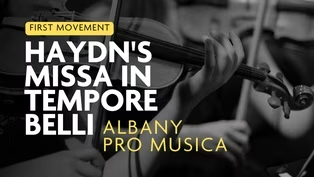
Albany Pro Musica Performs Haydn's Missa in tempore belli
Video has Closed Captions
Clip: S9 Ep8 | 4m 49s | Experience the magnificence of Albany Pro Musica's Haydn performance. (4m 49s)
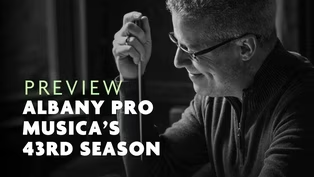
Albany Pro Musica's Season Preview
Video has Closed Captions
Clip: S9 Ep8 | 10m 58s | Explore Albany Pro Musica's upcoming season. (10m 58s)
Providing Support for PBS.org
Learn Moreabout PBS online sponsorship













Support for PBS provided by:
AHA! A House for Arts is a local public television program presented by WMHT
Support provided by the New York State Council on the Arts (NYSCA), M&T Bank, the Leo Cox Beach Philanthropic Foundation, and is also provided by contributors to the WMHT Venture...