
The Protect College Sports Act Cleared the US Senate. Here's What to Know
Clip: 10/7/2026 | 8m 41sVideo has Closed Captions
College sports teams are contending with higher costs and a greater frequency of transfers.
In recent years, the NCAA has reached settlements in wide-ranging anti-trust lawsuits, opening the door for player payments and boosting economic competition between schools. Congress is looking to change the laws.
Problems playing video? | Closed Captioning Feedback
Problems playing video? | Closed Captioning Feedback
Chicago Tonight is a local public television program presented by WTTW
WTTW video streaming support provided by members and sponsors.
The Protect College Sports Act Cleared the US Senate. Here's What to Know
Clip: 10/7/2026 | 8m 41sVideo has Closed Captions
In recent years, the NCAA has reached settlements in wide-ranging anti-trust lawsuits, opening the door for player payments and boosting economic competition between schools. Congress is looking to change the laws.
Problems playing video? | Closed Captioning Feedback
Where to Watch Chicago Tonight
Chicago Tonight is available to stream on pbs.org and the PBS app.

WTTW News Explains
In this Emmy Award-winning series, WTTW News tackles your questions — big and small — about life in the Chicago area. Our video animations guide you through local government, city history, public utilities and everything in between.Providing Support for PBS.org
Learn Moreabout PBS online sponsorship>> College sports teams are facing higher costs and more athlete transfers, signs of a system getting out of hand or simply players exercising their rights.
That's part of the debate over the Protect College Sports Act which passed the U.S.
Senate last week with bipartisan support and now heads to the House in recent years.
The NCAA has reached settlements in wide-ranging antitrust lawsuits.
Opening the door for player payments in boosting economic competition between schools and states.
Now all eyes are on Congress where lawmakers are looking to establish national standard on issues like eligibility and compensation.
Joining us now is Henderson, clinical assistant professor of sport management at Loyola University.
Thanks for joining us now with happy to be here.
what are some specific antitrust concerns that are unique to sports leagues?
>> Great.
So all antitrust law permeates all of sports.
I think one thing that we might not realize most people don't realize when they watch sports that the reason that the structures of professional sports look the way they do trades players getting caught drafts are so unique, right?
No account and finishes college and get drafted by KPMG.
That's all the result labor unions collective bargaining agreements that they enter into with their respective sports leagues.
College athletes are employees.
They can't unionize.
So a lot of things that we see in professional sports that we we might think get imported into college sports don't always happen because these leagues monopolies as is the NCAA antitrust law really place a heavy hand and how they operate.
What record as the NCAA have so far in antitrust lawsuits.
It's been a rough past 5 years for the NCAA.
>> Really stemming from a case in Twenty-twenty Alston v NCAA, which was limited in scope.
But it was a 9, 0, loss at the Supreme Court about the restrictions that they can have on the amount of scholarship athletes can her what a full cost of attendance scholarship looks like.
Since then, the NCAA is continued to lose.
Most notably there restrictions on transfers used to be athletes would have one penalty free transfer, significant case ultimately ended their ability to enforce transfer restrictions at all.
So at the completion of every season, athletes are eligble eligible.
The change teams whenever they want.
Subsequently the NCAA last kind of their longstanding are they didn't lose in court, but they had a settlement that ultimately ended their long-standing restriction of college is directly paying athletes themselves.
What a student want to want to make a transfer.
And and what are some the complications that come along with that?
>> Great.
So there's a myriad of reasons that student athletes want to transfer in non-revenue sports sports that don't bring in tremendous amounts of television rights, money.
>> Or you know, tickets to sell the fans.
Student athletes in those sports are not usually earning money so they might transfer because they're not getting enough playing time.
Perhaps they want to go somewhere.
That's a better fit academically.
They want to move back closer to home.
There's so many reasons the same that any normal student would want to transfer but when we look at football and basketball players who now are making 6 figures and at times even 7 figures annually for their participation college.
Sports teams, the reasons are usually are a bit more financial that if I go out and put by services on the open market, there's going to be a bidding war between schools for how much they want to pay me to play next season.
And so a lot of top athletes in football, basketball transfer financial reasons.
And then of course, they are students.
Right?
So then you've got to be sure that like they're on their academics for transferring as well to that other university.
Because isn't the point to get a degree?
>> Absolutely.
And that is a big concern and something that we haven't seen because all of these changes are relatively new.
>> But yes, student athletes who transfer notorious your credits don't always transfer even if you do.
Some schools have residency requirements that you have to complete 2 years there.
So many students who are making multi multiple transfers might ultimately sacrifice their ability to have a timely graduation.
>> In a Supreme Court case on player compensation into Double-A v Alston.
As you mentioned, Justice Brett Kavanaugh said, quote, traditions alone cannot justify the NC Double A's decision to build a massive money raising enterprise on the backs of student athletes who are not fairly compensated.
The NCAA is not above the law.
What message does this opinion center, the NCAA?
So this opinion back in 2020 was a little bit of the catalyst in part, kind of in conjunction with some state legislative efforts.
>> To open the door for, I think what a lot of people now known as nil, the ability for athletes to cash in on their name image and likeness and the way that any social media influencer cut an athlete could have a brand a following endorse products.
But ultimately that case opened the door for athlete compensation.
Now things change significantly.
Those endorsement contracts, clever boosters and clever schools found those as a vehicle to pay athletes for their athletic performance.
Not necessarily just a used car commercial, but more pay for play.
The Protect College Sports Act.
Now this would cap payments to athletes 50 million dollars per school annually.
Different schools are going to hit different levels you know, some schools are going to run into that.
That ceiling sooner than others >> in a letter to Senators Durbin and Duckworth, athletic directors from the 13 Division, one universities in Illinois said, quote, these improvements would provide student athletes with greater financial opportunity today while reinforcing the educational and health protections that help support them long after their playing careers end.
How would this cap change player compensation?
So I think that there would be more money in the total pot in the short term.
All those schools currently through.
>> There is a current cap, but there's a lot of ways to circumvent the cap through endorsement contracts with school apparel companies or other vehicles that probably a bit too much to get into the weeds into right now on on this show.
But ultimately the compensation capped would be elevated but would still restrict what schools are able to pay athletes, their schools right now that are far exceeding that number between their football and basketball teams combined.
>> Are there any examples of Congress regulating industries like this?
Any It seems unprecedented.
And I think that that's part of the opposition of this bill.
When you look at who's targeted Senator introduced an amendment that would effectively limit coaching composite compensation.
The impetus of this bill is exactly what those conferences set schools are facing massive financial pressure to remain competitive in the field athletics programs that can win on the field and ultimately serve as a marketing arm for the university.
However, when presented with the opportunity to cap coaching compensation right at a pretty significant figure, nothing over 5 million dollars.
Congress almost unanimous or not unanimously.
But Congress rejected that amendment right.
The group of individuals interested in capping earnings on seems to be the players themselves, right?
There's 20 or so head coaches who are making over 10 million dollars this year, right?
The only restriction seemed to be on the athletes the act would preempt state laws would have states previously done to try and regulate college sports states have done myriad of different things such as trying to shield their states from NCAA investigations.
Ncaa sanctions.
>> Ncaa effectively enforcement of their rules and regulations.
This would stop states from kind of trying to game what the NCAA can and can't enforce if you doesn't pass.
How would you expect college sports to change in the coming years?
I think college sports right now is bit of chaotic time.
Athletes are transferring schools are paying insane amounts of money to stay competitive without this act.
I think that we're going to see a lot of schools may be make a decision not to compete in division.
One athletics, perhaps maybe moving to a division 3 model, more focused on academics, then athletics themselves.
There could be implications where men's and women's tennis teams get cut or smaller non-revenue sports ultimately don't have the funding in order to have the money required to fund some of these
 New
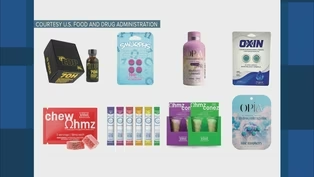
NewThe Highly Addictive 7-OH Is Raising Alarms Among Health Officials
Video has Closed Captions
7-OH is an opioid-like substance that can be found at gas stations, vape shops and CBD shops. (7m 47s)
 New
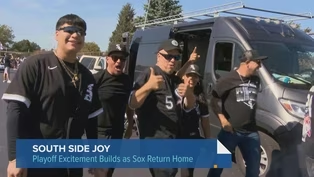
NewWhite Sox Fans Share Their Hopes for the Playoffs
Video has Closed Captions
WTTW News correspondent Joanna Hernandez is live at Rate Field. (4m 40s)
Providing Support for PBS.org
Learn Moreabout PBS online sponsorship New Episode
- News and Public Affairs

Top journalists deliver compelling original analysis of the hour's headlines.
 New Episode
- News and Public Affairs

Today's top journalists discuss Washington's current political events and public affairs.
 New Season


 New Episode
 New Episode
 New Episode

 New Episode
 New Episode
Support for PBS provided by:
Chicago Tonight is a local public television program presented by WTTW
WTTW video streaming support provided by members and sponsors.