
The public health crisis faced by Black Wisconsinites
Clip: 10/9/2023 | 6m 15sVideo has Closed Captions
Racism has left Wisconsin's Black residents suffering disproportionate disease and death.
Impacts of racism have left Wisconsin's Black residents suffering disproportionate levels of disease and death shaped by social determinants of health, from income to food access to sense of safety.
Problems playing video? | Closed Captioning Feedback
Problems playing video? | Closed Captioning Feedback
Wisconsin in Black & White is a local public television program presented by PBS Wisconsin
Funding for Wisconsin in Black & White is provided by the Ira and Ineva Reilly Baldwin Wisconsin Idea Endowment, DeAtley Family Foundation, Joe and Mary Ellyn Sensenbrenner, Lau and Bea...
The public health crisis faced by Black Wisconsinites
Clip: 10/9/2023 | 6m 15sVideo has Closed Captions
Impacts of racism have left Wisconsin's Black residents suffering disproportionate levels of disease and death shaped by social determinants of health, from income to food access to sense of safety.
Problems playing video? | Closed Captioning Feedback
How to Watch Wisconsin in Black & White
Wisconsin in Black & White is available to stream on pbs.org and the free PBS App, available on iPhone, Apple TV, Android TV, Android smartphones, Amazon Fire TV, Amazon Fire Tablet, Roku, Samsung Smart TV, and Vizio.
Providing Support for PBS.org
Learn Moreabout PBS online sponsorship[solemn music] - Nathan Denzin: Across the board, Black people in Wisconsin suffer disproportionately from bad health and/or barriers to health care.
Black children in the state are four times more likely to have lead poisoning than their white peers.
Also in Wisconsin, Black people die younger than almost all other races, and Black women are far more likely to die during pregnancy or in childbirth than white women.
The statistics are so bad for Black people that in 2019, Milwaukee County declared racism a public health crisis.
- We can say all health disparities are a direct consequence of being an American descendant of slavery.
- Nathan: Tito Izard is the president and CEO for Milwaukee Health Services, where he opened a clinic in an underserved neighborhood.
He says that because racism impacts every aspect of Black Wisconsinites' life, it affects their health.
- Health is, again, the narrow consequence of the condition or the environment that has been created.
- Black people, Indigenous people are disproportionately likely to be in impoverished and socially-stratified circumstances.
- Nathan: Tiffany Green is a professor for population health sciences at UW-Madison.
- We know that having unstable housing, not having enough food, being poor, those contribute to outcomes.
- Health is not just things that are going on in your physical body, but it is your emotional well-being, your mental well-being, your spiritual health, even your social health.
- Nathan: Dr. Jasmine Zapata is the chief medical officer for community health at the Wisconsin Department of Health Services.
She says health is much more than trips to the doctor.
- The things that happen outside of the clinic walls have more of an impact on one's health outcomes and quality of life than the very things we do in the hospitals and clinics.
- Nathan: All of those factors outside of the clinic are known as the social determinants of health.
- Dr. Zapata: Broadly, social determinants of health refers to non-medical factors that influence one's health outcome.
Where people are born, where they age, where they grow, where they live, where they work.
Things outside of the traditional medical model that we think of when we think about health outcomes.
- Nathan: When it comes to where Black Wisconsinites live, only a quarter of them own their own home, and they face one of the highest income gaps in the country.
A gap that has persisted since 1968.
Another important social determinant, how close you are to fresh food.
Black Wisconsinites are five times more likely to live in a food desert than white residents.
- We generally don't have control of the food that we have in our community.
You know, grocery stores, full service grocery stores are oftentimes far away from our communities.
- Nathan: Reggie Jackson educates people about diversity.
He says that living in a food desert means much of your food comes from gas stations or convenience stores, where the only options are highly processed.
- Reggie: People don't have access to healthy food or they can't afford healthy food.
- We didn't just come to this place where Black and Brown people are disproportionately likely to live in resource-deprived environments.
It is, it's racism.
- Nathan: But despite the declaration that racism is a public health crisis, Izard says not much has been done in Milwaukee since 2019 that brings parity to health outcomes.
- Making that declaration without subsequent steps though, is disingenuous.
So for most people in the community, it's like, "Okay, well, we hear that statement.
Tell us something that we don't know already," right?
- Nathan: For Izard, the only path forward is to improve all of the determinants of health.
The Madison-based Nehemiah is a community group working to take those subsequent steps.
- When you start to shift systems, then you start to actually impact the outcomes.
- Nathan: Kim Neuschel is now the community outreach facilitator at the UW School of Nursing.
When she worked as a public health nurse, she enrolled in Nehemiah's Justified Anger: Black History for a New Day course.
The nine-week course teaches the community about race, history, and justice.
- I think something like this course helps us zoom out and recognize that we all are who we are because of everything that came before us.
- Nathan: Neuschel said the course helped her realize the full scope of how racism has affected health care, and shifted her perspective to see patients more holistically.
- Health care is important.
Your genetic makeup is important, but significantly more important are the social, economic, and environmental factors, and these are the things that we know racism is, you know, embedded within.
- Nathan: The course also helped Neuschel's public health team find out why young Black students in one grade school were repeatedly absent from class.
- Kim: And one of the main factors was the walking route to school didn't feel safe.
- Nathan: So the team worked to make the path safe and inviting again.
First, they installed better lighting in a tunnel that felt unsafe, but then went further.
- We raised money to respond to their idea of putting in a mural that the kids designed.
- Nathan: After adding the lights, the mural, and a few other improvements, absence rates improved.
- And we did show at the end of that, kids' sense of safety and sense of belonging and connection both to the school as well as to their community and that walking route really shifted for them.
- Nathan: That shift brought healthy change and access to opportunity in the children's lives who now felt safe enough to walk to school every day.
- It's good to become aware; it's better to actually transform that into actual actionable items.
What are you specifically going to do?
- Nathan: For Here & Now, I'm Nathan Denzin.
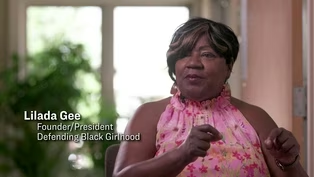
Lilada Gee on generational trauma and the Black experience
Video has Closed Captions
Lilada Gee on the struggle to pursue healing for the traumas of racism and injustice. (1m 33s)
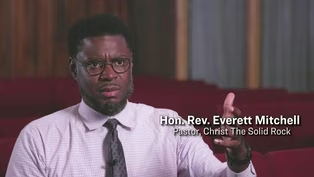
Hon. Rev. Everett Mitchell on Black communities and church
Video has Closed Captions
Everett Mitchell on the significance and impacts of Black churches and faith. (1m 59s)
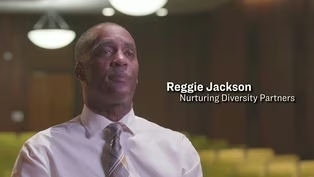
Reggie Jackson on life expectancy among Black Wisconsinites
Video has Closed Captions
Reggie Jackson on Wisconsin's persistent racial disparities in life expectancy. (2m 10s)
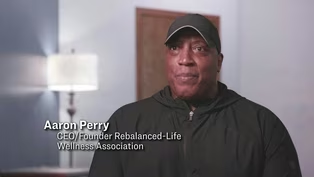
Aaron Perry on obstacles to Black men's health in Wisconsin
Video has Closed Captions
Aaron Perry on an array of chronic health problems among Black men around Wisconsin. (2m 32s)
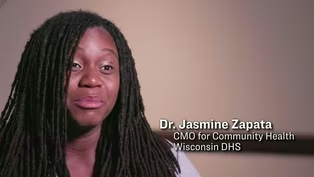
Dr. Jasmine Zapata on the impacts of having a preterm birth
Video has Closed Captions
Dr. Jasmine Zapata on the state's high Black infant and maternal mortality rates. (3m 24s)
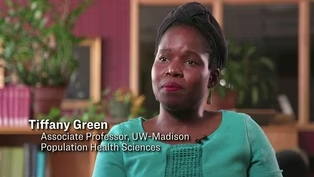
Tiffany Green on racial inequities in delivering health care
Video has Closed Captions
Tiffany Green on trust and racial biases among medical providers for pregnant patients. (2m 30s)
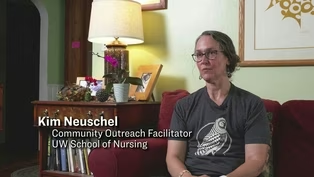
Kim Neuschel on safety and outcomes for children in school
Video has Closed Captions
Kim Neuschel on an effort to help elementary school students in Madison feel safer. (2m 43s)

Dr. Tito Izard on tracing racist roots of health disparities
Video has Closed Captions
Dr. Tito Izard on continuing health disparities and barriers to care in Black communities. (1m 47s)
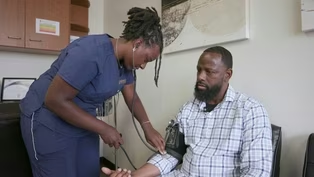
A mission to expand health access for Black men in Wisconsin
Video has Closed Captions
One athlete is developing a health care model that expands access options for Black men. (7m 8s)
Racism, cycles of trauma and the importance of mental health
Video has Closed Captions
Generational trauma harms the mental health of Black children and adults in Wisconsin. (6m 8s)
Wisconsin's racial disparities in maternal, infant mortality
Video has Closed Captions
Deaths of Black infants, mothers in Wisconsin are shaped by access, biases in health care. (7m 16s)
Providing Support for PBS.org
Learn Moreabout PBS online sponsorship












Support for PBS provided by:
Wisconsin in Black & White is a local public television program presented by PBS Wisconsin
Funding for Wisconsin in Black & White is provided by the Ira and Ineva Reilly Baldwin Wisconsin Idea Endowment, DeAtley Family Foundation, Joe and Mary Ellyn Sensenbrenner, Lau and Bea...