Utah Insight
The Purse Strings of Public Lands
Season 2 Episode 9 | 26m 46sVideo has Closed Captions
Nearly 2/3 of Utah is public land. Here's how that impacts local budgets in rural Utah.
The federal government owns nearly two-thirds of all the land in Utah, and the way that land gets managed often impacts rural budgets. From revenue generated by tourism, to the complex way local governments are compensated for lost property taxes, the issue can be complicated. We’re bringing together leaders from around the state to discuss the intricate economics of Utah’s public lands.
Problems playing video? | Closed Captioning Feedback
Problems playing video? | Closed Captioning Feedback
Utah Insight is a local public television program presented by PBS Utah
Utah Insight
The Purse Strings of Public Lands
Season 2 Episode 9 | 26m 46sVideo has Closed Captions
The federal government owns nearly two-thirds of all the land in Utah, and the way that land gets managed often impacts rural budgets. From revenue generated by tourism, to the complex way local governments are compensated for lost property taxes, the issue can be complicated. We’re bringing together leaders from around the state to discuss the intricate economics of Utah’s public lands.
Problems playing video? | Closed Captioning Feedback
How to Watch Utah Insight
Utah Insight is available to stream on pbs.org and the free PBS App, available on iPhone, Apple TV, Android TV, Android smartphones, Amazon Fire TV, Amazon Fire Tablet, Roku, Samsung Smart TV, and Vizio.
All Episodes Now Streaming
Hosted by Jason Perry, each week’s guests feature Utah’s top journalists, lawmakers and policy experts.Providing Support for PBS.org
Learn Moreabout PBS online sponsorship(soft chiming) Funding for Utah Insight is made possible By viewers like you.
Thank You (gentle upbeat music) Next on Utah Insight money and management.... We believe agriculture and businesses, communities up and down the river can have a better partnership than we currently have under the current management plan for the reservoir and the recovery program..."” We dive into the tricky debate surrounding the purse strings of public lands... How a shift in ideas managing resources versus protecting and preserving land has split communities... plus what changes are on the horizon with President Biden'’s 30 by 30 Plan.
♪♪ - Welcome to Utah insight, I'm Liz Adiola.
There's an ongoing struggle happening in rural communities across the nation.
A push and pull of who determines what happens to the land where people recreate, earn a living, and respect the historic ties that go back long before you and I were even thought of.
If you looked up the definition in Merriam-Webster, they would tell you that public land is land that's owned by the government.
And it's reinforced by the Forest Land Policy and Management Act of 1773.
Dig a little deeper and you'll learn about the 13 different designations of US public lands.
A few of the examples are on your screen right now, national parks, monuments, and scenic byways.
Yep, those are all public lands.
And check out this BLM map of Utah on your screen.
BLM or the Bureau of Land Management manages 22.8 million acres of public lands in Utah.
About 42% of the state.
You can see privately owned land, if you come close up to your screen, you can see it depicted in white on that map.
Well, joining us now to discuss what's going on with public lands, we have representative Mark Wheatley, who serves Utah's 35th district.
Joining us via Skype, Irene Hansen, who is the Duchesne County Commissioner, and also on Skype, Ashley Korenblat, who is the managing director of Public Land Solutions.
Glad to have you all here today.
I gave a little bit of history and background to start us off, but let's dive a little bit deeper into some of the main concerns regarding public lands in Utah right now.
Irene, what are you hearing?
- Well, of course, we're anxious to maintain multiple use.
We feel that that's the best way for Utah and to be very honest for the nation, to make sure that we have a robust use of public warrants.
Duchesne County is a 27% private.
So all of the rest, of course, being owned by either the federal government, we also are very proud of the fact that we have the Ute Indian nation within our boundaries in both and basically the entire Uinta basin.
But what we're hearing is optimism, but also concern because, and I'll refer to this several times, I believe that 70% of the people agree, 70% of the time, about 70% of the issues.
And I really believe that's where we need to start.
What do we agree on?
And there's a whole bunch that we do.
- And representative Wheatley.
What are you hearing right now about this issue?
- Well, I'm hearing a lot of the same things.
We have a lot of individuals who have concerns about maintaining the preservation and conserve our public lands.
We have a lot of concerns from our other legislators about the percentage of private lands that are administered by the federal government.
But there's a lot of optimism, I agree, that people, farmers, outdoors, people that hike and love our outdoor facilities, and camps, and grounds that they can agree on a lot of what is being talked about.
And I agree that 70% of the people agree with 70% of the time.
But there are some distinct differences that we have to address.
- And what would those differences be?
- Well, I think the percentage of federal lands that are currently being managed, that's a big issue.
We have to ensure that our ecosystems are not disrupted, our grassland ecosystems, our forest ecosystems, and our aquatic ecosystems.
Sometimes there's different ways of approaching that, we have cattle, our ranchers who take care, they do a fantastic job.
But with the situation as it is now with the lack of water, we're the second dry state in the nation, there are big, big concerns that some of them may not be able to continue that they've had in their family for generations.
And so we want to ensure that we're all on the same page on these issues.
- And Ashley, what are you hearing right now?
- Well, Public Land Solutions works on the business angle of public lands regarding how these lands bring revenue to the communities nearby.
And what we're seeing is this really macro economic trend where people want to get outside.
The pandemic has really accelerated demand for outdoor access.
And so we're going from a time a few hundred years ago when private land was the best way to generate wealth for your family to a new time where communities that have shared access to public land are really prospering because entrepreneurs, businesses, professionals want to locate in places where they have access to public land.
And Utah has a long tradition of this.
This is how Goldman Sachs and Adobe chose Utah, because of the outdoor access that we have.
And there's a real opportunity coming up to spread that economic prosperity to more of rural Utah, because so much of rural Utah has access to the out of doors.
- And Ashley, you touched upon it.
I wanna dump into how the pandemic has impacted these concerns.
Irene, we spoke a little bit about the crowds that you're seeing in your area.
- Yeah, of course I brag all the time about beautiful Duchesne County, and sure enough, people are coming from far and wide, oftentimes they're passing through to dinosaur land, to Colorado, to other areas.
But certainly we are a destination.
The beautiful High Uintas wilderness brings tens of thousands of people every year that want to hike, that want to get away.
Now in all honesty, there is, you know, when you actually have wilderness, there's not a lot of people that can access that, simply from a health perspective.
I think it's less than 10% of the public that can strap on a 60 pound backpack and walk 20 miles.
So it's from that standpoint, it's not open to everyone and that's kind of a shame, but we do have a lot of people visiting and we're thrilled about that.
It does cause impacts to some of our services, and we certainly are not considered the destination tourism area that other areas are.
- Wow, and representative Wheatley.
You're on the board of HACHO, Can you share a little bit about what that is and in how your organization tries to bring access to more people?
- Well, HACHO stands for Hispanics enjoying camping and hunting outdoors.
It's been in existence since 2013.
And we provide a platform for individuals to contribute to talk about public land issues, make sick recommendations, so on and so forth.
But we want to ensure that the voices, Hispanic voices and Latino voices are strengthened by ensuring that when it comes to public lands, that they have a voice and they have a voice of advocacy.
And we wanted to continue this tradition and encourage more and more people, especially people of color, to be part of the outdoor recreation and of our public lands.
It's such a beautiful, beautiful state that we have, and we need to all be able to enjoy.
- Absolutely, and in Emery County, the annual Joe's Valley Festival focuses on building relationships.
It's returning in September, and this festival focuses on building those relationships by creating a net understanding and respect between community members and those who visit for recreation.
Castle Dale mayor, Danny Van Wagoner had this to say about the issue and everything that's going on.
He says "Public lands are just that, 'public' but more importantly, it must be balanced.
We must protect and enhance our lands for the locals by bringing them together.
Now's the perfect time to get acquainted, explore, share a sandwich and stories.
It's all ours, everyone recreate responsibly."
Irene, you shared that you've experienced some not so great situations with people wanting to enjoy the beauty of your area, but showing disrespect to the very way of life that sustains that area for the people who live there.
Can you talk about that?
- Yeah, you know, it is discouraging when people come and they find their treasure or their beautiful vacation, that they were excited to take, they come and enjoy the dark skies, the landscape, the mountains, the rivers, whatever might be the case, but somehow as they're traveling to their destination, or their adventure, they don't wanna see how we make our living.
And yet I would never expect that I would travel to my destination in Salt Lake City or in Portland, Oregon, or anywhere else, and not have to drive by how people make their living, whether that's farming and ranching or whether it's energy development.
Again, we know that there's places where things should be done and other places where it shouldn't.
But it certainly, sometimes that can be quite to be very honest with, just hurts our feelings.
Because again, we farming and ranching, those things are our way of life.
And we hope that when people come for their adventure and we're so thrilled, they do come, that they actually respect our way of life and what we're doing and how we make a living.
- And representative Wheatley.
I was on head show's website and I saw that it calls for conservation, and conservation is it has that aspect on it.
And for so many people, they hear that word and they think that it's a threat to their way of life.
What do you say to those people?
- Well, I don't think it's a threat to their way of life.
What we want to do is ensure that what we're enjoying now is passed onto the future generations and that we work with all individuals that are involved in our public lands.
And I think that's what we should be doing.
If individuals have concerns, they should be working with the towns, cities, and counties, and your legislators to address some of those concerns.
But let's- I do believe that we can have individuals come together and work together to ensure that the way of life is not impacted and still maintain the beautiful visitors that we have, that we share statewide.
- So Ashley, how do communities find a way to balance extraction, and conservation, recreation, and resource management?
- Well, there's two things you really have to look at.
You have to look at the economic trends,, what's really happening economically?
And where are future revenues gonna come from?
So once you've kind of looked at that, the next step is to look at the details and think about, what experiences are we providing and how can we maximize the visitor experience while maintaining the locals way of life?
And so it gets into the details of, where the trail heads are, how the trail heads are managed, where you're gonna develop oil and gas, how you want, which landscapes are best for what, and then how we market them.
There's been a long tradition of the marketing department being somewhat disconnected from the product development department.
So there's a real opportunity, and Emery county is actually taking steps to do this, really looking at their recreation assets and balancing what should happen where, and how to get OHVs out of Green River without disturbing neighborhoods.
Little details like that are super important as we see more visitors.
And there is a chance to balance all of this, and to make it work for everyone, but it takes some work on the ground, in the details.
- Absolutely.
We turn now to Daggett County where a plan to save endangered fish backfired on farmers and local businesses.
Utah insights RaeAnn Christiansen has more on the fallout and how one farmer plans to move forward.
- [Jack] We all need these public lands and the grazing and the multiple use.
We've just got to fix some of the impacts that some of these management plans, they were unintended consequences, but they're very real consequences that we've got to find the right solution for it.
- Our family has been here since 1885.
This particular property was settled in the early 1880s, late 1870s in there by some of the original settlers.
We of course raise hay, over a cow-calf operation.
- [RaeAnn] The land of Vermilion ranch has been in T Wright Dickinson's family for more than 135 years.
His ranch is dependent on the most precious resource, flowing in the Green River.
But nearly six decades ago, the dynamic of the river changed forever.
Standing more than 500 feet above the canyon floor.
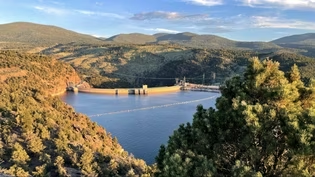
The Flaming Gorge dam was completed in 1964.
- [Wright] There were consequences when the reservoirs were created, the system was no longer natural.
- [RaeAnn] The Green River behaves differently, and the native fish are paying the price.
In an effort to help endangered species of fish, the bureau of reclamation started artificial releases of water at the dam back in 2006, but that operation has had effects that were not intended.
- [Wright] This all used to be hayfield at one time, we've lost in this area, probably about four or five acres.
- [RaeAnn] The sediment hungry river is stealing T Wright's land.
- We lose the annual hay crop beside, it isn't the one-time loss of land.
It's the productivity that you lose with a land over time.
- [RaeAnn] From above, you can see the river has carved away his property in multiple locations.
The cracked unstable land shows there's more erosion coming.
- [Wright] The impacts are being felt by the fishing businesses, the farmers and ranchers, the folks along the river who are losing property, and losing stability of their businesses.
- Certainly being the commissioner is a lot more than public lands.
But when Daggett County is 89% public land, it certainly is one of the issues we pay attention to.
- Balancing the needs of the fish and every stakeholder with the river is not an easy task.
Jack Lytle is a Daggett County commissioner.
- There really wasn't anything for the economic impact of those changing flows.
So we're trying to bring that thought to the table to say, hey, is there some stuff we can do or figure out some funding sources that will help these guys that are kind of paying the price for those fish to get recovered?
(water flowing) - [RaeAnn] Jack says he wants both the government and businesses to take responsibility for their actions on the river.
- You look at what the private land owners, the ranchers and farmers, whether it's sweat equity or cash that they've done to make these fields be productive.
And then to see that going away, when there are ways to physically help that bank become more stable and not have that loss.
It's not an insurmountable thing, but it does take money.
- [RaeAnn] This year, the Utah legislature passed H.C.R 1, a resolution to support the Green River stakeholders and reduce the adverse effects of Flaming Gorge dam, Jack and T Wright both have confidence it's going to help.
- [Jack] Every person that's involved as a partner in one form or another, especially from an agency standpoint.
And then the public has an interest in it as well, we have a responsibility to serve them.
- We hope that that's going to create the catalyst that we need to bring both the state and federal agencies together.
- [RaeAnn] T Wright says the impact from the high flows are not sustainable for his property, and they have to find a way to mitigate the effects.
- [Wright] That's the ultimate solution is get out of the river and get the river back in balance.
We've got to change the recovery program so that works for all of us.
- Ashley, what are your thoughts after watching that story?
- Well, the first piece has to do with the law of unintended consequences, right?
When we change nature, we don't always think how it's gonna affect everybody or everything.
So that is a big challenge going forward as we work to solve some of these types of problems.
It sounds like they are working towards acknowledging the effects of this and looking to find solutions and working together to do that.
So that's always positive.
- Absolutely, and one thing that stuck with me was Jack's words saying that everyone is involved as a partner in one form or another in this process.
Ashley, does that ring true in your line of work, and how can more people who feel like they have no stake in this get involved?
- There are really lots of opportunities to get involved and you see that communities that have good partnerships with their federal land managers are really making progress.
The federal land managers so much of their job is to seek public input, but oftentimes that gets complicated or polarized or just it isn't productive.
And a lot of what Public Land Solutions does is work with stakeholder groups so that we can sort out those really important details and try to anticipate these types of unintended consequences and mitigate for them from the start.
But there are so many NGOs that work with their user groups, from hiking groups, to mountain biking groups, to fishing groups that work very well with their federal land managers.
And those types of partnerships really do help.
- Irene, we just had a big an election season and the changing of the guard, so to speak.
Can you talk about the, how you navigate making those relationships when people come and people go and things change?
- You know, it is hard.
I've often said that I get attached to people.
And so it is hard as land managers change, and administrations change.
But I will tell you one thing we've done here in the Uinta the basin, we have a monthly collaborative meeting with all of our federal and state land managers, elected officials, public lands, offices within the county.
And we basically just go around the table and talk.
We visit about activities, events that are coming.
We talk about issues that may be coming up.
We don't try and solve maybe the giant issues that none of us are, because the local land manager doesn't have a ton of authority.
They certainly do have authority, but a lot of those policies are set in Washington, DC, and even with the state of Utah.
But we have great relationships, we know who we can pick up the phone and call.
We all again, we agree, and actually it's more than this, but 70% of the time.
And we really do.
And I think we all understand how blessed we are to live in the state of Utah, to have these public lands, to have the opportunities to build our lives and livelihood, and also to allow residents of the United States and the world to come and see these amazing, these amazing treasures that we have in Utah.
So we appreciate those relationships and it's been proven that they work.
Counties are considered collaborators, and we have a seat at the table, and we appreciate that.
And it definitely pays big dividends.
- Well, looking ahead, towards the future, president Joe Biden has shared his 30 by 30 plan that seeks to set aside 30% of the nation's land in water by 2030.
Representative Wheatley, what are your thoughts on this plan?
- Well, it's a starting point.
It's a starting point, there's a lot of collaboration that needs to happen.
It starting from individuals who have concerns or have ideas.
As I mentioned before, to work with their cities, towns, and counties and elected officials to come together and collaborate and address their concerns and work together.
And so there's not a whole lot of- I think it's a fabulous idea, but we need more specifics and that will happen.
We need to conserve, we need to ensure that the individuals are not adversely affected like ranchers.
But it's something that I believe in and that we can get it done.
- Irene, what are your thoughts on this?
- You know, I would just say very quickly that, I believe that Utah along those lines has done their share.
So if this becomes a model that we believe is viable, then it should start in states with little or no public lands.
So let's start there, because maybe they haven't done their share.
And I think Utah has, and we've proven our commitment to the land, our commitment to conservation, our commitment to the environment.
And I believe it should start in other places.
I'm not sure that it is the way to go, but if it is, then let's start in some of the states that don't have any public land.
- And Ashley, what are your thoughts?
- Well, they've renamed it America the Beautiful, and they're in the process of working out all of the details of what this could mean.
And a lot of folks said it really has to be based on an opt in program, and they took that to heart.
And it's one of the eight points that they make about the America the Beautiful program, that it is an opt in program.
So I think there's a real opportunity.
Every part of America has beautiful lands that are worth conserving from an ecosystem standpoint, but also from an outdoor access standpoint.
So I think it is, there's a lot of misconceptions around it.
I'm looking forward to those things getting straightened out, and everyone's starting to look around and saying, okay, what areas in our county are worth looking at more or improving or changing the way we manage to protect them for the future.
And there is a whole spectrum of what that word conservation means.
Anything from just a park to wilderness, there's a whole lot in between.
And I think we're gonna be able to explore those and find ways to maintain those lands that work for each community.
- Well, thank you all for joining us and thank you for sharing your perspectives.
For more on this topic, you can head to pbsutah.org to view the documentary battle over bears ears, and this all PBS plus we'll release an updated version of the documentary nationwide.
Next week on Utah Insight, is Utah's higher education system, helping students prepare for success.
You can join the conversation using the methods that were just on your screen.
Thank you so much for watching Utah Insight.
Have a great week.
(gentle upbeat music)
Video has Closed Captions
Clip: S2 Ep9 | 4m 22s | How a plan to save endangered fish backfired on farmers and businesses in Daggett County. (4m 22s)
The Purse Strings of Public Lands - Preview
Preview: S2 Ep9 | 30s | On the next Utah Insight, how federal management of public lands impacts local Utahns. (30s)
Providing Support for PBS.org
Learn Moreabout PBS online sponsorship
- News and Public Affairs

Top journalists deliver compelling original analysis of the hour's headlines.

- News and Public Affairs

FRONTLINE is investigative journalism that questions, explains and changes our world.












Support for PBS provided by:
Utah Insight is a local public television program presented by PBS Utah