Lakeland Currents
The Reality of Human Trafficking in Northern Minnesota
Season 15 Episode 12 | 27m 59sVideo has Closed Captions
The reality of human trafficking in Minnesota is discussed with experts from the area.
Join Lakeland Currents host Jason Edens as he welcomes his next guests, Regional Navigator Kate LePage with East Central MN Safe Harbor and Heather Kelm, Executive Director of Port Homes while they discuss the hard facts on human trafficking and its affects on our families and communities in Minnesota.
Problems playing video? | Closed Captioning Feedback
Problems playing video? | Closed Captioning Feedback
Lakeland Currents is a local public television program presented by Lakeland PBS
Lakeland Currents
The Reality of Human Trafficking in Northern Minnesota
Season 15 Episode 12 | 27m 59sVideo has Closed Captions
Join Lakeland Currents host Jason Edens as he welcomes his next guests, Regional Navigator Kate LePage with East Central MN Safe Harbor and Heather Kelm, Executive Director of Port Homes while they discuss the hard facts on human trafficking and its affects on our families and communities in Minnesota.
Problems playing video? | Closed Captioning Feedback
How to Watch Lakeland Currents
Lakeland Currents is available to stream on pbs.org and the free PBS App, available on iPhone, Apple TV, Android TV, Android smartphones, Amazon Fire TV, Amazon Fire Tablet, Roku, Samsung Smart TV, and Vizio.
Providing Support for PBS.org
Learn Moreabout PBS online sponsorshipWelcome to Lakeland Currents, your public affairs program for north central Minnesota.
Production funding for Lakeland Currents is made possible by Bemidji Regional Airports, serving the region with daily flights to Minneapolis St Paul International Airport.
More information available at bemidjiairport.org.
Closed captioning for Lakeland Currents is sponsored by Nisswa Tax Service, tax preparation for businesses and individuals, online at nisswatax.com.
Hello again friends.
I'm Jason Edens, your host of Lakeland Currents.
Thanks for joining the conversation today and thanks for your ongoing support of Lakeland Public TV.
According to the judicial branch of Minnesota, our state has the 3rd highest rates of sex trafficking in the nation.
This is an international issue that's taking place right here in our backyard.
We've all been learning of high profile cases of sex trafficking, both here in Minnesota and around the globe, which is why we're addressing this issue once again on Lakeland Currents.
In fact, this is the first of two conversations.
Later this season, we're going to be learning about Rotary International's efforts to end human trafficking, but today, my two guests will help us better understand this difficult and complex issue and what's being done about it right here in our region.
Kayla Page works to prevent human trafficking and support victims at Lutheran Social Services, and Heather Kelm is the Executive Director at Port Group Homes in Brainerd, Minnesota.
Kate and Heather, welcome to the program and thanks for making time for our conversation.
Thanks for having us.
Thank you.
Absolutely, so first of all, Kate, as I mentioned, Minnesota has some terrible statistics when it comes to sex trafficking, so I was wondering if you would start out by defining sex trafficking, and then explain to us what's the extent of this program in our region.
Sure, so in Minnesota, we follow a little bit of a different definition of sex trafficking than our federal partners do.
However, in Minnesota, trafficking is really a third party being involved in the commercial sexual exploitation of another.
Commercial sexual exploitation is the exchange of something of value, or the promise of something of value, for a sexual favor/sexual act.
That "something of value" could be transportation, could be money, could be food, drugs, housing.
It really is anything that's perceived of value, so in Minnesota, trafficking is when we have that exchange happening between two parties, and then we have an a third party involved.
That third party is involved in the facilitating, transporting, or knowingly being involved, in that transactional situation in any way, shape, or form.
How extensive is this in Minnesota?
Well, like you said, there's statistics out there from a bunch of different avenues that kind of say different states have the highest statistics, or in the top 10, or top 5; it's really such a hidden issue that I have a hard time leaning into any of those statistics too heavily.
I can say in Minnesota that we have really created a good approach to identifying and responding and having services for victims, which means because we're putting so much effort into identifying and responding, we're seeing it more than other states, that maybe don't have the same level of services in place already.
I do know that according to the Minnesota Student Survey, when we look at youth that are impacted by this issue, they found that about 5000 youth were underestimated to be impacted by commercial sexual exploitation each year.
That stemmed from self-disclosures out of the Minnesota Student Survey, looking at youth from all over the state.
We also know a lot of people think that this issue is related more to metro areas, however, that Minnesota Student Survey also showed us data and numbers to support that this is happening throughout the entire state and actually, at higher rates in rural communities.
Our rural communities with less access to resources, housing, and economic stability and growth, seem to have higher rates of exploitation and trafficking taking place.
Kate, that leads me to ask you, do we really have a full understanding of the extent of this issue, it sounds as if the data is a little bit spotty, is that accurate?
I think that this issue is so hidden that we're never going to have a clear accurate snapshot of the data, because it stems from mostly disclosures of individuals that are going through this type of victimization.
That's similar to any type of sexual violence, as I'm sure Heather sees in her work, too.
A lot of times we're working with individuals that have experienced victimization for a long time prior to closure.
We know that things happen behind those doors; there's always going to be a gap in reports versus what's actually happening in communities.
Well, that makes sense.
I have a question for you which is, according to the Minnesota-based Wilder Foundation, about 6000 Minnesota youth experience homelessness every single night, so, I'm curious, to what extent does youth homelessness actually contribute to human trafficking, and what are the other causes?
It's certainly one of the risk factors, along with sexual abuse, emotional abuse, physical abuse, mental health issues, chemical dependency.
Certainly, homelessness is right up there with with all of that, and kind of speaking a little bit to what Kate was talking about, kind of being hidden, we see a surprising number of youth being sex-trafficked by family members, and sometimes generationally, where we've had situations where the grandmother is trafficking the daughter, who's trafficking the granddaughter.
It's quite, quite startling, things that these kids are going through.
That's astonishing, I would like to know a little bit more about who the victims are, Kate.
How do people become victims ,and generally speaking, if that's a suitable question, who are they?
It's really a grooming process, and I know over the last couple years, there's been a lot of conspiracy theories out there, and social media has kind of flooded us with all of these myths around trafficking and sex trafficking , and what that looks like.
We're always worried of the "stranger-danger" mentality, but really, what we find is the vast majority of cases involving trafficking or exploitation are involving somebody that is known to the victim.
There's a grooming process that takes place, like Heather was stating, there's familial trafficking, and we know that that's happening a lot.
That's a large portion of any of the reports coming through to child protection in Minnesota.
I don't have the number on hand, so I won't speak to any percentages, but it's a pretty high number of cases that are being reported that are familial.
The cases that aren't familial are still involving someone that's known to the victim, so whether that person is represented as a significant other, as a friend, as a neighbor, as an employer, as a landlord, you know it's somebody that they know.
It's not somebody that's being abducted, and I think that's what makes this issue kind of scary to our communities, is it's happening right under our noses.
We have those that are being trafficked and exploited that are still going to school, still living at their home, and it's just it's so well hidden in the grooming, and the trauma bonds are so prominent, that it's not as easy to see as we would like to think.
As for those that are being impacted, we know that cisgender boys and girls are impacted at about 50% rate, so about equal rates, and then our transgender youth, or gender non-conforming youth, are victimized at an extremely high rate compared to our cisgendered youth.
We know that grooming takes place and youth are identified as potential victims for grooming, based on needs and vulnerabilities.
When we look at different youth, or different communities, different populations, that have higher vulnerabilities or more vulnerabilities, we have to understand that they're going to be easier to groom, because there's more things that, that exploiter or trafficker, can take advantage of and more needs that they can meet that families aren't meeting or societies aren't already meeting.
So the other piece of that is, who's being victimized aside from gender, is minorities.
Minorities in our community are also victimized at a much higher rate and the race in Minnesota that is impacted at the highest rate, is our native population, and there's a lot of info out there, and there's a new report that was released that the Missing and Murdered Indigenous Women's Task Force put out.
I won't speak to that today, but if people want to learn more about how our native communities are being impacted on this issue, but sexual violence and generational violence in general, that's a really great report to start with.
I believe I heard you use the term "trauma bond," is that correct, and what does that mean?
Yes, so trauma bond, a lot of people understand "Stockholm Syndrome."
Stockholm Syndrome is when somebody has a threat to their life, followed by a small act of kindness; over and over and over, so it's this repeated threat of violence followed by a kind act.
It creates this really strong bond between a victim and a perpetrator.
Trauma bonds are very similar to that, but in addition to that, they have this relational component, so when you have somebody that it's consistent threats and predictable threats of violence, and abuse manipulation or harm, followed by intermittent love and care, we have this really strong bond that's created between a victim and a perpetrator.
With traffickers and exploiters, we see this trauma bond taking place in almost every case that I've seen, so again, I've been working in Safe Harbor, so specifically with trafficked and exploited youth, for over 4 years and I have yet to have a case where somebody is abducted.
It's always the slow progression of grooming and trauma bonds that are formed with a victim.
I appreciate the clarification there.
Heather, I was going to ask you about a nationwide FBI investigation that has basically revealed that about 60 percent of trafficked individuals have a history with the foster care system and group homes, so my question to you is, to what extent, or I should say, how are you able to safeguard against trafficking risks in a group home environment, or in your case, Kate, at Lutheran Social Services with your foster care program, how do you safeguard against that inherent risk?
Heather?
Well, we have a lot of safeguards that we put up; the first and foremost would be, we have physical, and that would be locked doors, ensuring the safety of the youth, making sure that they're not hanging out at the windows and can be seen.
A lot of times, the survivors, or, the victims, they can be re-traumatized just by having those windows, or the thought that their perpetrator might come to see them or find them.
Those are some of the kind of physical ones.
We also implement different tactics with phone calls, so that we know the person who's on the phone is the person who is supposed to be on the phone, through various methods and things like that, so just really trying to make that youth feel safe and do everything that we can, both physically and emotionally, to kind of protect them.
Making sure they're not having contact with their perpetrator.
So Kate, same question for you.
Of course, Lutheran Social Services manages a pretty large foster care program, how does LSS safeguard against those risks?
Sure, so LSS is a really large program, so I can't speak to all of our programs around the state.
I know that in my role as a regional navigator, part of my job is to provide education and create systems where we're identifying and responding to this issue appropriately with youth and adults.
I've done a lot of trainings and educational forums to Foster parents, as well as parents in general in the community, to help them not only learn about this issue and what it really looks like - but how to look for warning signs of unhealthy relationships and grooming behaviors; so that we can better identify this prior to, sometimes victimization, taking place.
We know that online is a huge avenue for traffickers and exploiters to begin grooming, so I talk to foster parents, and parents in general, again, a lot about how to look for unhealthy internet use and how to kind of safeguard against some of those things within your own home.
When we had, prior to two years ago, we had a foster care program that was Safe Harbor -funded out of my office and I did work in that program.
What that program was, is we basically utilized foster care homes to house trafficked and exploited youth, and during that time when we were using foster care homes and we were specifically using LSS Therapeutic foster care homes, if at all possible, for that program, is I would do a training with each of the foster care providers to help, before we would place anybody with them, to make sure we had safety plans in place in case a youth were to go on the run.
We know that youth are likely to go back to trafficking situations 7 to 9 times before leaving.
Again, that stems from those trauma bonds and those relationships with their traffickers.
Again, if that's a familial relationship or a romantic relationship or a friendship, there are significant relationships that do mean a lot to these youth.
So they are going back to those situations at a fairly high rate, and one of the things that we always talk about with anybody that especially is confirmed exploited or trafficked, when they go back to their home or go into a foster care home or even a group home, like Port, with Heather, is how are we going to create safety plans if this youth goes on runs, or talks about going on the run; so making sure that they have a safe place to go, that they know what their local resources are.
Also, one thing we did with our program is for minors, we have a photo of them and an identifying information sheet all ready to go, so if they go on the run, we can get that out to law enforcement right away, and have a really streamlined process for locating them as soon as possible.
So, by "on run", I'm assuming you mean escaping a group home or a foster care environment, or what is, what exactly does that mean?
Yeah, so youth go on run all the time, unfortunately.
Right from group homes, from foster care homes, but also from their own homes as well.
Actually, a lot of kids that end up in places like Port and other group homes, are there because they consistently are going on run from their parents home.
So yeah, it means that they're just leaving the environment without permission, essentially, and going to stay somewhere else, or couch hopping.
Some youth, in the summertime, will sleep on the streets.
For whatever reason, they're not at home, so they're leaving that environment without permission is essentially what that is.
It's not a missing youth, where they're removed from their environment and they're leaving.
So Heather, you've been serving as the Executive Director of Port Group Homes for 17 years, is that correct?
I've been with Port for almost 18 years, serving in the Executive Director role for the past 6 years.
I see.
During that tenure of 18 years, how have you seen this issue evolve or change and to what extent are you serving trafficked individuals at your group homes?
I don't know that it has necessarily evolved or changed, I think there's just been a lot more awareness being brought to, awareness and understanding.
I think the general public is starting to get an understanding of what it is, who it is, and that's the part that has kind of changed.
The same youth who came into Port's doors 18 years ago are the same youth that are coming in there now, with the same trauma, very significant trauma, trauma histories, and things like that.
Yeah, I would say, I don't know that it's the kids that have changed so much as much as the insight.
I think we have all kind of grown to understand about human trafficking.
Well, how has that insight changed the way in which you deliver your services?
I would say, in some ways it's become a lot easier, because there's a lot more resources available, not just to Port, but also to the survivors or victims of sex trafficking.
There's a really good curriculum out there called "Not a Number," and we started incorporating that within Port probably about 5 or 6 years ago.
That really helps the youth understand and learn how to develop healthy relationships with those who are in their lives.
Something that I was actually pretty surprised at was the takeaways that these kids were getting from the program, things that I would take for granted, what I learned growing up.
These kids are not learning those kinds of things, whether it's their trauma, their homelessness, their support system, they're just not getting that stuff.
When they come to a place like Port or another group home, or just a class in the community about human trafficking, or the "Not a Number" curriculum, they can learn those types of things.
Well Kate, I wanted to follow up on something you mentioned, because I actually wanted to ask that of you.
You mentioned missing and murdered indigenous women.
Of course, Minnesota shares a geography with 11 native nations, so are you suggesting that part of the missing and murdered indigenous women are trafficked individuals?
Yeah.
I mean, the report does discuss trafficking as one of those forms of victimization that our native communities are experiencing at a much higher rate.
Again, this issue does involve some kids going missing, or going on run for long periods of time, or leaving their environments, but, again, it does boil down to often-times, some form of relationship and grooming process that takes place.
I don't want to misrepresent to any listeners that this is something where we're seeing high rates of abductions or kidnapping.
This is something that involves this grooming process that takes place, but yes, I mean, definitely individuals that are trafficked and exploited experience high rates of harm and abuse.
That can be from the trafficker, exploiter, or the buyers , so there's definitely a lot of potential harm to these individuals that may cause additional individuals to go missing, especially related to some of those minority populations that are victimized at a higher rate.
I want to ask you all about solutions, but I have one more question about the issue itself.
Recently, a lot of very high profile individuals from the British royal family to even members of Congress, have either been accused of, or even indicted , on sex trafficking charges, so I'm curious - what's the relationship between sex trafficking, socioeconomic status, power, and privilege, Kate?
Actually, Minnesota did a study - the Women's Foundation of Minnesota and the University of Minnesota put out a study called "Mapping the Demand," and that was looking at buyers in Minnesota.
What they found was, our vast majority of buyers, almost all of our buyers, are white, middle-aged, married men, middle class or higher, in Minnesota.
Again, when you're looking at purchasing sex, usually you have a job, right, because you have to be able to afford to purchase sex.
We do have individuals that are in positions of authority, positions of power, that are involved in our mainstream society, seen as family men, that are purchasing sex from adults and minors in Minnesota.
Again, that study is called "Mapping the Demand."
It was done really really well, looks at how this is impacting our entire state; not just metro areas, but our rural and urban communities.
It shows that individuals are often traveling between 30 and 60 miles per transaction to purchase and they're purchasing around commute hours, so to work, from work, and over the lunch hour.
This creates a lot of anonymity for our buyers and it gets really hard to identify who our purchasers are.
Again, it adds a layer to this "hiddenness" of this crime that our victims are identifying themselves as part of a relationship, and so they're not self-disclosing this abuse, at least not as early on as some other forms of abuse.
Our traffickers are really hitting, because they're creating relationships and rapport with their victims.
Then our buyers are also hidden because they're purchasing in ways that creates a lot of anonymity for them, and it allows them to be away from their families, and not being identified as purchasing, because they're already out of the home, and they're purchasing away from their towns where they live in and work in, specifically, so that individuals can't identify them purchasing at different locations.
I want to hear from both of you about Law Enforcement.
I'm somewhat confused as to why Law Enforcement hasn't really been able to reduce or even stop this.
Is there a lack of training, is it a lack of resources, is it not a priority, are they complicit?
Why is it that law enforcement has yet to stop this?
Heather, let's start with you.
Well, I guess I would probably go back to what Kate was saying at the beginning, and just how hidden this issue is, and it's not, it's not really out there, it's behind the scenes, you don't see a lot of stuff, so there's not a lot of opportunity to "catch" them.
The task force had been doing some kind of sting operations, and they were able to to catch quite a few of them, and then just the anonymity of the internet and things like that, that kind of helps keep the issue hidden and very hard to track.
I do know that Law Enforcement is not the only place that we can find support in stopping this.
I know there's trainings being done at local hotels so that they can be aware of the signs and then call on their law enforcement partners to come and help.
I think that it's not just a law enforcement solution, I think we all need to work together, across all industries and the general public, to know what these signs are, what the issues are, and to help kind of point that out and point Law Enforcement in the right direction.
So, Kate, very briefly, what would you ask of law enforcement?
If you could change one thing in the law enforcement sector, what would it be in order to accelerate the rate at which we stop this problem?
I wish it was that easy, I don't have a a request of the law enforcement, I cover 11 counties, I cover a very large area in Minnesota, and I would say that I feel really blessed.
I have great law enforcement partners that really want to invest time and resources into this issue locating youth and adults, identifying adults and youth as potential victims when they come into contact with them, accessing services for them, rather than putting more charges on their record, if at all possible, I think that they're responding really really well.
This issue is becoming harder and harder to identify, especially since the CDA law change regarding third party websites back in 2017, or 2018, I want to say.
What that did is, it made it so that third-party websites could be held liable for criminal activity if it was taking place on their site.
Prior to that change, a vast majority, some places were saying up to 80 percent of trafficking of individuals was happening on places like "Backpage."
Specifically, "Backpage" was a big hub for this.
Since that went into place, Backpage has been seized and shut down and that's great, right?
It's taking a stance against companies that are being complacent or even actively participating in the sales of human beings.
However, it made it much more difficult for law enforcement to do these Sting operations, because now, instead of being able to place ads on "Backpage" and locate buyers that way, they're having to go to all of these "under" sites, and it takes a lot more resource time and just technology resources in general, that these are harder sting operations to conduct now.
I would also say that these individuals are, when we look at the list of high vulnerabilities that we see are red flags, that we see youth that are already in the system, so already in placement, whether in foster care or juvenile detention center, or a DHS group home, youth that are using substances, youth that have mental health concerns, youth that have had prior abuse, or history of child abuse, all of these different things, increase youth that are in run, increase their likelihood of being exploited and trafficked.
They're already youth that we're seeing in the system, that means that as a system we need to work collectively together to respond to this issue, and put pieces of the puzzle together to start identifying youth at a greater rate.
and also then, accessing them services and identifying that this isn't just a criminal justice issue.
If we want to stop the cycle of abuse and ongoing abuse, we need to make sure that we're connecting youth and adults that have experienced this form of victimization, with resources, and then letting them have a say, too, in whether or not they want to pursue charges for their perpetrator.
It can be really dangerous for them to testify in court against their perpetrators, so this can be a long road for individuals.
They need to get to a safe place, prior to being able to sometimes make those disclosures to law enforcement.
I think for me, and my one request to everybody working with youth and adults that are experiencing this form of victimization, is to be patient with the process, and to continue to stay in contact with one another when we're working with victims and survivors.
Well, I want to thank you both for the incredibly important work that you do and of course, spending time today helping us better understand it.
For the rest of you, you can keep track of the important work that my guests are doing on our twitter feed at currents@pbs.
Thank you both for joining me today.
Thank you.
Thank you.
Thank you all for joining me once again.
I'm Jason Edens, your host of Lakeland Currents.
Be kind and be well.
We'll see you next week.
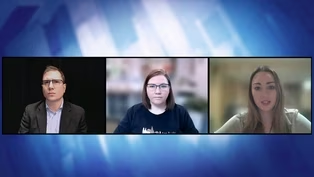
Tonight On Lakeland Currents... Season 15, Episode 12 Teaser
Preview: S15 Ep12 | 29s | A teaser trailer for the new episode about Human Trafficking in Northern Minnesota (29s)
Providing Support for PBS.org
Learn Moreabout PBS online sponsorship
- News and Public Affairs

Top journalists deliver compelling original analysis of the hour's headlines.

- News and Public Affairs

FRONTLINE is investigative journalism that questions, explains and changes our world.












Support for PBS provided by:
Lakeland Currents is a local public television program presented by Lakeland PBS