
Ken Kramer's About San Diego
The Rebirth of an Iconic El Cajon Sign
Season 2025 Episode 104 | 26m 46sVideo has Closed Captions
We witness the rebirth of an iconic neon sign in El Cajon, and more!
We witness the rebirth of an iconic neon sign in El Cajon; solve a mystery about traffic on Broadway Downtown; discover Little Libraries that share books for free in neighborhoods from Chula Vista to Ramona, see what’s behind the headlines from years gone by, and much more!
Problems playing video? | Closed Captioning Feedback
Problems playing video? | Closed Captioning Feedback
Ken Kramer's About San Diego is a local public television program presented by KPBS
Ken Kramer's About San Diego
The Rebirth of an Iconic El Cajon Sign
Season 2025 Episode 104 | 26m 46sVideo has Closed Captions
We witness the rebirth of an iconic neon sign in El Cajon; solve a mystery about traffic on Broadway Downtown; discover Little Libraries that share books for free in neighborhoods from Chula Vista to Ramona, see what’s behind the headlines from years gone by, and much more!
Problems playing video? | Closed Captioning Feedback
Where to Watch Ken Kramer's About San Diego
Ken Kramer's About San Diego is available to stream on pbs.org and the PBS app.
Providing Support for PBS.org
Learn Moreabout PBS online sponsorshipKen Kramer: What is it that's brought so many people to this spot on this particular evening?
Esteban Villanueva: We're gonna be seeing what nobody has seen in 30 years, including myself.
I haven't seen it at night yet.
Ken: We're all going to, and do you know this location, the very place we're looking at now, used to be a place where trash was dumped, but not anymore.
No, no, a historic transformation.
Plus, photos and stories of times gone by, some of them documented in the newspaper, an update on some of the stories we've told here because things have changed, and something from the "Things That Aren't Here Anymore" file, and little libraries so cute, wait till you see.
We've got that for you, and more stories, too, all of them true, about San Diego.
male announcer: "Ken Kramer's About San Diego," the history and people of the area we call home.
Here's Ken Kramer.
Ken: From Camp Pendleton to Cockatoo Grove, and Descanso to Burlingame, I'm so happy to be here, and happy you are too.
Let's hear some stories about San Diego.
And to start this time, we're gonna see something that is a bit of a curiosity that maybe you have noticed, and if so, you would be rare, honestly.
But after this, you'll know the story, so let's get started.
Here we go.
Ken: There are little things about San Diego that you would hardly notice today, unless you do.
Downtown, for example, on Broadway, the north side of the street, the street and the curb are just as straight as can be, see?
Everybody driving west goes straight.
And I mean, there you are, watch the curb.
The curb is straight, right?
Well, yes, until you come to Broadway and Third.
Look right past the trash can.
See how the street kind of bends out a little bit?
I bet there isn't 1 in 100,000 people passing by who notice that one thing.
See that tiny little bend?
It makes Broadway just a little wider heading west, all the way down to the waterfront.
Now, why would that be?
Well, there's a story about that.
Today, right at the spot, Broadway and Third, is a hotel, the US Grant Hotel.
Been there since 1910, built by US Grant Jr.
to honor his dad, the 18th president.
But in order to build it, they had to tear down another hotel that had been there since 1870, right on that same spot, and it was called the Horton House.
Called itself the largest and finest hotel in California south of San Francisco.
Built by Alonzo Horton, real estate developer and San Diego's most influential citizen and biggest promoter, who had bought up and owned most of what was today downtown San Diego, and I guess he could lay out the streets however he chose.
Now, today, at the US Grant Hotel, guests don't enter from Broadway, but back in the days of the Horton House, the grand entrance was right about here, and Mister Horton wanted visitors stepping from their carriages to have their first impression of his hotel to be a dazzling one.
He wanted them to have an unobstructed view right down the street to the bay, wow.
So he just made it a little wider all the way down to the water, and more than a century and a half later, you can still see where Broadway gets a little broader.
A little something you now know about San Diego.
Ken: By the way, Mr.
Horton never did anything that didn't make business sense.
If you drive through downtown, you see all the traffic lights, you know, you go, and then you stop, and then you go again, and it seems like the blocks are short?
Because they are, because he owned the land, and he knew he could get more money selling a corner lot than one in the middle of the block, so he made shorter blocks and more corners.
All right, we have an event to attend, something to see that hasn't been seen in a long time until, well, right now.
Ken: So, okay, this is going to be something to see, you ready?
The crowd is gathered.
Esteban: Kind of excited, kind of nervous.
I mean this has been three years in the making, so-- Ken: So, yes!
I mean, three years to make it happen, but 30 years since anybody has seen it.
Thirty years, and Esteban Villanueva has been counting down the minutes.
Has to be dark enough, you see.
Esteban: Because this is timed carefully with civil twilight, nautical twilight, sunset, the moon, the tides.
Ken: Well, sunset, anyway, because that's when, for the first time in three decades, it's going to happen.
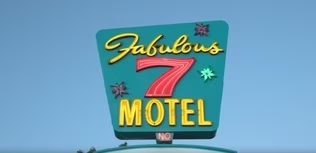
Esteban: In a few minutes, we're going to be relighting the fabulous 7 motel sign, a classic 1960s piece of roadside Americana.
Ken: Okay, a little background.
The fabulous 7 Motel was in the 1500 block of East Main and El Cajon back when it was part of old Highway 80 to the Imperial Valley and Yuma, but then, Interstate 8 was built right through what was pretty much the motel's backyard.
So that's where the traffic now was, and the motel decided to put up an eye-catching neon sign along the freeway to get attention, you know, "Come stay at our motel."
But then the motel closed years ago, and nobody cared very much about the sign anymore.
Esteban: And I would drive by this sign four or six times a day going to work, and it was rusting into the ground, and I said, "We can't let this happen."
Ken: Well, first of all, it isn't a motel any longer.
It's the East County Transitional Living Center, a faith-based emergency shelter that provides transitional housing.
The sign was on their property, and its CEO Doctor Julie Hayden said okay.
Dr.
Julie Hayden: It's not just a sign, which is absolutely the coolest thing I've ever seen, it's also a meaning in our community that there's hope, and we can restore lives.
Ken: All kinds of people stepped up to help, The Air and Space Museum.
Esteban: I figured if anybody could help restore an aluminum box with paint on the side, it'd be the Air and Space Museum.
Ken: All right, meantime, the sun is setting, a couple of proclamations, a lot of anticipation in the crowd.
Esteban has been hearing that from excited people for weeks.
Esteban: "So I'm going to be able to see this sign glow like I did when I was a kid?"
Yes, we wanted the art and the history of this sign built in the 1960s to illuminate the Southern California night.
Ken: So just a little bit darker now, and for the first time in 30 years, it is time to light the sign.
Esteban: Three, two, one... [people cheering] Ken: It was a golden moment, at the golden hour, on a perfectly clear evening, and in that moment, more than a few memories were rekindled.
For Esteban Villanueva, after years of work, a little history was at last brought to light.
Esteban: Something about San Diego that we've brought from the past to the present.
Ken: Brilliantly said.
Ken: So great, and while I was wondering, and I asked Esteban about this because it's an impressive sign, but there's no motel any longer, did he think anyone driving wearily back from Yuma along Interstate 8 might see it and say, "Well, let's stop in and get a room?"
Well, those classic motel signs, do you remember they had the word "no" that would light up in neon, meaning it's closed or no vacancy?
And this one has a neon "no" which will always be lit while the sign, once again, shines.
♪♪♪ Ken: Okay, an update, now, on some stories about San Diego, some postscripts to our scripts.
Let's see what's been happening.
Ken: Couple of story updates now, and something else.
First, our story about the old Bostonia Ballroom in the 1300 block of Broadway in El Cajon, which for years was a music and dance hall, showcasing a particular kind of music called Western swing, but also played host to everybody from Johnny Cash to Hank Williams.
It was a place to go on Saturday nights, from the 1940s into the 1960s, kind of like the Grand Ole Opry of the Southwest.
In recent years, it had become a social hall for various events, but now, word that what was the Bostonia is no more, torn down to make way for new development.
[train whistle blowing] Our story on what was that whistling in the night, from Commercial Street in San Diego, through Lemon Grove, and out to El Cajon, was a rail line that dated back to the 1890s that, for decades, had only operated at night when the trolley wasn't using the tracks.
Well, with just a couple of customers anymore, it seems to have now lost its last one.
Toro Irrigation has sold its building on Marshall Avenue, and barring somebody who needs to ship overnight that way, well over a century of rail history has now gone silent.
The story a few weeks back about recreated baseball games: 1950s Padres couldn't afford to send an announcer to away games when the team was playing out of town, so based on tiny bits of teletype information and some sound effects records of a crowd, and a bat tied to a string next to a microphone that when you struck it sounded like a hit.
"Here's the pitch, and it's a base hit to left field!"
Baseball historian Bill Swank explained how, with just a few sound tricks, an announcer back here in San Diego could make us believe he was there at that faraway ballpark watching everything.
Bill Swank: And it sounded pretty real.
It sounded pretty real.
Ken: But it didn't seem there were any recordings of it from all those years ago because, of course, it was all live.
Well-- radio announcer: It's "Take Me Out to the Ballgame," as once again, we bring you this second game in the nine game series between Los Padres from San Diego and the Solons from Sacramento, by direct wire from Edmonds Field in Sacramento.
Ken: Mr.
P. Hicks, urban archaeologist of San Diego Audio and Video, found phonograph transcriptions.
Listen, you can hear the bat and the teletype ticker.
male announcer: Here's the pitch.
Graham pulls it on the ground down towards first base.
Jennings takes it on the hop and then loses it, rolling off to the side, and all the runners are safe.
Ken: Baseball history preserved.
Did you take our seven bridges walk around and about San Diego a few weeks back?
There's a route you can take through Balboa Park, Banker Hill, Hillcrest, and you see bridges like the Quince Street Bridge, oldest one in San Diego, goes back to 1905, and the Spruce Street Suspension Bridge, a century old, popular, and wobbling its way 375 feet across Kate Sessions Canyon.
They are seven in all.
Well, here's another pedestrian bridge.
This one, it's not on the official walk, it isn't as old as the others we saw, but we should know about and appreciate the 30th Street Bridge linking Barrio Logan and Logan Heights, the community and all the neighborhoods that were ripped apart when Interstate 5 was built.
Families and friends for generations and the businesses they supported that ended up on one side or the other of this massive, noisy freeway.
More recently, the bridge has had some art added now.
Brisk One is the name of the artist who designed the work that you see now as you cross the 30th Street Bridge.
And something else, our story about the secret stairs of San Diego in Valencia Park, and Rolando, and La Mesa, among others.
Couple of oddities to share.
One is a postcard depicting stairs that led to a lookout on Grosmont's Summit.
It's still there, we are told, but on private property these days.
And in boulevard, in the high desert of East County, there is this: a spiral staircase, stairs winding up a solitary rock.
No signage, no markings, no information around it, just something out there in the windy desert that is a curiosity about San Diego.
Ken: Time for a segment now that we call "Things That Aren't Here Anymore."
The years go by, and it's a place or a thing that if you've been here in San Diego for a while, you might remember.
We go back to the archives to find something that isn't here anymore.
Well, looking back, this was something that was definitely different back then about San Diego.
If you get impatient at traffic signals, you don't want to end up stuck at this light.
It's already been five minutes, and still red.
If you want it to change, it's going to be a wait, a long, long wait.
Oh, yeah, you could wait five minutes, you could wait five days, you could wait five years, and that light's not going to change.
Now, of course, if you're going the other way, it's always green.
Thousands of cars zipping by every day.
The light this way never changes either, but suppose they wanted the lights to change.
They'd throw this switch at the Coast Guard station and get a couple of people with flashlights and orange vests out there long enough to let the airplane cross.
That's right, used to be there were airplanes kept at the Coast Guard station, but to get to the runway at Lindbergh Field, they had to cross Harbor Drive.
So this was a familiar sight.
Everybody waiting while that traffic signal turned red for the cars on Harbor Drive, and green for the airplanes.
But no more, in fact, the last time anybody can remember seeing it was back in May of 2001.
They pulled a big C-130 right across Harbor Drive, and it was a tight fit, but they made it, and it was quite a sight.
female: I haven't seen it since I was a kid.
Ken: Maybe with traffic as bad as it is anyway, the last thing we need is cars stopped on Harbor Drive.
But if called upon, that red light that faces the runway is ready to turn green long enough to let the airplanes go by.
Till then, it is something that just won't change about San Diego.
Ken: Oh, do I remember that.
Harbor Drive traffic would stop, and way up there you'd see a Coast Guard airplane crossing.
You remember that?
Something that isn't here anymore.
Well, to Del Mar now for a story about a transformation, how a place that didn't ever have too much to do with history now very much does.
Ken: There was a time when I don't think anybody in their wildest dreams could have guessed what this place down here would become.
I say "down here" because there is also an upstairs, you see, and back in the old days, upstairs was, well-- Jim Watkins: The upstairs were apartments, and they were apartments that were occupied by rather unsavory ladies, shall we say, ladies of the night.
Ken: That's Jim Watkins who owns the building with the upstairs up there, and the downstairs down here, in a town with a lot of history, and that's important.
You can look at photographs and see there used to be a pier, pretty nice one, 1000 feet long.
And also a place where people came down a long flight of stairs and swam in the natatorium, a shallow cement swimming pool in the ocean.
You could go horseback riding, it was really something.
"Coney Island West," some people called it, and all of it just steps, really, from this place with the upstairs and the downstairs here, particularly this hall, which was where trash from upstairs was dumped here.
I mean trash in barrels and out, coffee grounds, egg cartons, banana peels, discarded copies of the "San Diego Union," everything.
Jim: And they smelled-- not the "Union."
But yeah, it was a very smelly place for the garbage.
Ken: When Jim bought the place back in the '60s, he cleaned it up down here, of course, but here's where the story takes a little turn.
This is the late Swede Throneson, a retired Marine colonel, teacher, partner in the building, and a huge fan of preserving history who said, "Let's take all these great pictures and put them down here in this hallway."
And so, now, any day, every day, you can come here and see what Del Mar was like back in the day.
Jim: All the time, we teach about the history of Del Mar here in this gallery, which used to be a garbage dump.
Ken: That's right, Del Mar, at what is one of the most familiar buildings in Southern California, Stratford Square.
You'll find it downstairs, full of history and a story, to be sure, about San Diego.
Ken: At 15th and Camino del Mar, it gives a photographic look back at the city's history, celebrity pictures, a look at the town as a seaside resort in its early days in a building that goes back to 1927, and to a particular place within it that has been, to say the least, transformed.
♪♪♪ Ken: Okay, coming up, a story about little libraries.
You ever see them along sidewalks in neighborhoods?
They are there for everybody to share, some really interesting ones that have been put together in San Diego, wait till you see.
But first, let's check out what's in the inbox from you, and things that you've led us to.
At the end of the show, we'll tell you how to send in your photos and memories that you may have discovered.
If they're yours and we can show them, thank you, and your suggestions, too, are always welcome.
They led us to some discoveries this time, too, interesting and very fun.
Since it's a newspaper theme this time, let's see what's on the front page.
Ken: Let's start up here on the ninth floor of the downtown library, and just through these doors is an area of microfilm readers and a century-and-a-half or so of San Diego newspapers on microfilm in little boxed reels.
So pick a day, any day, like September 26, 1963, hottest day, it turns out, in San Diego history.
Well, it was the "Evening Tribune," so they had a noontime deadline.
It actually got hotter, 111 degrees.
Or ads, in this case, from 1913, right below one for a machine that makes cooking and heating gas for half the cost of what you'd pay the city for it-- I want one of those immediately, please!
Well, right below it in the "Tribune" is an advertisement for the Harvard and the Yale.
$2.35 to LA, $10 to San Francisco.
These were ships, steam ships that zipped up and down the coast several times a week, nice accommodations, good meals, a picture postcard experience.
Newspaper history, also.
Thank you for the pictures, Bill Ruben, who's a fourth-generation newspaper street sales kid.
His great-grandfather used to distribute the "Union-Tribune," so did his grandfather and his father, and so did he.
Two thousand editions early morning every Sunday, a family tradition for generations.
Of course, for a long time, the "Evening Tribune" was its own separate newspaper, had its own circulation, its own staff, its own masthead, its own classified ads.
1937, a three-bedroom bungalow at 30th and University, $2650.
And there was the "San Diego Sun," 1935 edition here, and another one from 1921.
"Always for San Diego, 3 cents."
Inside, an ad targeting lonely bachelors.
You know, sometimes you get a little blue.
Stop by Thearle Music on Broadway, get yourself a record player, a Columbia Grafonola, put on a rhythmic waltz dance tune, and some tip-top jazz.
That's the way to be yourself again.
Bill Arbaio's daughter, Teresa, says her dad sold papers in 1937 and kept some of those through the years, including one from when President Franklin Roosevelt came to town in October of 1935.
Businesses let their employees off work, and the whole city seemed to welcome him unconditionally.
The paper devoted an entire section to his visit, and that of First Lady Eleanor.
Jimmy Durante: Stop the music.
Stop the music.
Stop the music.
Ken: Jimmy Durante, one of the most popular entertainers, singers, actor, comedian for 50 years, beginning in the vaudeville days, and who lived in Del Mar, and who loved to go to the horse races at the Del Mar Track.
And here's a photo that Michelle Sund sent us.
It was taken by her dad, Al Sund, a photographer for the "San Diego Union" in the 1950s and '60s.
Jimmy Durante tossing betting tickets in the air.
Well, after that photo appeared, the paper got a letter saying, "That was the greatest action shot I ever had taken of me in all the years I've been in the business.
Best wishes, Jimmy Durante.
Give the photographer my best.
I loves him," Jimmy Durante wrote.
And finally, remember that super hot day in September of 1963?
The next day was cooler, according to the newspaper, a positively chilly 104.
♪♪♪ Ken: Finally, I wonder, do you see them along the sidewalk every few blocks or so?
Somebody has put up a little lending library, a tiny waterproof shelter with books inside.
Who knows what kind of books, because it's whatever the last person has left.
What strikes me about them is not just the books, which are very cool, but the imagination that goes into so many of the libraries themselves.
Sidewalk along 2nd Avenue in Chula Vista, for example, you're greeted by an offer.
"Free books," very welcoming, simple idea.
Bring the book back when you're done reading it, or a different one to share if you can.
Let's see here.
"Calvin and Hobbes," okay, and "The Grouchy Historian?"
Well, little place to sit if you find yourself at home with a tome.
There are tiny libraries like this all over the county.
Here's one, grab a book, contribute a book.
It's free.
Keep it or pass it along.
You don't have to leave a book to take one.
It's an open, free exchange with whatever your neighbors have to share, and sometimes you get some insights into the hot topics up-and-down the street.
Many have a little plaque and an identification number from LittleFreeLibrary.org.
It's a nonprofit that sells structures and the posts they stand on, even books to put in them.
But many that you see are do-it-yourself, and are very clever, and from all around San Diego.
Look, here's a handsome one in the 1200 block of Center Street in Escondido.
At the First Congregational Church in Ramona right there on 8th Street, look at this, a tiny library for kids, wonderful.
And on Union Street in Middletown, a super cute shingled shelter for selected soft covers and others.
David West's Carmel Mountain neighbor was building one with a special lower shelf so kids could pick out books themselves, but the neighbor passed away before he could finish the project, so a few friends donated materials, finished and painted it.
In Kensington, here's another that offers a bit of whimsy and serves as a loving memorial.
Rory Townsley's husband, Tim, made these two walk-by libraries for the Water Conservation Garden in El Cajon.
There was this from John Giannini, and from Maureen Leary, another on North Mountain View and Normal Heights.
In Mission Hills, thank you, Tegan Glasheen, and a cool one in Mission Beach.
Behold, a sidewalk-side library on D Street in Chula Vista, and at the waterfront park, here's what's making the literary rounds there.
West Point Avenue in La Mesa, it's a neighborhood library of seeds.
Community members can come and take free native seeds to use in their garden.
The plants grow, you harvest the seeds, and return some of them to the library.
Information packets, how-to instructions from the San Diego Bird Alliance.
And in OB, in the 5000 block of West Point Loma, from Tracy Dezenzo, it's her library of dog toys, right on the way to Dog Beach.
Take one or two, bring them back this time or next time.
You'll never have to ask, "Where's your ball?"
Other creators of these free libraries seem to know that passersby are likely to have a companion and are prepared, especially this one near 23rd and Upas.
So here's a wish: may you never run out of things to read, especially with all these tiny libraries to be found in so many places around and about San Diego.
Ken: And that's it for this time and this episode of "About San Diego."
If you'd like to send us something for the show, you know, photos or bits of memorabilia from San Diego's past, so we can see what things used to look like, or learn more about the stories you see here, we have links to take you to the sources for that.
Just go to our website, it's KenKramerTV.com, KenKramerTV.com.
In the contact area, you will see an email to reach us.
We will hear from you, and we will look for you next time.
Until then, and as always, I am Ken Kramer.
Thank you for watching and for caring about San Diego.
♪♪♪ ♪♪♪ ♪♪♪ female announcer: Support for this program comes from the KPBS Explore Local Content Fund, supporting new ideas and programs for San Diego.
The Rebirth of an Iconic El Cajon Sign Preview
Video has Closed Captions
Preview: S2025 Ep104 | 30s | Coming 6/18 - witness the rebirth of an iconic neon sign in El Cajon, and more! (30s)
Providing Support for PBS.org
Learn Moreabout PBS online sponsorship














Support for PBS provided by:
Ken Kramer's About San Diego is a local public television program presented by KPBS