
The River
Clip: Season 2026 | 11m 4sVideo has Closed Captions
Jason Brown discusses the making of the music video for "The River."
Jason Brown discusses the making of the music video for "The River", from his "Wabanavia" album.
Problems playing video? | Closed Captioning Feedback
Problems playing video? | Closed Captioning Feedback
Sound Waves is a local public television program presented by Maine PBS
Sound Waves is made possible through the generous support of Reny's, Bangor Savings Bank, Highland Green, and by Maine Public's viewers and listeners.
The River
Clip: Season 2026 | 11m 4sVideo has Closed Captions
Jason Brown discusses the making of the music video for "The River", from his "Wabanavia" album.
Problems playing video? | Closed Captioning Feedback
How to Watch Sound Waves
Sound Waves is available to stream on pbs.org and the free PBS App, available on iPhone, Apple TV, Android TV, Android smartphones, Amazon Fire TV, Amazon Fire Tablet, Roku, Samsung Smart TV, and Vizio.
Providing Support for PBS.org
Learn Moreabout PBS online sponsorship1,2,3,4 (RHYTHMIC DRUMBEAT) (ELECTRIC GUITAR) (FIREFLY SINGING) “HEY” ♪ HEY.... Mighty river, watch you flow Drowning in our tears Sacred waters they dont know assuming you are theirs Early dawn I'll come to you offering my prayers I see green has poisoned you If only, If only they would care (drum solo) Millions of gallons in your veins have we gone insane Oh no.
Worked so hard to get you clean somebody bought a change So early dawn I'll come to you offering my prayers And all of us will see it through the fight, the fight to save what's there Fight to save what's there (You gotta fight) Fight to save what's there (You gotta fight) Fight to save what's there (You gotta fight) Yeah, yeah, yeah... (drums, rattle and song comes to an end) So, River, tell me about your vision, about this project and how you made it.
It's really.
Powerful.
Thank you.
River was, So every morning I, I go for a morning walk, and I live pretty close to downtown Bangor, so I'm really close to the river and the waterfront.
And I walk down there every morning and, you know, if you do that almost every morning, year after year after year, you really have a relationship with the river and what you see and what you see coming down the river.
And, what I noticed, was all this like, this foam on the river, and it would build up around the docks and it was like getting worse and worse.
And then sometimes when you look across the river, it's it's almost like there's a weird film or a slick that just sits on top of the water, you know, and it's like, I don't know if because of my sunglasses or polarized, maybe that's why I could see it.
But you can't, you know, you can't just see it.
It has to be the right conditions.
And it started me to thinking about, like, you know, all of the fight that was done, you know, in this in the, the 80s to clean up the river because the Penobscot Nation, I don't know what the statistic is now, but at that time, our small community had the highest cancer rate per capita of any other community in Maine.
So all my family members, all my relatives, friends, that's mostly what people would pass away from.
And it could be traced back to the pollution being put into the river from the paper mills.
And so that was, you know, quite a long fight.
So that fight was had in the river was cleaned up and the grasses come back and the eagles are coming back and the fish are coming back and and, but here we go again.
Yeah.
You know, and and what's happening now is, you know, is leachate runoff from mega dump as being, dumped into the river.
It's being trucked in tanker trucks from the, from the landfill, and it's being treated.
And because the paper mill already had systems in place to efficiently pollute the river, that's how it's being put into the river.
And it's got me wondering, like, is that what I'm seeing in the river, you know, is that all that foam and that slick and all that?
So I did my loop, and by the time I got back to my house, I had all the lyrics to the song in my head.
So I just wrote it down.
You know, and then, and then, you know, went from there, just kind of developed it.
And it's my first it was my first break away from sort of doing more traditional stuff or doing sort of like the, the electronic music that I'm sort of known for, and doing like a straight up rock song right now.
And I just it was a challenge for me to like singing really at the high end of my range.
And, and, you know, programing my keyboard to sound like a, like a, like an electric guitar, you know?
So do I know how to play the electric guitar?
No, but I know what it should sound like, you know?
So most of what I build is done by ear.
That way.
Where do you do it?
I have a studio at my home.
Okay.
Yeah.
So we have, I have, a recording studio area, and then I have, I guess you'd call like a, a mini sound stage area where we can, you know, do bigger productions and and shoot videos and things like that.
Yeah.
What you saw.
Yeah.
What you saw in the, in the, in the video was a combination of, of stuff that I shot live along the Penobscot River.
And then when I got to the point in the video where I had to show the industrial complex that was putting the pollution into the river, I didn't want to go and actually shoot the actual place that's doing it.
I want because it's this isn't the only place that's happening.
It's happening all over the world.
So while it's inspired by what's happening here in my homeland, it's really a message for everybody everywhere.
And, I built the the industrial complex as a miniature movie set out of boxes and trash and just anything laying around my house.
I bought miniature little tanker trucks, that were to scale me by eight of those and had them moving on a track.
And, so there's a line in the song that says, you know, a millions of gallons in our veins.
Have we gone insane?
And, I just had the vision in my head of like, you know, we are so connected to the river in our language.
The word for medicine is nabis, and and the word for water is nabi.
So all anything that's medicine or healing has the root word of water in it.
So that's the ultimate medicine, right?
Yeah.
That's why we need to take care of it.
And so I wanted to do this thing where it was like, I'm in the river, you know, and the toxic waste, the leachate is coming out of me, you know, because it can get into, you know, we consume the fish, we eat the plants, and it doesn't discriminate.
It doesn't just go after indigenous Penobscot people, right?
It goes after everybody.
So when we when we championed to clean the river, when we, you know, put up the fight, you know, to to keep the things that are happening from happening, it's not just for us.
That's for everybody.
Let's for the world.
Exactly.
Yeah.
And so interesting story.
I shot that scene in my, in my bathtub.
We have, like, a clawfoot tub.
So, you know, I the stuff that you see coming out of my mouth, it's like a, it's a combination of, like, almond milk, flour, some tumeric for color.
And then, I was going to add ketchup in it to, to to get the red tone.
Just anything that was safe for me to put in my mouth.
Yeah.
I go into their fridge in the kitchen and there's no ketchup.
And you know, when you're hyper creative and you want to do something, you want to do it right then and there.
So there was no stopping.
So I grabbed, I grabbed Tallulah Hot Sauce, and I loaded it up with hot sauce.
Yeah.
And then so I get into the bathtub, I set the camera up, I, you know, I do a test shot to make sure I'm all dialed in, and then, then I drink that, and as I put it into my mouth, it hit me.
It was like, wait a minute.
If I cough this up, what if it's going to splash back and get me in the eye and I'm going to pepper spray myself?
You know, I go, right?
I had one, one, one shot to get it, you know, and, I think I got it.
You sure did.
Man.
That is just it's chilling.
I saw that, and it just it's very powerful.
I really wanted it to feel, I think the feeling that I wanted to, to get in the insane part of it is insanity.
That we think that it's okay to do these things, you know, all in the name of, of profit, you know?
Absolutely.
And it's like, you know, you can't what's there.
You know, you can't eat money, you know, yeah, you can't drink money, you know.
So.
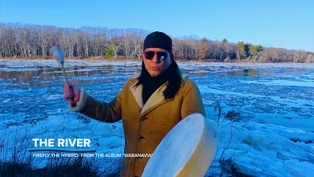 Now Playing
Video has Closed Captions
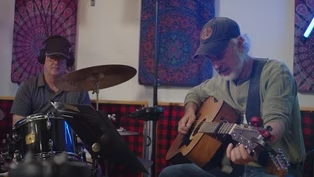
Jason Brown discusses the making of the music video for "The River." (11m 4s)
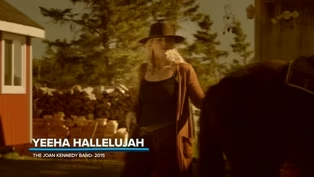
Video has Closed Captions
Joan discusses shooting her music video for "Yeeha Hallelujah." (5m 44s)
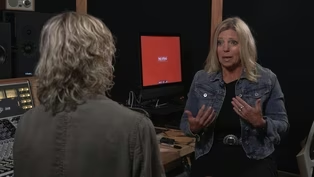
Video has Closed Captions
Joan talks about how her life has been touched by cancer. (1m 46s)
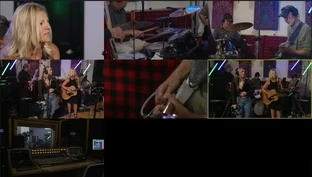
Video has Closed Captions
A peek at what the editors see when they cut together a performance for broadcast. (3m 44s)
Providing Support for PBS.org
Learn Moreabout PBS online sponsorship

- Arts and Music
The Best of the Joy of Painting with Bob Ross
A pop icon, Bob Ross offers soothing words of wisdom as he paints captivating landscapes.










Support for PBS provided by:
Sound Waves is a local public television program presented by Maine PBS
Sound Waves is made possible through the generous support of Reny's, Bangor Savings Bank, Highland Green, and by Maine Public's viewers and listeners.