
Ken Kramer's About San Diego
Episode 106 - The Romping Canines of Dog Beach
Season 2025 Episode 106 | 26m 46sVideo has Closed Captions
We pay a loving visit to the romping canines of Dog Beach and more!
We meet a North County woman who has amassed the largest collection of pop-up books west of the Mississippi; get an inside look at law enforcement 80-years ago; see things sent in by viewers from the desert to the sea and pay a loving visit to the romping canines of Dog Beach.
Problems playing video? | Closed Captioning Feedback
Problems playing video? | Closed Captioning Feedback
Ken Kramer's About San Diego is a local public television program presented by KPBS
Ken Kramer's About San Diego
Episode 106 - The Romping Canines of Dog Beach
Season 2025 Episode 106 | 26m 46sVideo has Closed Captions
We meet a North County woman who has amassed the largest collection of pop-up books west of the Mississippi; get an inside look at law enforcement 80-years ago; see things sent in by viewers from the desert to the sea and pay a loving visit to the romping canines of Dog Beach.
Problems playing video? | Closed Captioning Feedback
Where to Watch Ken Kramer's About San Diego
Ken Kramer's About San Diego is available to stream on pbs.org and the PBS app.
Providing Support for PBS.org
Learn Moreabout PBS online sponsorshipKen Kramer: You know, we're always on the lookout, we are, for things that were or are even yet on the streets and sidewalks of San Diego.
And all through our episodes, always some of the coolest photos come from you, and we've got some great ones this time, including... That's right, partner, a little restaurant history.
See if you remember.
We love to find San Diego people who are drawn to collect unusual things, and thus we found a woman who has taken that to a whole different level.
Her fascination is with books, but more than that, with what might be called paper engineering.
Marian Benassi: A lot of times the reaction is, "Oh, I'm gonna go out and buy some."
Ken: And when it comes to anthropomorphizing canines, I'm guilty as charged because after all, dogs are people too, and that's always been the case in Ocean Beach.
Plus, more stories too, all of them true about San Diego.
narrator: "Ken Kramer's About San Diego," the history and people of the area we call home.
Here's Ken Kramer.
Ken: Dear friends, hello and welcome.
Welcome to another episode.
Whether you are in Pala or Palomar, Shelltown, Mira Mesa, Poway, or Borrego Springs or the Imperial Valley, let me tell you some stories about San Diego.
It may not be as chilly as our fire here might suggest, but get comfortable because we got a lot of things to get to.
And if you just saw that woman who collects things, let's start there.
Take a minute to marvel as we did at her collection.
Ken: I've never, and I'll bet you've never seen this many in one place, and this is just some of them.
Marian: Probably around 1200.
Ken: They are pop-up books.
Might look like any other book until you open it.
Marian: But all of a sudden, when you see that paper engineering and it jumps off the page, it's magical.
Ken: Marian Benassi is very modest, so let me declare that she is our county's most knowledgeable collector, passionate advocate, and fervent enthusiast of pop-up books.
Marian: And I love showing them to people for the first time because even for them they go, "I had no idea these exist."
Ken: Show you what I mean.
Look, anatomy books, each flap revealing another layer of the human body.
Marian: And these, some of these still exist from the 1200s, and they would have done this throughout the body as a teaching tool, but also for doctors.
Ken: A camera dissected.
Marian: They actually did the outline of the whole camera, then over here was lenses and how lenses work.
You can actually move this lens.
Ken: Hundreds of books, some going back most of a century, that are created with such cleverness.
Marian: All of this, what makes these so special is the engineering side of it.
Ken: The movement bringing hand-created images to life.
Marian: Look at this from the 1940s.
So that when kids all of a sudden would open them, that they had that, you know, wow factor.
Ken: It is these masterpieces of paper engineering that have inspired a decades-long obsession now, started with the first one she ever saw.
Marian: You know, I came across it in a bookstore, I think was the first one.
And then once I started to, you know, look at them and collect them, and people would find them for me too and say, "Do you have this one?
Do you have that one?"
Little Bo Peep is looking for the sheep, and then all of a sudden she disappears.
Ken: Grown now to be a museum-worthy collection unto itself, from science... Marian: I mean, there's so much of this that makes it exciting when it's interactive.
Ken: To whimsy... Marian: I love this one where they're all outside eating under the arbor.
Ken: From Harry Potter... Marian: This is the pop-up guide to the creatures of the wizarding world.
The spider that comes out.
Ken: To anything you can imagine.
Marian: You know, go on a tour of Graceland through it as a pop-up book.
Ken: Her delight with each one... Marian: And here, "The Birds."
Remember that?
Oh, that was such a good movie.
Ken: Is in itself a delight.
Marian: It's gotten really sophisticated, and many of these books sometimes take a whole year to design.
Ken: She is in her element.
Marian: What makes these all special is that when you go to close them, that that image will now close down, and the next one is there.
Ken: And truly, you can't help but catch the enthusiasm.
Marian: So when you open it up, and look at how that transforms and just comes, you know, at you, and the energy that goes on there.
Ken: And one thing more: in all of our conversations, Marian Benassi never spoke about what the books were worth, what they cost, what they could sell for.
Marian: Then I need to!
Ken: No, she talked about kids and adults processing this visual information with an excitement not offered by the printed word alone.
Marian: I mean, look at as these come way with an excitement not offered Look at how all of a sudden the ears and the eyes would move.
Ken: And about the whole point of being able to collect them in the first place.
Marian: I'm hoping to share them, and hopefully other people that see these will grow a passion for these, and it will allow them to keep going and have an excitement about them.
You know, he's about to take a photograph, and his watch comes up and he takes the picture.
Ken: Local universities have expressed interest, and no wonder.
This collection of pop-up books: extraordinary.
It's preservation, mandatory.
Marian: I love that somebody, you know, through all the years will come and discover these and just think these are amazing.
Ken: Amazing indeed, and taken together, something unique about San Diego.
Marian: Look at that, isn't that cool?
[music] Ken: Most cool, and if you check around for collections of pop-up books in the western United States: the LA Public Library, University of Washington, San Jose State, Long Beach State, Arizona State, and if all works out soon, her books may pop up at a local university.
That would be something very special about San Diego.
[music] Ken: Okay, if you watch our show every week, you know we almost always have a part where we show off the things you've discovered for us all to see, and a lot of times, that's kind of at the end of the show, but this time we have something a little different in that slot.
So with your permission, let us see what may jog your memory, trigger some nostalgia, or leave you saying, "I didn't know that about San Diego."
Let's see, do you remember San Diego's "Choice" magazine, it was called?
Photo of anchorwoman Bree Walker on the cover of this one, and April 1986, Steve Garvey.
"San Diego People" magazine had a run in 1981 with headliners Dan Fouts and Joan Embery.
About the same time, "Tuned In" magazine, a kind of local TV guide, was published.
Lasted about five years, and listed every TV show you could see over the air and on cable.
Thanks to Bruce Golden for these memories.
Sherry McDowell sent a newspaper picture the family has kept almost a century.
Her grandfather's brother Bill, you see, bought a six-cylinder truck from Bay City Chevrolet.
That's the salesman on the left there, Mister Fraley.
Thank you, Harrison Littrell.
One of those auto club highway signs prior to 1947.
It was the auto club that erected thousands of these signs throughout California to help motorists know where they were going and how to get there.
By the 1950s, the state began taking all that on.
Here's a view of Taylor Street near Old Town.
Recognize it where Interstate 8 cuts through now?
And one more from the waterfront, you can see the county building, which was also our city hall back then.
From Chris Youngman, the rainy season of 1987-88 flooding in Mission Beach.
If you live there or you just know, you know.
And also from Chris, here's a postcard from the dirt street, watering trough, general store days of Bostonia.
Palm City, our story about the early days of that South Bay community.
Here's a matchbook from Ford's Wayside Inn, the place to go if you want a good duck dinner.
Oh, and matchbooks.
Greg Smith of Vista says his grandfather used to collect them.
Grabbed these from Lubach's.
Remember Lubach's restaurant on the waterfront?
From the 1950s, it ran 'til it closed a week after Thanksgiving of the year 1990.
Or you had the Biltmore Hotel in Los Angeles and the US Grant in San Diego.
Baron Long, president.
Maybe these came from his office, who knows.
How about this?
The Show Boat, the hot spot, place to go.
You know, 1035 2nd Avenue looks like a classic Western place.
Order a beer, take in the show.
San Diego County book of matches.
Kind of an amazing thing when we don't want people really to smoke, but there it was with the official seal there: "The noblest motive is the public good."
The Kona Kai, which you reached by dialing Academy-2-1191.
The London Opera House, and... [music] Bonanza Restaurant.
Sure, there was the Bonanza and the Ponderosa chain.
The popular TV series of the 1960s inspired both of them.
Dan Blocker, Hoss, founded the Bonanza restaurant chain in Connecticut, then sold it.
Used to be hundreds of them around the country, remember?
Rich Bartole managed two of the three Bonanzas in San Diego in the mid-1970s between raising a couple of kids, including our co-producer, photographer, and editor Suzanne Bartole.
Barbara Schroerer sent a picture.
She doesn't know who the couple is on the left, but on the right, that's Bernie and Helen.
Her mom and dad in 1965 come to San Diego for a Prudential insurance convention.
Her mom is aged 97 1/2 now.
Coronado Federal Savings and Loan in the 1960s gave out a book of pictures of the Coronado Ferry.
Mary Lou Simpson's husband Francis created it as the ferry boats were coming to an end.
It became like a keepsake around town.
A lot of memories.
As Joe Ditler would say, you can almost smell the creosoted timbers and hear the pilings creak.
Here's what it cost: 45 cents plus 10 cents each additional person, but as they say, the memories were priceless.
And finally, remember Bill, the customer who bought that truck, made it into the newspaper?
Story says he was so happy he came right back and bought a sedan, and times being what they were in the 1930s, that was some news about San Diego.
[klaxon horn] Ken: Sure, those two vehicles back then: cost in San Diego was probably close to $1400, and gasoline to drive them was 10 cents a gallon.
[music] What else was true in 1930?
The population of San Diego was 147,995, about the same as Escondido today.
Harry C. Clark was the San Diego mayor.
Republican, came here from Louisville, Kentucky, was a civil engineer and a lawyer, president of the County Bar Association.
Phil Swing was our congressman.
Republican, co-authored legislation that would create the Hoover Dam.
Herbert Hoover was president.
Having carried San Diego County two years ago, he got 47,000 votes countywide, and that was enough for him to win by more than 2-to-1.
Big screen stars: Greta Garbo.
Greta Garbo: I like your eyes.
Who are you?
Robert Montgomery: Um, my name is Andre.
Ken: Most popular band, Paul Whiteman and His Orchestra.
Do you want to know what things cost?
[music] [music] [music] Greta: Shall we go?
[music] [music] Ken: We love doing this show on TV, and we also post some of our stories on YouTube, and there is one that popped up there, and it got well over a quarter of a million views right away and many more since, and I think it's because it's about something we all see heading into and out of San Diego.
A lot of people on Interstate 15 say, "That's my marker, that bridge.
It tells me I'm almost home."
Well, years ago we wanted to know the story of this bridge, and we found the now late John Metlin to talk with us about how that all happened, and I think when you see it from now on, you'll know this story about San Diego.
Let's start out on a drive.
Here we are on a two-lane country road, kind of between Valley Center and Bonsall, and can I tell you that this road, West Lilac Road it's called, is known for something very special, and it's odd because there isn't a lot of traffic on it.
It can be a while between cars.
Not what you'd describe as a heavily traveled road, which makes what's right down here all the more remarkable.
Okay, we're coming up on it right now, see it?
It's a bridge, the Lilac Road Bridge.
Considering how little traffic there is, you might wonder why they even built it, but if you've ever driven Interstate 15 north of Escondido, you sure know it, you've seen it.
It's a dramatic, iconic, something from a picture book bridge, 745 feet across.
That is pretty breathtaking.
And 160 feet up there is little old West Lilac Road.
Well, we got curious, right?
And at his home in San Marcos we found John Metlin, who knows a lot about that bridge.
John Metlin: I basically oversaw all of the construction of the bridge from day one.
Ken: And he's kept the plans and drawings, dimensions, and everything from when it was built more than 40 years ago.
John: The superstructures here, that would be this.
This is the arch.
That would be this.
Ken: First of all, look at the bridge.
Now imagine that whole valley under it there where the road is being put in here, that was completely dug out of solid granite.
The land used to be all the way up to where the top of the bridge is.
So here's a drawing of the bridge.
You can see the arch, and he's tracing with his thumb there where the ground used to be.
John: In order to get down to the grade necessary for the 15 construction, they had to go down about 160 feet.
Ken: Three quarters of a million cubic yards of solid granite dug and blasted away to get down to where the freeway was going to be before they could even start to build the bridge.
Oh, and then the bridge itself, that big sweeping arch: looks like solid concrete, right?
But that arch is hollow.
It's got utility lines.
You could walk in there if you could walk in there.
John: From one end to the other.
Ken: It's a marvel of bridge construction, it really is.
All told, it took three years, $1.5 million, and the traffic up here on West Lilac Road?
John: Well, right now, this, I would say in the neighborhood of 500 cars per day.
Ken: Which brings us back to "Why?"
Why go to all the trouble to build this exceptional and striking bridge when a detour or something simpler and cheaper would have done the trick?
But no, no, the Caltrans of 40 years ago thought, "We can build a bridge for Lilac Road, but we can also do something drivers will really notice for decades to come."
John: You know what, the setting was right, you know?
The approach and the departure from the structure, just the way the vistas had opened up on both ways.
Ken: It was a conscious decision to build something aesthetically pleasing purely for its own sake, just so drivers moving along I-15 might look at it and for a moment or two be impressed or inspired or pleased.
John: That's exactly what the thinking was.
Ken: And that's how it came to be: how Interstate 15 between Escondido and Rainbow got a landmark everyone sees and remembers, how West Lilac Road ended up with a major league bridge, and how 40 years ago John Metlin came to be such a big part of it all.
John: I think about it almost every day.
Ken: And why not?
It's something so visible and so very familiar about San Diego.
Okay, one more jump back in time, and here's the story about what you're about to see now.
A San Diego man named Rick Edgil happened to come across a movie, 16 millimeter sound movie that was going to be dumped.
It was gonna be thrown into the dumpster because it was way out of date.
It was a movie meant to be shown to the San Diego Police Department in the 1940s, but he and we thought the cars, the scenery, the setting, the whole thing was kind of interesting, so let's roll the film.
[music] [music] [music] Ken: Now, what we're going to see first is a holdup with actors staging it, of course.
The place they used was Jake's Liquor on the southeast corner of 32nd and Thorn.
speaker: To set the scene for this film, the crime of robbery of a liquor store is used.
Ken: The bad guys clean out the cash register and flee, and you can see what the neighborhood looked like back then.
And the police cars too.
This one is making a U after hearing the call on what looks like El Cajon Boulevard.
speaker: The officers arriving at the scene first must immediately secure information which will serve to identify the criminals and their means of escape.
[music] Blockade equipment is maintained at each blockade post in order that the necessary equipment may be immediately available within as short a time as possible.
Ken: In this case, the suspects see the blockade on Pacific Highway near La Jolla and try to avoid it, but they're spotted and the chase is on.
speaker: In the event of hot pursuit, the pursuing officers will make radio contact with headquarters.
Ken: South on Pacific Highway, east on Washington Street, over roads and through neighborhoods as they looked 65 years ago, and, ah, closing in.
They're about to get them, as you can see.
[music] speaker: All prisoners of the police are immediately taken to the city jail and booked.
Ken: Which in those days would have been at 801 West Market.
[music] [music] The suspects face the judge, the movie wraps up, and justice prevails in the end.
[music] Ken: Among the things we get from viewers are photos of sidewalk stamps.
We've got a lot stacked up here.
So fun, take a look.
Do you see them?
Especially on older sidewalks, they tell you who poured the concrete and sometimes the year.
Well, we put the question on our Facebook page: show us, what do you have in your neighborhood?
And we got dozens of pictures and stories.
Bill Hill found this in Little Italy, where Joseph Kelley set the cement in 1904.
One of the letters got kind of sideways, but it says 964 Fifth, where Mr.
Kelley had his offices in what would have been back then the exciting new Granger Building, still there today.
In Point Loma, Walter Trepte, what a name, was a huge figure in the development of San Diego and some of its most exquisite buildings, from the Gaslamp to Balboa Park and beyond.
His dad was a carpenter who was said to have worked on the ceiling at the Crown Room at the Hotel Del, built, by the way, without using a single nail.
Samantha Cavitt found this one at the corner of Boundary and Maple.
It's from April of 1930, and the stamp says "Griffith Company."
Griffith was and still is a large contractor responsible for streets, highways, and even airport runways up and down the state of California.
Their name shows up on sidewalks all around the city.
Sue Aleman found this one on C Street between 27th and 28th, and also one from Ole Swarstad, who lived nearby in Golden Hill.
In North Park, Elaine Silos found hard evidence that FW Jack had a busy day in September of 1923.
Look at this, 1896.
Susan Hunt Williams spotted this in Sherman Heights, and another little one from what I guess was November of 1910, but who or what was Otto?
Brooks Wilson sent this.
Look, contractor CB Saunders looks like he might have tried to write the date in by hand.
What is it, does it say 1955 maybe?
And can't forget a local contractor, Mr.
Orville Ullman Miracle, who lived in Oceanside and had such a unique and curious name, he earned a mention in "Ripley's Believe It or Not."
Okay, Shawn Shaw saw this at 25th and E in Golden Hill, but where the Folsom brothers really made an impression and where they were responsible for a lot of development was Pacific Beach.
In La Jolla, David Truett found where they preserved a bit of sidewalk on Girard Street from 1912.
Roman numerals marked this Mission Hills sidewalk in September of 1922.
Eric D. Hansen saw it there and also, oops.
This was probably meant to be 1912, or was it 1921?
On Kettner at Juniper was once the San Diego Macaroni Factory, home of first-class macaroni and a classic sidewalk stamp.
Thank you, Beth Vause Collado.
And from Steven Marquez, at Mississippi and Polk December of 1926, the contractor left his signature, and so did a passing dog, forever immortalized concretely in our history about San Diego.
And hold that dog thought for a moment here because finally this time, let's go to Ocean Beach, which I would maintain has always been super dog friendly.
OB's was the first leash-free dog beach in the country, established in 1972.
I think it is a dog beach that you see such sheer joy, and because, well, maybe we could all use a dose of that, Suzanne Bartole put together a video essay there that is a happy thing to see anytime.
[music] Suzanne Bartole: Hi, guys!
[music] [music] [music] [music] Suzanne: Hi!
[music] [music] [music] [music] [music] [music] Suzanne: Hi!
[music] Ken: And that's it for this time and this episode of "About San Diego."
Running a little bit late this time, so let me quickly say: to see these stories again, send us things to show on the show, find links to see these and other stories, go to our web page, KenKramerTV.com.
That's KenKramerTV.com.
See you next time.
Until then, and as always, I am Ken Kramer.
Thank you for watching and for caring about San Diego, bye-bye.
[music] [music] [music] [music] narrator: Support for this program comes from the KPBS Explore Local Content Fund, supporting new ideas and programs for San Diego.
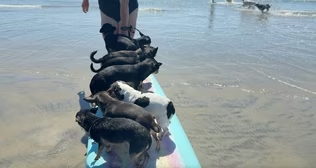
The Romping Canines of Dog Beach Preview
Video has Closed Captions
Preview: S2025 Ep106 | 30s | Coming 8/20 - we pay a loving visit to the romping canines of Dog Beach and more! (30s)
Providing Support for PBS.org
Learn Moreabout PBS online sponsorship












Support for PBS provided by:
Ken Kramer's About San Diego is a local public television program presented by KPBS