
Latvia's foreign minister warns of Russian sabotage acts
Clip: 8/27/2026 | 7m 24sVideo has Closed Captions
Latvia's foreign minister warns of Russian sabotage acts in Europe
For many countries in Europe that recall living under Soviet occupation, the specter of the Russian threat is never far from mind. Many of those nations are now part of NATO, the alliance built to repel that threat. One of those states that was occupied for half a century is Latvia, a NATO member that borders Russia. Nick Schifrin spoke with its foreign minister after an active week of diplomacy.
Problems playing video? | Closed Captioning Feedback
Problems playing video? | Closed Captioning Feedback
Major corporate funding for the PBS News Hour is provided by BDO, BNSF, Consumer Cellular, American Cruise Lines, and Raymond James. Funding for the PBS NewsHour Weekend is provided by...
Latvia's foreign minister warns of Russian sabotage acts
Clip: 8/27/2026 | 7m 24sVideo has Closed Captions
For many countries in Europe that recall living under Soviet occupation, the specter of the Russian threat is never far from mind. Many of those nations are now part of NATO, the alliance built to repel that threat. One of those states that was occupied for half a century is Latvia, a NATO member that borders Russia. Nick Schifrin spoke with its foreign minister after an active week of diplomacy.
Problems playing video? | Closed Captioning Feedback
Where to Watch PBS News Hour
PBS News Hour is available to stream on pbs.org and the PBS app.
Providing Support for PBS.org
Learn Moreabout PBS online sponsorshipGEOFF BENNETT: For many countries in Europe that recall living under Soviet occupation, the specter of the Russia threat is never far from mind.
Many of those nations are now part of the alliance built to repel that threat, NATO.
AMNA NAWAZ: That includes Latvia, which borders Russia to the West.
Nick Schifrin spoke earlier today with its foreign minister after an active week of high-profile diplomacy.
NICK SCHIFRIN: This week, CIA Director John Ratcliffe flew to Moscow to meet with his Russian counterparts.
A person briefed on the meeting tells me that, at least in part, it was designed to deliver a warning against Russia's sabotage attacks inside of NATO.
U.S.
and European officials are increasingly worried about examples of sabotage across Europe that they blame on Russian actors, including multiple armed drones found in the Leipzig Airport in Germany and a near assassination of an American citizen in Poland.
Earlier this week, the president suggested the visit was also about Ukraine and today dismissed the possibility of any Russian attack on NATO.
DONALD TRUMP, President of the United States: I don't want to comment on that, but they're not going to attack.
NICK SCHIFRIN: The Baltics have long been the target of Russian cyber and sabotage attacks.
And I'm now joined by Latvian Foreign Minister Baiba Braze.
Minister Braze, thank you very much.
Welcome back to the "News Hour."
How widespread is this concern of Russian sabotage, Russian cyberattacks across Europe, including in Latvia?
BAIBA BRAZE, Latvian Minister of Foreign Affairs: Russian concept, warfare doctrine includes all types of means.
It's not just conventional warfare, as we are seeing that in Ukraine.
First, it includes cyber, as you rightly said, disinformation, hostile information operations, sabotage activities, killing of activists.
We have seen burning of the ammunition factories.
We have seen possible arson attacks on Prime Minister Starmer's properties or planning of those.
We have seen indeed, as you rightly mentioned, in Leipzig, the drone, the armed drone in the airport near big transport aircraft.
So there is no immediate military threat, but indeed the whole security situation in Europe, in Euro-Atlantic zone, is much more sort of active, much more in need of proper understanding and reaction if necessary.
NICK SCHIFRIN: Let me have you explain that last point especially.
The Latvian prime minister, Andris Kulbergs, put it this way: "There's currently no reason for concern.
Latvia's level of military threat has not changed.
The risk of direct military invasion threats to Latvia is currently low."
Explain that.
Does that mean that Latvia, your assessment is that Russia is deterred from a traditional military campaign against NATO, even as we talk about these other threats?
BAIBA BRAZE: Our military commanders altogether as NATO are planning and executing responses that are necessary.
So, when we say that there's no direct military threat, it's based on the whole set of analysis and understanding of the military picture.
It doesn't mean that there is no sort of other threats.
That is what we are trying to underline.
The rest of the picture is quite volatile because Russia is trying to challenge countries in various ways.
NICK SCHIFRIN: You use the word volatile security situation in Europe.
The U.S.
officials I talk to cite the Leipzig, Germany, drone incident as a particular source of worry and as a sign that Vladimir Putin is increasing his willingness to commit violence as part of these sabotage acts.
Are you concerned about these sabotage acts across Europe increasing in nature and in violence?
BAIBA BRAZE: I think all the services are indeed concerned, because these type of activities are much more difficult to assess in terms of -- as I said, the pure military conventional activity is quite well visible and understood.
In terms of these types of subconventional or asymmetric activities, TikTok much more difficult to sort of both understand, to see, to prevent.
And this is where challenge arises.
And that's why indeed we would characterize that as volatile in Europe itself.
NICK SCHIFRIN: I should say that Moscow denies any responsibility in these incidents.
European officials have cited either Russian intelligence actors or cutouts working on behalf of Moscow, pinpointing Moscow behind these attacks.
Do you believe that Vladimir Putin's intentions with these examples of sabotage are to test what he can get away with or to test NATO resilience, or perhaps both?
BAIBA BRAZE: Yes, I think all of that, and also indeed trying to undermine support for Ukraine.
Here in Latvia, there were -- there was a sabotage against a big warehouse from which supplies to Ukraine were provided.
There's the whole set of various troll factories, bots, and so on so forth constantly pushing various messages that, why are you supporting Ukraine, that support has to go to your own countries, and so on and so forth.
NICK SCHIFRIN: Inside of Russia, we have seen Putin under domestic pressure.
We have seen elites breaking with him over the war in Ukraine.
We have seen refining capacity drop below 50 percent in Russia because of Ukrainian attacks.
We have even seen social media posts criticizing the Kremlin because of long gas lines.
There are analysts who are concerned that Putin could respond to that domestic pressure by escalating the war, including beyond Ukraine's borders.
Is that a concern that you have?
BAIBA BRAZE: Our task is to take seriously the possibility of these variety of hybrid attacks.
Russia is bogged down and it doesn't have capabilities to challenge NATO.
And we have seen what happens if you start conventional war.
But below the level of conventional, it will continue.
And it might escalate.
It might be different.
But we all need to be ready.
We all need to be ready.
NICK SCHIFRIN: And while you're being ready, what can change Russian behavior?
Can, for example, a visit by the director of the CIA,who comes with warnings, get Russia to stop some of these hybrid attacks?
BAIBA BRAZE: I really can't comment on that, because that should be used to the American authorities.
Obviously, the -- what can change Russia's behaviors?
I think it's very clear message that they're not going to win the war, also more sanctions and continuing support to Ukraine.
NICK SCHIFRIN: Baiba Braze is the Latvian foreign minister.
Thank you very much.
BAIBA BRAZE: Thank you so much.
Craig Fugate joins Amna Nawaz on 'Settle In'
Video has Closed Captions
Craig Fugate and Amna Nawaz discuss climate change and disaster response on 'Settle In' (3m 13s)
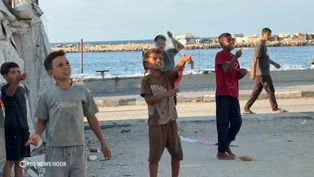
Gaza's youth search for hope in devastated homeland
Video has Closed Captions
Gaza's traumatized youth search for glimmers of hope in devastated homeland (6m 45s)

How Mayo Clinic is using improv to engage dementia patients
Video has Closed Captions
How the Mayo Clinic is using improv to engage dementia patients (7m 13s)

How melting glaciers contributed to Himalayas flooding
Video has Closed Captions
How melting glaciers contributed to the flooding disaster in the Himalayas (8m 34s)

The issue the Lindsay Clancy jury will be deliberating
Video has Closed Captions
The central issue that the Lindsay Clancy jury will be deliberating (7m 7s)

Jan. 6 rioters pursue new path for payments from Trump
Video has Closed Captions
Jan. 6 rioters pursue new path for payments from Trump administration (5m 4s)
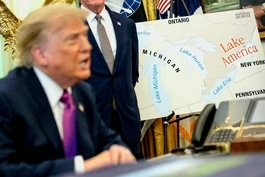
News Wrap: Trump signs order to rename Lake Ontario
Video has Closed Captions
News Wrap: Trump signs order to rename Lake Ontario as Lake America (7m 3s)
Providing Support for PBS.org
Learn Moreabout PBS online sponsorship
- News and Public Affairs

FRONTLINE is investigative journalism that questions, explains and changes our world.

- News and Public Affairs

Today's top journalists discuss Washington's current political events and public affairs.
 New Season
 New Episode
 New Episode
 New Episode

 New Episode


 New Episode
 New Season
Support for PBS provided by:
Major corporate funding for the PBS News Hour is provided by BDO, BNSF, Consumer Cellular, American Cruise Lines, and Raymond James. Funding for the PBS NewsHour Weekend is provided by...