
The Second Story of Home
10/1/2026 | 1h 3m 46sVideo has Closed Captions
Go upstairs to the most intimate rooms of the house -- the study, the bathroom, and the bedroom.
Go upstairs to the most intimate rooms of the house -- the study, the bathroom, and the bedroom. Working from home takes on new meaning in history's greatest studies as the episode pulls back the curtains on the rooms that made Mark Twain, Thomas Edison and Virginia Woolf. Finally, there is a look towards the horizon to see what the future of home on Earth, and even on Mars, might look like.
Problems playing video? | Closed Captioning Feedback
Problems playing video? | Closed Captioning Feedback
The History of Home is presented by your local public television station.
Distributed nationally by American Public Television
The Second Story of Home
10/1/2026 | 1h 3m 46sVideo has Closed Captions
Go upstairs to the most intimate rooms of the house -- the study, the bathroom, and the bedroom. Working from home takes on new meaning in history's greatest studies as the episode pulls back the curtains on the rooms that made Mark Twain, Thomas Edison and Virginia Woolf. Finally, there is a look towards the horizon to see what the future of home on Earth, and even on Mars, might look like.
Problems playing video? | Closed Captioning Feedback
Where to Watch The History of Home
The History of Home is available to stream on pbs.org and the PBS app.
(dramatic music) - [Nick] In this episode of "The History of Home," it's time to take the stairs and explore the final story.
Here, we'll take a peek inside our most private rooms, spaces where we create, where we procreate, where we clean, and where we dream.
So come on in and come on up.
We'll work from home in some of history's greatest studies, then dive on in to the dirty details of our bathrooms.
And finally, get intimate as we enter royal boudoirs of the past and explore the high tech bedrooms of the future.
Welcome to "The History of Home."
(calm music) Staircases can be great and small.
Rickety and regal.
Whatever you do, don't run.
Take it slow.
This elegant solution to accessing the more private areas of the house is actually one of the most dangerous places in it.
Falls are the second most common cause of accidental death at home in America.
But assuming we've made it safe and sound, where to begin?
Ah, yes, the study.
Some of the most influential thinkers in history have shaken up our lives from the comfort of home.
And in Fort Myers, Florida stands the home office and laboratory of a man who did more to alter the course of home history than any other.
- I think to Edison, home was a place of relaxation but also inspiration.
- [Nick] The Edison and Ford Winter Estate.
Henry Ford and Thomas Edison are both American icons, but these titans were also friends and neighbors.
Even at his vacation home, Thomas Edison never stopped inventing.
- [Mike] So I think Edison was really driven by curiosity.
He was very interested in solving problems that were sort of pressing on humanity and Americans inside the home.
- [Nick] Edison spent much of his time tinkering with ideas in one particular room.
- Edison has this study built for him in his later years of life.
That study becomes an important place for him to kind of tool around with new ideas, projects that he's working on, turn ideas over in his head.
- [Nick] Ever the practical inventor, Edison needed a place at home to experiment.
Someplace special.
- So this lab was used by Thomas Edison, Harvey Firestone, and Henry Ford.
So the three of them worked together in this laboratory about six months out of the year and then transported the whole project up to New Jersey and worked on it the rest of the year there.
- [Nick] This grand lab of his later years was a reward for his life's astonishing success.
His work changed the way we see the world.
We'll let historian Emma Wells illuminate us on the history of lighting our homes.
Emma?
- We start with what we have behind me, a fireplace.
Often within a sort of great hall.
If you were extremely poverty-stricken, indeed you would perhaps just have your fireplace and you had to make do.
And then we have rushlights.
A rush would be dipped in animal fat.
Usually the rush could be lit on both ends and that's where we think the phrase burning the candle at both ends comes from.
We then move into candles, again around the same sort of era.
We had tallow candles and these were just a sort of wick dipped in the animal fat.
Beeswax was the prime candle but it was the most expensive.
They burnt very brightly, that's why they were so coveted.
The real sort of ramping up of new light was firstly oil lamps.
Had whale oil, mineral oil, but they were quite sort of smoky is perhaps the right word, gave off a lot of soot.
Then we moved into the era of gas lamps, invented as a byproduct of burning coal.
Starts in the London streets in the 17th century and then it moves into the home.
You now, you didn't have to go to sleep once it got dark.
You could carry on into the night because you had light.
- [Nick] These advances meant we were no longer slaves to sunrise and sunset.
And our nights became brighter.
- But still, compared to the modern light bulb, there is no comparison.
A modern light bulb is about 100 times more powerful in light than a candle.
It's a sort of luminescent light that you will never get with a candle.
- [Nick] Bringing this radiant light into homes around the world was the dream of many inventors of the age, but it was Thomas Edison that cracked the code.
- If you picture Edison working on his most famous invention, the light bulb, he was probably working either by gas light or candlelight, as the case might be.
He's got his team of researchers.
Many of them don't believe it's actually possible to do what he says he's going to do.
Edison tests thousands of different filaments for the light bulb.
They're working against the clock to bring this thing to the market and show it to the press and show that it really is possible and he just had this faith that it was doable.
He doesn't invent the light bulb but he really improves it and makes it practical for home and commercial use.
- [Nick] His hard work literally flipped a switch in the history of home.
- Edison is famous for many things.
If you picture that you are an average resident of America in the mid-19th century, you're eating by candlelight.
If you're listening to music, you're listening to it live.
After Edison's innovations, let's say by the turn of the 20th century, you can listen to recorded music on a phonograph.
You can turn on your light bulb and have plenty of light any time you need it in your house.
You can have electric-powered appliances, everything from washing machines to fans, all kinds of things that we take for granted today.
And eventually, the ability to go to the movies and participate in all kinds of entertainment that just were not even thinkable in the mid-19th century.
So compare your life before Edison to after Edison, and it's a pretty incredible difference for the average person living in a house in America.
- [Nick] The home study is not only a haven for those of the scientific persuasion.
It's a place of artistic pursuits as well.
And for those in search of creative inspiration, the study can be a refuge.
- She's, you know, a gay icon, a feminist icon, and she supposedly had this sort of bohemian life.
But Virginia Woolf absolutely needed peace and quiet to write.
- [Nick] We're in the quiet village of Rodmell, England at Monk's House, Virginia Woolf's country home.
- Her style of writing was absolutely groundbreaking.
There's the flair.
In 1934, they built this writing room and this is where she wrote some of her most famous novels.
"Mrs.
Dalloway", "The Lighthouse", "Orlando".
We think this house was a huge inspiration to her.
- [Nick] Monk's House was a retreat from her busy London life.
- This room is quite basic.
She wasn't one of those people who needed absolute cleanliness to work for sure.
Her writing process was peace and quiet.
The success of a day was judged by how many words she'd managed to get down on a page.
This house was so important to her to have that solitude.
- [Nick] Having a special space in which to work and create was so meaningful that it inspired one of her most famous works.
- My favorite book is "A Room of One's Own."
It's brilliant and it's just so ahead of its time but relevant today.
The premise of it is that a woman needs an independent financial means in order to be able to write.
And space.
Obviously that wasn't possible for almost the entire female population.
So I think she was very aware of the privilege she had and it's absolutely personified in Monk's House.
She's got a writing room here and it was very much Virginia's space.
- [Nick] Her diary captures her connection with the room she called her own.
- The happy, undistinguished days, ripe and sweet and sound, the daily bread, where nothing strange or exalted has happened, only the day has gone rightly and harmoniously.
A day of no interruptions, writing and walking, and that's all she needed.
- [Nick] While some artists use their studies as a barricade to the outside world, others use it as a source of inspiration.
- We are in the Mark Twain House and Museum in Hartford, Connecticut.
- [Nick] It's a far cry from the peaceful simplicity of Woolf's writing room.
- We are in the billiard room on the third floor of the house.
His study where he worked so intensely and so brilliantly.
Where Mark Twain, when he lived here, did most of his writing, his pool playing, and a good deal of socializing.
- [Nick] And what else would you expect from a cigar-smoking, pool-playing, adventure-loving humorist?
No wonder he told one hell of a yarn.
- It all happened here.
He could take chapters from his books that he was writing out and lay them out on the table and cut and paste.
This was a workspace as well as his desk.
And then a lot of political discussion and social discussion and business discussion went on.
So this was not only for writing.
- [Nick] This lively environment proved to be a productive one.
- This is the place where he stayed for the longest period during his wandering life, where he wrote a lot of his greatest works.
He wrote "Tom Sawyer", "Huckleberry Finn", "Connecticut Yankee in King Arthur's Court", "Prince and the Pauper", big massive travel books, all during this period.
- [Nick] While the study was a room of his own, the library nurtured the artistic sensibilities of the whole family.
- Having a library and a study in the house were planned in when the house was designed.
And this also served as a room where Livy, Mrs.
Clemens, edited his works.
He would open up "Huckleberry Finn" in manuscript and read it aloud and if there was something that was a little bit improper, it came out.
This was part of his creative process and he respected her editing tremendously.
- [Nick] Mark Twain's love and appreciation of his home as a vital force is best expressed by the man himself.
- He said, "To us, our house had a heart and a soul "and eyes to see us with "and approvals and solicitudes and deep sympathies.
"It was of us and we were in its confidence "and lived in its grace and the peace of its benediction."
Now who wouldn't want a house like that?
- [Nick] Among dusty shelves and crumpled papers, our homes became places to work, to create, and to learn.
In places of their own, great men and women allowed their passions and talents to flourish.
In doing so, the study changed not only their lives but ours.
Not every home has a study.
But you better hope it has the room where we spend around a year and a half of our lives, the bathroom.
Or as we call it in my house, the thunder closet.
The comfort and cleanliness that we associate with our bathrooms today are the result of thousands of years of civil engineering and social change.
Indoor plumbing, flushing toilets, and hot water are truly modern wonders.
And although we've always needed the facilities and a good wash is highly advisable, it took centuries to bring these functions together into one convenient room.
Indoor plumbing dates back to the Minoan civilization of the second millennium BC.
Here in Crete, at the Palace of Knossos is the oldest bathroom ever discovered.
The luxurious bathtub and colorful decorations suggest these ancient people valued their bath time.
In ancient Rome, public baths were at the center of culture and political life.
And from Japan to the aptly named Bath, England, public bathing and the use of hot springs was common throughout the ancient world.
But with the fall of the Roman Empire and the rise of Christianity, bathing, quite unbelievably, would fall in and out of fashion.
English Christians developed an odd tradition of equating holiness with dirtiness.
- So in the Tudor period, it was considered dangerous to bathe the body because it was thought that water could enter through the pores and could do damage to one's internal organs.
This doesn't mean that they were unhygienic or they didn't believe in cleanliness, but they focused their attentions chiefly on cleaning the clothes as opposed to the body.
So everybody would wear a linen shift and at the end of a day, they would rub themselves down with that to try and reduce their body odor.
Even in the 17th century, there's lots of discussion about whether water can possibly be good for you to bathe.
And it takes a long time for it to sort of be adopted as a custom and not be considered injurious to health.
- [Nick] It wasn't until the 1700s when Queen Anne began to take baths for her gout that the practice of bathing began to creep slowly back into English society.
Hail to the Queen.
This time, keeping clean was no fad and the next innovation in scrubbing up was just around the corner.
In 1767, a stove maker from London named William Feetham patented the 10 foot tall, hand-pumped Regency shower.
And over the next century, the act of showering would eventually catch on.
But the shower and toilet didn't really end up in the same room until the post-war era.
- There had been outdoor privies, outdoor toilets, for a long time.
But the introduction of the bathroom into the house as adding a boiler to heat the water suddenly makes a whole lot more luxury than your weekly bath in front of the fire with the water that's been heated there.
So that is a change.
Of course, standards of cleanliness just go off and so people spend more time cleaning in order to keep up with the Joneses.
But the idea at least is there.
- [Nick] Keeping up with the Joneses now requires a power shower just to get started.
We have moved on from the dark ages of dirtiness and into the light of understanding.
- Our houses are a kind of jungle, full of things that we don't understand.
- [Nick] Well, at least now we have the tools to get truly clean.
- We don't get clean or not clean.
We just change which microbes are around us.
- [Nick] Okay.
Forget everything I said and listen to ecologist Rob Dunn, a man drawn to the dark and mysterious corners of our homes.
And if you look closely, really closely, you'll realize that we are never home alone.
- [Rob] In my lab, we've been studying homes for a long time now.
And in homes, we've found hundreds of thousands of species, many of them new to science, all but a tiny handful never before studied.
If we found 200,000 species in homes, maybe 10 of those are regular pathogens.
Many of those species are beneficial and many of the species are benign.
They don't do anything good or bad.
- [Nick] The microbial world was unknown to us until it was discovered, where else but at home?
- In Delft, in the Netherlands, an amateur scientist Antoni van Leeuwenhoek becomes interested in nature.
But the nature he becomes interested in is the invisible nature.
And at some point, he figures out that he can look through a little microscope lens, a little single lens, and then eventually he starts to see things that he's never seen anybody else write about.
He's opened up the entire microbial world for the first time.
And so he's really the founding scientist in many ways of the study of daily life and especially of the study of daily life with a sense of wonder.
- [Nick] Antoni van Leeuwenhoek, the father of microbiology, first discovered what he called little animals floating in a cloudy glass of water.
He had just discovered bacteria.
This is an exact replica of the microscope used to discover microorganisms.
It doesn't look like much but this instrument introduced a whole new kingdom of organisms.
- And so I invite you to walk through your own home, through your kitchen, through your bathroom, through the basement, and think about what are the unique ecosystems here that nobody's studied yet?
And I guarantee you they're there.
- [Nick] Leeuwenhoek's discovery revealed hitherto unknown forms of life, most of which are still largely mysterious.
But as Rob and his lab continue his legacy.
- Oh, look at that.
- [Nick] They are now able to observe the home on a level that Leeuwenhoek could only ever have imagined.
- In the last decade or two, we have many new genetic tools that we can use to document the life around us without ever seeing it visually.
So I think once again, there's been this rebirth of paying attention to what's around us.
One of the ecosystems we've become really interested in lately is the water ecosystem that flows through your house and your body and over you as you shower.
And so we started to sample and study what lives inside shower heads like this one.
When we think about water, we tend to think water is devoid of life.
But every bit of water you've ever used in your life is full of life.
- [Nick] Rob and his colleagues took samples from hundreds of bathrooms across America to study the mysteries of the microbes hidden in our shower heads.
- You have a kind of habitat up in here and a group of unusual bacteria have figured out a way to build the kind of apartment out of their own excretions.
Why do some of those little apartments seem to have bacteria that are potentially dangerous?
That if you're immunocompromised, if you're part of a subset of the US population, that can be dangerous.
And then in other cases, you actually have bacteria living in those little apartments that actually trigger the release of beneficial hormones in your brain.
One of the biggest factors in determining what's in the shower head is whether or not the water is from a public municipal water system.
- [Nick] Many municipal water systems, especially in the US, are chlorinated.
Countless lives have been saved since we understood the dangers and disease spread by little animals living in dirty water.
But the chemical warfare we're now waging on our water supply is a result of misunderstanding of what clean water really is.
- When you're in the shower, you think about the water coming over you and cleaning you and I think we've come in the last 100 years to think of this as a sterile thing, that the water is free of life and it will wash the life off of you.
This is wrong in like every possible way.
It's wrong in the sense that if you wash the life off of your skin, you would die.
That life protects you from pathogens, right?
You have this invisible carpet, shimmering carpet of species you need.
- [Nick] We know so little about the life all around us that studies like Rob's will be invaluable in finally understanding life at home.
On the other side of the bathroom, the toilet is part number two in our tale of the tiles.
Human waste has always been a challenge.
What comes in must go out.
And from the aqueduct of ancient Rome to the sewers of Victorian London, some of humanity's greatest feats of engineering simply bring us clean water and take it away.
But for most of history, privies were anything but private.
And yes, I said butt two times.
- At Hampton Court, there used to be what was called the Great House of Easement, which was where you could go to relieve yourself.
So it was a 28-seater lavatory.
And so perhaps a place to go and be companionable whilst you made yourself more comfortable.
But I mean, at this time, even the Great House of Easement was something of an innovation.
A lot of the time, to be perfectly frank, men are weeing on the floor.
Like the floors are covered with rushes, just like if you make a sort of bed for a guinea pig.
These rushes soak up urine, so a lot of the instructions for the court on how to behave tell men, "Could you please stop ....... in the corners?"
(laughs) - [Nick] Toilets have developed from rush-covered floors to houses of easement to outdoor loos.
Today, our throne room is the most personal and private space in the home.
And what better way to relax than by taking a seat?
The Toto toilet showroom is exactly that, a place to see the latest and greatest in toilet tech.
But no test drives.
With seat warmers, remote controls, and personalized settings, if you can afford it, your toilet can become the most technically advanced accessory in your home.
But it was a spin on a European favorite that made Toto an industry leader.
The bidet.
So why all this fuss for such a simple and universal act?
Bathing or washing in all its forms is cultural, with traditions and techniques particular to countries and people.
But Toto sees their brand as more than a product.
They provide an experience.
(sighs) The warm feeling one gets here isn't only thanks to the heated seats.
It's a place where we can have some time to ourselves.
And just as the bathroom has evolved from a public place to a personal one, the bedroom has undergone a journey of its own.
Today, we're unlikely to pop into someone's bedroom without an invitation.
But in the past, when the sun went down and the fire grew low, our bedrooms were wherever we found a good spot and went to sleep.
But eventually our desire for a nice private place to snooze changed our homes.
- We see a huge shift in domestic architecture.
We see people moving from every human activity happening in one or two rooms to subdividing the house into more rooms so that there's an extra level of privacy.
And there can be designated spaces for designated activities.
- [Nick] Since it was dreamed into existence, the bedroom has been a place of intimacy.
It's the domain of love, birth, illness, and death.
But for those at the very top of society, the bedroom was more than just a place to retreat.
The bedroom became a place to project wealth and influence.
And 40 miles outside of Paris lies one of the most influential homes and bedrooms in European history.
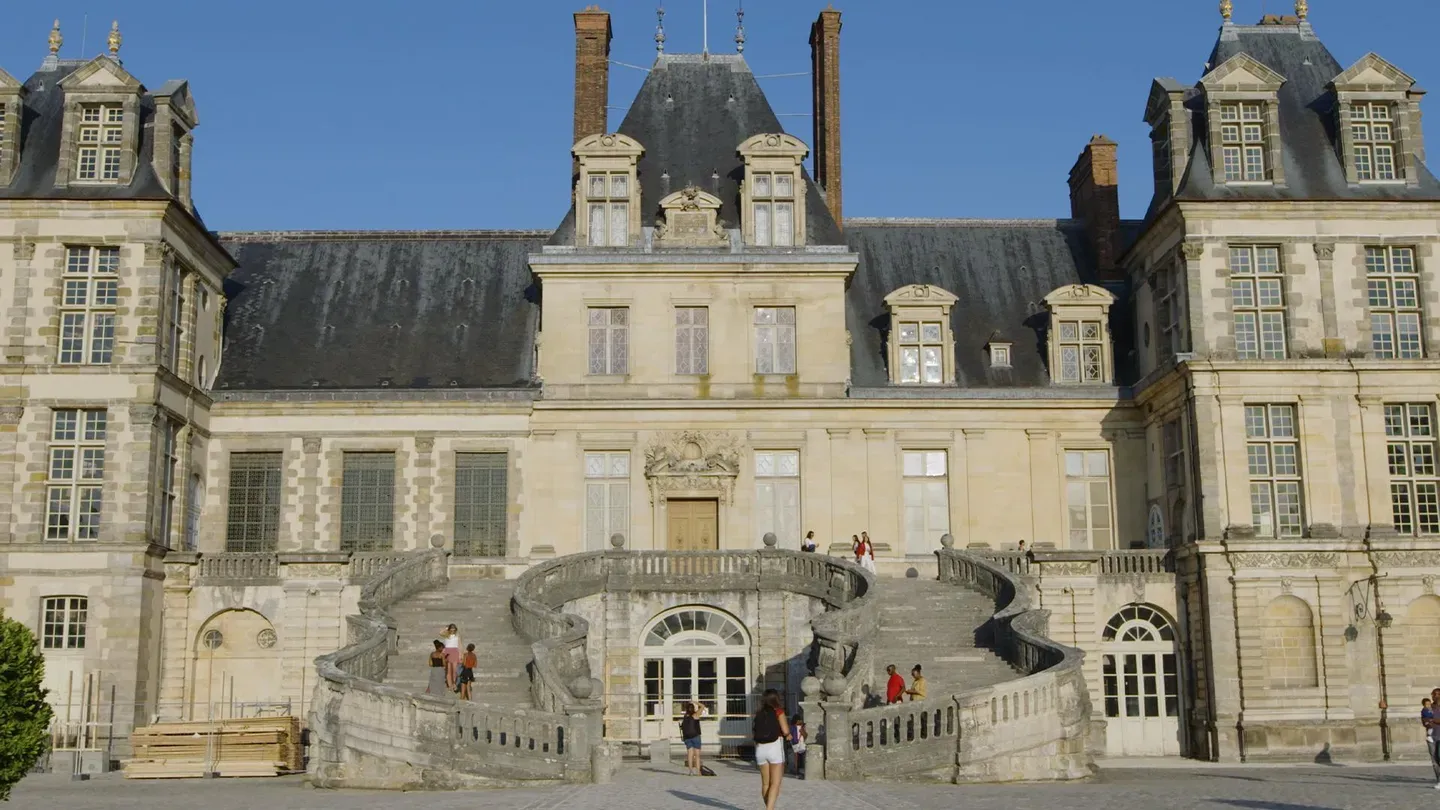
Napoleon Bonaparte called Chateau de Fontainebleau the true abode of kings.
And this epic pleasure palace predates Versailles by 500 years.
Here, the self-appointed emperor ruled, plotted, and of course slept.
Extravagant royal bedrooms were anything but private.
They were often filled with a parade of official and honored guests.
The tradition of the bedroom being a room of parade is one of pomp and politics.
And even before Emperor Napoleon, French kings like Louis XIV were greeted every morning by throngs of noblemen at hand to witness his dressing ceremony.
And on special evenings, an audience would even attend a king's intimate evening with his queen, which strikes me as a surefire way to ruin the mood.
It's little wonder that during her time at Chateau Fontainebleau, Queen Marie Antoinette sought respite from a life on display.
At the Palace of Versailles, the birth of her first son attracted a gaggle of onlookers.
But here, at least, she could enjoy the privacy that our bedrooms are supposed to provide.
For kings, queens, and us cake-eaters alike, that desire for a refuge from the world, a place to sleep and to dream is universal.
Privacy is important but the true key to a good night's sleep is obvious, our beds.
We make our beds today because for most of history, that expression was much more literal.
For centuries, humans wove, sheared, stuffed, stacked, picked, and plucked, all in search of a nice place to bed down for the night.
Beds were often the most important and expensive possession in a home, and there's good reason.
The average person spends 1/3 of their life just (yawns) sleeping.
Bedtime has been and will always be a big part of our lives.
But when we're not sleeping or pursuing other undercover interests, our bedrooms are taking up an awful lot of real estate.
- Bumblebee, turn on night mode.
- [Nick] And in the modern world, the last thing people can afford is a waste of space.
- I'm Sankarshan Murthy, co-founder and CEO of Bumblebee Spaces.
We're a robotics and tech startup that's revolutionizing the home.
- [Nick] Sankarshan Murthy has worked on some seriously cool tech designs in his career, including the Apple Watch and the Tesla.
Bumblebee has its sights set on changing the way we think about our bedrooms.
- Traditionally, bedrooms are their own rooms and all you're doing there is sleeping and like bedroom activities.
And the rest of the time, the bedroom's unused.
If you look at one of the resources that we currently are running out of, it's the space and time are the two luxuries that we can't afford anymore.
This will continue like as the population grows, as more people move into urban spaces, so we use technology, we use robotics and artificial intelligence and we've maximized the utilization of every cubic micrometer of space inside homes.
- [Nick] Their plan?
You better watch your head.
- So how we think about space, as you'll see, a beautiful living room becomes a beautiful bedroom, becomes your beautiful walk in closet, becomes a dresser.
In a one bedroom footprint, we can give you like four, five, six rooms.
It just changes around the life of the user.
Bumblebee, close the closet.
- [Nick] Bumblebee's AI-based storage systems maximize the space available for our lives at home.
- The thing with home is like George Carlin jokingly says, "Home is just piles of stuff."
The beauty of Bumblebee is that it really solves your stuff problem.
- [Nick] At the end of the day, it can't just be about saving space.
When it's time for bed, we want to feel comfortable and at home in our bedrooms.
- The bedroom is accessible on demand.
But when you do need it, it needs to be a great bedroom.
For a great bedroom, you just need a serene, calm environment.
You've come here, spent your day like entertaining with friends and working out and now you're like tired, ready to go to sleep.
You just, Bumblebee, turn the night mode on.
And the home mood changes around the user and beautiful bedroom descends from the ceiling.
It's all like choreography, you know?
And it's a beautiful bedroom.
It's comfortable and it's a great place to sleep.
- [Nick] This futuristic bedroom will provide some solutions for challenges of the future.
But we are by no means the first generation to worry about what's on the horizon.
Japan is an intoxicating mix of old and new, a country obsessed with the future but enamored with the past.
And almost 50 years ago, Tokyo was facing challenges that seem like modern dilemmas.
- So my name Yuka Yoshida.
We're now in a building called Nakagin Capsule Tower, which was built in 1972.
- [Nick] In the 1970s, Tokyo was a city looking forward.
But the Nakagin Capsule Tower is unique for the era.
- After the devastation of World War II, it was time when whole Japan was growing like rapidly, like economically.
And it was a time when the population was just going like crazy, like growing.
So one of their concern was how to deal with this overpopulation in Tokyo.
- [Nick] Assembled in just 30 days in 1972, the tower is comprised of two concrete cores.
Each capsule was pre-fabricated and then attached.
This retro vision of the future was a first attempt at popularizing micro-apartments as a solution to urban overcrowding.
- So this tower is called Capsule Tower because the combination of 140 cubicle, which the architect called capsule, looking like a Jenga.
Almost look like a washing machine stacked up.
Each cubicle is actually 10 square meter size apartment room for people to live.
- [Nick] Each comfy capsule has an identical layout with space-saving storage, the latest and greatest in tech, a bathroom, and most importantly, a place to sleep.
- And I think in some way, the Japanese people feel a bit relaxed in cozy, like small spaces.
Like small space actually gives us comfort.
The size is actually half size of shipping container but it's still pretty small even for a standard Japanese house.
- [Nick] To ask an obvious question, why exactly does it look like the Blade Runner's laundromat?
The unique design was dreamt up by architect Kisho Kurokawa.
- Japanese architect came up with original architectural theory called metabolism.
Metabolism theory is about like how to live sustainably, so the concept of the tower is that you could actually change the capsule when it got old so that the tower will be reusable and updatable.
- [Nick] Metabolism viewed architecture as regenerative and dynamic, able to evolve and adapt to new challenges, just as bedrooms have evolved to meet our needs.
Whether our bedchambers are a place of privacy, power, or high tech luxury, this is the room where dreams are made.
Kisho Kurokawa dreamed of solving problems of space and sustainability for the future.
That future is now here.
And when it comes to the home of tomorrow, humanity better dream big.
Tucked away in a nature reserve outside of Amsterdam is the Dutch Mountain House.
- Well, I'm Sanne, this is Lucas.
We live here and have built this house and we have two little sons.
- [Nick] Completed in 2011, this futuristic fairy tale hobbit hole is hidden in a hill.
It's a unique family home and the brainchild of architect Sanne and designer Lucas.
- The original idea is to create a sort of Alice in Wonderland effect.
So we're going into a hole in the mountain and then, whoa, you're in a different world, our world.
I think it's really important to create a very personal atmosphere where you feel at home and comfortable and also that it reflects yourself.
- [Nick] As they tumbled down the rabbit hole in designing their home, the couple collected and transformed flea market finds.
- I really like to design this sort of thing, looking for the old stuff and then making something new.
And we like to make jokes in the interior as well, make you think, oh, what's this?
This is an old heating system.
Collage of cupboards, old grandma's cupboards.
I think it really makes it more beautiful.
We're now going to our bedroom.
It has a secret door hidden in the bookshelf.
So here you can take a drink and here we have the cookbooks and some art pieces and jugs, yeah.
It's all, I think it's very important to also for the kids to really run and do everything inside here and use everything and that it can be used because, yeah, otherwise you live in a museum.
- The biggest compliment we get from people who are coming here is that it's a new building, a lot of glass, a lot of concrete, a lot of steel, but it's cozy.
- [Sanne] It has atmosphere.
- [Lucas] Because we have used a lot of old materials and I think all those old stuff gave the house a kind of soul.
And for that reason, it became a home.
- [Nick] This house is more than secret bedrooms and classic car cabinets.
The home was designed, decorated, and built with a very important message in mind.
- It's a very sustainable home.
In the design, we used the earth to insulate the house from the cold side and opened the house on the south side with a lot of glass for light and warmth.
- [Nick] The thermal mass of the hill disguises the building on its northern facade and creates a blanket of insulation, while solar panels power the home.
When combined with recycled water and efficient heating systems, this is a stunning example of what a sustainable home can look like.
- There's a lot of awareness when you open a newspaper or switch on the telly.
You hear about mass extinction and we're all gonna die and our children or grandchildren or their children, they will live in another world.
And but a lot of awareness and no call to action.
Nobody is telling us what we can do to change the world.
Our home is all about sustainability and it's all about changing our habits.
I hope, we hope we've created a spot where people can be inspired and to see that change can be funny, change can be easy, that change can be inspiring and it's not so hard.
- [Sanne] Every little bit helps.
- [Lucas] Yeah.
- [Nick] Dutch Mountain House is a call to action for a greener tomorrow.
With population growth, mass urbanization, and climate change already a threat to communities, the fight for the future of the home is already upon us and humanity's best and brightest know where we build will be as important as how.
- Well, I think the home is the fundamental building block of any society.
- [Nick] Originally from southwest Nigeria, Kunle Adeyemi was introduced to the power of architecture from an early age.
- My father was an architect.
He established one of the first indigenous architectural practices in Northern Nigeria.
I think somewhat I may have been born an architect.
- [Nick] Today, his own architectural firm, NLE, is based in Amsterdam.
- NLE is an architecture design and organizing practice for innovating cities and communities around the world.
NLE means at home in Yoruba, which is one of the languages of Nigeria.
- [Nick] As an award-winning architect and urban designer, Kunle traveled the world, seeking solutions for the environmental challenges fast upon us.
And rising sea levels mean water will be one of our chief concerns in designing homes and communities.
- I envision a future where we have a lot more water in our urban fabric.
- [Nick] In designing water worlds of the future, Kunle looked to his hometown of Lagos, Nigeria for inspiration.
- Lagos has nearly 30% of its surface area covered by water and you find that in many cities.
So how do we increase real estate for water within our urban fabric?
- [Nick] Makoko is a community of almost 100,000 people, living, working, and building their homes on water.
To the residents of Lagos, Makoko was nothing but a poor neighborhood.
But Kunle saw genius.
- Africa, for instance, is said to be the least responsible for climate change.
It is said to be one of the most affected by its impact.
For me, Makoko represents the resilience of humankind and capacity to adapt to their environment.
I was incredibly inspired by the ingenuity and resourcefulness and the capacity to build.
They're already living with water.
Instead of constantly fighting with water, I believe there's an opportunity to learn to live with it.
- [Nick] The seed of Kunle's Floating Cities Project was born.
- It occurred to me that we couldn't continue to build even on stilts and that many parts of Lagos were flood plains and have potential to get flooded.
And I realized that I had to find a solution that would adapt to the changing tidal condition, which was the birth of Makoko Floating School.
Makoko Floating School is a A-frame building, supported by 256 recycled plastic barrels.
It is a triangular frame structure, because a triangle has a relatively low center of gravity.
It's quite a tall structure and perhaps one of the rare three floor floating structures anywhere in the world that is also incredibly built by a community of relatively low-skilled workers with nothing more complicated than a hand drill.
- [Nick] The success of this pilot project has encouraged Kunle to build these affordable floating structures all over the world.
They can be schools, homes, community centers, and even performance halls.
This is a vision for the floating cities of tomorrow.
- We're not proposing anything that is outlandish or out of the world.
I think we're only identifying the trends that are happening and pointing to these as potential ways of developing our cities, which allow a lot better coexistence between humanity and the environment.
- [Nick] Makoko demonstrates the overwhelming resilience humanity is capable of in the face of Mother Nature.
It also suggests that in planning for the future, we are not limited to terrestrial ambitions.
As a species, we have one home, the planet Earth.
But gazing into the vast starry skies above us, scientists, architects, and engineers around the world are planning for life on the final frontier.
Welcome to the home of tomorrow.
Inspired by the dream of making life on Mars a possibility, this is the most advanced sustainable building ever conceived.
- Architecture has been always trying to respond and solve a survival issue.
I always have a touch of that in my designs.
And it just always pushes me.
- [Nick] Sima Shahverdi is an Iranian-born architect with a background in design and robotic technology.
One of the lead designers at AI SpaceFactory, NASA gave Sima and her team the ultimate challenge.
The result was MARSHA.
- MARSHA stands for Mars Habitat.
It ranked first in the 3D printed NASA challenge.
And we were so excited to see a dream come true.
(laughs) - [Nick] They won NASA's Mars Habitat Challenge by successfully printing a 1/3 scale model home, uniquely suited to the incredible challenges posed by the Martian environment.
- Let's say you want to build a building on Mars.
The gravity is different, the air pressure is different, the change of the temperature is different.
Your building is kind of like breathing all the time because it's cooling off and then it's getting heated up in a very extreme difference of temperature.
Your building wants to explode as opposed to being pushed down because of the change of the gravity.
So all of these, it makes you have a very unique form and unique building.
- [Nick] And in a world devoid of earthly construction materials, one must improvise.
- The first step towards Mars is solving a very fundamental problem of our own planet.
The material that we are using is biopolymer basalt fiber.
It's a plant-based material from a crop like corn or sugar cane.
And another part of it, well, we have a lot of basalt on Earth as well but it's in abundance on Mars, so you don't have to carry a lot of material from the Earth.
Comes out like an ooze.
It's actually kind of five times more durable based on NASA crush testing than concrete.
- [Nick] In planning for off-world challenges, it's also important to take a moment to consider those on our very doorstep.
- I have heard this very interesting moment for astronauts, that when they look back at Earth and see like how fragile and how delicate that living thing is, which is life-changing for them, we want to create sort of the same feeling for the people living in TERA, on Earth.
- [Nick] The lessons learned by the endeavor inspired AI SpaceFactory to turn their attentions closer to home.
The concept became TERA, the earthly form of this Martian conception.
- TERA is a two-story building.
The interior design of TERA is kind of based on tiny house design, so it's responding to all of your needs but in the most efficient way.
It's a very small space, so we need it to be very smart designing.
This is one step toward living on another planet.
- [Nick] It's the why as well as the how that makes TERA important.
- The problem with right now of how we are in our construction industry is that it's very wasteful and we have like very crazy percentages about how much we are adding to the waste on the planet Earth and how much we are adding to the carbon emissions.
We need to rethink the whole building industry, we need to rethink our material that we are using.
- [Nick] By innovating for the Martian environment, TERA and MARSHA might just help change how we build here on the home world.
And in doing so, create a better future for us all.
- The home is where you're elevating your perception of yourself, where you're building yourself, and nothing is more valuable to make a better version of yourself tomorrow and tomorrow.
- [Nick] Wherever we end up, for now, home sweet home is planet Earth.
But now more than ever, the shared home of our species seems as fragile as it is precious.
Our grand notion of home has evolved with us through history.
- We frame our identity as a species as Homo sapiens, right?
We do so in light of changes that happened in our lineage hundreds of thousands of years ago.
And I think there's a fair argument to be made that the changes we've made in the last 100 years are almost as substantial.
And one of those changes is that we've moved indoors.
The average person in the US now spends upwards of 23 hours of the day indoors.
What are we now?
Maybe we're Homo indoorus or something.
And so if we're going to spend all of this time indoors, we really need to think about what does home mean to people?
- [Nick] And in a world where we spend an ever-increasing amount of time within the walls of our sanctuaries, it's time to ask the big question.
What does home mean to you?
- Oh, it's getting philosophical.
(laughs) - Um.
- That's a good question.
What does the idea of home mean to me?
- I think home is the place where you, I don't know, where you have a, I actually don't, I haven't thought much about that.
I probably have to start all over.
(dramatic music) - We always say that when you are making a house, you're making your own universe.
- Home is not only a shelter, it's also a place where you live out your life and you share memories with your family.
- I think a home is more than the stones that it's made of.
It's about the community spirit and the heart.
(laughs) - I grew up in India, where communal living is just part of how you live.
You're much more happier living surrounded by your loved ones.
- Memories, I think.
I think a place to make memories.
- There's a level of comfort and security that one gets from their home, whether it's a rented apartment or it's the first house you bought.
Those are the places where you can go, sit down in your favorite chair, and just feel completely safe.
- The thing that makes a house a home are the personal details that you bring to it, the traditions and the different elements that become important to you and the other people that live there.
- Home is where you can smell food being cooked.
- It's just those kind of cues that tell me that you're inviting me in, you want me in that space.
- When you sit 'round a dining table, it's creating memories, it's laughter, it's discussions, arguments.
- I think home is a sense of place, knowing where your center is.
- The building is one thing and I can appreciate that but it still boils down to what happens in the belly of the beast, right?
So it's still about the people and the soul.
- [Nick] At the end of this long journey, it's easy to see that our homes were always more than shelter.
They are a shape-shifting reflection of who we are.
The human race has made our homes in caves, castles, skyscrapers, and everything in between.
But wherever we lay our heads or raise our families, home, there's no place like it.
(calm music)
















Support for PBS provided by:
The History of Home is presented by your local public television station.
Distributed nationally by American Public Television